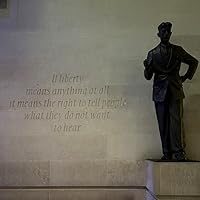
"I think that trip's going to be what we call a notional benefit, something they tell you when you start off you might get and then phase out before it happens."
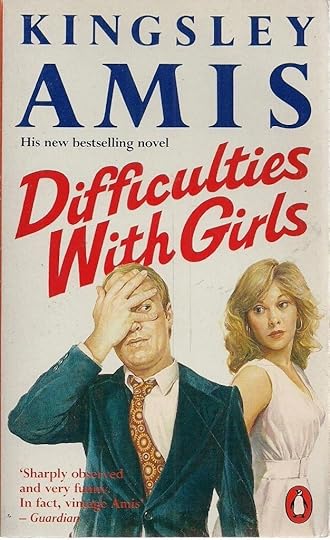
Kingsley Amis explains the misleading praise on the back of the book.
This was a book I chose purely by title: it sounded comedic and vapid, much like most movies starring Meg Ryan/Jennifer Aniston, and I wanted something similarly simple, mindless, and happily-ever-after. A quote from the back says the book is about a man falling in love with his wife. Because of that, I put it in a romance bookshelf, but the book has little romance: It really more like a man grudgingly settling.
The main character Patrick Standish is unrelatable and unlikable. The plot focuses on his uncontrollable selfishness via various liaisons with married women. When not in a clinch or drowning his self-made difficulties in alcohol, he speaks of his colleagues and friends contemptuously, save for a few which he mocks but mostly tolerates. At one point, he proposes to equalize his marriage/guilt by setting his neglected wife, Jenny, up with an extramarital affair. Throughout the book, one hopes for his redemption, but in the end all transgressions are merely forgiven with a conveniently-timed conception by his wife.
Jenny as a main female character in a time where feminism was in its second wave does the movement no favors. She opts for a part-time job in order to have more time to play house and please her husband. Her main concerns are dealing with Patrick's infidelities/idiocy, and coping with her potential infertility. I hold nothing against a woman who feels sorrow at not being able to have a child, but it is hard to fathom a woman who wants to raise a family with a whiny, distracted boor. Still, the miracle marriage-saving pregnancy speaks more of the author's lack of planning, or lack of comprehension of relationships, more than the character's moral fiber.
Near the end, she finally gives Patrick an ultimatum, but it is quickly forgotten in the explosive climax of a sub-plot, and afterwards the aforementioned pregnancy is discovered and hope is only temporarily renewed: "She was going to have him all to herself for at least three years, probably more like five, and a part of him for ever, and now she could put it all out of her mind." This is quite possibly the most sickening, disappointing final line of a book I have ever read.
The supporting cast of the book is colorful and initially endearing, but overall stupidity and lack of foresight makes them all fascinating in the way of a particularly gruesome car accident: Patrick's boss is miserly and offers his bored wife to any who will take her; a new neighbor leaves his wife in order to "try" homosexuality; more neighbors (also homosexual) spar dramatically and incessantly; even more neighbors are concerned with appearing well-off and worldly. It is as if Amis drew stereotypes and cliches out of a hat to make ultimate trash.
After finishing the book, I learned it was the followup to Take A Girl Like You. The younger Jenny and Patrick struggle over her desire to maintain her virginity, until he finally takes advantage of her while she is drunk. She leaves him, but she obviously forgives him as they reunite and marry. To know that he relentlessly pursued her, but then eventually grew bored is depressing. Reality is often tragic and confusing, but these two are just plain thick. There is no lesson or moral to be learned by their story, save that trust is immaterial. It’s a shame, as I really did enjoy the writing style: dialogue-driven and matter-of-fact.
In short: the book is set in the sixties (though written in the eighties), and tries to give off a socially progressive and tolerant tone, but the author's own stunted knowledge and simplistic interpretation of homosexuality and the female mind make this book invariably dated and offensive. I won't be sad to dump it through the library drop-slot.