Nouvelle édition de cette première oeuvre de Seth, un roman graphique à saveur autobiographique dans lequel il relate sa quête obsessionnelle de toutes les traces de Kalo, un dessinateur méconnu des années 1940 et 1950 dont le style ressemble au sien. Cette quête devient le prétexte à sa propre introspection sur sa vie, sur ses relations avec les femmes et avec sa famille, sur sa nostalgie d'un passé qu'il refuse de voir disparaître, sur la vision qu'il entretient de son métier. Une oeuvre méditative au rythme lent, bien servie par un dessin épuré et précis en bichromie (gris bleu) qui sert parfaitement la mélancolie imprégnant de ce récit miroir. En fin d'ouvrage est reproduite la douzaine de caricatures de Kalo que possède l'auteur. [SDM]
"La vie est belle malgré tout" disait la mère de Seth à son fils. C'est le titre de cette autobiographie désabusée, par un auteur nostalgique que la modernité désespère. Ayant découvert un dessinateur des années 1950 dont le trait ressemble étrangement au sien, Seth part à sa recherche et ne découvre que 11 dessins de Kalo... [Éditions Delcourt]
An Acknowledged Classic returns gorgeously re-designed.
In his first graphic novel, It’s a Good Life, if You Don’t Weaken--a best-selling D & Q titles ever--Seth pays homage to the wit and sophistication of the old-fashioned magazine cartoon. While trying to understand his dissatisfaction with the present, Seth discovers the life and work of Kalo, a forgotten New Yorker cartoonist from the 1940s. But his obsession blinds him to the needs of his lover and the quiet desperation of his family. Wry self-reflection and moody colours characterize Seth’s style in this tale about learning lessons from nostalgia. His playful and sophisticated experiment with memoir provoked a furious debate among cartoon historians and archivists about the existence of Kalo, and prompted a Details feature about Seth's "hoax".
Seth, born Gregory Gallant in Clinton, Ontario, is a Canadian cartoonist celebrated for his distinctive visual style, deep sense of nostalgia, and influential contributions to contemporary comics. Known for the long-running series Palookaville and the widely acclaimed graphic novel It’s a Good Life, If You Don’t Weaken, he developed an aesthetic shaped by mid-20th-century magazine cartooning, particularly from The New Yorker, which he blends with themes rooted in Southern Ontario’s cultural memory. After studying at the Ontario College of Art and becoming part of Toronto’s punk-influenced creative scene, he adopted the pen name Seth and began gaining recognition through his work on Mister X. His friendships with fellow cartoonists Chester Brown and Joe Matt formed a notable circle within autobiographical comics of the early 1990s, where each depicted the others in their work. With Palookaville, published by Drawn & Quarterly, Seth refined his signature atmosphere of reflection, melancholy, and visual elegance. Beyond cartooning, he is an accomplished designer and illustrator, responsible for the celebrated book design of the ongoing complete Peanuts collection from Fantagraphics, as well as archival editions of Doug Wright and John Stanley. His graphic novels Clyde Fans, Wimbledon Green, and George Sprott explore memory, identity, and the passage of time through richly composed drawings and narrative restraint. Seth also constructs detailed cardboard architectural models of his imagined city, Dominion, which have been exhibited in major Canadian art institutions. He continues to live and work in Guelph, Ontario, noted for his influential role in shaping literary comics.
I’ve heard that most people who read comics rarely read them every year of their life continuously unlike, say, “regular” books. The habit is patchy. Read comics for a year or two, maybe give them up for a few years, return later, etc. I can speak to the truth of that as I gave up comics from the end of high school to the end of university. Then I went and did something most people do in between high school and university and went on a gap year, travelling America for six months, Japan for the other six.
This was 2006 or 07 and I was working my way through the southern islands of Japan, doing a mixture of charity work, working on farms for bed and board, and general slacking off. I was still in my “serious literature student” mindset which included the utterly moronic view that comics were childish and/or of lesser literary worth than prose fiction.
My book bag was full of stuff like Herzog, The Red Badge of Courage, Life of Pi, Somerset Maugham, and so on. Most of it was shit (not the Maugham - that dude could write!) and, more often than not, in the balmy evenings I’d lie down and listen to music than wade through pages of lofty sentences. Aimee Mann was a favourite, and still is, and I was listening to her album Lost in Space - arguably her masterpiece - on a near continuous loop.
I don’t know why but I’d never looked at the album’s booklet before so I slipped it out of the plastic case and started looking through it. To my surprise, there were comic strips inside. A bespectacled chap sat in a room listening to records by himself. Later on he’d hear a tune in the far off distance at night, go outside and walk around looking for it. There were also silent character portraits of melancholic souls with their eyes closed. Very moody, ambient, real sad bastard stuff!
I was mesmerised.
For the rest of the trip I’d take out the booklet at least once a day and stare at the eight or so pages. Reading the liner notes, I saw that “Seth” was credited with designing the booklet and drawing the cartoons. But that couldn’t be right - what sort of artist name is “Seth”? Where’s his surname?!
It didn’t occur to me until right before I was scheduled to fly back to the UK to look up what else Seth had done and I was delighted to find a book of his had just been published by Jonathan Cape called It’s a Good Life, If You Don’t Weaken! I thought about it intermittently on the long plane ride home and, driving back from the train station in my home town, Cardiff, I asked the cabbie to take a detour and went first to the local library - not my parents’ house! - because I’d looked up on the online library catalogue beforehand that they had it in stock. And they did.
I got back home and no-one was in. I dumped my bags, sat on the sofa and read It’s a Good Life from cover to cover. That was it. I was back into comics! From there I discovered the Norwegian cartoonist Jason (2007-ish was the time of the great indie comics boom and tons of awesome books were appearing in high street stores), Dan Clowes, Transmetropolitan, Y: The Last Man, and others. I haven’t stopped reading comics since and, some eight years later, I’m more deeply in love with the medium than I’ve ever been.
And It’s a Good Life might not have been the exact book that did it - a small booklet that came with a record was the spark - but Seth has always been a special cartoonist for me because his comics, as miserable as they were, showed me another side to the art form that I hadn’t seen before. My taste in comics prior to this was The Beano, 2000AD, and Batman. Seth showed me comics are for grown-ups too and could be as powerful - maybe more so - than other forms of contemporary literature.
Re-reading It’s a Good Life (yes the review begins here!) was still fun but it didn’t carry the charge it once did to a person who hadn’t picked up a comic in nearly five years. Of course it couldn’t, I’ve been reading comics non-stop for nearly a decade now! But it’s still really good, though more so for Seth’s beautiful art than the story.
This is an autobiographical/semi-fictional tale featuring a twenty-something Seth in 1987 obsessively looking for cartoons by an obscure New Yorker cartoonist called Kalo. It’s non-fictional in that a lot of the book feels like it’s journaling Seth’s day to day life: hanging out with his friend Chester Brown (a brilliant cartoonist in his own right), hooking up with art student chicks, enjoying melancholic walks by himself, buying old comics from second-hand bookshops. And it’s fictional in that Kalo isn’t real.
Seth goes out of his way to create a convincing past - even including a photo at the end to solidify what would turn out to be a hoax - but Kalo’s not a real person and Seth’s search is more a metaphorical/spiritual one. The thing you notice very quickly about Seth is that he yearns for the past - it was a better place, he’s always moaning - and Kalo represents the 40s and 50s, an era he wishes he was born in (though he’s self-aware enough to know that even if he was, he’d probably complain about not being born in the 20s or 30s, and so on!).
Creating fictional cartoonists is something Seth would return to again and again in his books. Wimbledon Green (my favourite comic of his) is about a comic book collector, and Seth creates dozens of fictional obscure comics in the story, while in The Great Northern Brotherhood of Canadian Cartoonists, he would replace those pages of obscure comics with their equally obscure creators.
It’s not the most riveting read watching Seth slowly make his way across the snowy Canadian landscape, visiting out of the way towns and meeting people who knew Kalo, etc. It’s unapologetically a very slow book.
But the art! It just speaks to me in a profound way. The black, white and blue tones of the book, the shadows, the quietness of the settings, the simple shots of building exteriors, trees, the sky, ice-skating in the park at night, talking to someone in the rain - it’s our world but it’s not. And it’s extraordinary - I haven’t seen anything like Seth’s almost meditative art style anywhere else.
It’s hard to be objective about a book that has such personal significance but even more so when it touches your soul in a way you can’t explain. And there should be books out there like that - everyone should have a book they love for reasons they can’t fully explain! For me that’s this one.
If you like Aimee Mann (and if nothing else, give Lost in Space a listen), Wes Anderson movies, and sad bastard/indie comics, you’ll enjoy Seth’s It’s a Good Life. But check it out for Seth’s art which is really something!
It is a good life and sometimes you have to weaken, particularly your idiotic views on things like comics being for dum-dums, to enjoy it all the more.
“It's a good world if you don't weaken.” ― Graham Greene, Brighton Rock
This book is a tribute to cartoonists and cartoon history. Seth, a historian of cartoons as well as a famous comic/graphic artist himself, writes this sweet book about an almost unheard of cartoonist from his native Canada he sort of obsesses about, a guy who did cartoons, struggled with it, gave it up. . . it's one of the best works of one of the greatest comics artists alive (that would be Seth, not the cartoonist he is writing about), in my opinion, giving you a perfect blend of nostalgia, depth, beauty, humor, sweetness, darkness.
Seth hangs with his friend Chet Brown through the book. Seth, Chet, Chris Ware, so many of these guys seem similar to me: quiet, contemplative, not obviously all that social, deeply and sometimes quirkily devoted to their art and the history of their profession, nostalgic. . . kind of grumpy, curmudgeonly, misanthropic, sweet, but for me, ultimately compelling.. . . and beautifully, lovingly drawn here... The art, his vision, his attention to line and detail, wow!!
I liked the art and the meta about cartoons but Seth is insufferable and I couldn't have cared less about his man-angst. Gimme a break. I stopped reading it with about 12 pages left, couldn't even bring myself to finish it.
A poignant homage to a lost golden age of cartooning, and a moving tribute to the work of a long-forgotten cartoonist who, like countless others before and after him, enjoyed a brief, flickering moment of fame before sliding back into obscurity.
A cartoonist dissatisfied with the present seeks escape in a romanticized past, and becomes obsessed with the works of a long-forgotten New Yorker cartoonist of the 1940s -- to the detriment of his personal relationships.
Yes, it really is an arthouse work - a graphic novel about a cartoonist rhapsodizing about cartoons, time, meaning, memory and the beauty of art while neglecting his real-world relationships - but a damn fine good one indeed, beautifully rendered in the style of the works of the unsung heroes it seeks to celebrate.
I initially thought this would serve up a cautionary fable in the manner of a Stefan Zweig, Satyajit Ray or Sadat Hasan Manto short story, but what emerges is something beautiful and original, something uniquely Canadian, bursting with honesty and a self-effacing authenticity. One of the few graphic novels out there that can be said to articulate a Canadian vision for life.
Deep, probing monologues alternate with stirring, philosophical dialogues, setting the stage for an exploration of cartooning both as a high art and a philosophy, while in the background loom broader debates around fate, free will, history, art, time, memory and post-modernism. (In that sense this novel ought to command a similar stature to Midnight in Paris, or the Before Trilogy.)
At its heart, it is a mystery wrapped around a coming-of-age tale, and threaded through with love - love for art, for family, for Nature, for lives well-lived, and for the labours of countless unsung artists who have toiled to make the world a better place for everyone by expressing themselves every single day.
If you care about art, artists and the craft of artistry, you will enjoy this work.
Dreadful. Me, me, me. Like a teenager. Only, he is not one. He’s an immature adult. The character’s obsession with a fictional cartoonist is nothing but a way to prove to himself that he is somehow different from anyone else and “special”, which is every teenager’s dream. And the author’s similar issues can be easily inferred from the book, which is in itself an odd onion - once you peel away the outside layers, you’re left with nothing.
Not even with the title, thrown out there with nonsensical “Unbearable lightness of being” posturing and disconnected from the content of the book.
There is some beauty in the art, although it’s mediocre compared to Chris Ware’s. I think of cartoonist Chris Ware for two reasons:
1). both artists should stick to drawing, and let someone else take care of the writing. Please, I beg you. 2). Ware’s book “Building Stories” has an ending scene that is almost identical to this book’s end. (The end sentence “I didn’t know he had it in him.”, which in the case of “Building Stories” is referred to himself). Coincidence?
Anyway. If you get easily tricked by pretentious, artsy-fartsy, meaningless books into thinking that they are original and profound, buy it right now, because you’re going to love it.
"Güçsüz düşmezsen hayat güzeldir.." kötü bir hikaye değil.
Kitabın yazarı/çizeri Seth aynı zamanda başkahramanımız. Pessoa-vari sayıklamaları var -ki sevdim-, hayata dair detayları gözlem yeteneği var.
Bu gözlemlerin onu sürekli götürdüğü yer -hatta bu gözlemlerle gitmeyi hedeflediği yer- ise nostalji ve melankoli.
Melankolisi ise "nostalji" nicelik ve niteliğinin yetersizliğinden kaynaklanıyor. Çünkü Seth'in geçmiş hatıraları aslına bakılırsa hiç de ilgi çekici değil.
Seth kendince kurduğu minimalist bir yaşam döngüsü içinde, yeni olan her şeyden (kadınlardan, bağlanmaktan, farklılıktan) korkarak ve ondan sakınarak yaşayıp gidiyor. Gitsin banane diyebilirsiniz. Bence de size ne.. Yanlış anlamayın bana da ne.
Fekat iyi de, Seth adam gibi dese "dünyada kendime acı bir kök tadı" seçtim; ona göre davransa, Eyvallah. Ama Seth efendi bir pozlar, bir bencillikler. Örneğin bi tane yakın arkadaşı var Bu Seth efendinin adını unuttum. Bir kare olsun detay vermedi arkadaşının hayatı-karakteri hakkında, o sarı oğlan ne zaman derdi olsa koştu bu Seth'in yanına, kedisine mama mı vermedi, parasız kalınca cebine 50 papeller mi koymadı..Bir derdini sormadı bu sarı oğlanın be.. 300 karedir vik vik konuşuyorum kendimden, sen nasılsın gardaşım demedi.
Bundandır; Seth kendi kendine konuştuğu zaman hoşuma giden kitap, başkaları ile konuşunca Kanadalı dövme istediği uyandırdı.
Özetle güzel hikaye, ortalama çizgiler. Dayak yemesi gereken bir karakter.
This is probably best understood by people who like to collect things, who get deep into geek culture (in terms of wanting to know everything about a certain author or character). Half way through it, I wondered why I was still reading it, since I cannot relate to a character that spends his time trying to know everything about an obscure cartoonist. And I thought, maybe this is an autobiographical account. It was (I only realized it at the end of the book).
The reason I read it is because the ilustrations are wonderful. And the nostalgia that the character/author feels towards the past is there, in the drawing style, in every single page. This is beautifully ilustrated.
Got to agree that this was one of the most unappealing protagonists I've read. His total self involvement, misanthropy, myopic nostalgia, and general whinyness left me without any real empathy for his situation and obsessions.
This gets an extra star for the art, which I did enjoy. I really had a hard time with this one though.
#ThrowbackThursday - Back in the '90s, I used to write comic book reviews for the website of a now-defunct comic book retailer called Rockem Sockem Comics. From the June 1997 edition with a theme of "Trade Paperbacks":
INTRODUCTION
Regular readers of this column have probably noticed a bias towards DC Comics trade paperbacks in the "From the Backlist" section. This happens because DC has the longest backlist in PREVIEWS each month, and I have more comics from DC in my personal collection than from any other comic book company. In the interests of equal time, I intended to dedicate this column to new and resolicited trade paperbacks from other companies. Alas and alack, those sneaky devils at DC still managed to slip in by reprinting a graphic novel originally available only through an English publisher. Honest, I'm not getting any sort of kickback for this, it just happens! Maybe next month I'll finally exorcise that demonic DC influence . . . if they stop publishing good comics by then.
LIVE THE GOOD LIFE
PALOOKA-VILLE #1-10 (Drawn & Quarterly)
It's a bit hard to describe since it is so unique and tends to contradict surface expectations. It's an autobiographical story of discovering someone else's life. It's a tale of obsession which doesn't end with two people trying to kill each other in the final act. It's a comic book drawn in a cartoon style more commonly found in comic strips or the gag panels of magazines like the "New Yorker," yet lacking in killer punchlines and loaded with introspection. It's PALOOKA-VILLE.
Since it is an autobiographical comic, we'd best take a look at the writer/artist first. Seth is a seething mass of affectations. First, his name is a pseudonym for Gregory Gallant (a name which sorta sounds made up too, come to think of it). As an artist, his most famous work was for the cutting edge comic, MR. X (Vortex Comics). For a while, he dyed his long hair, eyebrows and goatee white in the hopes of being mistaken for an albino. He also wore prescription sunglasses day and night during this period and made use of a cane well after a leg injury had healed. He's now going through a phase where he dresses in clothes reminiscent of the forties and fifties. A nostalgia buff, his tastes in books, magazines, art and memorabilia extend back to the twenties or thirties even though he is a relatively young man. He deems a narrow range of subjects worthy of attention and is quick to dismiss anyone with interests he finds unworthy. He even depicts himself as being pretentious enough to put down other people with affectations, even ones he once had himself. As you can probably tell, I'm lifting most of these descriptions directly from his comic book. He really opens up a window to his inner self and allows the reader to peer in and judge him. While he may not sound like a person you might want for a friend, he is definitely interesting and colorful enough to carry an autobiographical comic.
Some of the above details come from the first few issues of PALOOKA-VILLE. Issue #1 recounts a time when Seth was the victim of a gay bashing despite being heterosexual. His albino look caught the attention of some punks on a subway car who proceeded to call him names. After ignoring their taunts, Seth couldn't resist a teasing gesture and blew them a kiss as he got off the train. Unfortunately, the doors hadn't closed and the punks pursued. The rest of the issue deals with the aftermath. Issues #2 and #3 contain a story called "Beaches" which takes place during Seth's teenage years and tells of his first sexual encounter. Since the encounter was with a married woman, there is plenty of aftermath to deal with here too. Both anecdotes are well told and beautifully illustrated. (Warning: Casual use of full frontal nudity in these and subsequent issues limits this series to mature readers.)
With issues #4 through #9 Seth tackles his first long story arc, entitled "It's a Good Life, If You Don't Weaken," which has been collected into a trade paperback of the same name. Here's where Seth's storytelling abilities really shine. "Good Life" (for short) is the story of Seth's obsession with an obscure cartoonist from the past who signed his work "Kalo." Seth's interest is sparked when he discovers that, despite Kalo's obvious talent, he only had one cartoon published in the Mecca of cartoon gag panels, "The New Yorker" magazine. Seth wonders if this 1951 panel was the beginning of Kalo's career or the peak. Seth's curiosity is piqued because he can find almost no information about Kalo readily available. His obsession deepens as his search uncovers parallels between his and Kalo's lives: both Canadian, both artists, both obscure, both having similar drawing styles, both living in the same small town different times. Seth uses each new discovery about Kalo to further understand himself. As Seth says, "If you don't like 'navel-gazers' you wouldn't much care for me." Regardless of Seth's caveat, the story was engrossing, and I couldn't wait to find out more about both men.
The secret to the success of "Good Life" is the rock solid storytelling. The pacing is gentle and slow, as is most appropriate for this kind of tale. Seth lingers over buildings, landscapes and characters, often using a page or two simply to establish the setting or mood. Many of these pages seem like still life studies lifted out of a sketchbook, but they do not interfere with or interrupt the story; instead, amazing richness and depth are added. While his drawing is cartoony, each panel is filled with lavish detail. His linework may resemble the gag panels and comic strips he so loves, but his art melds with the story to achieve a far different effect: a beautiful and serious reflection of two lives intersecting across time.
The cherry on top of this sundae is the appearance of Chester Brown as a character. Brown (no relation, by the way) is the real life writer/artist of the comics YUMMY FUR (Vortex Comics/Drawn & Quarterly, grade: A), ED THE HAPPY CLOWN (Vortex Comics, grade: A), THE PLAYBOY (Drawn & Quarterly, grade: A) and UNDERWATER (Drawn & Quarterly, grade: still under consideration 'cuz I'm not really sure what's going on yet). Brown is also a Canadian who sometimes does autobiographical comics, but those are the only things Brown and Seth have in common, so it's interesting to watch the two interact. Brown serves as a sounding board for Seth, listening to details of the quest and Seth's introspective interpretations. And it's just a hoot to watch a real person whose work I know and like being featured in someone else's comic. If you really like Chester Brown, writer/artist Joe Matt also includes Chester Brown as a character in his autobiographical comic, PEEP SHOW (Kitchen Sink/Drawn & Quarterly, grade: A). To make this whole situation even more incestuous, Joe Matt gives us another take on Seth, making him a supporting character in PEEP SHOW too.
The tenth issue of PALOOKAVILLE (the hyphen was dropped without warning as of issue #9) begins a new story arc called "Clyde Fans." Seth seems to be swerving away from autobiography, as the issue is narrated by an old man with Seth nowhere to be found. But hey, that's okay, because this old man's monologue is very intriguing. All the old fellow does is wander around his fan store talking to himself about his younger days as a salesman. Seth's tone and pacing are again dead-on perfect, easily evoking the bittersweet nostalgia and regret of the character. I'm not sure where the story is going, but I'm sure as heck gonna be along for the ride. Don't wait for the trade paperback this time! Jump on the first chance you get!
This is so masterful. The beginning, especially, I just find to be so utterly perfect. I was listening to a Comics Alternative interview with Noah Van Sciver this morning while drawing, and he mentions how he rereads this maybe once a year. I hadn’t read it since 2012 and was glad to be reminded of it.
It’s a Good Life, If You Don’t Weaken is a graphic novel that came highly recommended. If one searches “top graphic novel lists”, Seth’s piece is a common addition. Plus, it was one of Drawn and Quarterly’s bestselling books, and I usually love what this publishing company produces. Combined with the fact that the story takes place in Canada and deals with the coming of age of a disaffected twenty-something, I figured that this graphic novel would be a staple of my library. As it turns out, I loathed it. I hated the story, the characters, and the overall themes (though the art is really quite nice). Even after reading the reviews of other people to see if I missed something and giving myself a lengthy period of time to contemplate my thoughts on the piece, I’m afraid that I can only give this book one star.
It’s a Good Life, If You Don’t Weaken is a good example of a one star book that has nothing objectively wrong with it. Sometimes I will rank a book low because there are glaring technical errors that make it a weak and frustrating read. Sometimes, as in this case, I just hate the subject matter. Plenty of people absolutely adore this graphic novel, and I can understand their appreciation for the work. Similar to books such as A Catcher in the Rye, this is a novel that will have dedicated followers and intense haters, and there is nothing wrong with that. While I might not like the story, it is well-crafted and has powerful themes.
Seth’s picture-novella (as it is coined on the cover) is about a disordered young man who alienates all those around him by obsessing about the supposed perfections of the past as he searches for information regarding an old cartoonist. The protagonist describes himself at one point as a maudlin dope and truer words have never been spoken. What I disliked most about this book was the protagonist’s inability to see his own selfish, navel-gazing nature in a way that could inspire him to change. He accepted his personality faults, but seemed to treat them as immutable. Throughout the book you see that his interactions with others are always centered on his interests and needs. If the other person is not needed in these pursuits, they are dismissed from his life. He comments on this briefly, but centers his thoughts on what harms come to him as a cause of his behaviour. He gives no thought to the pain that he causes others. For example, he enters into a relationship with a young woman, then, after he finds himself consumed by his search for Kalo the cartoon artist, he completely cuts her out of his life. He stops calling or trying to see her without any explanation, and eventually the young woman tells him that things are obviously over between the two of them. While Seth recognises that this type of behaviour is unacceptable and hurtful, instead of thinking about the pain he caused another person because of his selfishness, he focused on the effects that his inability to have a relationship have on his own life and loneliness. He lacks empathy for his partners, and states that this situation will inevitably happen to him again. Instead of taking steps to change himself, Seth self-indulgently wallows in his faults, and this is exceptionally irritating for the reader. This is a character who refuses to change. This is not an inherently bad story choice, but it is one that I personally have little patience for.
Regardless of my dislike of the subject matter of this graphic novel, the artist does convey the protagonist’s world view very realistically, and many will probably find that they too have had similar thoughts at some point. I was quite stuck by a scene where the protagonist was looking at some knick-knacks on display in a window. He felt melancholic when he saw that the fake flowers were dust-covered and sun-damaged, imagining the thought and care that was originally put into the display, and the degradation that had since occurred to it. This scene well-portrayed the pain and distress that some can feel with the passage of time, and I too have felt the stirrings of sadness when I see something that was once meaningful become destroyed or damaged as the years go by. The main character also suffers from ongoing depression, and many readers will probably identify with the listless and unsatisfied feelings that Seth undergoes throughout his story. The author very capably draws the reader into these emotions, and it is hard to avoid feeling a sense of disgruntled apathy and misanthropy at certain points throughout the story.
On a positive note, I found the art in It’s a Good Life, If You Don’t Weaken to be quite beautiful. The story is told in a decompressed manner so readers can enjoy slow scenes with many frames detailing character movement and expression. The style is simple, but confident, and it worked well for the small town backgrounds that were used in much of the story. If anything could have bumped this graphic novel up in ranking for me, it would have been the art, and I really find little fault in this area.
Overall, It’s a Good Life, If You Don’t Weaken is a book that I wished had taken a different path. I don’t mind reading about flawed and disordered protagonists, but I found this particular character had few redeeming features. Since the story is told in first person, you are stuck in his head, and his thoughts are incredibly one-track and self-focused. If he had changed throughout the book, I would have enjoyed this piece more, but the ending of the novel only suggests that it is possible that the protagonist has been given the right knowledge to turn his life around. Given his ability to ignore life lessons, however, I didn’t leave the book feeling very hopeful. Despite my dislike for this graphic novel, I can honestly see why some people do really like it, and if the topic appeals despite my admonishments, you might want to give it a shot. It’s certainly not on my recommend list though.
Seth is a cartoonist who loves to collect “newspaper strips, gag-cartoons, (and) comic books.” He lives in that world, and his perspectives and references are based mostly in that world. One day, he stumbles upon a cartoon that appeared in the New Yorker signed simply as ‘Kalo’. He catches Seth’s fancy for his “bold brushstrokes…and his compositions.” Seth is hooked and he embarks on a mission to find more about the mysterious Kalo.
‘It’s a Good Life, If You Don’t Weaken’ is a tale of parallel journeys. One is obvious and follows Seth’s quest to find Kalo. The other is Seth’s own journey inward, tracing his own emotional history. There are many pages containing Seth’s ruminations about himself, observations about his behaviour, and his place in the world. Through a stream of consciousness-like narrative, we get a portrait of Seth himself. He is dissatisfied with the present and believes that everything good was in the past. Well, sort of.
“For a couple of years, I actually had myself convinced that I’d be happier living in the past…What a joke. I mean, sure, I really do think lots of things were better in the past…but when I’m truly honest with myself I know I couldn’t stand the attitudes or the social conditions back then.”
He is very aware of his disillusionment and discontentment and knows that he has a proclivity for melancholia, which makes him feel worse.
“Even some of the things I love have a kind of sad aura around them… I guess I carry around a lot of melancholy feelings…Maybe I like feeling depressed.”
Ultimately, the novel epitomises the search for individual meaning. When you place no meaning in the future, like Seth, what else gives you meaning?
Seth’s character comes across as a judgemental, curmudgeonly, pessimistic individual on the surface. But look underneath, and you recognise a vulnerable, raw person. And we also see that there is a Seth in all of us.
The New York Times Magazine section called ‘The Funny Pages,’ unfortunately no longer around, introduced me to Seth. So you can look at a complete work of his online and for free (http://www.nytimes.com/ref/magazine/f...). Fabulous.
It might be wise to take a look at ‘George Sprott,’ before delving into ‘It’s a Good Life, If You Don’t Weaken,’ just to test out your tolerance for Seth’s elegant portrayal of the quotidian. If you’re looking for action comics or dramatics, you are not likely to be satisfied.
‘It’s a Good Life’ is a magical piece of fiction that reads like autobiography. It’s about Seth, who is not really Seth, a neurotic graphic artist who views the modern world with utter distaste and yearns for an imagined past, much like the real Seth. That yearning takes him on a quest for Kalo, an unsung cartoonist from yesteryear, whom the fictional Seth first notices in an old New Yorker. Of course, there never was a Kalo, and his work is really Seth’s.
In an understated style that shows his appreciation for mid-twentieth century architecture, Seth gets you believing all this, to the point where you might Google Kalo, or start looking through old New Yorkers.
‘It’s a Good Life, If You Don’t Weaken’ is an endearing and bittersweet graphic novel, which I highly recommend to endearing and bittersweet oddballs who like to read comic books, and like old cartoons.
Read this book if you want to see the absolute limits an author's ego can reach. Lectures endlessly with nothing to say and expects you to follow the motivation of his whims without even trying to make them interesting. "I find this old cartoonist interesting, so you probably should too."
Seth mopes about being a cynic, giving himself lengthy monologues on the wrongs of the world, makes everyone around him a caricature of patheticness so he can tear them down and then seduces a girl by looking at her in a park. Later he takes a train to find a cartoonist for no reason and the story just limps out. I quite like stories where nothing is resolved, but there was nothing to resolve so he doesn't get a free pass there.
What I liked about this picto-novel: the polite sorrow, the broken nostalgia, the hats, the cats, the overcoats, the abject shab, the Ontarioioio, the angleture, the stilled snowdrops and most of all, the ice whites, chilled greys and vapo-rub blues.
This clever memoir explores the author's belief that things were much better in the 1940s and 1950s when compared to the status quo of the current era.
But does his obsessive reverence for the past distract from his every day existence in the present? Does his living with an all consuming nostalgia for the past unrealistically raise his expectations for the present? Does the apparent failure of the present, to "live up to" the past, drive the seemingly depressed state of the author, in a seemingly never-ending downward spiral of melancholy?
This thought provoking and beautifully illustrated memoir cleverly consists of an autobiographical story, that in turn tells a second story, about the career of, and home life of, "Kalo," a New Yorker magazine cartoonist from days gone by.
These two levels of story not only explore the memoirist's personal tale of his past and present, but also examine the author's general reflections on the seasons of life, as presented in parallel in that second storyline (about the memoirist's current day investigation into the life and career of "Kalo," the obscure cartoonist who was featured in popular magazines of a bygone era, including The New Yorker of the 1940s and 1950s).
What does the author discover about his own life -- and the life of the obscure cartoonist from The New Yorker's post-War era -- during his investigation (through library research, detective work, and in person interviews with "Kalo's" living relatives)?
That discovery is the point of the book. Perhaps the author begins to realize that romanticizing the past may be clouding his assessment of, and behavior in, the present -- including his interpersonal relationships with his own family; his willful avoidance of any discomfort associated with the dysfunction of, and his quiet distress with, his family; his inability to get out of his own head to the detriment of a promising relationship with a bright young woman; and his neurotic narcissistic approach to the world as he sees it.
Finally, if you'd like to uncover an intriguing THIRD, Meta-Story, floating above this story within a story, Google the terms "Kalo," "Jack Kalloway," and "Seth." What you'll find in the Google search results will add a special, quirky, genuinely oddball revelation regarding this memoir which would have COMPLETELY ESCAPED ME if I were not in the habit of Googling the meanings of words I've never heard, or people with whom I am unfamiliar.
5 Stars. Engrossing, witty, somber, bittersweet, and extremely clever. I will read this again. And again. I like it.
I've always liked the look of Seth's comics, but this is the first book of his I've read. I don't think it's the best introduction. Seth spends a lot of time in this comic worrying about whether his navel-gazing, obsessive and misanthropic tendencies make him a terrible bore and I'd have to say he has good reason to worry. I'm not a big fan of autobiographical comics for exactly this kind of neurotic self-indulgence. The fact that he's aware of it doesn't make him any more interesting as a subject. The drawing and design are beautiful I'm sure his compulsive nature has helped him develop such a sharp eye and classic comics style. But the best parts of this book are definitely the observations not put into words, making me wish he would just shut up and draw about someone else.
Auto-ficção gráfica com um protagonista à medida dos jovens cavalheiros dos filmes que Rohmer rodou na década de noventa do século passado. A virtude maior deste delicioso álbum é a transmissão de um volver do tempo a várias velocidades, revelando em vez de explicar a evolução do narrador na sua busca algo obsessiva pelo autor de um cartoon numa New Yorker dos anos 50, figura tão rebuscada que as poucas migalhas de informação chegam espaçadas e em pouca quantidade. Além do traço elegante e da coloração minimalista-nostálgica, a obra é particularmente cativante pela quietude. Lida agora, no tempo frenético da internet ubiquamente na ponta dos dedos, esta lenta e progressiva busca por Kalo é um bálsamo, um belo conto de amor ao processo. Num tempo em que havia vagar para tal.
Este cómic es una carta de amor a la historia del cómic y a sus protagonistas y, por lo tanto, un auténtico regalo para los amantes de las historietas. Estilísticamente es clásico y sobrio, y nos cuenta la historia autobiográfica de un autor que vive su presente añorando un pasado que sueña como idílico. En su camino de librerías de viejo y de revisar revistas de los años 50 y 60, se cruzan las viñetas de un autor desconocido y poco exitoso. Tratar de saber más sobre ese autor ya desaparecido se convierte en una obsesión personal en la que embarcará su vida.
Not being any kind of authority when it comes to graphic novels, I picked this one up for a gentle read after a long hectic stretch. Realising that the author is "local" was the deciding factor.
This is a nice little, what I assume to be somewhat autobiographical read with some pleasant drawing (please keep in mind I really would not know good from bad, but it is clean, crisp, and appealing to my untutored eye)
Throughout we are taken on the character Seth's journey to unearth the life story of an obscure cartoonist, ever privy to his poignant dislike towards the passage of time. His idealistic romanticism with the fading past justifies this ever present dissatisfaction with his own present day existence and allows him to dissociate from the ongoing advancement of today's society. Whether this is how the author actually views present day society I would not know, but that does appear to be his message in this story.
I will read this again as it is quite a charming read.
I re-read this a few days ago, and I wanted to see what I had written about it. NOTHING! I never even gave it a rating! I'm shocked b/c I love this book. I love Seth's style, the blues and the greys and all the ciggarettes. I love how so much of the novel is introspective. My favorite part of the book is the first few pages, where Seth is walking though the snow and finds The Office Party at Book Brothers, then goes home and has the dialouge with his brother. I've read this book at least 10 times. I just love it.
Seth has dedicated his cartooning career to finding or inventing obscure, old, sad, forgotten things and people. In this, his most well-known book, Seth investigates an obscure, midcentury Canadian cartoonist and produces a book that is, in direct refutation of Henry David Thoreau, a paean to a “life of quiet desperation.”
Priča o karikaturisti koji je postojao od karikaturisti koji još uvek postoji i skuplja stare karikature. Ipak u priči ima neke zanimljive filozofije o životu i zanimljivih psihološki momenata i odnosa medju ljudima tako da 3 zvezdice zasluženo dao bih i četiri da je crtež malo bolji za moj ukus
Nick Mount did a wonderful lecture on this novella through the Big Idea's podcast network on iTunes, and, either fortunately or unfortunately I chanced to listen to it before I cracked this book open. The setup Mount creates for this book is rather ostentatious, citing it as the 'best graphic novel around', referencing its many awards and literary status in the annals of Canadian literary culture. Perhaps, in my case, the gauntlet of these words weighed too heavily on my mind as I first dove into this work by the seemingly neurotic Seth, and I was intimidated by the grandiose atmosphere. In other words, my expectations were unrealistic, which is not to say that the novel didn't entertain and wasn't enjoyable. On the contrary, I thoroughly enjoyed Seth’s biographical character, and there are times when I sare his particular world view. I remember having a conversation with my father while doing the dishes and lamenting that there just wasn't any good music anymore. Everything of significance was already recorded making the music of today nothing but hollow crap churned out by a unfeeling and talentless money machine. I was about 9 years old. Additionally, having been on the receiving end of insults much like the 'Dick Tracey' scene I have responded with the same "I hate people" attitude as well as a regret that I have nothing to say in return. (side note...is it odd that the kids used a comic reference to insult Seth?) Coming back to my original line of thinking, the novel is one whose prestige has preceded itself and I am a little embarrassed to admit that I don't get 'it'. Specifically, I don't understand the subtleties of the ending and the whole disagreement on the death of Kalo between the mother and the daughter. I can understand nostalgia, obsession and the difficulty of creating and maintaining human social relationships, but why the little mystery in the end? Is this a proof that Seth hinted at all along, that we can never really go back, we can never really truly reach the past and some of us have a hard time dealing with that fact? I feel like this novel has meant so much to the culture of Canada and its literary merits have rocked the world of graphic novels, but to me it is nothing but an annoying little ending that I can't help but focus on, and indeed, have nothing of significance to comment about. Much like being insulted without a comeback, I have this feeling that the novel is some great significant body of work and my inability to truly understand it makes It's a Good Life an insult directed at me. Or perhaps, more accurately, an inside joke that I'm not allowed to be a part of. I will dive into the reviews on this website and see if anyone can share my distain, or can shed some light on the umbra of my ignorance.
As weird as it is to feel embarrassed and wallow in the opinion that his book and the entire Canadian literary culture is laughing specifically at me, it is a wonderful thing to have an element of the novel stick in my brain like an abscessed kitty tooth. I find that novels, or music, or movies or whatever that have something about them that challenges me in a way that causes a “well, I don’t think I like that, but I can’t stop thinking about it” are the pieces of works that I end up liking the most.
There's little sense to make a big production about this book, but it was a yawner. The artwork was decent: Simple, round characters drawn with blue, black, grey and white and clearly affected how the piece was received. So good job for that. But I'm easy to please with art, I'm more interested in the writing.
The problem then is that the writing is trite. Coming of age itself is a difficult theme to address in a fresh way, and this book suffers from what I think of as forced epiphany seen in these types of myopic pieces.
Yes, it's tough to grow up and leave home even if we didn't exactly love it when we were there (or when we visit). I understand that love is hard to find when you're looking for it, and that it can fall in your lap when you're not. We get that returning to childhood's place, may years later, gets us in touch with who we have changed into and where we've come from. We're aware, of course, when dating goes wrong it's not "you", it's "me". And we understand and can relate to wanting to show ourselves in the story as the literate, discerning, intelligent, questioning human, above the claptrap and mindlessness of what society is now becoming (and has been marching toward for a very long time). But the author tries too hard and in the end doesn't pull it off. This is a person who does exist, but he just doesn't pull it off enough for me to care why.
In fact he spends so much time reflecting on youth now lost and other such generic expression of existential angst that the story within the story device of Seth searching out the elusive and obscure cartoonist "Kalo" falls under the weight of the main character, getting trampled underfoot by the autobiographer, the poor, sad, angry, lost, unhappy, forlorn, pensive Seth's pondering. (Did you find that a bit much? Redundant, excessive, superfluous? That's how it was reading this book). The part of the story that could have been interesting is lost in so much sap. Man likes obscure artist, man relates to artist, embarks on a quest to know who the artist is, man finds out. But finds out what? And who cares? Alex Robinson tried the same thing in "Box Office Poison" and where he pulled it off, Seth could not.
To me, this book reads a bit like a creative writing piece you'd find from a more seriously inclined but still novice student in an intro to writing class. I'd grade it: "meh".
Ako nemate vremena da pročitate ovaj strip (verujte mi da nemate), evo jedan siže:
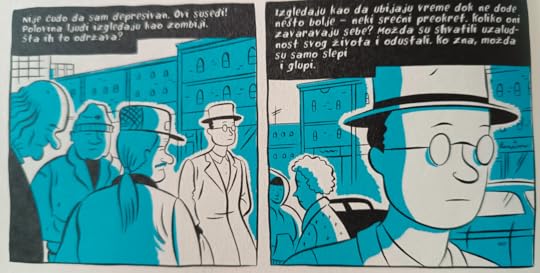
"Ćao, ja sam Set, ja sam najpametniji i Bože kako interesantan lik, svi ostali su tako obični i nikakvi, ne mogu da shvate koliko sam ja super, ja nosim šešir i slušam džez i volim prošlost, ah, kako u pogrešnom smeru ide ovaj svet, sve me žene vole ali ja nikako da se zaljubim, ipak nekako kad vidim kako nisu toliko interesantne kao ja sve propadne, uh, moj brat je tako primitivan, ja volim da idem u muzeje jer tamo nalazim mir..."
Nepodnošljivo egocentrično trućanje jednog čoveka, koji je možda (?) i svestan toga koliko je nepodnošljiv, ali ga to ne čini nimalo podnošljivijim. Radnje u suštini nema, niti nekog zaključka. Na sve to dodaj i loš prevod, gde su engleski idiomi prevedeni direktno u nepostojeće i besmislene srpske idiome (on nije izgubio ironiju iz konteksta pretpostavljam potiče od irony was not lost on him?). Loš prevod je možda i razumljiv - ja isto ne bih podneo da pročitam ovu knjigu više puta i da je analiziram kako bih je dobro preveo.
The narrator reminds me of my best friend--a good-hearted, curmudgeonly aesthete born a couple decades too late. The well-drawn imagery supports an introspective narrative that explores misery and depression, family histories, creativity, the well-lived life, and the work of an obscure Canadian cartoonist-turned-realtor. A little too self-absorbed at times for my taste, but it is obvious to me why the editors of Comics Journal selected this as one of the 100 best comics of the 20th century.
One review here at Goodreads describes Seth as "loathsome," and while that is a pretty strong word, I mean he is not an evil person, but I can see what they mean. I appreciate the courage of the unflattering self portrait, but I really enjoyed the portrayal of Chester Brown who puts up with Seth and is his friend. On the whole it is not much of a story, plot-wise, but I enjoyed the read, and the concept of a fan (short for fanatic) who obsesses over an unknown artists work!