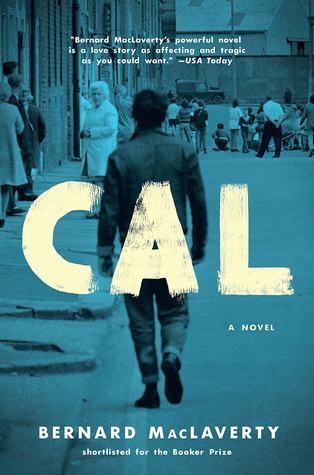
Set in the Northern Ireland of the 1980’s, Cal tells the story of a young Catholic man living in a Protestant area. For Cal, some choices are devastatingly simple: he can work in an abattoir that nauseates him or join the dole queue; he can brood on his past or plan a future with Marcella.
Springing out of the fear and violence of Ulster, Cal is a haunting love story that unfolds in a land where tenderness and innocence can only flicker briefly in the dark.
Bernard MacLaverty was born in Belfast in 1942 and lived there until 1975 when he moved to Scotland with his wife, Madeline, and four children. He has been a Medical Laboratory Technician, a mature student, a teacher of English and, for two years in the mid eighties, Writer-in-Residence at the University of Aberdeen.
After living for a time in Edinburgh and the Isle of Islay he now lives in Glasgow. He is a member of Aosdana in Ireland and is Visiting Writer/Professor at the University of Strathclyde.
Currently he is employed as a teacher of creative writing on a postgraduate course in prose fiction run by the Research Institute of Irish and Scottish Studies at the University of Aberdeen.
He has published five collections of short stories and four novels. He has written versions of his fiction for other media - radio plays, television plays, screenplays. Recently he wrote and directed a short film 'Bye-Child'
Set in Northern Ireland in the 1980’s, this is the story of 19 year old Cal. Cal and his father are Catholics living in Ulster where it is predominantly Protestant. Cal is a quiet and intelligent young man, but mixed up in a violent culture which only brings fear and intimidation his way.
Cal is on the fringe of the IRA with little choice. Occasionally, he is asked to drive a car to help out. In the past he witnessed a killing and now wants to distance himself from the group.
Then comes the love story predestined for tragedy between Cal and widowed Marcella. Cal’s past actions haunt him. Little by little MacLaverty unfolds the truth. This love affair cannot survive the past.
With beautiful prose, Bernard MacLaverty has written a very fine book. He has put us in the shoes of an insecure young man unable to change fate.
Thanks to Barbara’s review which put this Irish novel on my TBR.
Maclaverty has the Cal film poster in his home. Or he did, once. Decor can change. Indebtedness, too, can fade. But when we met, MacLaverty was grateful for the film's success. It meant that he could devote more time to writing which he did.
It's hard to imagine anyone other than Helen Mirren and John Lynch as the lovers. But even if you can, you know they're doomed from the start.
The first pages describe the smell of an abattoir and bloody hands. The Biblical references are rife. This is a modern day tale pumped with sacrificial lambs, forbidden fruit, and guilt that begs for redemption. If you're after a cosy love story, look elsewhere. If Northern Ireland interests you, read Cal then Heaney's poem "Whatever You Say, Say Nothing." Good luck getting that soundtrack out of your head.
4+ This novel is an example of being in the wrong place at the wrong time. Like a Greek tragedy or Romeo and Juliet, there was no way this would be a light read with a happy ending. The Troubles in Ireland was a time of hatred and fear for all the Irish whether they were political activists or not. How could there be any joy or happiness in this story? It was a story doomed. Yet, MacLaverty was able to convey beauty.
Nineteen-year-old Cal and his father were unfortunately living in a Protestant area of Ulster in Northern Ireland. Taunted and harassed by those who wanted no Catholics in their neighborhood, Cal was continually edge. He and his father were left homeless when their house was torched. When asked to drive the getaway car for some I.R.A. terrorists, he agrees thinking it would stop their requests. It is a decision he will pay for. (I was reminded of Eneas McNulty in Sebastian Barry’s fine novel The Whereabouts of Eneas McNulty.) The murder he witnessed will haunt him and change his life. Burdened with guilt, he becomes entranced by the young woman left a widow by the killing, befriending her and eventually becoming her lover.
The love affair was the light in this story, one that I knew would be extinguished. Its innocence and purity juxtaposed with the ugliness, hate, and violence was powerful. This novel did what great literature should do; it made me feel along with the characters, experience in a remote way their range of emotions. Although the ending is not what I may have unrealistically hoped for, MacLaverty left a glimmer of hope for this optimist.
It's a depressing story about life in Northern Ireland in the '80's. If a Catholic is living in a mainly Protestant area, he's asking for trouble. Cal tries to hold his own in the environment of the Troubles. Had it been a film, it would have been in black and white.
Bernard Mac Laverty’s Cal is one of the best anti-war novels I have read. It is about a civil war, the Catholics fighting for freedom from British rule (Nationalists) vs. the Protestant Loyalists in northern Ireland, with the Brit forces policing the cities where these “troubles” are taking their toll. Americans are familiar with the fighting between friends and relatives who have chosen sides in the Union vs confederacy bloodbath. In Cal, we see how one’s own confederates are equally destructive to a decent young man’s survival. It’s the militant atmosphere that makes Cal suffer. He is sensitive, music-loving, thoughtful person who cannot join his dad in a job in a slaughterhouse. Ironically, he lives in one. Loyalists which had for years been on friendly terms with Cal in his Belfast neighborhood Nationalist Catholics, cannot prevent paramilitary from burning out Cal and his father.
It’s an atmosphere which resembles the Sunni-Shiite divide in Iraq, deliberately exacerbated during Bushwar, just as the Brits worked with the warring sides during the Troubles, setting up prisons where only Catholic nationalists were interned, and without trial. That was their version of the later US 2011 "military administration" act, doing away with habeas corpus.
Mac Laverty shows exactly what “yer either for us or agin us” means. It means it is impossible to live as any human being has the inalienable right to. After the burning of Cal’s house, his father loses his self-respect and identity. . Cal must (or risk being murdered) drive a car for his boyhood friend Crilly, whose sadism finds release in killing Loyalists. No one in this kind of militant culture has any choice. It has little to do with the ideology of conflict. It is about being part of a machine (If you saw the penultimate episode of Mad Men, you know what various Korean vets, and Don Draper himself, had to do to “get to go home.”)
Since Cal is intelligent, he suffers self-hate and despair. Two of the men Crilly kills (while Cal drives him) are closely related to Marcella, a librarian for whom he carries a torch. He cannot tell her, after he and she get to meet and make love. Now, the situation becomes intolerable for Cal, due to the next plan of Crilly’s. This novel is powerfully relevant to today’s militancies: in Palestine/Israel and with the blowback to the war in Iraq Cal finds a way to protect Marcella. Temporarily at least.
He also faces a reckoning, with himself, with Crilly, with the Brits and their internment. Read to the end and decide which is worse—the paramilitary forces’ slaughterhouse or the state of Cal’s soul b/c he came to maturity during the troubles.
Compare Cal with the souless children of a militant father in the film The White Ribbon; with the intelligent young student in a military school (Musil’s The Confusions of Young Torless) who writes objective observations in his notebook while his buddies torture (and sodomize) another student whom Torless, although (because?) he also is sexually drawn to the hapless victim, does not lift a finger to help him; or with Frank in Simenon’s The Snow Was Black, whose impassivity in his occupied city is due to his inability to accept feeling. Cal, I think, does much better, maybe, although he might actually welcome what is coming to him.
Cal the central character of this book is Catholic. Living with his father in Ulster, Northern Ireland, in a Protestant housing estate during the 1980s, their very existence is threatened. They are not welcome. They are sent menacing letters, “Move, get out, this is your last warning!” What is drawn is life in that era so glibly called by Brits “The Troubles”.
What if you are physically and emotionally drawn one way and your head in another? Say that person is not self-assured, a person lacking in self-confidence. That person is Cal.
For me what is drawn is possible. If you believe, as I do, that Cal’s actions are feasible, you hold the belief that an immediate spark of physical, sexual attraction has the power to make you do what is not sensible.
Marcella, the woman for whom Cal feels this attraction, turns out to be
There is the story in a nutshell. I have put this in a spoiler, unsure of how much you want to know.
Cal is Catholic. Marcella is Catholic, but Cal’s past actions have irretrievably divided them. One might classify this as an Irish Romeo and Juliet.
Do you need a reminder of who is who in the Irish conflict? Stack up the Catholics, the IRA, the Republicans, the Nationalists on one side and the Protestants, Orange, the Unionists and the Loyalists on the other.
The prose, the stringing together of words is what makes the book special for me. Cal’s and Marcella’s sexual attraction is tantalizingly drawn. The dilemma of the times, the act of being pulled in opposing directions became very real to me. This is what attracts me to the book.
This is a short novel. Give it a try. See what you think. I am attracted to the writing and will definitely be reading more of the author’s books.
The audiobook is narrated by David Threlfall. The characters speak in a pronounced Irish brogue. This is not always easy to follow, but for me it felt absolutely right. It is performed, not merely read. This I don’t usually like, but I do here. I have given David Threlfall’s narration performance four stars.
The mid 70's to early 80's was a time fraught with danger in Northern Ireland. As an expat living and working in England I am well versed to understand the mindset of the various embattled groups that continued to carry on a war of attrition not only against the so called enemy (police and army) but equally against each other and if you happened to be of the wrong religion residing in the perceived wrong locality intimidation was an everyday occurrence.
Cal McCluskey and his dad are a catholic family living in a predominately protestant locality...."he could not bear to look up and see the flutter of Union Jacks, and now the red and white cross of the Ulster flag with it red hand.".... Cal was often the target of insults, taunting, and intimidation, but he tried to ignore, picking up his Giro on a regular basis and hanging around street corners, ripe pickings for paramilitary scouts. So he helped with the "cause" and when needed would act as a driver for his fellow republicans Crilly and Skeffington. With so much free time, and little hope of a job in this divided land, he was often to be seen perusing books and cassettes in the local library where one day he notices a new woman behind the counter. What follows is a beautifully written story of a love affair that is doomed to failure from the start. Cal holds a secret that if revealed to Marcella would end their relationship as he is torn between loyalties to his friends and honesty to his lover.
The language and descriptive prose of the author reminded me of the many years I lived in a country riddled with hypocrisy and bigotry....."the weight and darkness of Protestant Ulster, with its neat stifled Sabbath towns.".... "people were dying everyday, men and women were being crippled and turned into vegetables in the name of Ireland. An Ireland which never was and never would be."....."I like the look of Donegal where nothing grows. Beaches, bogs and mountains."......"The parade led by Evangelists screaming about sin and death and damnation."....
The ending when it happens is unexpected and sudden in its execution and brutality but I felt that it suited so well the time and events in such a deeply divided community. Highly Recommended.
I read this quite a number of years ago but the plot has always stayed with me (the mark of a good book generally). The truth is, I thought Neil Gaiman was the author, and decided I had to look it up. Well, I was married to a Cal and that's why I picked up the book in the first place. Tragic story during the "Troubles" in Northern Ireland. Cal lives in a Protestant part of Northern Ireland and becomes enmeshed with the Catholic forces of the 70s and 80s. It involves his meeting of someone who doesn't realize his past, and falling in love with them. Don't want to give away the plot, and there are many (better) reviews on Goodreads of this book. Let's just say, if you have any interest in Northern Ireland, this would be a good place to start.
Last year I read and loved Milkman (2018) by Anna Burns which is a highly original take on the Troubles in Northern Ireland, and one of the best books I have ever read.
Cal is also set in the Troubles and is a bleak portrait of Cal, a young Catholic man who lives with his father in a Protestant area. He's on the fringes of the IRA however, after participating in political violence, he is trying to distance himself from them. Sadly his options are very limited and this novel gives the reader an insight into a grim predicament, along with a tantalising glimpse of what might have been.
Cal is a short and powerful novel but its abrupt ending left me wanting more. Ultimately it felt a bit inconsequential, and a bit of a missed opportunity, particularly when compared with Milkman which makes so much more of similar material.
3/5
The blurb.... Set in the Northern Ireland of the 1980s, Cal tells the story of a young Catholic man living in a Protestant area.
For Cal, some choices are devastatingly simple: he can work in an abattoir that nauseates him or join the dole queue; he can brood on his past or plan a future with Marcella.
Springing out of the fear and violence of Ulster, Cal is a haunting love story that unfolds in a land where tenderness and innocence can only flicker briefly in the dark.
As Catholics, Cal McCluskey and his father are a rarity in their community and fear attacks on their home. Resistant to join his father in working at the local abattoir, Cal spends his days doing odd jobs and lurking around the public library – he has a crush on a married librarian named Marcella. Aimless and impressionable, he’s easily talked into acting as a driver for Crilly and Skeffington, the kind of associates who have gotten him branded as “Fenian scum.” The novella reflects on the futility of cycles of violence (“If you’re not part of the solution, you’re part of the problem,” Crilly says, to which Cal replies, “But it all seems so pointless”), but is definitely a period piece. Cal is not the most sympathetic of protagonists. I didn’t enjoy this as much as the two other books I’ve read by MacLaverty.
I like McLaverty's writing a lot. This is the first one I read - I thought I'd put it on GR but apparently not. A tense, superior novel set in Northern Ireland during the troubles in the 70s. Try his stories - recently read 'Matters of Life and Death' which has two great stories. http://www.goodreads.com/book/show/74... bugger it I don't know how to put links in or italics come to that
I’ve actually had this book since I was in year 10, mum bought this book off of ebay after parents evening with my history teacher Mr Nigel Stemp (wherever he is bless him, best man I’ve met in my life) because although I was already a bright and eager student when it came to my gcse classes on the Irish Troubles (weird way to label paramilitary warfare methinks) my mum had to ask what I could be doing more in addition to my homework, and this book came up through Mr Stemp’s recommendation. I’m stubborn and refused to read it until now not because I questioned his judgment but out of spite for my mum ( I was an angsty 15 year old) to prove the point that I would not be the perfect student and satisfy her anxieties for me (whatever they were at the time).
I’m glad I left it for so long and came back to it eventually because for the life of me I can’t think why good-humoured Nigel would have recommended a poetically-written, tragic lovestory set in Ulster as further reading for my coursework? Did he vaguely remember it featured several pages on some charactered involved in rebel action amidst the other 100 pages on a depressed 19 year old possessed by an interminably longing and insatiable yearning for both a united Ireland and catholic widower to a protestant R.U.C officer? An occupation that is ritually interrupted by smoking breaks and erotic fantasies?
It was good I actually enjoyed it for it’s out of the ordinary qualities, well written apart from a strange typo where the editor has left a half finished sentence and ? comment towards the end during the denouement.
Prematurely being handed books only to delay reading them years later is something I excel at and thoroughly enjoy, so can’t say I’m displeased in any way.
Hello, I’m a highschool student from Germany, and in an advanced English class, we were supposed to read this book. Before, we gave the teacher recommendations about what we wanted to read as a lecture and discuss in class. He ignored our recommendations and requests, and chose Cal. When I ordered the book, I didn’t think anything of it. But boy, when I read this..
This book has the most horrendous writing I’ve ever witnessed in my entire life. Just by reading this, you can clearly state that this book is written by a white man (I’m a white girl). It started out boringly, some dude in the 1960s is having a midlife crisis quite early. But shiver me Timbers, it got worse. The plot started by the middle of the book. And it was SO bad. The language is fine, but whenever Cal sees Marcella, BERNARD HAS TO DESCRIBE THE SHAPE AND LOOKS OF HER BREASTS ALL THE TIME. IT DOESNT EVEN STOP WITH MARCELLA. No thank you Bernard, I don’t want to know the appearance of her chest, nor do I want to know the appearance of her grandma‘s saggy chest, nor do I want to know that Cal has a wrinkled dingledong. Even Coleen Hoover writes more interesting romances than Bernard. That’s the worst shit I’ve ever read, I’d like to bleach my eyes out. My opinion ofc <33
This entire review has been hidden because of spoilers.
This book was described by my professor as Romeo and Juliet in 1970s Northern Ireland, which turned out to be incredibly accurate. It is a quaint and tender story of first love and the happiness and desperation that comes along with it, in the midst of incredible violence and uncontrollable guilt in its complicity. It was beautiful and the last paragraphs were haunting. I will definitely be thinking about this story for a long time.
I want to apologise to everyone who has spoken to me; I now understand what it feels like to be on the receiving end of UTTER NONSENSE SPOKEN, I DID NOT NEED TO KNOW SOME OF THIS INFORMATION, AND THE PROGRESSION OF THE INNOCENT CRUSH TO FUCKING HER ASLEEP???? The beginning was ok, and then Chapter 5 came along. I would burn this book.
Probably 3.5. MacLaverty is a favourite writer of mine, and this is a good book but not my favourite of his or his best. Film is also good; I actually saw that before reading the book, a rarity for me.
Fine, fine novel about the Troubles in the mid 60's. The blurbs call it a classic, the "Passage To India" of the era and though I don't unfortunately know the Forester book very well, it's easy to see why.
Cal McClusky is a teenager on the dole, the only son of an abbatoir man who is in the midst of some serious turmoil- physical (puberty), political (he's the only son of a widowed father who is stubbornly staying in a hostile Ulster neighborhood, a bitter Roman Catholic among aggressive Protestants), emotional (guilt over the passive, ambivalent assistance he gave to some IRA school friends in a couple of their, um, "assignments") and romantic (he's got a straining, largely voyeuristic crush on the widowed wife of the man who was killed).
It's easy to relate to Cal, at least for this reader. He's awkward, gangly, self-hating, confused, and unsure of himself and his place in the world. Hell, in some much tamer ways I WAS Cal back in my teenage years- sufficiently scared and uncomprehending of the world outside to brood in anguish in my room all day every day, scurrying to and from the library to take out records, awkwardly strumming along with my Nirvana cds and endlessly pushing my greasy hair back over my eyes.
Cal's 'courtship' of the widow Marcella is written sensitively and with some drizzlings of humor. He can't talk to her for obvious reasons and he can pretty much only worry and peek and semi-stalk and fantasize. Meanwhile, his house is being firebomb threatened and his gruff, repressed father has taken to unearthing the gun from the floorboards of his bedroom and sleeping with it. Its both protection and incrimination- if the cops find it for whatever reason, he's done for. If he uses it he's done for, for that matter.
I won't give away any spoilers but suffice to say the background is set for the plot to start moving. I am not the greatest at forecasting plot twists, but with this setup it's very suggestible what might happen next. We get answers to a lot of our immediate questions, but it's a tribute to MacLaverty's art that even when things are revealed there are still surprises and things withheld in very meaningful ways.
Why does brother kill brother?
I do hope that Cal was read widely when it was written (I do think it was) and contributed in some small way to abating the fear, terror (literal and figurative), and disgust still thick as smoke in the air when it was first published. Pascal was famous for saying that all of mankind's problems can really be traced back to our inability to sit quietly in our rooms. True indeed, but we must also be careful what sitting quietly might summon, the dark side of solitude, as it were.
***
Here is a small paper I wrote about it:
The Shell of Self: Identity, Choice and Redemption in Cal
The final sentence of Bernard Mac Laverty’s novel Cal is as enigmatic and yet profoundly suggestive as any successful ending would wish to be. Upon first reading, its specificity and bitter irony seems both matter-of-fact and also somewhat ambiguous: “The next morning, Christmas Eve, almost as if he expected it, the police arrived to arrest him and he stood in a dead man’s Y-fronts listening to the charge, grateful that at last someone was going to beat him to within an inch of his life.” (154) The bitter irony in the last dozen words is what complicates matters considerably. Why is Cal “grateful” that someone will beat him up, to within an inch of his life, at that? It could be read as sarcastic fatalism: poor Cal is yet again going to be at the mercy of powers which have defined and dominated his life thus far and this arrest will be no more than a further humiliation among many others. It could be read as a final, pathetic defeat, suggesting that Cal is about to surrender totally, fatally, to this oppression to get rid of his misery and to stop struggling once and for all. Neither of these answers seem sufficient, and for good reason. It is not hard to sympathize with Cal throughout the narrative and this seems to be MacLaverty‘s intention. Elimination at the hands of his tormenters is not what he deserves. It might be difficult to stomach, but Cal might be on his way to redemption. Cal has his faults but those very faults are entwined with his virtues and all-too-human characteristics. He is guilt-ridden to the point of stagnation, self-hating and constantly self-critical, most importantly he is not prone to acts of self- assertion or self-defense against the hostile world which he properly rejects. Cal tends to retreat or to isolate himself, either in his room at his father’s house or, later when that space is no longer available, in the cabin outside Marcella’s. At the risk of falling into the reductive, ingratiating language of the self-help industry, he certainly has ‘low self esteem’ and could indeed try to be a ‘better person‘. All of this is, at least arguably, true of Cal. It is also important to remember, in contrast, that he is guilt-ridden and self-hating because of his conscience, not because he lacks one. Cal is in many ways an ordinary adolescent but what is plaguing him is far more immediate and dreadful than puberty alone. It is widely accepted that adolescence is, at least in part, about questioning one’s own identity. This is a cliché, of course, but it also points toward a more complex and textually relevant issue. One way to explore one’s identity is through culture, engagement with culture, as a sort of psychic anchor. Part of being interested in the arts is the discovery of what one loves or hates, what one is passionate about, what one believes, what makes one truly happy. Exploring culture- be it music or literature or film- is a way to not only develop talents but also to begin a process of self-discovery. Taste, particularly for young people, can be a gesture towards self-understanding, a piece of the puzzle of one’s identity. Amid his alienation, Cal seems to find solace in music. Early on we see him sitting in his room, awkwardly strumming his guitar, listening to his Rolling Stones# LP “to drown the silence…Within the tent of his hair with eyes shut he listened to the sounds his fingernails picked from the strings as he sang in an American voice the things he’d heard on record.” (10, italics mine) Cal is not only trying to keep his mind off the tension he feels, he’s also exploring a different form of self-expression, a possibility of a different identity, separate from the ‘crotte de vache’ (in his own self-loathing, angst-ridden terms) which disgusts him so much. This is significant because Cal is a character for whom social identity- religious, geographic, and economic- is very much at the heart of what is causing him so much pain and confusion. It is interesting to notice that a short while later, he is flipping through Time magazine and he feels “strangely proud that the place where he lived was given so much room in such an important magazine.” (12) Cal’s social circumstances are alternately overwhelming and underwhelming. He is frightened for his safety as a Roman Catholic in a hostile, threatening Protestant Ulster, which is probably the reason his hometown appears in a worldly magazine in the first place. He is also bored out of his mind. He has chosen not to work in the reeking abattoir with his father, which is reasonable enough, though life on the dole doesn’t seem to offer anything more than a form of economic limbo. It seems that having his hometown spotlighted in Time magazine because of civil strife and pervading despair is an irony which wouldn’t be lost on him. In contrast to the pugilistic Crilly, killing and robbing does not seem to Cal like a good time at all, or even a possible escape route. It is interesting to note that early in the narrative, when the reader is introduced to the sadistic Crilly and the murderous, pseudo- intellectual Skeffington, Cal’s alienation and longing for change is described through music: “The wailing guitar sequence from ‘The Dark Side of the Moon’ came into his head and he listened to it, moving his fingers.” (23) After his house is burned by Protestant terrorists he specifically returns to his room to reclaim his guitar and finds it ruined, in cinders. When he makes his trips to the library he borrows tapes, not books. Enter Marcella. Cal’s interest in Marcella isn’t only erotic, though this is certainly an important element for the apparently virginal young man. It’s also existential- a chance to take his life in another direction, a manifestation of possibility. Marcella represents to Cal not only a difference of gender (being an adult female), culture (an Italian emigrant to Ireland) and his past (her husband was, after all, the victim of the drive-by shooting in which Cal did the driving but not the shooting) but also of his future. His interest in Marcella is described in voyeuristic terms from its beginning to its eventual consummation. He peeks at her through the library stacks, watches from across the street to see when she will leave the library and even gazes at her through her shower window when he is living in her family’s barn. Cal’s voyeurism is connected not only to his adolescent male fascination with the female body but also with the internal guilt and fear which paralyze him. Throughout much of the narrative he looks at Marcella but can hardly bear to touch her. When he manages to do so, in church of all places, it is furtive, ephemeral, a physical version of a glance. The reason for this aspect of Cal’s paralysis is not merely adolescent timidity- Marcella is the obscure object of his desire because she simultaneously represents both his guilt and his possibility for redemption. It’s understandable that Cal would feel both attracted and repelled to her. Once they finally become lovers and begin to have a steady relationship, he is still burning with the guilt he understandably feels. He can’t tell her the awful secret he keeps, though he must tell her if she is to truly know him, and to love him. It is significant that Marcella describes her previous marriage as a gradual process of indifference. Her husband became a stranger to her over time, their marriage gone distant, not what one would consider a love of any real intimacy. Cal, for his part, cannot truly be her lover until he purges himself of the secret which has imprisoned him in guilt all along. St Theresa once suggested that hell is “the impossibility of love“, and Cal might well understand the meaning of this: “The rest of his prayers consisted of telling himself how vile he was. If he was sick of himself, how would God react to him?” (37) If Cal feels that way about an ostensibly loving God, how is he going to explain to the woman he loves his implication in her husband’s death? For Christmas, Cal buys her a book of paintings by the German artist Grunewald which significantly contains a painting of a gaunt, suffering Christ on the cross. The image of the suffering Christ is appropriate for Cal in the sense that he is crucified by his social environment- his inherited Roman Catholicism is the root cause of his alienation and the threats within his social context. He doesn’t seem especially pious or devout; on the contrary, his chance of redemption is in love, not faith. Cal won’t be ‘saved‘, in religious terms, but be might be redeemed in secular, emotional ones: “Cal looked at the flesh of Christ spotted and torn, bubonic almost, and then behind it at the smoothness of Marcella’s body and it became a permanent picture in his mind.” (153) Cal’s consideration of the two bodies- one hideous and suffering, the other lovely and peaceful- suggests the difference between Cal’s past and future. It offers the possibility of a recovery, an alternative to the solitude and self-hate which previously defined him. In his essay “The Geography of Irish Fiction”, John Wilson Foster asserts that one of the recurring themes of the Irish novel is “the attempt to escape…‘the cave of the self.‘ Even when the self appears to have emerged from its cave, it still inhabits what O’Faolain calls ‘the shell of self’, which for my purposes I will take to mean place transformed into memory of place and therefore transportable.“ This insight was originally applied to Gyppo Nolan, though it can also apply equally to Cal Mc Cluskey. Cal needs to escape the social shell imprisoning him. His otherwise repressed and distant father is still too traumatized from the attack to do much but stare out the window. Crilly and Skeffington have nothing to offer him but more anguish and violence and he has suffered enough by associating with them already. He knows, as he has always known, that he must do something conclusive to sever ties with them once and for all. It seems that the reciprocal affection which he finds in Marcella emboldens him, empowers him, it gives him something for which to live. Shortly after his consummation with Marcella, Cal seems a bit more joyful: ”He walked back to the cottage, his feet splayed like Charlie Chaplin…his excitement was such that he could not sleep.” (142) The next day he sees the ridiculous, bombastic Preacher on the corner of the road, spouting his usual fire and brimstone, and responds with wit and a healthy dignity: “He wind milled his arms and shouted as Cal passed him. ‘Without the shedding of blood there can be no forgiveness.’ ‘Good evening,’ said Cal.” (143) Before Marcella, this eerily relevant statement might have caused Cal to tighten his fists and curse himself some more. Now, he shrugs it off. Instead of letting his social environment dictate his reaction through tormenting him, he is beginning to fortify himself from letting it penetrate. The more he has to be excited about, the more he has to live for and the more he can become stronger within himself. When he discovers that Crilly has planted a bomb in the very library where Marcella works, he has had enough. The fact that he will inform on them, rather than simply tell them he won’t be a part of it anymore, is as much a line drawn in the sand as his relationship with Marcella. The fact that he goes to Marcella’s after having made the phone call is significant- she’s his source of comfort as much as strength. As they embrace, Cal’s problem is made clear: “He wanted to tell her that he had saved her precious library but knew it would be too complicated. He wanted to be open and honest with her and tell her everything. To explain how the events of his life were never what he wanted, how he seemed unable to influence what was going on around him.” (152) This is precisely why he’s been so troubled throughout the story and why he is about to stop his cycle of paralysis and self-hatred. Cal‘s decision is irrevocable. It is also freely made of Cal‘s own volition, not the rushed coercion which Crilly pushed on him by making his house a safe house, and therefore a target. By consciously acting, by making an irrevocable decision, he has begun to define on whose terms he will live and define himself. The bitter irony in the concluding paragraph is the irony which attaches to a social context which does not make for easy answers or greeting-card endings. Before he is arrested, Cal is planning to reveal his secret once and for all, considering writing it down “that way he could say what he meant and not get confused.” (153) The problem is, of course, that this would be evidence which would be used against him, a terrible fact of life in a social matrix in which it seems everyone is implicated, another layer in the ‘shell’ of the self. Cal seems to decide that he will finally relinquish his guilt about his crime, behind prison bars, in necessary: “if he was ever caught…he would write to her and try to tell it as it was.” (153) At last, Cal will have the chance to release himself from the guilt which has defined him thus far and impeded his development as a person. The arrest, and the beating which follows, is an imprisonment but also, ironically, a liberation. It will serve as a purgation, a hand he forced on himself, the cathartic act through which the guilt and pain he feels will be beaten out of him at last. Cal has spent much of the narrative in a very specific pain and lacking both the reason and the will to overcome it, to “force the moment to its crisis“, in T.S. Eliot‘s phrase. There is also an irony in the fact that though he will have his catharsis through others, the situation has come to a head by his own hand. Cal doesn’t know if Marcella is going to receive him back into her life after his arrest, and this is part of the ending‘s power. The fact is, however, Cal has gone from unwilling participant to conscious agent, makes all the difference in the world. He could not stay in the place he began, and it is now impossible to return to it- he can only go elsewhere. He can only leave the shell. The reader can only hope he isn’t alone when he does.
I would really recommend this book. It centers around the troubles in Ireland and Cal’s participation into various conflicts. The plot needed some time to get going but once the character moves, the dynamics between him and others change. The relationship in the novel is also interesting, although a bit rushed at the end. The last few pages also wrapped things up a little too quickly for me.
Another book about the "troubles" in Northern Ireland. This is a superb book. It creates a tension in the first few pages and never lets go. The balance between love and shame and betrayal and fear is always being weighed up. Who can be trusted? A brilliant, drama filled, short novel. 8.5/10
I will be visiting Northern Ireland for the first time in a few months with my wife and this novel came highly recommended for its ability to communicate a lot about the Troubles with humanity and brevity. The story is spare but not shallow by any means, and the protagonist is sympathetic and emblematic of what existentialists refer to as the "thrownness" of the human condition. Cal is in the midst of a situation in which no choice is especially attractive, and no matter what he does he will disappoint and anger someone. There are moments of great tenderness and beauty in this story, but it is not sentimental in the least. It is at time harrowing, but a story told with great humanity and compassion.
Had to read it for school and it was honestly one of the most boring books I've ever read. It takes forever to pick up the pace, whereas the actual ending feels terribly rushed. As if there's put too much stress on the things the reader isn't interested in. This book actually got me into a reading slump because I was forcing myself to finish it for school in time, before reading anything enjoyable for myself. Do understand that tastes differ and this is only an opinion of mine.
Life ain't easy if you coming of age in N. Ireland during the years the constant conflict between the IRA & Loyalists. Tough times, tough choices and tough consequences for mistakes made.
Not something I would normally read. Picked for family member book club. Felt like i was back in college decifering authors intent and symbolism. Style of writing took some getting used to.