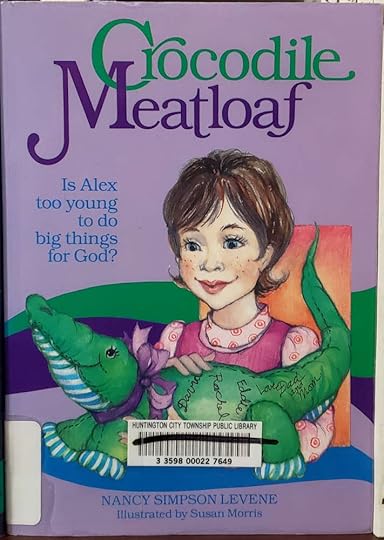
As she becomes friends with Rachel, a deaf girl who has joined her sixth grade class, Alex begins to feel that God has given her a mission to protect Rachel from the boy who is tormenting her.
I couldn’t find any author info, but I did some sleuthing on the name from her acknowledgments and potentially found the deaf woman who “helped to inspire” book, and presumably the character Rachel. Though I have no idea if that means any kind of consultation from Emily or if the author is merely drawing from childhood memories. (I suspect the latter.) I had hoped that because the author had a deaf childhood friend, we would have gotten better rep, but that unfortunately didn't happen. The messaging in particular is problematic. Let's get into it:
First, a little context. The main character, Alex, is from an evangelical Christian family and dreams of becoming a missionary in Africa, so she approaches and thinks of Rachel in more of a charity sense, rather than feelings of friendship. Alex essentially adopts Rachel (who is in her class) as an extrovert adopts an introvert, taking Rachel protectively under her wing and getting her onto the softball team. The only thing these girls really have in common is softball, but they primarily interact with each other outside of their games/practices.
We begin the book with bullies trying to get a reaction from Rachel. She is apparently so profoundly deaf that she cannot hear a stack of books hitting the floor nor sharp whistles—but her silent tears seem to suggest otherwise, and that she is choosing to ignore these sounds. That signposts something more authentic. Indeed, there are little "glimpses" of authenticity throughout the book (which I will cover below), where it seems that the author may have noticed certain behaviors like going off alone, but she doesn't seem to quite understand the rationales for them or what contexts specifically they arise in.
Rachel can read lips “amazingly well” and so has been moved into a mainstream 6th grade classroom by her parents to see what would happen. But Rachel doesn’t seem to lipread much, and it's not clear whether this is because she's supposed to be shy, if she's rebelling against her parents for enrolling her in mainstream school where she is the sole deaf student, or if she actually can't lipread as well as Alex assumes. Case in point: for some reason, instead of looking up at the softball coach when he's speaking to her, Rachel stares at the ground after every monosyllabic answer that Alex pulls out of her by touching her arm and repeating the coach’s questions.
Rachel knows and uses “sign language” (presumably ASL) with another signing character (a random police officer). This is the only time sign is portrayed, or even mentioned. I'm admittedly a little surprised that Alex desiring to learn ASL in order to help more deaf people didn't come up, as that is a bit of a staple in these kinds of stories (and in real life).
Alex brings Rachel into her circle, interacting with her in class and at softball practice. Rachel supposedly becomes a part of the larger friend group (which I think is just some other girls on the softball team?), but only Alex, the softball coach, and one of Rachel's bullies ever have direct dialogue with Rachel. (Not counting the police officer who signs with Rachel toward the beginning.)
Throughout the book, we are told how Rachel reacts to/feels about situations happening around her, from Alex’s point of view. (E.g., Rachel wordlessly follows when they run after a dog and then she goes home; Alex drops a book off at Rachel’s house and they leave without conversation, etc.) But Rachel actually does and says very little, and is portrayed in a sort of doll-like manner with Alex interacting with her when she remembers she's there.
Even at the slumber party that Alex arranges (supposedly) for Rachel’s benefit and fun, the latter is noted to be having fun playing ping-pong (specifically with Alex) and Monopoly. Rachel then disappears from the narrative for the movie and shenanigans. We’re probably supposed to assume that Rachel is participating or at least watching/enjoying everything, but she would be unable to speechread in the dark or follow a bunch of chaotic group chatter in the light. And does the movie have captions? (I don’t really expect that children should know all about how to interact with a deaf person, especially as Rachel doesn’t seem to self-advocate at all. What I’m mainly problematizing is the author’s tendency to just completely omit Rachel from scenarios rather than dealing with or even acknowledging language barriers, except those caused by Rachel inexplicably refusing to look at people.)
When the author tries to center Rachel, she uses more or less contrived scenarios for the purpose of injecting drama and ensuring that Alex is the hero.
First, on the field trip, Rachel excuses herself and goes off alone—this is actually realistic! She is probably looking to get a break from trying and failing to participate in conversation, especially considering none of the girls are addressing her. The contrivance is that she disappears after running from a bully, setting off a “silent” search party (which is unrealistic in that often people would forget that she’s deaf and holler anyway—plus the “visual” of someone cupping their hands around their mouths as they call or shading their eyes with a hand as they scan the horizon would be helpful for a deaf person to figure out they’re being looked for). She's eventually found (by Alex, of course) in a tree, having climbed up there to hide and mope.
Later, when the gym lights are knocked out by a storm, Rachel can’t hear instructions and is later found (by--you guessed it--Alex) alone and balled up, hugging herself. If you think about it, this is a bit silly. Rachel would have been part of the crush of bodies (if they were lined up by name as usually happens, she would have been somewhere in the middle with the rest of the Ks). She would have felt the boards vibrating beneath her as kids stomped off the stage. She would have—or at least could have—voiced that she needs help.
These scenarios are contrived to play up Rachel's apparent helplessness so that the main character can be a hero.
Alex receives the outstanding student reward at graduation specifically because she helped Rachel, and Rachel tells Alex that she’s “an extra-special person.” I’m not *too* mad about the award because it’s clear throughout the book that Alex is not motivated to help Rachel for her own gain. I *do,* however, take issue with the author’s representation of a deaf child being passive and dependent and in need of rescue in all these different situations to begin with—especially when there’s the whole episode with the lost dog finding his way home perfectly happily. In other words, Rachel is more helpless than a dog, and never speaks up for herself or has any kind of growth at all, etc.
Rachel literally only exists as a character so that Alex can “teach” readers how they should help. Rachel only receives help, never gives. Her primary role as a catcher on the softball team reinforces this as well, and even though she hits multiple balls out of the park (literally) this isn’t portrayed as game-changing. In fact, it’s Alex who is valorized for hitting a home run later, bringing “tremendous victory” for the team. (What is Rachel? Chopped croc meatloaf?)
Overall, on the surface, Rachel is an okay representation, filtered as she is through the eyes of a very Christian girl (in that Alex has been taught a Christian ideal that she should help those she perceives as less fortunate). But get down to brass tacks and actually look at Rachel, it becomes increasingly clear that she exists *for* Alex's growth and valor, not as a character in her own right.
Alex meets the new girl in class, Rachel, who is deaf, and feels protective of her when the obnoxious boys torment her. Alex learns that God has a plan for her life and wonders if that plan could start now, even though she’s a kid, and if it might just be related to Rachel.
Though Alex is a little older now than in the books I remember from my childhood, she’s still learning about all that God has to offer, even to a kid. What I miss, though, from her younger days are the situations she’d get herself into as she tried to correct some kind of mistake she made. This book is more about external problems than internal ones, which doesn’t make it bad. Just different. I still like the way Alex tries her best to help or to fix things (whether her own mistakes or someone else’s). I’m not sure how realistic the turn-around is near the end, but overall, it’s a good book with solid lessons. If you have an opportunity to pick up any of the Alex series books, I recommend them. They’re short, quick reads that children will be able to connect to.