

What do you think?

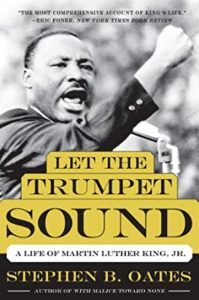
Let the Trumpet Sound: A Life of Martin Luther King Jr.
“The most comprehensive, the most thoroughly researched and documented, the most scholarly of the biographies of Martin Luther King, Jr.” —Henry Steele Commanger, Philadelphia Inquirer
Winner of the Robert F. Kennedy Memorial Book Award * A New York Times Notable Book of the Year
By the acclaimed biographer of Abraham Lincoln, Nat Turner, and John Brown, Stephen B. Oates's prizewinning Let the Trumpet Sound is the definitive one-volume life of Martin Luther King, Jr. This brilliant examination of the great civil rights icon and the movement he led provides a lasting portrait of a man whose dream shaped American history.
“Drawing on interviews with those who knew King, previously unutilized material at Presidential libraries, and the holdings of the Martin Luther King Jr. Center in Atlanta, Mr. Oates has written the most comprehensive account of King’s life yet published. . . . He displays a remarkable understanding of King’s individual role in the civil rights movement. . . . Oates’s biography helps us appreciate how sorely King is missed.” —Eric Foner, New York Times Book Review
Winner of the Robert F. Kennedy Memorial Book Award * A New York Times Notable Book of the Year
By the acclaimed biographer of Abraham Lincoln, Nat Turner, and John Brown, Stephen B. Oates's prizewinning Let the Trumpet Sound is the definitive one-volume life of Martin Luther King, Jr. This brilliant examination of the great civil rights icon and the movement he led provides a lasting portrait of a man whose dream shaped American history.
“Drawing on interviews with those who knew King, previously unutilized material at Presidential libraries, and the holdings of the Martin Luther King Jr. Center in Atlanta, Mr. Oates has written the most comprehensive account of King’s life yet published. . . . He displays a remarkable understanding of King’s individual role in the civil rights movement. . . . Oates’s biography helps us appreciate how sorely King is missed.” —Eric Foner, New York Times Book Review
777 pages, Kindle Edition
First published January 1, 1982
About the author
Stephen B. Oates
45 books65 followersAn expert on 18th century U.S. history, Stephen B. Oates was professor of history at the University of Massachusetts Amherst, where he taught from 1969 until his retirement in 1997. Oates received his BA (1958), MA (1960), and Ph.D. (1969) from the University of Texas.
Oates wrote 16 books during his career, including biographies of Martin Luther King, Jr., Abraham Lincoln, Clara Barton, and John Brown, and an account of Nat Turner's slave rebellion. His Portrait of America, a compilation of essays about United States history, is widely used in advanced high school and undergraduate university American history courses. His two "Voices of the Storm" books are compilations of monologues of key individuals in events leading up to and during the American Civil War. He also appeared in the well-known Ken Burns PBS documentary on the war.
Oates received the Nevins-Freeman Award of the Chicago Civil War Round Table for his historical work on the American Civil War.
Oates wrote 16 books during his career, including biographies of Martin Luther King, Jr., Abraham Lincoln, Clara Barton, and John Brown, and an account of Nat Turner's slave rebellion. His Portrait of America, a compilation of essays about United States history, is widely used in advanced high school and undergraduate university American history courses. His two "Voices of the Storm" books are compilations of monologues of key individuals in events leading up to and during the American Civil War. He also appeared in the well-known Ken Burns PBS documentary on the war.
Oates received the Nevins-Freeman Award of the Chicago Civil War Round Table for his historical work on the American Civil War.
Ratings & Reviews
Friends & Following
Create a free account to discover what your friends think of this book!
Community Reviews
Displaying 1 - 30 of 98 reviews

January 2, 2017
I found myself unacceptably ignorant of the Civil Rights Movement. I took this biography to inform me of the movement through its most known figure. As I read the book I realized that my ignorance of the subject was on a much higher level than I had imagined.
The book begins by telling the story of King's father and thus explains in detail the social and family milieu that Luther King Jr. was born and raised. It is striking to note how King's natural talents made him engage in movement almost naturally. "Almost" because as a privileged black he could have made his life in the north as a university professor. His decision to participate in the black civil rights struggle in the South was an individual decision with high costs for his personal life.
The book is very well written and his description of King's murder is one of the most memorable things I've ever read.
So, I came to this book to know more about civil rights movement. In the end, I have learned a lot about racial questions, social justice and, above all, love. I finished it in tears!
The book begins by telling the story of King's father and thus explains in detail the social and family milieu that Luther King Jr. was born and raised. It is striking to note how King's natural talents made him engage in movement almost naturally. "Almost" because as a privileged black he could have made his life in the north as a university professor. His decision to participate in the black civil rights struggle in the South was an individual decision with high costs for his personal life.
The book is very well written and his description of King's murder is one of the most memorable things I've ever read.
So, I came to this book to know more about civil rights movement. In the end, I have learned a lot about racial questions, social justice and, above all, love. I finished it in tears!

April 12, 2022
Nonviolent, Integrated and Dignified
“Any religion that professes to be concerned with the souls of men and is not concerned with the slums that damn them, the economic conditions that strangle them, and the social conditions that cripple them, is a spiritually moribund religion.”
A philosopher as well as a minister, Martin Luther King Jr. questioned whether or not man was intrinsically good and whether or not divine grace could lift him from the contradictions of history. In such queries King showed himself to be a present tense realist and a future tense optimist. He took on Jim Crow on the buses of Montgomery, in the streets of Selma, and in the jail cells of Birmingham. He didn’t always win but the reverberations of his achievements are still being felt half a century after his passing.
"If a man has not found something that is worth giving his life for he is not fit to live”
I admire that rare biographer that can be both objective and enthusiastic; Stephen Oates is about 95% there. Aside from his tangent apologetics (we get it, Dr. King wasn’t a beacon of fidelity, let’s move on) and his referral to the U.S. as a “christian nation” (it’s not—don’t get me started), Oates has penned a doozy. Highly recommended. 4 stars.
_________________________________________
On the morning of April 4, 1968 when an assassin’s bullet found the good Dr. on that Memphis motel balcony, I was five years old and 335 miles away. I have no specific memories of the event but I can say, without any doubt or reservation, there were no tears shed in my father’s house. Years later, whenever the name Martin Luther King Jr. would surface in passing conversation, both my mom and dad would refer to him as a “troublemaker.” Trust me on this one, if you ever find yourself on the wrong side of racist bigots (i.e. my parents) you can bet your ass you are on the right side of history.
“Any religion that professes to be concerned with the souls of men and is not concerned with the slums that damn them, the economic conditions that strangle them, and the social conditions that cripple them, is a spiritually moribund religion.”
A philosopher as well as a minister, Martin Luther King Jr. questioned whether or not man was intrinsically good and whether or not divine grace could lift him from the contradictions of history. In such queries King showed himself to be a present tense realist and a future tense optimist. He took on Jim Crow on the buses of Montgomery, in the streets of Selma, and in the jail cells of Birmingham. He didn’t always win but the reverberations of his achievements are still being felt half a century after his passing.
"If a man has not found something that is worth giving his life for he is not fit to live”
I admire that rare biographer that can be both objective and enthusiastic; Stephen Oates is about 95% there. Aside from his tangent apologetics (we get it, Dr. King wasn’t a beacon of fidelity, let’s move on) and his referral to the U.S. as a “christian nation” (it’s not—don’t get me started), Oates has penned a doozy. Highly recommended. 4 stars.
_________________________________________
On the morning of April 4, 1968 when an assassin’s bullet found the good Dr. on that Memphis motel balcony, I was five years old and 335 miles away. I have no specific memories of the event but I can say, without any doubt or reservation, there were no tears shed in my father’s house. Years later, whenever the name Martin Luther King Jr. would surface in passing conversation, both my mom and dad would refer to him as a “troublemaker.” Trust me on this one, if you ever find yourself on the wrong side of racist bigots (i.e. my parents) you can bet your ass you are on the right side of history.

February 4, 2022
Let the Trumpet Sound is a worthy read for anyone looking to learn about the life, career, and pivotal role in the Civil Rights Movement of Martin Luther King Jr. A lineal biography, it may not be as expansive as Taylor Branch's epic America in the King Years series but is a great entry point for readers not quite ready to tackle Branch's near 3000 page odyssey. I have to admit, though, that America in the King Years loomed over my reading of Stephen B. Oates' work, which is probably a bit harsh considering this book was written first and gives quality treatment to the MLK story. Indeed, I'd probably give Let the Trumpet Sound top marks if it weren't for a couple of niggling issues I have with it. Firstly, it does a questionable job of trying to rationalize King's extramarital activities. And I don't think anyone will ever convince me that Lyndon Johnson was "distraught" in the wake of John F. Kennedy's assassination. That being said, this is a solid biography of one of America's greatest men. The closing chapters, following King's assassination and its aftermath, are particularly powerful.

July 13, 2010
This is my second very big biography of Dr. King (the first was the Pulitzer Prize winning Bearing the Cross). I also tried to read Taylor Branch's magisterial Parting the Waters but it was just too damn long...which doesn't mean I won't return to it at some point.
Martin Luther King, Jr. is, without a doubt, my favorite figure from American history, and the only person I can truly call my hero. I admire him tremendously, and each time I read about his death, or see the final speech he gave on April 3rd, 1968, I get all teary-eyed. To me, Dr. King represents what is best in our nation, and what is best in Christianity. His life, his work, and his legacy inspire me, challenge me, and keep me very, very humble. If I could wave a magic wand and meet one person from history, it would be Dr. King. There are so many things I want to ask him.
This particular biography weighed in at 500 pages, and I pretty much inhaled it. The more familiar part of Dr. King's story--the Montgomery busy boycott, the protests in Birmingham, AL, the gathering on the Mall in DC where he delivered his famous "I Have a Dream Speech," and the march in Selma, AL are wonderful testaments to the power of creative nonviolence, Christian love, and an appeal to what is best in our nation's politics and culture. I have to admit, though, it is the later King--the King of Chicago, the King at the Riverside Church delivering his "Beyond Viet Nam" speech, and the King of the aborted Poor People's Campaign, who intrigues me the most. By the end of his life, Dr. King had began to recognize some global truths about power and racism and poverty that--had he lived--may have led to real changes in our nation's soul.
Likewise, I find it fascinating to read about Dr. King's clashes with Stokley Carmichael and other leaders in the Black Power Movement. King's dedication to trans-racial coalitions, and nonviolent resistance--in just a the few short years between Selma and Memphis--seemed positively outdated in the face of race riots and the burgeoning anti-war movement. Still, I believe he was right: "darkness cannot drive out darkness. Only light can do that."
An excellent, well-written biography of a great American, and a great human being. Dr. King certainly earned his Nobel Peace Prize...unlike some other people I could name.
Martin Luther King, Jr. is, without a doubt, my favorite figure from American history, and the only person I can truly call my hero. I admire him tremendously, and each time I read about his death, or see the final speech he gave on April 3rd, 1968, I get all teary-eyed. To me, Dr. King represents what is best in our nation, and what is best in Christianity. His life, his work, and his legacy inspire me, challenge me, and keep me very, very humble. If I could wave a magic wand and meet one person from history, it would be Dr. King. There are so many things I want to ask him.
This particular biography weighed in at 500 pages, and I pretty much inhaled it. The more familiar part of Dr. King's story--the Montgomery busy boycott, the protests in Birmingham, AL, the gathering on the Mall in DC where he delivered his famous "I Have a Dream Speech," and the march in Selma, AL are wonderful testaments to the power of creative nonviolence, Christian love, and an appeal to what is best in our nation's politics and culture. I have to admit, though, it is the later King--the King of Chicago, the King at the Riverside Church delivering his "Beyond Viet Nam" speech, and the King of the aborted Poor People's Campaign, who intrigues me the most. By the end of his life, Dr. King had began to recognize some global truths about power and racism and poverty that--had he lived--may have led to real changes in our nation's soul.
Likewise, I find it fascinating to read about Dr. King's clashes with Stokley Carmichael and other leaders in the Black Power Movement. King's dedication to trans-racial coalitions, and nonviolent resistance--in just a the few short years between Selma and Memphis--seemed positively outdated in the face of race riots and the burgeoning anti-war movement. Still, I believe he was right: "darkness cannot drive out darkness. Only light can do that."
An excellent, well-written biography of a great American, and a great human being. Dr. King certainly earned his Nobel Peace Prize...unlike some other people I could name.

June 24, 2008
I’m not surprised this got so many good reviews as it’s a damned fine book. Obviously the subject matter is something you want to read in the first place which gives it a head start but I’m sure we’ve all read some duff biogs.
Oates manages to tell the story of MLK with a dispassion that is important for such a historical figure. Oates didn’t evangelise him, rather he the recounted events and let the reader draw their own conclusions. As well as recanting MLK’s life Oates also managed to give some overall perspective to the civil rights movement as a whole.
A very powerful and emotional book that can’t fail to move its reader.
Oates manages to tell the story of MLK with a dispassion that is important for such a historical figure. Oates didn’t evangelise him, rather he the recounted events and let the reader draw their own conclusions. As well as recanting MLK’s life Oates also managed to give some overall perspective to the civil rights movement as a whole.
A very powerful and emotional book that can’t fail to move its reader.

September 7, 2017
This is a good biography but Oates writes in a very slow, dull pedantic style that doesn't bring King to life. More excerpts from his speeches would have enlivened the story.

September 26, 2024
MLK’s life fascinates me. I think since I learned about him and the civil rights movement in elementary school, details and stories about his life captivate me.
Many people want to reduce MLK down to a saint, a communist, a charismatic leader, a prophet, a man of secret pleasures, or anything that is one-dimensional. He is clearly a man like the rest of us. He had many moments of strength and conviction, but also many moments of weakness and wavering.
A lot of people question if he was a true believer or not. I think he was a genuine Christian. Yes, he had some faulty theology and even some egregious sin; however, he sought after the Lord and followed his high calling. His tumultuous life constantly tested him. He regularly fell short of perfection but humbly admitted his flaws and deficiencies.
I wish this biography brought out his personality more, but it did bring MLK to life. A long, slow, and worthwhile read!
Many people want to reduce MLK down to a saint, a communist, a charismatic leader, a prophet, a man of secret pleasures, or anything that is one-dimensional. He is clearly a man like the rest of us. He had many moments of strength and conviction, but also many moments of weakness and wavering.
A lot of people question if he was a true believer or not. I think he was a genuine Christian. Yes, he had some faulty theology and even some egregious sin; however, he sought after the Lord and followed his high calling. His tumultuous life constantly tested him. He regularly fell short of perfection but humbly admitted his flaws and deficiencies.
I wish this biography brought out his personality more, but it did bring MLK to life. A long, slow, and worthwhile read!

November 3, 2021
 Summary: A dated but well-written biography of Martin Luther King Jr.
I don't remember who suggested it, but someone, about four years ago, recommended Let the Trumpet Sounds as the best biography of Martin Luther King Jr. I picked up the Kindle edition back in early 2018 and just got around to listening to the audiobook, in part because it is free if you are an Audible member. Oates initially published this in 1982, roughly 15 years after MLK's death. Three years ago was the 50th anniversary of King's death.
Let the Trumpet Sound is my first full-length biography of King. It is not that I have not read about King. I have read two joint biographies of King and Malcolm X, including this one. I have read the autobiography of Coretta Scott King. I have read a narrow biography of just his seminary years. I have read his book Where do We Go From Here and collections of his writing and speeches. I have read a book about his social thought compared to Bonhoeffer and a book about Letter From a Birmingham Jail. And I read a book about the social impact his death had on the United States. And none of that includes books about general civil rights history or autobiographies, memoirs, or biographies of other civil rights figures.
But a single-volume biography of King still helps to orient the reader to the timeline and broad impact that his short 39 years had on the world. Oates is not writing a hagiography. King, while a great man, is not a perfect man here. He was able to inspire many, not the least of whom, his loyal staff. But he was not a perfect leader. There is a good discussion on several strategic missteps and areas where King pushed against the wishes of his staff and advisors. Some of those disagreements were likely good decisions, some bad. But no cultural-wide protest is going to be tactically or strategically perfect. Mistakes will be made.
I do wonder what aspects of this book have been called into question. Because as much as Oates spends a lot of time on how the FBI blatantly and illegally wiretapped and surveilled and tried to discredit King, it feels like some of the aspects of the reporting from the FBI were still given more credit than I am comfortable with. Hoover pledged to destroy King. And more than 50 years later, there are still documents that have not been released to the public yet.
I do wonder at how King could have had a more healthy life. Not just physically and emotionally, but with his kids and work. King was pushed to be all things, and he wanted to help everyone. There were few limits, so that he spent nearly 90 percent of his time on the road once the Montgomery campaign was completed. So much happened in the 13 years from the start of the Montgomery campaign until his death. Even at nearly 600 pages, I know many events were glossed over or skipped.
One other aspect of the book being dated, virtually all racialized language describing Black or African American people uses the term Negro. That is historically accurate to King's own quotations. But even in 1982, that was a choice that seems to be questionable. I can understand the justification of not wanting to highlight King and other people's quotations by using Black or African American to refer to the quotes, but Negro within the quotes. When I did a word search, more than 500 instances of Negro appear, which means that there is likely more than that because that is the maximum number of words shown. More troubling is the 87 occurrences of the N-word. I was not intentionally searching, but as I just glanced now, every instance was inside a quotation. But the audiobook does read out loud both Negro and the N-word. It is a consideration if you choose to listen to the audiobook (which again, is free for Audible members currently.)
There is far more to the civil rights era than just Martin Luther King Jr. Books about unknown people, or characters that only get mentioned, are essential. And there are many more characters that were important, like Stokley Carmicheal and John Lewis or Rosa Parks. But we do still need to give attention to Martin Luther King Jr.
If someone has a suggestion of another full-length biography of King, I would like to hear it, especially if it is a more recent one.

March 19, 2022
A fairly complete (if a bit dry at times) look at the public life of MLK. After reading this, I got to know a lot more about King's work, but I don't feel like I know him as a person any better.
My other complaint about the book isn't really Oates' fault, but it still makes it a bit of an incomplete biography: Since this book was written in the early 80s, it omits a few things that have happened to King's legacy since, such as the findings of plagiarism and the government losing a lawsuit proving that they conspired to kill King.
My other complaint about the book isn't really Oates' fault, but it still makes it a bit of an incomplete biography: Since this book was written in the early 80s, it omits a few things that have happened to King's legacy since, such as the findings of plagiarism and the government losing a lawsuit proving that they conspired to kill King.

October 17, 2008
I read this book cover to cover for a history class in college. It was very well-researched. I really appreciated that it covered all aspects of King's character and life. I highly recommend this book, especially for people like me who were not even alive during the civil rights movement of the 1960s. If you yearn to know what life was like back then, and why someone like Martin Luther King, Jr. was so important, this book is for you.

August 25, 2008
This is an easy to read, well written biography. It was assigned, but I couldn't put it down. I loved that it was realistic. Too often MLK has been put on a pedestal. This book showed him as both a man and the legend.

October 20, 2022
Over and over again, I have been asked if I have read this biography. It seems as though anyone I knew who had read it, considered it the best biography on MLK out there. Perhaps because of such high expectations, I was slightly disappointed. Don't get me wrong. I have read a few bios and I do think this is the best single volume biography I have read. But I still think MLK's collection of essays and writings: Testament of Hope, is better. The best way to know a man is to hear his own voice, not someone speaking about him no matter how well they speak.
My only real complaint about Oates's book is that I do not feel he understood MLK's faith or the way that faith influenced him. I don't know Stephen Oates, but I consistently felt he was off when he was writing about Martin Senior, Junior, and pretty much anyone else who had strong Christian convictions. SO seemed to be writing from the perspective of an outsider who just doesn't quite get it. This isn't as big a thing as I might be making it sound, but it does go to show that there is room for improvement. As good as this book is, I have not yet found a definitive biography of this man who is one of my heroes. Any suggestions?
My only real complaint about Oates's book is that I do not feel he understood MLK's faith or the way that faith influenced him. I don't know Stephen Oates, but I consistently felt he was off when he was writing about Martin Senior, Junior, and pretty much anyone else who had strong Christian convictions. SO seemed to be writing from the perspective of an outsider who just doesn't quite get it. This isn't as big a thing as I might be making it sound, but it does go to show that there is room for improvement. As good as this book is, I have not yet found a definitive biography of this man who is one of my heroes. Any suggestions?

December 6, 2022
This is undoubtedly the best book I read in 2022. I'm convinced Dr. Martin Luther King Jr. was the greatest American to live to date. His life, faith, and courageous hope are profoundly inspiring. While I am left feeling stirred and inspired, I am also left disappointed at how dishonestly appropriated were Dr. King's life, message, and legacy by the system that educated me and my generarion and the generations before me. The King I read in this expertly written biography is in many ways so different from what I was taught in school. For example, I was unaware that Dr. King was one of the earliest prominent Americans to speak out and campaign against the war in Vietnam. His undying commitment to nonviolence was challenging to me. I was particularly shocked reading of the latter days of the civil rights movement and the response of the country following the civil rights legislations made in 1963-4. Many of the stories of racial and economic injustice throughout this biography will sound eerily familiar to anyone of our time. Read this book and you will see how obviously Dr. King's life and message are still needed today.

July 5, 2022
I've been meaning to read a biography of King for some time now. This was a good choice. There's enough detail that you feel you have really covered the important events of King's life. This is NOT an authorized biography, Oates refused to let Mrs. King approve its contents. Some may feel it is too soft on his episodic infidelity. But I'm happy that Oates reported succinctly the repeated attempts by the mentally unstable J. Edgar Hoover to tarnish his personal reputation and didn't give them more space than they deserve. Oates's description of King's many marches/demonstrations and the venomous opposition that they provoked was excellent - we all know some bare facts about these, but I for one learned quite a bit about the details of how they played out. It will not make you feel better about the human race.
I appreciated so much the way this biography read - like someone telling a story (albeit a story which involved so many public events and thus a complicated one) about a person that they respected immensely. The complexity and the doubts are portrayed but not allowed to dominate what was an exceptionally dedicated and courageous life for which we should all be grateful. That such a man was capable of facing so much hatred without violent retaliation and capable of retaining hope for his country and for mankind... is more than inspiring to me in 2022.
I appreciated so much the way this biography read - like someone telling a story (albeit a story which involved so many public events and thus a complicated one) about a person that they respected immensely. The complexity and the doubts are portrayed but not allowed to dominate what was an exceptionally dedicated and courageous life for which we should all be grateful. That such a man was capable of facing so much hatred without violent retaliation and capable of retaining hope for his country and for mankind... is more than inspiring to me in 2022.

January 26, 2018
If not the best biography, then one of the best single volume books about MLK. A great American leader period.
April 11, 2018
With the recent 50th anniversary of the death of Dr. King I felt a need to read his life story. Although I read about his activities while they occurred, I realized that I did not have a sense of the overall arc of his life's activities in the causes of equal rights, peace and the end of poverty. This book provided the narrative I needed to read.

April 27, 2021
I had always wanted to read the story of Martin Luther King Jr and his drive to improve the physical and mental health of Black Americans. This book takes you step by step alongside King in the various protests, parades and campaigns he led from the late 50's through to April 1968. Having read it I wonder what he would think or say at this time with regard to the Black Lives Matter campaign. From my own viewpoint I am sure that he would be saddened that it some ways no progress has been made in over 50 years on his aims and goals for the emancipation of poor black Americans. Frustration that even after a Black American had presided in the White House that still the battle for "Freedom" continues in 21st Century America." I have a dream, free at last" is still to come to fruition.

October 2, 2011
Let the Trumpet Sound (which Oates began writing in 1977) was derided as an "authorized" biography by some critics when it was first published. By today's standards, however, it seems more like a hatchet job than a hagiography.
Oates uses racial epithets profusely in his quoted material. How many quotations are necessary to establish that the anti-Civil Rights people are virulently racist? A dozen? Two dozen? It's closer to one hundred in this book, which is pretty solidly in the gratuitous zone.
At the start of the biography, Oates dwells on MLK, Jr.'s height (5'6"), as though his physical stature somehow diminishes his historical stature.
He also talks obsessively about the FBI's sex tapes, defending the supposed infidelities before dismissing them as irrelevant because King's supporters "couldn't care less" about King's personal life (ignoring the more obvious answer that his supporters would assume that J. Edgar Hoover's tapes were lies, just as the "King is a Commie" line was a lie aimed at discrediting the SCLC).
He spends a great deal of time discussing the divisions within the Civil Rights movement -- petty jealousies that would have destroyed the movement had King not been there to temporarily unify the warring factions with motivational speeches that few listeners understood -- they were just mesmerized by the intonations (never mind that the listeners know exactly when and how to respond when King pauses).
He uses essentially the same anecdote twice: King is always late because he operates on "Colored People's Time". There doesn't seem to be a reason for including either instance. Similarly irrelevant are the repeated references to the foul-smelling shaving powder King uses (which he then irrelevantly covers up with Aramis aftershave).
Oates' version of King comes across as someone who wishes to be martyred, and who rushes into situations he immediately regrets, then looks for face-saving maneuvers to escape (while leaving the fundamental problems unchanged).
The book ends with King's funeral -- nothing at all about his legacy or whether the SCLC survived his death.
For most readers, I think, there will be very little that is new about the Civil Rights Era (the Albany Movement was the exception for me -- I had no idea than any Southern opposition ever met non-violent protests with non-violence). However, this book serves a double function -- it explicitly provides some historical information about the Civil Rights movement, and implicitly provides a cultural window on the subconscious prejudices of the liberal-minded adults of the late 70's. I have no doubt that Oates believed he had written a fair and unbiased biography of a great American, but I also have no doubt that Let the Trumpet Sound is neither fair nor unbiased.
Oates uses racial epithets profusely in his quoted material. How many quotations are necessary to establish that the anti-Civil Rights people are virulently racist? A dozen? Two dozen? It's closer to one hundred in this book, which is pretty solidly in the gratuitous zone.
At the start of the biography, Oates dwells on MLK, Jr.'s height (5'6"), as though his physical stature somehow diminishes his historical stature.
He also talks obsessively about the FBI's sex tapes, defending the supposed infidelities before dismissing them as irrelevant because King's supporters "couldn't care less" about King's personal life (ignoring the more obvious answer that his supporters would assume that J. Edgar Hoover's tapes were lies, just as the "King is a Commie" line was a lie aimed at discrediting the SCLC).
He spends a great deal of time discussing the divisions within the Civil Rights movement -- petty jealousies that would have destroyed the movement had King not been there to temporarily unify the warring factions with motivational speeches that few listeners understood -- they were just mesmerized by the intonations (never mind that the listeners know exactly when and how to respond when King pauses).
He uses essentially the same anecdote twice: King is always late because he operates on "Colored People's Time". There doesn't seem to be a reason for including either instance. Similarly irrelevant are the repeated references to the foul-smelling shaving powder King uses (which he then irrelevantly covers up with Aramis aftershave).
Oates' version of King comes across as someone who wishes to be martyred, and who rushes into situations he immediately regrets, then looks for face-saving maneuvers to escape (while leaving the fundamental problems unchanged).
The book ends with King's funeral -- nothing at all about his legacy or whether the SCLC survived his death.
For most readers, I think, there will be very little that is new about the Civil Rights Era (the Albany Movement was the exception for me -- I had no idea than any Southern opposition ever met non-violent protests with non-violence). However, this book serves a double function -- it explicitly provides some historical information about the Civil Rights movement, and implicitly provides a cultural window on the subconscious prejudices of the liberal-minded adults of the late 70's. I have no doubt that Oates believed he had written a fair and unbiased biography of a great American, but I also have no doubt that Let the Trumpet Sound is neither fair nor unbiased.

July 9, 2017
It's fine. A decent overview of the life of a great man. As a work of history, it's lacking. Oates is not a great writer. He spends long stretches merely summarizing--or block-quoting--King's speeches, and at times it is not clear from the text whether a particular line is of Oates' own invention or is part of the speech. In the introduction, Oates toots his own horn quite a bit about the fact that he was one of the first people to write about King's infidelities and the FBI's illegal and immoral surveillance of King, but he really doesn't get much mileage out of it. Also, it gives the post-Selma years of King's career--fighting against slums/redlining in the urban north, the Vietnam War, and poverty in general--short shrift. It's OK if you know that you're getting a summary of a fascinating person, but it isn't all that historically rigorous.
January 16, 2012
The book stands on it's own as a moving and inspiring 5 star read. You Tube added to my enjoyment of this biography as I could jump online and watch the speeches, the marches, the beatings, the fire hoses, and Bobby Kennedy's speech the night of King's death. I didn't know about King's march against poverty in Chicago exposing the fact that extreme racisim didn't just exist in the south. I was impressed with the courage of King to speak out against the Vietnam War even though it put
him at odds with Presidnet Johnson who had done so much to pass civil rights reform and thus put the entire civil rights movement at risk. Highly recommended for anyone even if you are not traditionally into history. A very human story.
him at odds with Presidnet Johnson who had done so much to pass civil rights reform and thus put the entire civil rights movement at risk. Highly recommended for anyone even if you are not traditionally into history. A very human story.
May 5, 2019
A mesmerizing look into a complex life of a True Christen
This should be required reading for all Americans. The power of love and non violent confrontation shows how one man can change the world. Martin Luther King was truly a gift of God and a voice crying in the wilderness. He wasn't perfect but neither was David, Peter, Paul and many other prophets of Old and New Testaments. He was honest and had a vision that is included all into forging a better nation. Stephen Oakes truly captures the pain, struggle, triumph and sadness of the 60's.
This should be required reading for all Americans. The power of love and non violent confrontation shows how one man can change the world. Martin Luther King was truly a gift of God and a voice crying in the wilderness. He wasn't perfect but neither was David, Peter, Paul and many other prophets of Old and New Testaments. He was honest and had a vision that is included all into forging a better nation. Stephen Oakes truly captures the pain, struggle, triumph and sadness of the 60's.

May 4, 2007
I had to read this for school (actually only chapters 5 and 8). It was good.. well written. The subject is what makes it incredible-- Martin Luther King. His message is very inspiring. also very sad.
I like how the author weaves King's speeches, quotes, and ideas in with biographical information.
I like how the author weaves King's speeches, quotes, and ideas in with biographical information.

May 12, 2008
This was one of the most powerful and emotional books I have ever read. If you want to gain some perspective on the Civil Rights Movement - this book is for you. I'm not a history buff but this was just so fascinatin and moving.

December 20, 2010
My favorite book from my undergraduate experience!

May 19, 2020
"Let the Trumpet Sound" is a pretty good place to start regarding Martin Luther King and the civil rights movement. Though it often reads like a Wikipedia article and sometimes fails to capture the intensity of a given situation, this overview of MLK's life is very easy to read, well-paced (once King gets to Montgomery), and doesn't bog itself down in minutiae. It's Martin Luther King's life in broad strokes, and within that framework it does pretty well. It seems those that rated the book low were already well-acquainted with the civil rights movement and were looking for deeper insights, while those that gave it 5 stars had never read a book on the subject before and were captivated by the story of King's life for the first time.
I enjoyed the book's exploration of Martin Luther King's philosophical underpinnings. You get a good understanding that King's approach to civil rights came as a result of his schooling and voracious appetite for theological, political, and philosophical reading. Stephen Oates' coverage of the Montgomery Bus Boycott and the Selma Marches were great, too. He also provides much-appreciated insights into King's not-so-successful campaigns, like those in Albany and Chicago. I do wish that the author had spent more time talking about the progression of King's political beliefs after the Voting Rights Act passed, however (why are the three evils never mentioned?). Even as someone who knows relatively little about Martin Luther King, I feel Oates keeps things a little too boiler-plate. He never questions why King was assassinated in the middle of a campaign to draw attention to poverty and wage slavery. He also stops the book dead in its tracks upon King's assassination, even though MLK had a lot of balls in the air when he died (including a second march on Washington)! Unfortunately, we don't get to see how his successor in the SCLC carried the torch and saw his Poor People's Campaign through.
Despite its flaws, I understand the need for the more straightforward, relatively-short summation of King's life which Oates presents. Let the Trumpet Sound also left me hungry to learn more about the movement that MLK was only one part of. If you're pretty unfamiliar with King and the southern civil rights movement, this is a great book to start with. If you already know the gist of Martin Luther King's life, maybe go for a book that's a bit thicker. A good alternative would be to watch "Eyes on the Prize," a documentary series on the movement which is all on YouTube.
I enjoyed the book's exploration of Martin Luther King's philosophical underpinnings. You get a good understanding that King's approach to civil rights came as a result of his schooling and voracious appetite for theological, political, and philosophical reading. Stephen Oates' coverage of the Montgomery Bus Boycott and the Selma Marches were great, too. He also provides much-appreciated insights into King's not-so-successful campaigns, like those in Albany and Chicago. I do wish that the author had spent more time talking about the progression of King's political beliefs after the Voting Rights Act passed, however (why are the three evils never mentioned?). Even as someone who knows relatively little about Martin Luther King, I feel Oates keeps things a little too boiler-plate. He never questions why King was assassinated in the middle of a campaign to draw attention to poverty and wage slavery. He also stops the book dead in its tracks upon King's assassination, even though MLK had a lot of balls in the air when he died (including a second march on Washington)! Unfortunately, we don't get to see how his successor in the SCLC carried the torch and saw his Poor People's Campaign through.
Despite its flaws, I understand the need for the more straightforward, relatively-short summation of King's life which Oates presents. Let the Trumpet Sound also left me hungry to learn more about the movement that MLK was only one part of. If you're pretty unfamiliar with King and the southern civil rights movement, this is a great book to start with. If you already know the gist of Martin Luther King's life, maybe go for a book that's a bit thicker. A good alternative would be to watch "Eyes on the Prize," a documentary series on the movement which is all on YouTube.

October 22, 2019
I am a part of a book discussion group that our church has, and this book was a recent selection for discussion. That introductory note is partly to explain why I only recently read this biography, first published in 1982.
My knowledge of Dr. King was only cursory, having been aware of him in the 1960s. I confess to having had only a surface level of knowledge about his life. Of course, the news of his tragic death was one of those sentinel events in the 1960s, and one of which I was well aware.
So, I approached reading this book to fill in the gaps.
DID IT EVER…fill in the gaps, that is.
I have read a fair number of biographies, and I am hard pressed to recall a more exhaustive one.
The author provided much material on Dr. King’s childhood, his formative years, his family background and his education. The book covers his educational development, his call to ministry and his awakening understanding of the mission he felt he had to pursue.
And that is just the beginning.
The work is long—exhaustive is one word. I learned so much more than I ever knew about Dr. King’s life. So for the reader who undertakes reading it should be forewarned that the reading is not easy.
My objections are few—they are 1) the book is too hagiographical. While Oates does cover many of the flaws in Dr. King, he does so in such a way that he dismissed the fact of those flaws. 2) The book uses extensive exhaustingly long portions of speeches and sermons. No doubt, that proves that Oates had permission from the King family to use those writings (they are famously parsimonious in permitting the use of Dr. King’s words. 3) The way in which the sources are cited is somewhat unusual. As it happens, I was reading an e-reader version. So when I attended the book discussion, I asked if the quotes were cited. Well, my fellow readers showed me that in the print version, sources are credited at the end of the book—by page number. Frankly, this technique is arduous and totally unhelpful to a serious scholar who would want to check source.
My overall assessment—this is one of the more important books I have read since it informed about a great man in current American history about whom I previously knew only the barest of facts.
My knowledge of Dr. King was only cursory, having been aware of him in the 1960s. I confess to having had only a surface level of knowledge about his life. Of course, the news of his tragic death was one of those sentinel events in the 1960s, and one of which I was well aware.
So, I approached reading this book to fill in the gaps.
DID IT EVER…fill in the gaps, that is.
I have read a fair number of biographies, and I am hard pressed to recall a more exhaustive one.
The author provided much material on Dr. King’s childhood, his formative years, his family background and his education. The book covers his educational development, his call to ministry and his awakening understanding of the mission he felt he had to pursue.
And that is just the beginning.
The work is long—exhaustive is one word. I learned so much more than I ever knew about Dr. King’s life. So for the reader who undertakes reading it should be forewarned that the reading is not easy.
My objections are few—they are 1) the book is too hagiographical. While Oates does cover many of the flaws in Dr. King, he does so in such a way that he dismissed the fact of those flaws. 2) The book uses extensive exhaustingly long portions of speeches and sermons. No doubt, that proves that Oates had permission from the King family to use those writings (they are famously parsimonious in permitting the use of Dr. King’s words. 3) The way in which the sources are cited is somewhat unusual. As it happens, I was reading an e-reader version. So when I attended the book discussion, I asked if the quotes were cited. Well, my fellow readers showed me that in the print version, sources are credited at the end of the book—by page number. Frankly, this technique is arduous and totally unhelpful to a serious scholar who would want to check source.
My overall assessment—this is one of the more important books I have read since it informed about a great man in current American history about whom I previously knew only the barest of facts.
Read
August 7, 2020I was but a child when the civil rights movement of the 1960s occurred. As such, I knew (or at the time cared) little of the events and its recognized leader, Martin Luther King, Jr. Plus, the movement became somewhat overshadowed by the events in Vietnam. As a child, war was somehow more fascinating than civil rights. A shame.
Over the years I learned more about Martin Luther King Jr. and the movement he led. But not enough. The recent protests, marches and Black Lives Matter movement spurred an interest in me to learn more about Mr. King and the civil rights movement of the 1960s. This interest led me to "Let the Trumpet Sound" by Stephen B. Oates.
I found the book completely engrossing and my appreciation for Mr. King and his beliefs grew by leaps and bounds. The book is well organized and tells in some detail the events that affected his life. The book begins his life as a small boy and progresses through his spiritual development, civil rights awakening, emergence as a leader in the movement, country and world, and, ultimately, his untimely and tragic murder. The author also tells a bit about the people surrounding King and those he encountered, helping provide a well-rounded picture of Mr. King's world and just why he behaved and acted how he did. After completing the book, I feel I have a much better understanding of not only Mr. King, but the civil rights movement he led. He certainly is an inspiration, and his unwavering devotion to and espousing of non-violent protests is something that should speak to our nation and the world today.
Over the years I learned more about Martin Luther King Jr. and the movement he led. But not enough. The recent protests, marches and Black Lives Matter movement spurred an interest in me to learn more about Mr. King and the civil rights movement of the 1960s. This interest led me to "Let the Trumpet Sound" by Stephen B. Oates.
I found the book completely engrossing and my appreciation for Mr. King and his beliefs grew by leaps and bounds. The book is well organized and tells in some detail the events that affected his life. The book begins his life as a small boy and progresses through his spiritual development, civil rights awakening, emergence as a leader in the movement, country and world, and, ultimately, his untimely and tragic murder. The author also tells a bit about the people surrounding King and those he encountered, helping provide a well-rounded picture of Mr. King's world and just why he behaved and acted how he did. After completing the book, I feel I have a much better understanding of not only Mr. King, but the civil rights movement he led. He certainly is an inspiration, and his unwavering devotion to and espousing of non-violent protests is something that should speak to our nation and the world today.

August 22, 2017
A balanced biography of King which integrates a number of original interviews, sources, key texts and speeches. Though Oates didn’t get the cooperation, at first, of King’s widow Coretta, he was able to get 11th hour access to the King archival material in Atlanta shortly before it was opened to researchers. The presence of Harry Watchel, a Jewish confident and financier, and Harold de Wolf—King’s PhD adviser who remained a presence throughout his life—were new sources for me. This may have been the first bio to report about King’s depression and sexual affairs. It also accents the radical King who was sympathetic to some forms of Marxism, deployed a critique of capitalism, and was more in synch with post-colonial impulses than the standard, sanitized version of King. The afterwards to this edition narrates how Oates did his research. Unlike the three volume Parting the Waters, this bio focuses on King, mostly silent on the backstories of the people and places his 12 years of activism.

November 17, 2024
Published in the early 1980s when many of the principals were still alive to be interviewed, this biography of Dr. Martin Luther King, Jr. is a treasure for history lovers and anyone who wants to know more about the civil rights movement. I'm old enough to remember parts of this, like segregated schools, though admittedly I was a child at the time we integrated. While it's not quite a hagiography, Oates' book paints a mostly admirable portrait of King. He does cover the Nobel Laureate's flaws, but does so from a point of view that, while it doesn't excuse them, instead puts those failings in perspective. A few sections drag or lose momentum, but they are few. For the most part Oates moves the biography forward, concentrating on King's leadership of the civil rights movement.
The picture that emerges is all the more impressive and deserves to continue to be read. Nothing in this work has become outdated by the passage of time. Rather, it is a rich, multifaceted story that relies on primary sources, included King's own words in many cases. Recommended.
The picture that emerges is all the more impressive and deserves to continue to be read. Nothing in this work has become outdated by the passage of time. Rather, it is a rich, multifaceted story that relies on primary sources, included King's own words in many cases. Recommended.

February 24, 2025
I could not go through Black History Month and not read a biography on the Reverend Dr. Martin Luther King, Jr. I chose to read Let the Trumpet Sound: A Life of Martin Luther King, Jr. by Stephen B. Oates and it was a worthy read. Initially I discovered this book in Goodwill and saw William Manchester review quote on the cover. I greatly admired Mr. Manchester’s three volume biography on Winston Churchill, and thus that was as good of a recommendation as I could as for.
Mr. Oates writes a solid, riveting biography on Dr. King. This is my second biography I have read on him, the first being King: A Biography written by David Levering Lewis. That one had been originally published in 1970, so this one was a newer one and thus has added some additional sources. Both books are solid and I definitely think every American should take the time to learn about one of the greatest Americans we have been blessed to have. We shall overcome. #reading #history #letthetrumpetsound #martinlutherkingjr #biography #civilrightsmovement
Mr. Oates writes a solid, riveting biography on Dr. King. This is my second biography I have read on him, the first being King: A Biography written by David Levering Lewis. That one had been originally published in 1970, so this one was a newer one and thus has added some additional sources. Both books are solid and I definitely think every American should take the time to learn about one of the greatest Americans we have been blessed to have. We shall overcome. #reading #history #letthetrumpetsound #martinlutherkingjr #biography #civilrightsmovement
Displaying 1 - 30 of 98 reviews