

What do you think?
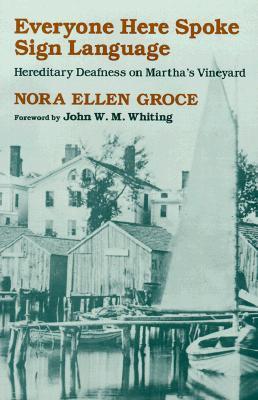
Everyone Here Spoke Sign Language: Hereditary Deafness on Martha’s Vineyard
From the seventeenth century to the early years of the twentieth, the population of Martha’s Vineyard manifested an extremely high rate of profound hereditary deafness. In stark contrast to the experience of most Deaf people in our own society, the Vineyarders who were born Deaf were so thoroughly integrated into the daily life of the community that they were not seen―and did not see themselves―as handicapped or as a group apart. Deaf people were included in all aspects of life, such as town politics, jobs, church affairs, and social life. How was this possible?
On the Vineyard, hearing and Deaf islanders alike grew up speaking sign language. This unique sociolinguistic adaptation meant that the usual barriers to communication between the hearing and the Deaf, which so isolate many Deaf people today, did not exist.
On the Vineyard, hearing and Deaf islanders alike grew up speaking sign language. This unique sociolinguistic adaptation meant that the usual barriers to communication between the hearing and the Deaf, which so isolate many Deaf people today, did not exist.
169 pages, Paperback
Published January 1, 1985
Ratings & Reviews
Friends & Following
Create a free account to discover what your friends think of this book!
Community Reviews
Displaying 1 - 30 of 74 reviews

August 30, 2019
Imagine: a book about deaf people without a single deaf person interviewed. All 200+ interviewees that make the source material for this work are hearing. Can you imagine if a - say - white historian chronicled the experience of black people in the Bronx and only interviewed their white neighbors?
That this is considered the "gold standard" for "ethnohistories" belies a fundamental flaw with the field itself.
The subjects are... well, subjected. This could never be published as such, today. And we are better for that fact. Read it if you're studying ethnography and its history. But don't read it to better understand deaf culture at Martha's Vinyard.
That this is considered the "gold standard" for "ethnohistories" belies a fundamental flaw with the field itself.
The subjects are... well, subjected. This could never be published as such, today. And we are better for that fact. Read it if you're studying ethnography and its history. But don't read it to better understand deaf culture at Martha's Vinyard.

February 1, 2012
The title of this book was misleading. I say that because it made me think that it was going to be a book full of anecdotal stories about deaf people on Martha's Vineyard and what life was like for them back in the "old days".
Instead, it was a very dry, scientific book full of data with just a few tiny anecdotal stories to illustrate the scientific points being discussed. It was really rather boring for me. It should have been given a more scientific name rather than one that makes you think you're going to read a bunch of personal stories.
Someone who has an interest in genetics and deafness may find this book interesting, though.
Instead, it was a very dry, scientific book full of data with just a few tiny anecdotal stories to illustrate the scientific points being discussed. It was really rather boring for me. It should have been given a more scientific name rather than one that makes you think you're going to read a bunch of personal stories.
Someone who has an interest in genetics and deafness may find this book interesting, though.

July 13, 2017
I first heard about this book on an NPR podcast, I think, but it was long enough ago that I forgot which one. It's about hereditary deafness on Martha's Vineyard during the seventeenth century, and how the community responded to their deaf neighbors.
This is not a book meant for popular consumption - Groce goes through ancestry and follows the recessive genes and there are lots of dense footnotes. Despite the academic language, its compact and to the point. What's really fascinating is how she follows the lineage of this particular village on Martha's Vineyard back to the forest in Kent: this small, isolated group of people (and their descendants) stuck together for hundreds of years, all the way across the Atlantic.
Because of this, they develop a society where deafness is hardly even remarked upon, and where the community at large is bilingual in sign language from birth. One of the most interesting things was how hearing people used sign language when no deaf people were around - when they were far apart on fishing boats, during church, when they wanted to tell the punch line of a dirty joke and womenfolk wandered in. Deaf people regarded their lack of hearing as just a nuisance, and became just as, or even more, successful as their counterparts. The whole book is framed as a discussion on the perception of disabilities.
This is not a book meant for popular consumption - Groce goes through ancestry and follows the recessive genes and there are lots of dense footnotes. Despite the academic language, its compact and to the point. What's really fascinating is how she follows the lineage of this particular village on Martha's Vineyard back to the forest in Kent: this small, isolated group of people (and their descendants) stuck together for hundreds of years, all the way across the Atlantic.
Because of this, they develop a society where deafness is hardly even remarked upon, and where the community at large is bilingual in sign language from birth. One of the most interesting things was how hearing people used sign language when no deaf people were around - when they were far apart on fishing boats, during church, when they wanted to tell the punch line of a dirty joke and womenfolk wandered in. Deaf people regarded their lack of hearing as just a nuisance, and became just as, or even more, successful as their counterparts. The whole book is framed as a discussion on the perception of disabilities.
July 17, 2010
The author really personifies the people (where many historical accounts treat them as characters or mere statistics) who used to live in the early Massachusetts colony, and I particularly like how she used her own research of the Islanders' oral history to reach back through time and grab onto the chain of Alexander Graham Bell's own research, and thus get very close to the beginning of the deaf population on Martha's Vineyard (she did not intend this, but rather found it only by happy coincidence, since Bell hadn't published the majority of his findings).
Another fortuitous aspect of the author's research was her timing- nearly half of her elderly informants (who lived while there were still deaf individuals on the Island) died within 2 years of her beginning the research! And in discussing the oral histories obtained from these elderly informants, she hints at the oral-historical value in cultures, such as the one present on Martha's Vineyard, that are willing to hash over old stories with contemporaries and use facts to zero in on the truth.
Towards the end of the book (pg 105) the author says, in regards to continuing issues with how we treat deafness in our society "A step toward fuller equality will be achieved when the society recognizes that much of what we think we know about "the deaf" and deafness is rooted in our own particular history and is not carved in stone." This statement is one of the many reasons I really enjoyed this book- replace "deaf" in that sentence with nearly any other issue we face, and it still holds quite true. I also enjoy that she both sees and states the broader implications of her research into deafness on Martha's Vineyard- that many societies have probably adapted to the disabled in equally inclusive ways, and that the tendency to only study modern Western society is probably greatly limiting our view of solutions to the problems faced by disabled in our society.
And props to the author for boiling down, often into a single sentence, research that probably took weeks to hunt down. There are far too many wordy non-fiction authors out there who need to realize that the point of this type of writing is to share information in a more succinct form than the original.
Random Facts I learned from this book:
This is the first time I learned that recessive genetic traits are caused by a single individual's mutation (who doesn't exhibit this trait) and that this trait only expresses itself when two of this person's offspring interbreed, somewhere down the line.
Finally I know where the expression "going down the cape " came from! (in nautical terms, traveling along decreasing longitudes towards Greenwich England is "going down" and traveling along increasing ones is "going up").
Another fortuitous aspect of the author's research was her timing- nearly half of her elderly informants (who lived while there were still deaf individuals on the Island) died within 2 years of her beginning the research! And in discussing the oral histories obtained from these elderly informants, she hints at the oral-historical value in cultures, such as the one present on Martha's Vineyard, that are willing to hash over old stories with contemporaries and use facts to zero in on the truth.
Towards the end of the book (pg 105) the author says, in regards to continuing issues with how we treat deafness in our society "A step toward fuller equality will be achieved when the society recognizes that much of what we think we know about "the deaf" and deafness is rooted in our own particular history and is not carved in stone." This statement is one of the many reasons I really enjoyed this book- replace "deaf" in that sentence with nearly any other issue we face, and it still holds quite true. I also enjoy that she both sees and states the broader implications of her research into deafness on Martha's Vineyard- that many societies have probably adapted to the disabled in equally inclusive ways, and that the tendency to only study modern Western society is probably greatly limiting our view of solutions to the problems faced by disabled in our society.
And props to the author for boiling down, often into a single sentence, research that probably took weeks to hunt down. There are far too many wordy non-fiction authors out there who need to realize that the point of this type of writing is to share information in a more succinct form than the original.
Random Facts I learned from this book:
This is the first time I learned that recessive genetic traits are caused by a single individual's mutation (who doesn't exhibit this trait) and that this trait only expresses itself when two of this person's offspring interbreed, somewhere down the line.
Finally I know where the expression "going down the cape " came from! (in nautical terms, traveling along decreasing longitudes towards Greenwich England is "going down" and traveling along increasing ones is "going up").

December 3, 2020
What a breath of fresh air to read about a society that adapts to the people that are present in that milieu! I loved reading the anecdotes of the old-timers (the only ones left who remembered when "everyone spoke sign language") and the picture it brought up of a bilingual community who used whichever language was appropriate for the circumstances and one in which the deaf were completely integrated. It's an older book but I'm so glad I was able to get a copy.

March 5, 2024
Such a unique, insightful story that gave me hope! I’m not typically a nonfiction reader, so I got a little bored by some of the history but could also appreciate the importance of it all for laying out the context so fully.
August 21, 2025
I spent at least a week every year from the ages of 1-18 going to Martha's Vineyard and now have the incredible privilege of spending two weeks there every two-ish years as an adult. My parents got married, my sister got married, my wife proposed to me - all on MV! The island is a part of me and my family's lives. As a hard of hearing person, this book introduced me to a part of the island that I was only vaguely familiar with. And this was published in 1985! The island has changed immensely since publication and I wonder if any remnants of it's deaf culture remain identifiably now, 30 years after Groce's research.
I was expecting this to be more of a narrative non-fiction and didn't realize it was someone's dissertation or thesis until reading! Once I realized I would be reading research, it took some time to adjust. Once I got past that, great book. Really interesting and made me feel even more connected to my favorite place.
I was expecting this to be more of a narrative non-fiction and didn't realize it was someone's dissertation or thesis until reading! Once I realized I would be reading research, it took some time to adjust. Once I got past that, great book. Really interesting and made me feel even more connected to my favorite place.
January 28, 2025
Big up The Social Model of Disability
(1970s language warning)
"On the mainland profound deafness is regarded as a true handicap, but I suggest that a handicap is defined by the community in which it appears"
"The Martha's Vineyard experience suggests strongly that the concept of a handicap is an arbitrary social category"
"The most important lesson to be learned from Martha's Vineyard is that disabled people can be full and useful members of a community if the community makes an effort to include them. The society must be willing to change slightly to adapt to all"
(1970s language warning)
"On the mainland profound deafness is regarded as a true handicap, but I suggest that a handicap is defined by the community in which it appears"
"The Martha's Vineyard experience suggests strongly that the concept of a handicap is an arbitrary social category"
"The most important lesson to be learned from Martha's Vineyard is that disabled people can be full and useful members of a community if the community makes an effort to include them. The society must be willing to change slightly to adapt to all"

August 12, 2018
The book was disappointing. Too much "heresay". Some contents were not true. I was surprised where the author found the information or just made up own story?
Not recommendation for reading.
Not recommendation for reading.

August 15, 2024
Beautiful, well-researched example of true inclusion.
Read
June 17, 2020Everyone Here Spoke sign language is an ethno history of the genetic disorder deafness. Groce conducted interviews and researched a very high concentration of deafness among a small population on Martha’s Vineyard. The unique thing about the community in which this disability took place is that the community itself changed to meet the needs of the disabled. Everyone in the community spoke sign language, and therefore since communication was one of the main barriers of success into a community, the deaf on Martha’s Vineyard were able to become fully functional members of society. Groce uses the aid of written records, oral history, and research about the unique strand of island deafness to paint her picture of what is was like in this unique community. A “handicap is defined by the community” is an argument she makes, and I personally think, the example she explores on Martha’s Vineyard gives that argument validity. Groce not only explores the reasons that the deafness was treated with such encouragement, but how it almost ceased to be a handicap at all.
This work made me think directly to the performance we experienced at Dreamland Arts. Her vision to raise awareness and integration for people with disabilities in the community is something I see as a large societal need. Currently at Wilder with our mobile lab we have no adaptive equipment, which means that members of our community with disabilities are unable to participate. We teach elderly who can have physical barriers to working with the computer, and finding a way for them to participate with the use of only one hand for example is something that is always an element to our classes. I would hope that there could be larger societal changes to integrate people with disabilities into communities, and more specifically I hope that we can serve people who have different abilities at Wilder and in AmeriCorps.
The book integrates information on deafness not only in the Martha’s Vineyard community, but also juxtaposes it with deafness in larger society. There is a small allusion to how this could translate to larger society, but those arguments are not found here. I would recommend this work if you are interested in learning more about certain aspects of the deaf community, or in general the possibilities of how disabilities or perceived within a society, and an example of how a community almost eliminated a disability socially.
This work made me think directly to the performance we experienced at Dreamland Arts. Her vision to raise awareness and integration for people with disabilities in the community is something I see as a large societal need. Currently at Wilder with our mobile lab we have no adaptive equipment, which means that members of our community with disabilities are unable to participate. We teach elderly who can have physical barriers to working with the computer, and finding a way for them to participate with the use of only one hand for example is something that is always an element to our classes. I would hope that there could be larger societal changes to integrate people with disabilities into communities, and more specifically I hope that we can serve people who have different abilities at Wilder and in AmeriCorps.
The book integrates information on deafness not only in the Martha’s Vineyard community, but also juxtaposes it with deafness in larger society. There is a small allusion to how this could translate to larger society, but those arguments are not found here. I would recommend this work if you are interested in learning more about certain aspects of the deaf community, or in general the possibilities of how disabilities or perceived within a society, and an example of how a community almost eliminated a disability socially.

January 18, 2022
Did you know Martha’s Vineyard had a large deaf population as early as the 17th century and into the 20th? I didn’t, which is why I picked up this book. It describes the hereditary deafness in this community, which likely came from marriages that shared a common ancestor with this very specific, recessive gene. Small island!
The best part about this book is that it describes a community where all hearing members learned sign language as soon as they learned a spoken language, and it was incorporated into daily life with ease. Groce interviews older islanders, who are the only ones left who remember how integrated the community once was. She describes the whole community’s comfort with both languages and how they code-switched often. Even decades later, when the younger population no longer spoke sign language, older members would still find themselves signing while speaking. The unfortunate thing about this book (and Groce’s research) is that it was done so late that the entirety of the island’s deaf population had died. Though the population was big in the beginning of the 20th century (and earlier), the decline of the whaling industry and the popularity of mainland schools for deaf children led to more off-island marriages, which meant fewer marriages with a common ancestor who had that recessive gene.
The last deaf person on the island died in the ‘50s. Groce wrote this book in 1985. In fact, she mostly speaks with hearing people who *knew* members of the deaf population. If you wanted to write this book today, you couldn’t. Groce says that half of her sources had died by the publication of this book (she began research 6 years prior to publishing). It’s a shame that the account isn’t firsthand from deaf people, but apparently there is little research about this community, so I guess it’s better than nothing. Also because it was written in 1985, there’s a bunch of outdated terminology. I wouldn’t recommend reading it because it really was a lot of research. GOOD RESEARCH, but dense and more information about the Puritans than I ever want to read again. Anyways, it’s a really cool bit of history! And now you know!
The best part about this book is that it describes a community where all hearing members learned sign language as soon as they learned a spoken language, and it was incorporated into daily life with ease. Groce interviews older islanders, who are the only ones left who remember how integrated the community once was. She describes the whole community’s comfort with both languages and how they code-switched often. Even decades later, when the younger population no longer spoke sign language, older members would still find themselves signing while speaking. The unfortunate thing about this book (and Groce’s research) is that it was done so late that the entirety of the island’s deaf population had died. Though the population was big in the beginning of the 20th century (and earlier), the decline of the whaling industry and the popularity of mainland schools for deaf children led to more off-island marriages, which meant fewer marriages with a common ancestor who had that recessive gene.
The last deaf person on the island died in the ‘50s. Groce wrote this book in 1985. In fact, she mostly speaks with hearing people who *knew* members of the deaf population. If you wanted to write this book today, you couldn’t. Groce says that half of her sources had died by the publication of this book (she began research 6 years prior to publishing). It’s a shame that the account isn’t firsthand from deaf people, but apparently there is little research about this community, so I guess it’s better than nothing. Also because it was written in 1985, there’s a bunch of outdated terminology. I wouldn’t recommend reading it because it really was a lot of research. GOOD RESEARCH, but dense and more information about the Puritans than I ever want to read again. Anyways, it’s a really cool bit of history! And now you know!

September 10, 2022
I had been really looking forward to this book but it ended up being a disappointment. I was quickly surprised to learn that the book didn’t contain any interviews with the deaf community that had lived on the island. That was the first strike. I couldn’t believe that this book could purport to center on the lives of deaf people and not even include what those deaf people themselves thought or experienced. I was the author extrapolated using the interviews of neighbors or family members. To top it off, this short book has very few of those interviews to begin with, concentrating too heavily on explaining how the author conducted the research without enough follow through that would have allowed readers to see the summation of this effort. I also took issue with the discussion of the Native American community on the island. Despite the author’s promise that this community played an important role on the island, they were hardly ever mentioned. The book lacked a critical eye to how relations may have occurred between the two groups, particularly in the history of white settlers moving onto that land. While that might not have been the explicit focus of the book, it left the section on the island’s history incomplete and inadequate. In general, I found the book to be outdated, particularly in its language and its perspective on disabled people. I liked reading about a group of people that all adapted to differences, rather than ostracizing or forcing others to change for them. I’m still uncertain what the deaf community felt about their lives there, but the concept is rather hopeful. I found the genetics section somewhat interesting and I liked learning about what influenced the development of ASL, but this book is not really useful other than that.

June 12, 2018
The story itself was interesting, I really loved how the people of Martha's Vineyard completely took control of the social construct of disability (is it obvious I read this for my ASL class? haha) and made it possible for me to imagine a world where Deaf people aren't considered disabled. That's exactly what makes being deaf a "disability", it's the inability to communicate AND the lack of aid that hearing people are willing to give to deaf people so that their lives may be easier.
Be that as it may, it took at least half of the book to get to anything remotely interesting. Sheesh. I was interested in why there were so many Deaf people on Martha's Vineyard at the time, but 75 pages wasn't needed to explain that. And that's exactly what Groce did. The first 75+ pages definitely read more like an anthropological essay as opposed to... something that would catch my interest. So for that reason, I took my rating down to three stars. Had it just been anecdotal stories and maybe some facts here and there for more background information, this would've definitely been a five-star book. But it just didn't do it for me. I spent way too much time yawning.
Be that as it may, it took at least half of the book to get to anything remotely interesting. Sheesh. I was interested in why there were so many Deaf people on Martha's Vineyard at the time, but 75 pages wasn't needed to explain that. And that's exactly what Groce did. The first 75+ pages definitely read more like an anthropological essay as opposed to... something that would catch my interest. So for that reason, I took my rating down to three stars. Had it just been anecdotal stories and maybe some facts here and there for more background information, this would've definitely been a five-star book. But it just didn't do it for me. I spent way too much time yawning.

October 28, 2021
I read a children's book a few years ago that dealt with the deaf communities on Martha's Vineyard, and that book (Show Me a Sign) led me here to learn more about the science behind the hereditary deafness that once was very prevalent in communities throughout the island. It's an old book, but since the last person from this community died in the 1950s, this was the last chance to get an oral history written. Very interesting if you are are into learning about lesser-known history and communities.
June 18, 2010
A great quick read about the high proportion of deaf people living on Martha's Vineyard from the 1700s to the early 1900s. The author takes an in-depth looks at the communities roots, and how that fostered an environment of shared responsibility concerning communication. This was a fascinating look at the chain of events and cultural/historical/genetic phenomenon that lead to almost an entire island of people thinking nothing of English-sign language bilingualism amongst the hearing and deaf alike.

January 11, 2008
It's my dream that everybody here would sign, too. It wasn't a dream in Martha's Vineyard because it did happen. Ironically, I went there two years ago or so and asked around for information about this book. Not one person at any store or museum on that island knew of this book or a story such like this! How sad to know it is completely extinct to the mind of today's people on that very same island :(

January 14, 2016
This took me awhile but still a good read-although it was like reading a thesis paper I still learned a lot from the book. I really enjoyed the last chapter -how Martha's Vineyard could prove that the term handicap can be redefined
It seemed like a great place to live-I wish my grandparents, their friends, my students, family as I could have experienced it!
It seemed like a great place to live-I wish my grandparents, their friends, my students, family as I could have experienced it!
March 26, 2020
I watched a YouTube video as part of my ASL101 course that showed this book and got me interested in it. I hunted it down in the college library. It is a very interesting book on the history and facts of the Deaf population of the island of Martha's Vineyard. Would definitely recommend that any ASL and Interpreter students give it a read!
July 17, 2017
A great read, Nora E Groce introduces you to Martha's Vineyard and it's communities like no other.
December 28, 2017
Incredibly thorough research of a unique and fascinating linguistic community.

August 1, 2018
This was a really fascinating read.

October 26, 2018
I read this after a recent trip to the Vineyard. It was quite interesting. In parts it's a little too analytical, but overall very interesting.

August 5, 2023
I had bought this book because, as a Deaf person from Kent, i had been told about a little about this story & wanted to know more.
I was pleased to see the author noting that the Deaf vinelanders did not consider their lack of hearing as a disability & further pleased to see the hearing amongst them shared that sentiment.
In a time where i am seeing more & more Deaf people, especially the younger generation, considering themselves as disabled as opposed to a cultural & linguistic minority, stories like this give me a little bit of hope for the future & comfort in my own identity.
I am somewhat puzzled as to negative reviews complaining that the author did not interview any Deaf vinelanders. This would be somewhat difficult as they are all gone or have passed away.
The important thing is the author made clear in this book that being Deaf in a hearing society does not engender physical or medical difficulties, it is a language barrier.
Their lives were not of a lesser quality because they could not hear, they were equal to their hearing counterparts because most could use sign language.
This is a message that is in stark contrast with many prominent & contemporary "Deaf" accounts who throw away the idea of a culture or language & label themselves (as well as everyone else, frequently, who gave them that right??) as disabled.
This book was a breath of fresh air for me
I was pleased to see the author noting that the Deaf vinelanders did not consider their lack of hearing as a disability & further pleased to see the hearing amongst them shared that sentiment.
In a time where i am seeing more & more Deaf people, especially the younger generation, considering themselves as disabled as opposed to a cultural & linguistic minority, stories like this give me a little bit of hope for the future & comfort in my own identity.
I am somewhat puzzled as to negative reviews complaining that the author did not interview any Deaf vinelanders. This would be somewhat difficult as they are all gone or have passed away.
The important thing is the author made clear in this book that being Deaf in a hearing society does not engender physical or medical difficulties, it is a language barrier.
Their lives were not of a lesser quality because they could not hear, they were equal to their hearing counterparts because most could use sign language.
This is a message that is in stark contrast with many prominent & contemporary "Deaf" accounts who throw away the idea of a culture or language & label themselves (as well as everyone else, frequently, who gave them that right??) as disabled.
This book was a breath of fresh air for me

January 20, 2026
The first half of the book is strictly history and not written in a particularly interesting way. I also strongly disliked her use of footnotes. Often she wouldn't go more than a sentence or two without adding a footnote and when I looked up the footnote it was at least a paragraph or two, occasionally spanning more than an entire page. Very early on in the book I learned to just keep two bookmarks the whole time, one for my actual place in the main text, and the second one over in the footnotes for when I would inevitably have to turn to read essentially another book within a book. I don't see why she didn't just put those footnotes in the text itself for convenience sake.
Unless you have an absolute fascination for esoteric history (dates piled on top of more dates, names, and locations with little else in between), the first 50 or so pages are quite dry. It is apparent that the author did a great deal of work researching and interviewing people to try to get as much history and facts surrounding the island. As a result the book read very much like a textbook or a long essay. I have a deep interest in Deaf culture and history and I found the book difficult to get through. I wish it was recounted in a more immersive style. I still give it three stars though because I appreciate getting to see an account of a society that wholly accepts the Deaf community. It's given me a goal to mentally strive for.
Unless you have an absolute fascination for esoteric history (dates piled on top of more dates, names, and locations with little else in between), the first 50 or so pages are quite dry. It is apparent that the author did a great deal of work researching and interviewing people to try to get as much history and facts surrounding the island. As a result the book read very much like a textbook or a long essay. I have a deep interest in Deaf culture and history and I found the book difficult to get through. I wish it was recounted in a more immersive style. I still give it three stars though because I appreciate getting to see an account of a society that wholly accepts the Deaf community. It's given me a goal to mentally strive for.

October 3, 2024
From the 1600s to the early 1900s, the small island communities on Martha’s Vineyard, secluded from much of the outside world, experienced a rate of hereditary deafness that far surpassed any other known locale. There, unlike most of the rest of the country, the deaf were perfectly assimilated into the social structure of the towns, due to their high population in the communities. Everyone spoke sign language.
I heard about this historical phenomenon (okay, the shared and re-shared familial genes wasn’t so much of a phenomenon back in those days, but - ) – the sheer numbers of non-hearing, and the fact that sign language was at one time as easily expressed as the oral word. I’d read a short article and was intrigued, so I researched and bought the book. Honestly, I should have stopped with the article. This was the driest, most doctoral-dissertation list of names and charts and numbers and figures and almost no stories ever. There is hardly any narrative to tie the rambling lists together, and most of the stories are foggy recollections of almost centenarians, remembering characters from their childhood years, who themselves were old. This was tedious and just an absolute chore to get through.
I heard about this historical phenomenon (okay, the shared and re-shared familial genes wasn’t so much of a phenomenon back in those days, but - ) – the sheer numbers of non-hearing, and the fact that sign language was at one time as easily expressed as the oral word. I’d read a short article and was intrigued, so I researched and bought the book. Honestly, I should have stopped with the article. This was the driest, most doctoral-dissertation list of names and charts and numbers and figures and almost no stories ever. There is hardly any narrative to tie the rambling lists together, and most of the stories are foggy recollections of almost centenarians, remembering characters from their childhood years, who themselves were old. This was tedious and just an absolute chore to get through.
September 26, 2026
A fascinating account of a small community in Martha’s Vineyard that was home to an unusually high percentage of deaf people whose origin can be traced to a certain county in Kent, England - all sharing common ancestors and a genetic pool that resulted in what is known as hereditary deafness (caused by a recessive gene which means that the physical trait only appears when an individual inherits two identical copies of it—one from each parent). For centuries they lived and thrived as part of a fully integrated community of hearing and non hearing members, that worked together, bonded in marriage, worshiped together and naturally communicated with each other in sign language. Hearing members of the community were fully bilingual and accepted deafness as a natural variation - as one would describe difference in eye color or height. A true model of inclusion that inspires and raises interesting questions about what constitutes a disability- is it the physical attribute itself or the social stigma and “othering” which comes with it?

February 19, 2021
While this book charms its reader with unique accounts of the island and its many Deaf inhabitants of yesteryear, it at times bores with the explanation of the island’s economy and timelines/family trees. Part sociological exploration, part transcription of oral histories, this book is only as limited as the officially recorded histories of the people it attempts to cover. What is, however, unearthed and included of the subject — between the unnecessary accounts of the “informants” who seem to just be happy to be interviewed — is a striking and almost unbelievably utopian account (in contrast to today’s experiences) of a sizable sect of society where Deaf people were included by default and not seen as disabled or unable to contribute to anything. For that alone, this book is a must read for anyone remotely interested in American Sign Language and Deaf/HoH culture, and the varying response people have historically had to those subjects.

June 8, 2025
Since my family generations can be traced to Norfolk/Kent, this academic book talked about almost everyone in Chilmark and West Tisbury in Martha's Vineyard using sign language to communicate with each other mainly because there were too many Deaf residents due to the recessive genetics throughout many generations. That particular sign langue is known as Martha's Vineyard Sign Language (MVSL) which was confirmed to merge with French Sign Language (LSF) brought by Laurent Clerc to Hartford, Connecticut which he and Thomas Hopkins Gallaudet founded a deaf school - that MVSL and LSF merged and became what? American Sign Language (ASL).
Today, it is too bad that Martha's Vineyard is filled with wealthy residents and visitors - taking our Deaf history away as well.
Today, it is too bad that Martha's Vineyard is filled with wealthy residents and visitors - taking our Deaf history away as well.
July 1, 2021
The history around the topic of how American Sign Language came about is so interesting. This is one of the main books to help in that understanding. I enjoyed it and it was not a dry fiction book at all! It excites me to thin that there could be a culture that includes rather than excludes people because of their differences. The story of Martha's Vineyard and the deaf community is really amazing.
Displaying 1 - 30 of 74 reviews