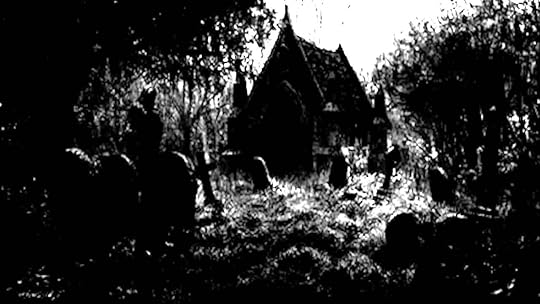
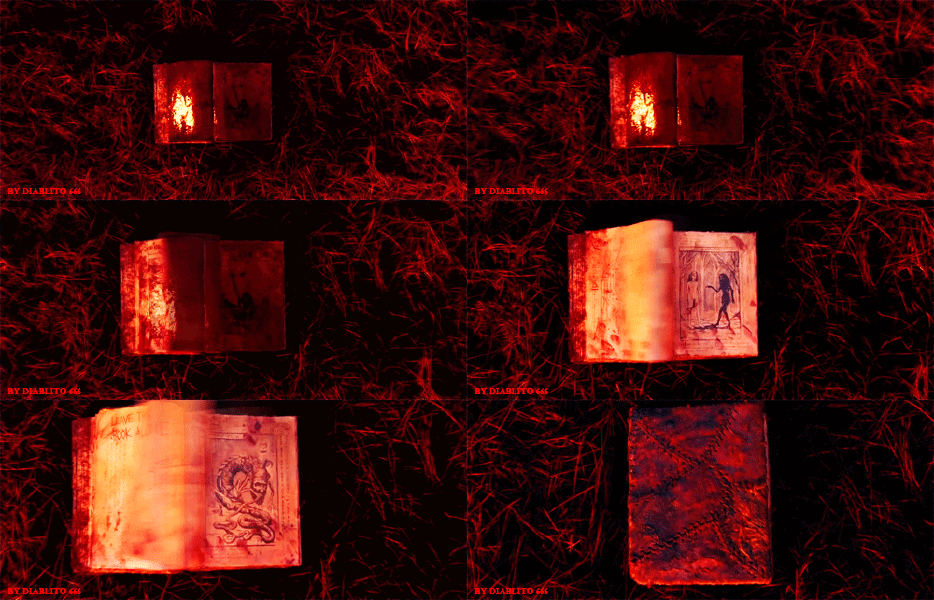
"The Hound" is a short story written by H. P. Lovecraft in September 1922 and published in the February 1924 issue of Weird Tales. It contains the first mention of Lovecraft's fictional text the Necronomicon, The story focuses around the narrator and his friend St. John, who have a deranged interest in robbing graves. They constantly defile crypts and often keep souvenirs of their nocturnal expeditions. Since they reside in the same house, they have the opportunity to set up a sort of morbid museum in their basement. Using the objects they collect from the various graves they have robbed, they organize the private exhibition. The collection consists of headstones, preserved bodies, skulls, and several heads in different phases of decomposition. It also included statues, frightful paintings, and a locked portfolio bound in tanned human-skin.
Howard Phillips Lovecraft, of Providence, Rhode Island, was an American author of horror, fantasy and science fiction.
Lovecraft's major inspiration and invention was cosmic horror: life is incomprehensible to human minds and the universe is fundamentally alien. Those who genuinely reason, like his protagonists, gamble with sanity. Lovecraft has developed a cult following for his Cthulhu Mythos, a series of loosely interconnected fictions featuring a pantheon of human-nullifying entities, as well as the Necronomicon, a fictional grimoire of magical rites and forbidden lore. His works were deeply pessimistic and cynical, challenging the values of the Enlightenment, Romanticism and Christianity. Lovecraft's protagonists usually achieve the mirror-opposite of traditional gnosis and mysticism by momentarily glimpsing the horror of ultimate reality.
Although Lovecraft's readership was limited during his life, his reputation has grown over the decades. He is now commonly regarded as one of the most influential horror writers of the 20th Century, exerting widespread and indirect influence, and frequently compared to Edgar Allan Poe. See also Howard Phillips Lovecraft.
"Wearied with the commonplaces of a prosaic world, where even the joys of romance and adventure soon grow stale, St. John and I had followed enthusiastically every aesthetic and intellectual movement which promised respite from our devastating ennui." So begins this tale of Lovecraft horror. Most unfortunately, how to deal with ennui, that is, one’s boredom, has been a huge, huge ongoing issue in the West, particularly in the last two hundred years.
To underline this point, there is hardly a novel written in nineteenth century Europe where at least one character doesn’t have an issue with their "devastating ennui." And the narrator in this Lovecraft tale who suffers from boredom complains of the "commonplaces of the prosaic world." A question we could pose: My good man, is the world really as commonplace, dull and prosaic as you make it out? Perhaps, sir, this dullness has nothing to do with the world but everything to do with your deadened perceptions, jaded worldview and dreary, lackluster mental state.
This gentleman and his aristocratic partner turn to aesthetics for a possible cure: "The enigmas of the Symbolists and the ecstasies of the pre-Raphaelites all were ours in their time, but each new mood was drained too soon of its diverting novelty and appeal. Only the somber philosophy of the Decadents could hold us, and this we found potent only by increasing gradually the depth and diabolism of our penetrations. Baudelaire and Huysmans were soon exhausted of thrills."
From the narrator’s tone, it sounds like they have been pondering Charles Baudelaire’s The Flowers of Evil, with such lines as: "Just like an angel with evil eye/ I shall return to thee silently/ Upon thy bower I'll alight/ With falling shadows of the night" and Joris-Karl Huysmans’s Là-Bas (Down There), a novel of Satanism, sadism and torture. The narrator tells us when it comes to reading these Decadents, he is "exhausted of thrills." Ha! To envision literature as a kind of top ten roller-coaster ride, a way to get your kicks and jollies. These works of Baudelaire and Huysmans could be infinitely rich and enlivening if one reads with creative engagement rather than placing the onus on the author to provide you, the reader, with a series of unending thrills.
Such a jaded sense of the world can have, especially in a Lovecraft tale, horrifying consequences. The narrator continues: "Until finally there remained for us only the more direct stimuli of unnatural personal experiences and adventures. t was this frightful emotional need which led us eventually to that detestable course which even in my present fear I mention with shame and timidity—that hideous extremity of human outrage, the abhorred practice of grave-robbing.”
Well, my goodness! Our engagement with a work of art or literature can be uplifting, inspiring, even transforming but such vital experiences according to aestheticians like Kant, Shelling and Schopenhauer are part of life’s fabric not the totality of life. Gentlemen, please, accept the natural flow of being alive - no need to go grave digging! On a somewhat humorous note, I can just imagine Arthur Schopenhauer and Immanuel Kant, shovel in hand, on a moonlight night, digging up a grave.
And the narrator provides us with a glimpse of his exploring the nuances of a new form of highly original, highly refined performance art. “The predatory excursions on which we collected our unmentionable treasures were always artistically memorable events. We were no vulgar ghouls, but worked only under certain conditions of mood, landscape, environment, weather, season, and moonlight. These pastimes were to us the most exquisite form of aesthetic expression, and we gave their details a fastidious technical care.” Well, if you are going to dig up corpses in a graveyard, please devote loving care and heightened attention to each step, embellishing every spadeful of dirt with a distinctive flourish as if you are performing on oboe or violin!
Lovecraft’s flair for creating metaphor and turn of phrase in the lavish style of high baroque, employing ornate, highly polished language, is most befitting for the ghoulish, chilling events that transpire in this gruesome tale. The narrator goes on to describe the details of his newly conceived subterranean museum, monstrous and unspeakable, an entire museum constructed to house his infernal graveyard bounty. But, there came a time, our artist of the diabolical haltingly confesses, in a Holland graveyard, when the wheel of nocturnal fortune took a decidedly bad turn.
Any aesthetic satisfaction the two British grave-robbers received in their past grisly undertakings is transformed into disorientation and terror once they pilfer a particular amulet from a most peculiar Dutch coffin. Alarm, dread, apprehension, horror and impending doom become their constant companions. Indeed, every horrifying hour of every ensuing day, including a number of unexpected, violent, harrowing deaths, leads our narrator to the decision he notes in the first sentences of his tale: he is about to put a revolver to his head to blow out his brains.
One evening, in September of 1922, H.P. Lovecraft visited a Brooklyn graveyard and took a souvenir home with him, a small chip from a tombstone dated 1747. Later, he began to muse, in a letter: “what thing might not come out of the centuried earth to exact vengeance for his desecrated tomb? And should it come, who can say what it might not resemble?” This short story, first published in Weird Tales in 1924, is the result of these musings.
Although it is not one of Lovecraft’s best, it is notable for a few reasons: 1) Like “Herbert West,” it is one of H.P.’s rare attempts at deliberate humor (if you don’t believe it is deliberate, just count the number of times H.P. repeats the old Baskerville cliché, a “gigantic hound”), 2) it is the only instance where the author chooses to make his heroes Huysman-style decadents, complete with crippling ennui, a collection of degenerate art, and their very own “perfume organ”, and 3) it is the first recorded mention of the Necronomicon.
Lovecraft later termed it a “piece of junk,” but that is a rather harsh condemnation. It is obvious that the author had a good time writing it, and I bet you have fun reading it too.
Fast paced and extreme tale of horror! Two friends, interested in everything sinister and macabre, have an occult museum in the lowest basement of their house. When they rob an ancient amulet from the grave of a magician strange things occur. They hear the baying of a great dog and St John (one of the friends) is torn to pieces by an eerie vulture like creature. Will his friend survive? Will the hauntings end when he gives back the amulet? Here we have all ingredients for a great horror story: uncanny objects, body snatching, demons and the reference of The Necronomicon of the mad Arab Abdul Alhazred. This story goes bump in the night. Absolutely recommended!
A pair of rather naive and harmless "decadents" whose main kink seems to digging up and collecting bits of dead bodies rob the wrong grave. A.... wait for it.... DUTCH grave! You know those Dutch and their cursed jade figurines and slavering ghouls. I mean, you read the Necronomicon, right? It definitely warns you about Holland. Er, wait, that warning was about jade amulets. Or was it dogs? Anyway, this was obviously a poorly planned vacation and SOMETHING EVIL follows St John and his pal back to their isolated ancient manor-house on a bleak and unfrequented moor where they hang out servantless like a couple of poser goth kids admiring their skull collection and pretending to worship demons without expecting to ever raise one for real.
4 stars is maybe a touch too generous but if you give up expecting horror this story is quite funny and contains winks to Poe, Doyle, Bierce et al writers HPL enjoyed.
"Madness rides the star-wind . . . claws and teeth sharpened on centuries of corpses . . . dripping death astride a Bacchanale of bats from night-black ruins of buried temples of Belial. . . . Now, as the baying of that dead, fleshless monstrosity grows louder and louder, and the stealthy whirring and flapping of those accursed web-wings circles closer and closer, I shall seek with my revolver the oblivion which is my only refuge from the unnamed and unnamable."
"¡Que perdone el cielo la locura y la morbosidad que atrajeron sobre nosotros tan monstruosa suerte!"
La estupidez adolescente y las leyendas se combinan para crear una historia excelente, donde queda claro que cada acción deja consecuencias y que las criaturas creadas por Lovecraft trascienden su época, además de la influencia que han tenido escritores de culto en el autor. Una excelente historia para adentrarse en el estilo del autor, pero no todavía en su mitología.
Why should any horror story lover read The Hound? Because it marks the first appearance of one of Lovecraft's most famous literary creations—the forbidden book known as the Necronomicon! MWA HA HA!!!
The Hound is one of the weirdest and longest suicide letters I've read. Told in the first person by an unnamed narrator, it is a story of the last days of the two friends who were trying to beat the boredom. After a very long search, they turned to macabre and eventually the quest to end their 'devastating ennui' led them to grave robbing.
I haven't read Lovecraft for months and I had forgotten the beauty of his prose. He wrote an excellent piece here (thank you again to Glen Russel for his review!). Lovecraft writes with power to transpose your reality into a new one. His descriptions create a world of damp darkness and ascending terror. The character in the story made me remember my desire to see Indiana Jones and The Call of Cthulhu. This story extends the story of the Necrononicon. Grave robbers, lusting for secret knowledge, take an amulet from an ancient grave, stealing from of figure, a sphinx with wings and the face of a Hound. When he goes home with his assistant, phantom sounds haunt him. His assistant gets shredded to death, as if by a Velociraptor. Children die, and these events parallel the echo of a howling hound. I found this entertaining and delightful.
This ghastly tale of two tomb raiders marks the very first appearance of Lovecraft’s infamous forbidden book, Necronomicon.
Two seemingly low life robbers, St. John and the narrator, who shares this vile interest in defiling centuried graves for logical pelf, goes to Nether–lands (literally!) to excavate/rob an ancient ghoul. Though the nocturnal expedition is repeatedly disturbed by background bayings of a hound, they unearth an old jaded amulet (semi canine faced) with sinister inscriptions that can be traced to those of old Arab daemonologist, Abdul Alhazred. Pulling it from the eerily fresh and torn carcass of ghoul, they flee home with the souvenir. With it came strange sounds and happenings.
Narrative took a turn from there, at least for me. Initial reluctant first person account suggested the grave excavations not being a profession of choice, but lack of options. But, as story progressed the complex and perverse nature of narrator and St. John’s relationship brought a new outlook to the happenings. For once, the narrator felt somewhat reliable to me. Though their deeper obsession towards occult and their own recluse cult of necrophilia suggested otherwise, I was inclined to read them with Lovecraft’s life and company(thanks to Paul La Farge’s Night Ocean); and to focus more on ‘material constants’ of the story than perceptions of narrator. Also it would be safe to admit that much of my thoughts changed after finishing the story.
The ending, now that I think back, shared a strong resemblance with my first lovecraftian tale ‘The Dagon‘ and I couldn’t help but read it along with his opening line from The Call of Cthulhu, “The most merciful thing in the world, I think, is the inability of the human mind to correlate all its contents“. The more I thought about the hound, the more it started to appear like the proto bed rock for modern cursed artefact adventures (ignoring the crude morale and admitting the weak comparison) from Indiana Jones to Nathan Drake and I began to form a vampirish interpretation of the same.
Nevertheless, terror inscribed in the writing made the story all the more atmospheric if not a bit Poe-esque. Or like Howard might say, ‘it’s a charnel premise of abhorrence and cosmicism‘.
Just because an HPL story is short doesn't mean it's easy. Clocking in at just under 3000 words, The Hound gives us tongue-twisters like 'illimitable' and the wonderful 'cacodaemonical' along with the Symbolists, the pre-Raphaelites, and Goya; not to mention Baudelaire and Huysmans.
Baudelaire and Huysmans? I told you not to mention them!
I'd like to say 'all joking aside', but I don't see how you can treat this as anything other than a joke. A wonderfully told joke, but a joke all the same.
Two guys grow bored with their normal everyday decadent pursuits and decide to turn to something even more so -- namely grave robbing -- in the course of which they steal an amulet from from the corpse of a rumored bad man, after which they are haunted and pursued by a baying sound. Eventually one gets torn to pieces and the other, the narrator, decides to off himself.
The plot is nothing original -- at least by today's standards. It's been done to death. By maybe in HPL's time it was fresher. What saves it the way he lays it on thick with atmosphere and imagined feelings of fear, although the hound itself is never seen. Something is seen at one point, but in no way does it resemble a hound, so maybe it's a metaphor predating Elvis' song 'Hound Dog'. HPL and Elvis. Now there's an image to conjure with.
Anyway, it's not bad. Nor is it particularly good. HPL wrote much better stuff than this and a few things that were worse. If you're an HPL fan you'll like it. If you're not a fan, this is not the one you'd want to start out with.
‘The Hound’, published in 1924, is the second extremely explicit horror story by H. P. Lovecraft I’ve read so far, the first being Herbert West—Reanimator. It is as explicit in the telling as many current horror movies today are in the showing of awful disarticulations of human bodies! The bodies which the narrator and his friend are tearing apart for souvenirs are already dead, having been buried in graves in cemeteries. Unfortunately for our antiheroes, while indulging themselves with robbing from graves parts of bodies and objects that had been buried along with the dead, they accidentally wake up something which decides to follow them around!
I have copied the book blurb:
”The Hound" is a short story written by H. P. Lovecraft in September 1922 and published in the February 1924 issue of Weird Tales. It contains the first mention of Lovecraft's fictional text the Necronomicon.
The story focuses around the narrator and his friend St. John, who have a deranged interest in robbing graves. They constantly defile crypts and often keep souvenirs of their nocturnal expeditions.
Since they reside in the same house, they have the opportunity to set up a sort of morbid museum in their basement. Using the objects they collect from the various graves they have robbed, they organize the private exhibition. The collection consists of headstones, preserved bodies, skulls, and several heads in different phases of decomposition. It also included statues, frightful paintings, and a locked portfolio bound in tanned human-skin.”
Really truly ick-ick stuff, gentler reader, and a surprise to me. I am only now exploring Lovecraft stories in my 7th decade despite having heard a lot about this author previously throughout my life. I know he is considered one of the most influential writers of all time, having inspired many authors of horror today. Frankly, the other stories by Lovecraft had given me the impression his stories were primarily about several types of mysterious immigrants from space who are abhorrent monsters to human eyes. Some of these disgusting monsters are able to mate with human females which creates morally twisted mutants as a result. However, up to now, the stories about the visitors from space terrifying people have been written by Lovecraft in an antique English, using words which obscured actions. Lovecraft purposely wrote about violence and murders obliquely in these stories. But the gloves have come off in the last two stories I’ve read!
The space creatures which have been Lovecraft’s primary interest in writing about have extraordinary powers, including those of being able to live under the oceans around the world, living in underwater cities. Some of the types of space creatures are also able to create portals to alternate universes on Earth. Some narrators in Lovecraft’s stories are able to access these alternate universes through dreams. A lot of space creature horrors are amplified by the ability of these immigrant monsters to reach into human minds, especially if humans perform certain rituals and recite certain incantations, which call the monsters to the humans performing these horrific rituals. This is probably how the practices of the believers in matters of the occult began! At least this is the reality behind the horrors in the world building of Lovecraft’s stories.
All of these human/space immigrant/occult interactions were described in many of Lovecraft’s stories I have read previously by sideways antique language that obscured a lot of the resulting carnage and other horrors. But the stories I have been reading in the last few days, all published in the 1920’s, are as explicit as any modern novel in the horror genre today! Still, Lovecraft’s writing is continuing to be a unique voice, easily identifiable as a story written by H. P. Lovecraft!
(I am wondering if these two characters were part of the 19th-century Aestheticism Movement, a Victorian art idea of bored rich people, which decayed into a decadence of sensation seekers. I learned of the movement in Oscar Wilde’s novel, The Picture of Dorian Grey. https://en.wikipedia.org/wiki/Aesthet...)
Es un relato corto, la manera en cómo está presentado me gustó. La ambientación que le da, la descripción detallada de los lugares, lo que va sucediendo conforme avanza la trama, hace que se te pongan los vellos de punta y percibas lo que siente el narrador. Todo acto tiene una consecuencia y ese acto le costó caro a uno de ellos.
I only read this because the book I was reading kept mentioning it LOL. I guess I expected something that felt instantly groundbreaking to any uninitiated to Lovecraft but I felt no such thing. Had to do a little research to appreciate this more and I guess I do already. This is camp.
Una historia muy buena y escalofriante. Es de lectura rápida. Sin embargo, con solo esas pocas páginas te adentras a una historia de un par de amigos que tiene una colección de objetos muy raros y asquerosos, que, para ellos es sin duda, fascinante. Pero se encuentran con algo que marcara para siempre su existencia. Con un desenlace que caracteriza a Lovecraft es el Sabueso una terrorífica historia.
A cautionary tale upon the topic of avoiding charismatic young men named St. John, demonism, the Necronomicon, grave robbing, cursed jade amulets, stocking museums with artefacts stolen from graves, lonely moors, decrepit manors, solitude, dissipation, flocks of bats - and smoking (well actually not smoking...)
So, here I am sitting in a pub in the town of Battle in England, where I have just finished walking around a sheep filled paddock where almost 1000 years ago a bunch of Normans (or should I call them French because, well, they spoke French, though some people claim that Normans weren’t French) decisively beat the English and completely changed the course of history. However, I’m not going to talk about that, or any of the vignettes that I could come up with, but rather this short story.
It makes me wonder to what extent the author can change a story to make it a different story, even though the plot seems to be similar to other stories that I have read. Mind you, it has been a while since I’ve read a Lovecraft story, and I can’t really remember many of the ones that I read six months ago, let alone five years. Still, I vaguely remember something similar to this story.
Well, apparently it is the first mention of the book the Necronomicon and the guy who wrote it came from Central Asia. That I found interesting because Cthulu’s city is supposed to be located at the point of inaccessibility in the middle of the Pacific Ocean, so it seems that the author of the Necronomicon comes from what one could consider the opposite point of inaccessibility, namely the point of land that is the farthest point from any body of water, or at least from the oceans if you don’t count the Caspian Sea (which is an inland sea, so technically doesn’t count).
Anyway, this is a story about a couple of introverts, though I suspect that I am putting that lightly – I think recluse is a much better term to describe them. Anyway, they have this hobby of robbing graves (pretty macabre hobby, and I’m not quite sure if you can consider something that is technically illegal a hobby, though I guess you can refer to some guy who sells drugs as having a side hustle).
Well, as is the case with Lovecraft they dig up the wrong grave and steal the wrong treasure (why do D&D adventurers get away with robbing graves but everybody else doesn’t?) which results in a demonic hound coming after them. Mind you, that probably shouldn’t surprise anybody because, well, they are going around robbing graves so, like, what are you going to expect from them.
I guess the morale of this story is, don’t make a hobby out of robbing graves. Hell, I might as well say just leave the poor buggers in their graves and find somebody else that is more productive to society.
Absolutely loved it, this is maybe my favorite Lovecraft I’ve read so far. It’s so over the top, so packed full of cool shit, so campy and funny, and the final paragraph goes ridiculously hard. I can’t praise this one enough. I especially love that the evil whatever that’s after this guy doesn’t want to kill him so much as it wants to really fuck with his head and then just have a laugh at him while he has a total breakdown and offs himself. That’s a solid twist on the way this sort of story usually goes, I think.
Lovecraft wasn’t too keen on this one, he called it junk and a dead dog. I’m here to tell you Lovecraft was wrong. Like yes, this story is empty and silly and has very little to say and isn’t much more than a collection of cool things happening, but those cool things are more than entertaining enough to make up for any other shortcomings this story has. This one’s just a good time.
Funny how robbers always get shocked when the robbed person comes after them to get their stolen stuff back. Always remember kids: Stealing is bad, especially of somebody who is defenseless.
The story wasn't really scary to me and I didn't like the characters, but it was amusing to watch karma strike.
”In my tortured ears there sounds unceasingly a nightmare whirring and flapping, and a faint distant baying as of some gigantic hound.”
...and so begins “The Hound”, an incredibly written work by the legendary H.P. Lovecraft. This is probably my personal favourite of his works that I have so far read (I have read very little of Lovecraft, mind you), and it is without a doubt the most amazingly and compellingly stylistic. “The Hound” recalls Edgar Allan Poe more than other Lovecraft stories, featuring an atmosphere more categorized by the eerie and gothic than the weird and unbelievable; however, that is not to say that Lovecraft is merely copying Poe with this story, because the story still has Lovecraft written all over it. Lovecraft’s eccentricities help guide us through this swift downward spiral of a story that has more brilliance and chaos dropping from its opening paragraph than the entirety of most horror stories out there ever come close to having.
A (gay?) couple have a common interest in defiling graves and crypts. They often keep souvenirs from their nightly expeditions, and even have a small museum displaying the objects.
One night, they rob a certain grave in Holland. In the grave, there’s a skeleton with a jade amulette. In the distance, they can hear the howling of a hound.
Spoiler alert: The doggy (or whatever creature it is) is not the cuddly kind.
I like the total decandence in this story. And grave openings are actually pretty scary.
A bit over dramatic, even for Lovecraft, and told from the POV of an evildoer, which I think is unusual for Lovecraft, who tends to prefer narration from the POV of a neutral observer.