Set in Bratislava, Czechoslovakia, in the 1980s, Martin Simecka's stunning first novel, "The Year of the Frog, portrays a young man struggling to come to terms with his circumstances in the last days of communist dictatorship. Milan, the son of a former party official now imprisoned for dissident activities, is barred from the university despite the fact that he is a brilliant student and an extraordinary runner. Forced to work, Milan takes a series of menial jobs -- first as a surgical orderly in a hospital, next as a clerk in an under-stocked hardware store, lastly as an assistant in a maternity hospital for both births and abortions -- all of which serve to break open his life. Two great passions save him from the bleakness of his everyday existence: long-distance running, and his love for Tania, a beautiful university student from whom he seeks salvation and ultimately marries. "The Year of the Frog is a coming-of-age story, a romance, and a novel which poses important questions about life and death, about love and freedom, faithfulness and infidelity.
Martin M. Šimečka (1957) do roku 1989 patril do okruhu českého a slovenského disentu, pracoval ako kurič alebo ošetrovateľ v nemocnici a podieľal sa aj na vydávaní slovenského samizdatového časopisu Fragment K. V novembri 1989 bol členom vedenia hnutia Verejnosť proti násiliu, v roku 1990 založil vydavateľstvo Archa, kde pôsobil ako šéfredaktor do roku 1997, keď sa stal šéfredaktorom týždenníka Domino fórum. Neskôr bol šéfredaktorom denníka SME, šéfredaktorom a členom redakcie českého týždenníka Respekt a od novembra 2016 je komentátorom Denníka N.
Je autorom románu Džin, ktorý vyšiel aj v USA a vo Francúzsku, posledné slovenské vydanie vyšlo vo vydavateľstve Artforum v roku 2015. Kniha Světelná znamení vyšla v roku 1991 vo vydavateľstve Archa a v roku 2018 vo vydavateľstvo SALON a Martin M. Šimečka v nej komentuje listy, ktoré z väzenia rodine posielal jeho otec, filozof Milan Šimečka. V roku 2019 vydalo české vydavateľstvo Paseka knihu rozhovorov Kirilla Ščeblykina a Filipa Zajíčka s názvom Jsme jako oni (Rozhovor s Martinem M. Šimečkou o liberálech, pokrytcích a fašistech). V knižnej edícii Denníka N mu v roku 2017 vyšla kniha Medzi Slovákmi (Stručné dejiny ľahostajnosti od Dubčeka k Ficovi) a v roku 2020 Telesná výchova (Úvahy bežca, plavca, tenistu a jazdca na koni o pohybe, tele a mysli).
It’s 1980 in Czechoslovakia nearing the end of communist rule. The Velvet Revolution of 1989 is coming when student demonstrations will overthrow communism and the nation will elect a writer/journalist/poet/playwright as their President – Vaclav Havel – who wrote the Foreword to this book.
In our story, despite the waning influence of communism, the young man who is the main character is still subject to hassling by the authorities. He has to find a job or face arrest. He and his friends’ apartments get raided by the police who confiscate their books. He is friends with an elderly man who wants to burn all his writings and who tells the young man “get out while you can.” (At the time it was possible to emigrate, if you wanted to, by traveling first to another more open country, such as Poland.) His father is in prison for speaking out and writing against the government. So the son is forbidden from attending college. Thus he is condemned to life of menial jobs – at least until the political situation changes.
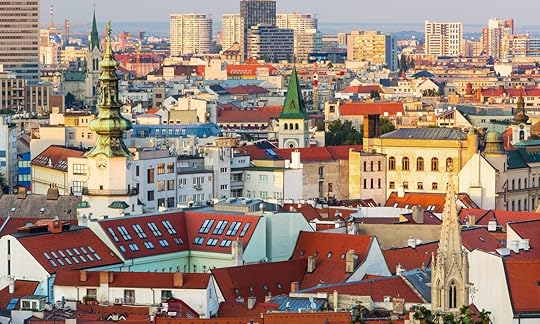
He runs almost every day, so he is well known to the police in Bratislava, the city that later became the capital of Slovakia. (The author is Slovak. He opposed the break-up of Czechoslovakia into two states, which occurred in 1995.) There’s a lot in the book about running and his body’s reaction to it. Is it normal to run so hard that your body gets chills, fevers, vision black-outs, vomiting, shakes, crying jags? These happen to him. He frequently runs out to the Red Bridge in Bratislava, which I found a picture of.
The main character, who is 23, loves his girlfriend. He thinks of saying all the right things to her but often can’t verbalize them. I think the main message of the book is that happiness is possible even within the grim world of communism. Or if not happiness, maybe some kind of normalcy? With his girlfriend he experiences his first feelings of jealousy when they take a trip to a vacation cottage with two men – she’s the only woman and they are both attracted to her.
Most of the work the young man does is as an orderly in a hospital. I suspected that this meant that a lot of the book would be a metaphor of illness for the cancerous quality of life under communism, as is true of many Eastern European novels of the time, but I don’t think that is true of this book. But I will warn that you have to have a strong stomach for some of the detailed medical procedures described: the gore of fingers digging through flesh for brain tumors; detailed descriptions of abortions and drilling through skulls. The young man gets attached to his patients, mourns them, and learns of death.
The young man’s mother is severely diabetic but uses her condition to get her way. She threatens suicide and gets sympathy for her self-induced comas. When she writes to her husband in prison (where he has lost 45 pounds and his teeth) there is role reversal from what you would expect. Her letters to him are such downers that he writes back to try to cheer HER up. On the phone “She switched to the sad tone of voice that she reserved for the family.”
There is some good writing and a few deep thoughts, some with a touch of humor:
“For life is strange. There are people who cannot make any sense of it, and I belong with them.”
“I’d rather not think of how wise I would be had I remembered a fraction of what people have told me in my life.”
“Anyway, all wisdom is nothing but shoulder straps that help us carry our cross.”
“At New Year’s I made a resolution to reflect on my life, but I soon learned again I should let such moods pass.”
I enjoyed the book despite a bit TOO much on the running and the medical stuff, but other than that it’s a good read.
Photo of Bratislava, Slovakia from static.independent.co.uk Photo of Bratislava's Red (railroad) Bridge from bratislavastory.com Photo of the author from img.cncenter.cz/
Dig the book. It's written in pretty plain prose, and if you get the Peter Petro translation it reads pretty smoothly. It's basically a tale about a young Czech man named Milan in love with a girl who studies at a university. He can't go to university himself because his father was a communist, and the Czech police are in effect making him pay for his father's sins. In attempting to deal with his frustration, he gets married, trades jobs, ends up in prison, has an affair...the whole nine yards. Probably my favorite scene in the book is when he confesses his affair to his wife, and she replies that "it doesn't concern her." He's stuck dealing with his guilt on his own; she won't give him the absolution from his "sins" that he desperately wants because she's not hurt in the slightest. The only thing preventing me from giving it five stars is the hospital gore. It's downright excessive. Lots of brain surgeries, abortions, and cesarian sections detailed. Lots too much. Ew. In retrospect, the juxtaposition of the brain & uterine surgeries in conjunction with his own musings emphasize Milan's constant questioning about the meaning of life and the definition of good and evil. It's interesting to read what goes on in his brain he's watching blood spurt from a patient as a doctor tries to remove a brain tumor. Nonetheless, Simecka is far too good at detailing the gore for my comfort. The skewed time frame also gets excessive...reminds me a bit of Woolf's writing.
Excellent, eindelijk weer een goede roman gevonden. Dank Luipaard!
« Het laatste jaar had ze geleerd zwijgzaam te zijn. Ooit vreesde ze de stilte, vreesde ze dat de liefde verloren ging in de stilte en daarom riep ze die voortdurend op met een spraakwaterval, de woorden waren de brug naar alles, ze vervingen zelfs het vrijen in de tijd dat we daar nog voor terugdeinsden. »
« Ongeluk heeft een speciale geur die mijn neusgaten prikkelt; zijn aanwezigheid verwar ik met niets anders. In tegenstelling tot het geluk dat me verdacht voorkomt omdat ik de geur daarvan meestal pas opmerk wanneer het al voorbij is en daarom zjn twijfels of het wel van deze wereld is, gerechtvaardigd. Ongeluk, pijn en angst daarentegen herken ik feilloos. Als ik ongelukkig en bang ben, weet ik dat ik besta. Die gevoelens zijn met een navelstreng verbonden aan het naakte bestaan. Ik jaag het ongeluk na als een jachthond, ik volg de sporen van hun dragers omdat ze het dichtst bij de naakte werkelijkheid staan en misschien hoop ik wel dat ze mij erheen brengen. »
« "Tanja?' zei ik en we verstarden allebei van verrassing. We spraken elkaar eigenlijk nooit met onze voornamen aan, we hadden dat eigenlijk niet nodig en misschien wilden we onbewust voorkomen dat we onze verhouding begrensden met onze namen, want benoemen is tegelijk iets tot object maken en als ik 'Tanja' zeg, bedoel ik daar alleen haar mee; tegelijk baken ik daarmee de rest van de wereld af, andere mensen, en erken ik het bestaan van andere vrouwen. »
While I can appreciate the significance of the book, and understand why it won the awards that it did - I absolutely despised the main character. Ruined the whole thing. The writing had merit, though I wonder what might have been lost in translation. And I definitely found myself marking a ton of passages that felt like an accurate description of certain emotions or universal life events, but behind each was a shithead narcissistic main character that I just could not stand. He ruined the whole book by the end as he got worse and worse. Do not recommend.
I don't know whether I loved this book or hated it. The slender story line revolves around a young man in Bratislava, Milan, during the 1980's when then-Czechoslovakia was still under Communist rule. Milan's father is an anti-communist sympathizer, and this causes Milan, a brilliant student, to be excluded from secondary school and university. Because it is the law that everyone must work, he takes a series of low-paid, low-status jobs. When not working, he spends his time running - the running experiences are described with a fierce joy, in a diction that is almost poetic - and his girlfriend Tania - whose body is also described (many, many times)poetically. There really isn't a starting point to the story, and (at the risk of dismaying anyone who is midway through) there really isn't a stopping point, either. The story is told in the first person, in very much a stream of consciousness style. Sometimes great emphasis is given to small details, other times single statements cover sweeping changes. Loose ends abound; for example, we never find out what happens to Milan's imprisoned father or hospitalized mother. Milan's work experiences are described, sometimes, in gruesome detail, especially the segments where he works as a surgical orderly in a hospital. Milan spends about eighty percent of the story telling us how he adores Tania and can't imagine living without her, yet in the last part of the book, when the two are amarried, he has an inexplicable affair with another woman. About every thirty pages I considered giving up and moving on to something else, but for some reason I persisted to the end. For all the story's peculiarities, the voice of the narrator is beguiling, even seductive. We see into Milan's thoughts and his thoughts are intriguing and captivating. Simecka's talent with language is undoubted; in his hands, the words flow and twist and sparkle and leap. Would I read another by Simecka? I'd give it a try, maybe.
‘We were sitting next to each other and yet flying apart like stars after the Big Bang. With increasing speed.’
‘You can get joy from observing a person eat. It seems that such a person radiates optimism.’
‘I suspected that she didn't herself know how she felt, that she was often happy only because she was supposed to be. She was not faking it, or if she was, then she faked it from the bottom of her heart.’
‘At the bus stop I finally found time to look into my soul, but I found nothing but loneliness. I had it in my hand and observed it with distaste as it was budding.’
‘Everyone was overshadowed by the distinguished crown and leathery leaves of a big walnut tree. Its trunk separated right above the ground into two, and both forks leaned away at dangerous angles so that I felt that an acrobatic feat was being performed for our entertainment. "Look," I said, grabbing Tania by the hand. "Let's buy this tree!"’
‘Richard, the king of sarcasm, who could utter through his gnashing teeth a line sharper than a dagger…’
‘As my days increase, my disgust increases as well, and the older I get, the more reason I can find for it.’
‘Nothing of what I had seen until then had I managed to understand, and yet I had stopped wondering. I didn't even know how it had come about. From some sort of mist appeared a memory that my soul used to have a different state and a different consistency.’
‘And only in Tania's eyes was I the person I wanted to be.’
‘Our relationship, with its logic of genius, provided me with the armor that let me laugh at the threats of terror that would otherwise reach every day into the very center of my neurotic soul.’
‘I don't know what it was I expected, but under the unbearable weight of evidence that Tania was made of the same tissue and reacted to the scalpel the same way as any other person, that she was equally mortal, my heart stopped beating.’
I wanted to like it, but the author/character's treatment of women and obsession with breasts made it unreadable for me. There's a character in a coma and he refers to her breasts/nipples every time he mentions her.... she dies, and he muses about her nipples and how she should have survived to make some "man happy". I didn't make it past page 42
*In the past year she had learned how to be silent. She used to be afraid of silence. She was afraid that love would disappear in silence, and therefore she constantly called to it with her stream of words.