Jump to ratings and reviews
Rate this book

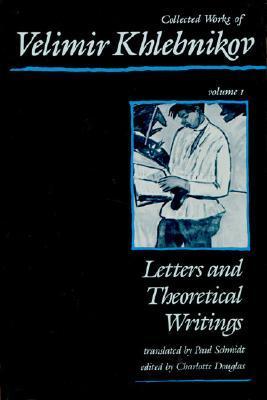
Collected Works, Vol. 1: Letters and Theoretical Writings

Rate this book
Dubbed by his fellow Futurists the "King of Time," Velimir Khlebnikov (1885-1922) spent his entire brief life searching for a new poetic language to express his convictions about the rhythm of history, the correspondence between human behavior and the "language of the stars." The result was a vast body of poetry and prose that has been called hermetic, incomprehensible, even deranged. Of all this tragic generation of Russian poets (including Blok, Esenin, and Mayakovsky), Khlebnikov has been perhaps the most praised and the more censured.

This first volume of the Collected Works, an edition sponsored by the Dia Art Foundation, will do much to establish the counterimage of Khlebnikov as an honest, serious writer. The 117 letters published here for the first time in English reveal an ebullient, humane, impractical, but deliberate working artist. We read of the continuing involvement with his family throughout his vagabond life (pleas to his smartest sister, Vera, to break out of the mold, pleas to his scholarly father not to condemn and to send a warm overcoat); the naive pleasure he took in being applauded by other artists; his insistence that a young girl's simple verses be included in one of the typically outrageous Futurist publications of the time; his jealous fury at the appearance in Moscow of the Italian Futurist Marinetti; a first draft of his famous zoo poem ("O Garden of Animals!"); his seriocomic but ultimately shattering efforts to be released from army service; his inexhaustibly courageous confrontation with his own disease and excruciating poverty; and always his deadly earnest attempt to make sense of numbers, language, suffering, politics, and the exigencies of publication.

The theoretical writings presented here are even more important than the letters to an understanding of Khlebnikov's creative output. In the scientific articles written before 1910, we discern foreshadowings of major patterns of later poetic work. In the pan-Slavic proclamations of 1908-1914, we find explicit connections between cultural roots and linguistic ramifications. In the semantic excursuses beginning in 1915, we can see Khlebnikov's experiments with consonants, nouns, and definitions spelled out in accessible, if arid, form. The essays of 1916-1922 take us into the future of Planet Earth, visions of universal order and accomplishment that no longer seem so farfetched but indeed resonate for modern readers.

464 pages, Hardcover

First published December 1, 1987

2 people are currently reading
117 people want to read

About the author

Velimir Khlebnikov

109 books64 followers
Velimir Khlebnikov (Russian: Велимир Хлебников; first name also spelled Velemir; last name also spelled Chlebnikov, Hlebnikov, Xlebnikov), pseudonym of Viktor Vladimirovich Khlebnikov was a central part of the Russian Futurist movement, but his work and influence stretch far beyond it.

Khlebnikov belonged to the most significant Russian Futurist group Hylaea (along with Vladimir Mayakovsky, Aleksei Kruchenykh, David Burliuk, and Benedikt Livshits), but had already written many significant poems before the Futurist movement in Russia had taken shape. Among his contemporaries, he was regarded as "a poet's poet" (Mayakovsky referred to him as a "poet for producers") and a maverick genius.

Khlebnikov is known for poems such as "Incantation by Laughter", "Bobeobi Sang The Lips", “The Grasshopper” (all 1908-9), “Snake Train” (1910), the prologue to the Futurist opera Victory over the Sun (1913), dramatic works such as “Death’s Mistake” (1915), prose works “Ka” (1915), and the so-called ‘super-tale’ (сверхповесть) “Zangezi”, a sort of ecstatic drama written partly in invented languages of gods and birds.
Khlebnikov's book Zangezi (1922).

In his work, Khlebnikov experimented with the Russian language, drawing upon its roots to invent huge numbers of neologisms, and finding significance in the shapes and sounds of individual letters of the Cyrillic alphabet. Along with Kruchenykh, he originated zaum.

He wrote futurological essays about such things as the possible evolution of mass communication ("The Radio of the Future") and transportation and housing ("Ourselves and Our Buildings"). He described a world in which people live and travel about in mobile glass cubicles that can attach themselves to skyscraper-like frameworks, and in which all human knowledge can be disseminated to the world by radio and displayed automatically on giant book-like displays at streetcorners.

In his last years, Khlebnikov became fascinated by Slavic mythology and Pythagorean numerology, and drew up long "Tables of Destiny" decomposing historical intervals and dates into functions of the numbers 2 and 3.

Khlebnikov died of paralysis while a guest in the house of his friend Pyotr Miturich near Kresttsy.

Ratings & Reviews

What do you think?
Rate this book

Friends & Following

Create a free account to discover what your friends think of this book!

Community Reviews

5 stars
22 (75%)
4 stars
5 (17%)
3 stars
2 (6%)
2 stars
0 (0%)
1 star
0 (0%)
Displaying 1 - 2 of 2 reviews
Profile Image for Thomas.
572 reviews98 followers
June 5, 2021
the letters are mostly skippable i think unless you are a total khlebnikov superfan but there are some nice turns of phrase and interesting observations scattered throughout. the theoretical writings are more engaging but i don't really claim to understand all the stuff about mathematical computation of history, and it sounds kind of nonsensical if neat. the stuff about the inherent meanings lurking behind syllables sounds kind of cool too even though he's probably not correct. the more polemical futurist rantings are good fun and have some great imagery.
Profile Image for Donald Lucas.
8 reviews
November 25, 2012
Interesting collection of the theoretical works of an interesting thinker. Definitely a lot of ideas that were beyond his time, but, and maybe this is simply a matter of translation, but I find a lot of it fairly tangential in nature and not necessarily well laid out. Some really elucidating letters and historical documents as well. And it does go into a little bit of depth on the zaum poetry style, which I found particularly of interest.
Displaying 1 - 2 of 2 reviews

Can't find what you're looking for?

Get help and learn more about the design.