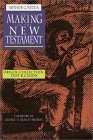
What motivated the early Christians to commit teaching and events and visions to papyrus? How were the stories and sayings of Jesus circulated, handed down and shaped into Gospels? Why were four Gospels included instead of one? What do we know about ancient letter writing, secretaries and "copy shops"? Would a first-century librarian have known how to classify a Gospel, an Acts or an Apocalypse? How were Paul's letters, sent here and there, gathered into a single collection? Are there other documents that almost made it into the New Testament but didn't? The narratives and letters of our New Testament were shaped by worn pens gripped by calloused, ink-stained fingers. Their authors' ears were more likely assaulted by the urban clatter of busy intersections and bustling markets than attuned to a still small voice. Scrolls that bumped across cobbled Roman roads and pitched through rolling Mediterranean seas found their destination in stuffy, dimly lit, crowded Christian house churches in Corinth or Cenchreae. There they were read aloud and reread, handled and copied, forwarded and collected, studied and treasured. Their ordinary story is true to their extraordinary the mystery of the Word that became flesh. In The Making of the New Testament Arthur Patzia retells that story. His textbook study of the origin, collection, copying and canonizing of the New Testament documents answers a myriad of questions--cultural, historical, geographical, linguistic and spiritual.
Arthur G. Patzia (PhD, McMaster University) is senior professor of New Testament at Fuller Theological Seminary of Northern California. He is also the author of Ephesians, Colossians, Philemon in the New International Bible Commentary series.
Here’s enlightenment where we really need it. The story of the making of the New Testament all the way through canonization is a weak area for many. Coupled with our insufficiency is how this issue has grown into one that Bible critics have coalesced around. Whether you would agree with every conclusion that Mr. Patzia makes or not, this book richly repays the reader who wrestles with it. I understand that this revised and expanded edition is used by many as a textbook, but I believe it’s needed by pastors and Bible students as well.
Part 1 gives an outstanding background of the literary world of the New Testament. You will gain an overview of the Hebrew Scriptures, the Septuagint, the Old Testament Apocrypha, the Old Testament Pseudepigrapha, the Dead Sea Scrolls, and Greco- Roman literature. These things are rarely presented with any kind of balance in popular articles, so this even has a wonderful apologetic value.
Part 2 describes the making of the Gospels. The first section describes the Gospels going from oral to written status. In mentioning form criticism, he is more than fair in describing its shortcomings. There’s another discussion about why the Gospels were written before he dives into how they were written. I can’t follow all he had to say about the synoptic problem, source, or redaction criticism. More helpful is his explanation of our fourfold gospel collection. He will give us both a positive argument for these four while suggesting why others are spurious. He covers the history of their acceptance as well.
Part 3 takes Paul’s letters on a similar journey to the one he did with the Gospels in the previous section. There are some additional debated points like Paul’s use of a secretary or that some scholars champion pseudonymity. The best part, again, is his taking Paul’s letters through their collection acceptance. Part 4 takes all the other parts of the New Testament through the same process.
Parts 5 and 6 are invaluable. They describe how the canon came together and counteracts the tilted scholarship of folks like Bart Ehrman. Paleography, types of materials used for writing, the forms of books like the roll and the codex, the actual writing of New Testament manuscripts, and the transmitting of them. I found less value in Part 7 on his explanations of textual variants and textual criticism.
This book is a major success. It’s now one of my favorites on the subject of canonization. I give it the highest recommendation!
I received this book free from the publisher. I was not required to write a positive review. The opinions I have expressed are my own. I am disclosing this in accordance with the Federal Trade Commission’s 16 CFR, Part 255.
Comprehensive account of how the New Testament came together. Although seminary level reading, it is very accessible, balanced, and interesting! Even if you think you know the story, you will undoubtedly discover in this book even more details that will enhance your understanding.
The Making of The New Testament, by Arthur G. Patzia, is a concise and interesting entry level text that introduces the reader to the origin, collection, canonization, and transmission of the New Testament. Patzia begins by helping the reader to see the world in which the early church existed. He introduces us to the Hebrew Scriptures, the Septuagint, the apocryphal writings, the OT pseudapigrapha, the Dead Sea scrolls, as well as Greco-Roman literature. This sounds like a large amount of info, but it is written in a manner that makes it accessible to all. It is a helpful background to have, however, to see the world into which the NT came. In part two, the author presents to us the gospels. The reader will find an overview of oral tradition, the transition from oral tradition to written gospels, why and how the gospels were written, a brief overview of the synoptic problem, source criticism and redaction criticism. While I felt that this chapter was not the strongest in the book due to the focus on Markan priority that seems to accept the theories of the day instead of dealing with the history found in the Apostolic Fathers, the author does take the time to give us a view of how the early church fathers viewed the Scriptures. He also shows us a bit of how the gospels became accepted as canonical. Parts three and four deal with the rest of the NT books. There is much here to interest the reader, as we not only find an introduction to the various books, but we are introduced to them in their historical, societal, and religious contexts. We also are given a view of the acceptance of the various books and how they came to be considered canonical books. Part five is among the stronger sections of the book, as it deals with the criteria of canonicity. It is brief, yet gives us an introduction to the subject that will help the reader understand the background of his NT. Parts six and seven were the parts that I found most interesting. In these sections we study the writing, copying, and transmission of the NT manuscripts as well as an introduction to textual variants and textual criticism. The author does well in introducing us to the writing materials that were used in the production of the NT. We are also introduced to the various styles of writing that were used in the copying and transmission of the NT. It is here that we begin to see why textual variants exist. They do not exist simply because of some widespread conspiracy to corrupt the text, but because of the imperfections of men. Never the less, textual criticism shows us that we have essentially the same NT as the early church possessed: it has not been lost, but has been preserved for us. Five appendices also add some info concerning various leaders in the early church, the canon of the OT, various lists of the NT canon, and a list of early NT manuscriptus. There is also a glossary included to help the reader. This book will serve to be a good introduction to the NT text. Though I wish that the author took a much more conservative stance toward the dating of the gospels (though he is by no means extremely far off) and the Synoptic problem, I find this book to be one that should be extremely helpful to the beginning student of the NT. I would recommend its being used along with Lea/Black The New Testament Message for a comprehensive overview of the NT.
Good contents but reads like some lecture notes. Little doubt that the author used his lecture notes from Fuller Seminary. Some inconsistencies are found, where the author would attribute authorship of some NT documents to 2nd century pseudonymous wirters but at the end of the chapter summaries he'd say all the NT were written in the 1st century. Of course they were all written in the 1st century.
The author relies a bit too much on Fart Errorman's re-"work" on Metzger's work.
Author Dr Patzia recommended Michael Kruger's books, if I recall correctly. Please read Kruger's books instead, if you have that option.
The Making of the New Testament: Origin, Collection, Text & Canon (Second Edition) by Arthur G. Patzia is a thoroughly revised, expanded, and updated edition of his classic textbook on the origin, collection, copying and canonizing of the New Testament documents. Nearly everything that was previously praised about the first edition has remained here. However, to the benefit of the reader, Patzia has made several needed changes to this second edition, including revised and updated documentation and interaction with more recent works on the subject material.
The Making of the New Testament is divided into seven major sections: (1) The Literary World of the New Testament, (2) The Gospels, (3) The Pauline Literature, (4) Other New Testament Literature, (5) The Criteria of Canonicity, (6) Writing, Copying & Transmitting the New Testament Manuscripts, and (7) Textual Variants & The Practice of Textual Criticism. Beyond these seven major sections, Patzia also provides five useful appendixes relating to the making of the New Testament: (1) Canon of the Old Testament, (2) Significant Leaders of the Early Church, (3) Early Canonical Lists of the New Testament, (4) Later Canonical Lists of the New Testament, and (5) Early Manuscripts Containing the New Testament. Like the material found throughout the volume, the appendixes have been both updated and revised.
The Making of the New Testament is an excellent resource for anyone who has ever pondered questions about how books and documents were produced in the first century, the motivation of the early Christians to write Scripture, why there are four Gospels instead of one, who decided and what criteria was used to choose the New Testament documents, and much more. Patzia has packed the book with a number of excellent graphs, charts, tables, and illustrations to illuminate the material for the reader. These are helpful even for those familiar with the subject matter of the book. Patzia also does an incredible job providing examples for the reader to better connect the material to the New Testament. This is especially helpful in his interaction with The Synoptic Problem, Source Criticism, Writing New Testament Manuscripts, and various aspects of Textual Criticism. Lastly, the Glossary and Selected Bibliography provide the reader with an excellent point of reference for immediate and further study.
The Making of the New Testament: Origin, Collection, Text & Canon by Arthur G. Patzia has been a well-received and widely used textbook for over two decades. Patzia is clear, concise, and informed in his interaction and communication of the issues related to the making of the New Testament. Those looking for an up-to-date introductory summation of the various disciplines related to the making of the New Testament will do well in acquiring this volume. It comes highly recommended to readers with all levels of interest and familiarity, but especially pastors and laity looking to ground their faith in something of substance and communicate it more clearly.
I received a review copy of this book in exchange for an honest review. I was not required to write a positive review. The opinions I have expressed are my own. I am disclosing this in accordance with the Federal Trade Commission’s 16 CFR, Part 255: “Guides Concerning the Use of Endorsements and Testimonials in Advertising.
Arthur G. Patzia's The Making of the New Testament. Started this one last year and finished it up early this year. I approach Bible study with an eye on translation and canonization issues, so I wanted this info.
So let me be honest: I only skimmed this. I was hoping for something not so dense. Don't get me wrong, I think this is well written & would be great as a text book or for a small group to ponder over a year. If anyone is interested, let me know.