Jump to ratings and reviews
Rate this book
Rate this book
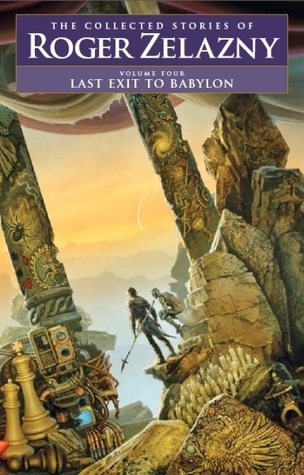
The fourth in a six-volume series, Volume 4: Last Exit to Babylon contains Zelazny's short works from the late 1970s and early 1980s when Zelazny's popularity opened new markets for his work. He continued to produce highly-crafted stories, such as the popular "The Last Defender of Camelot," the Hugo-winning "Unicorn Variation," and the Hugo and Nebula-winning "Home is the Hangman." The stories in this series are enriched by editors' notes and Zelazny's own words, taken from his many essays, describing why he wrote the stories and what he thought about them in retrospect.

576 pages, Hardcover

First published July 1, 2009

12 people are currently reading
268 people want to read

About the author

Roger Zelazny

745 books3,872 followers
Roger Joseph Zelazny was an American fantasy and science fiction writer known for his short stories and novels, best known for The Chronicles of Amber. He won the Nebula Award three times (out of 14 nominations) and the Hugo Award six times (also out of 14 nominations), including two Hugos for novels: the serialized novel ...And Call Me Conrad (1965), subsequently published under the title This Immortal (1966), and the novel Lord of Light (1967).

Ratings & Reviews

What do you think?
Rate this book

Friends & Following

Create a free account to discover what your friends think of this book!

Community Reviews

5 stars
101 (54%)
4 stars
54 (28%)
3 stars
26 (13%)
2 stars
5 (2%)
1 star
1 (<1%)
Displaying 1 - 10 of 10 reviews
Profile Image for Michael Battaglia.
531 reviews68 followers
May 13, 2022
By the mid-seventies, Zelazny was increasingly known as "That Amber Guy", with that series being immensely more popular than almost anything else he would ever do (the biographical section in the back of this volume covering this period mentions him basically getting mobbed at SF conventions, which I suspect is not a sentence Zelazny imagined would ever be written about him), to the point where it probably overshadowed the other fine work he was doing at the same time. It didn't quite help that his novels around this time were either crowd-pleasers or sometimes off-puttingly experimental (especially to the people who wanted more stuff as accessibly engaging as the Amber novels), apparently leading people to ask "Why do your novels suck?" because he didn't rewrite "Lord of Light" on an annual basis.

It'd still be hard to make a case that Zelazny somehow "sold-out" or compromised as his career entered what would turn out to be his middle period. Yes, the Amber novels seemed to be making him boatloads of money (or at least good money for a SF/fantasy author, back when the income level required for "lucrative" was probably a bit lower than today) and people weren't naming their children after all the characters in "A Rose For Ecclesiastes" anymore but its hard to say he was only winning awards because he was a swell guy (the mid-seventies didn't lack in decent SF). If nothing else, his short story work during this period is nothing less than interesting. Maybe not as challenging, but far from coasting.

Take the opening triptych here, published as "My Name is Legion" but really three thematically linked novellas featuring the same character and concept. Basically in the future a giant world spanning computer system has been created. Just before it goes live a guy wonders if that's really a good idea and because of where he works he's given the opportunity to . . . just not be in the system. The end result is that he technically doesn't exist and like the best anonymous people everywhere he does what you'd expect . . . becomes a one man lovechild of "The A-Team" and MacGuyver, getting himself hired for weird jobs when he needs the money, most of which rely on stuff he's forced himself to learn over the years or has to learn very, very quickly. Also, often he has to do it without giving himself away as a non-person. Often, people are trying to kill him.

All three stories are a lot of fun, with a kind of deadpan protagonist who's sassy enough to say what's on his mind without being too concerned about getting a beating because of it, competent enough to grasp what's going on without having the whole solution in front of him while having to do a little work to solve the bigger problems. For the most part they're essentially intelligent spy stories . . . "The Eve of RUMOKO" is about stopping sabotage on a project involving nuclear explosives, while the keyboard defying "Kjwalll'kje'k'koothai'lll'kje'k" focuses on proving that research dolphins aren't murdering people.

Its "Home is the Hangman" that got him another Hugo Award and as much as the other two stories are, it is the meatiest of the bunch. A robot sent out into space that apparently now has sentience appears to be heading back and killing all the people who created it in the first place. Our nameless hard working spy has to figure out what exactly is going on when everyone aggressively doing their best to not tell him anything. Meanwhile, the bodies keep stacking up and someone is doing it. With a definite "murder chickens coming home to roost" feel to it and a sense of claustrophobia that even the stories set on enclosed research stations couldn't seem to pull off, it's a story that constantly wobbles on its own back foot, counting down the time toward its own eruption. And when it comes its stabbingly poignant, less a battle than an exhalation where all the breath hits the air and holds on for a second or two longer than you'd expect, as if it refuses to disperse. It’s a nice way to end the trio but it wasn't meant to be the end. Unfortunately, Zelazny never got time to write any more.

The other series including in this volume is more featuring everyone's favorite humorless guy who rides a sarcastic metal horse, Dilvish. Not including the novel that wrapped all these stories up, there's eleven in total and we get five more of them here. I wasn't the biggest fan of the first round, finding Dilvish acting with a sort of po-faced seriousness that probably needed wackier or stranger circumstances to really stand out, but Zelazny seems to have figured things out better with this set, with a bit more focus on Dilvish being the straight man to his hell-horse, who rarely seems to have time for any of this nonsense. The basic premise overall remains the same, with Dilvish attempting to get back at the evil sorcerer who sent him down to Hell in the first place (which had the effect of not improving his mood and giving him some new skills) and running into some pretty strange scenarios in the process.

The longer ones for me are the highlights, probably because it gives Zelazny a chance to stretch out a bit more and let the concept unfold. Which works just fine when you something as pleasingly strange as "A City Divided", where Dilvish winds up part of some bizarre game between two factions in a moveable city. Part of the fun is watching Dilvish go along with whatever's happening until he seems to run out of patience and just starts to wreck everything in sight, with the ever important vibe of "I've stands all I can stands, I can't stands no more."

Its "Tower of Ice" that's the standout here, probably as close as Zelazny's going to get to famously insane Conan story "Red Nails" . . . trapped in a castle on a tall ice mountain with two magical siblings that are starting to have diverging views on what their goals should be (mostly because one of them is veering a bit toward "juggling with hand grenades" territory), with the added bonus of Dilvish's Most Hated Enemy more actively in the mix as a threat, it has Dilvish rarely in control of the situation while trying to deal with people and their shifting motivations before a big magic bomb goes off and destroys everything in sight. Having people for Dilvish to interact with instead of frighten half to death is a step in the right direction and its probably the first time for me that all the pieces of the saga start to fit together. Of course, its also the last Dilvish story in this volume.

Beyond those, it’s the usual mix of the good, pretty good, and the "only here for the hardcore readers." The latter category tends to be the stories that are based off the novels and so here we get the first of several bits related to his novel "Jack of Shadows". This time out we're treated to a prequel and a character outline (more comes in Volume 6, for the Shadowjack groupies out there), neither of which made a whole lot of sense to me, as a person who has never read "Jack of Shadows". You also get another episode from the world of crazed sentient cars (basically if all the dark scenarios people envision about the world of Pixar's "Cars" are true), featuring a guy and the lady car who loves him, but now is trying to kill him because she's gone wild. In case you missed them. I did finally figure out what "monoing" refers to, after two stories set in this world (basically a car deciding to kill its driver by flooding the inside with carbon monoxide, then driving around with the corpse still inside so it looks like a normal non-homicidal car, which I assume voids the warranty somehow).

Stronger and standalone are tales like "The Last Defender of Camelot" . . . a riff on "Arthurian knights in the modern age", it falls back a little onto Zelazny's trademark blend of mythology (minus some of the exuberant lyricism that made everyone swoon fifteen years prior) but it has some weight to it thanks to Zelazny's continued obsession with immortality and its effects on people. Its not going to beat out TH White and I feel like years of this theme since have probably diluted how novel this was back then (DC published "Camelot 3000" in the eighties that was a SF version of this with more sex and aliens and Brian Bolland on a semi-regular schedule). Though they did make a contemporary "Twilight Zone" episode out of this (written by George R. R. Martin! Starring the girl from "Walkabout" and "The Railway Children"! and Anthony LaPaglia?) so I guess that makes up for "Damnation Alley" being a less than stellar example of filmmaking.

Even better and even more drenched in myth is the also award-winning "Unicorn Variations", a snappy tale where a guy faces a unicorn in chess for the fate of the world, proceeds to get the unicorn periodically drunk and gradually builds a bar that somehow becomes patronized by castaways from the "Barnaby" comic strip. It’s a fun story as the protagonist keeps trying to win by getting some coaching without tipping off the unicorn, while the unicorn has varying degrees of interest in his original mission as he appears to enjoy just hanging out. It’s a snappy story, clever without being overly cute and probably way harder to pull off than you'd think (if you could ever come up with the idea in the first place) and while it doesn't have the impact the early stuff does it still stands out even in a career that at times was just a string of highlights. Its just a little bit stranger than stories like "The George Business", which also tinkers with medieval myths but comes as a little more lighthearted.

Somewhere in the middle is "The Horses of Lir", a fantasy story that has the feel of old tradition, where a young man inherits a job from his uncle . . . less than amusing than the other stories it has a sense of mystery and timelessness that I'm fond of, one of those stories that feels like a glimpse of what the world is like all the time, in the odd corners, even if we never see it. Its something very appealing to me, the idea that certain aspects of the world depend on these unknown people performing certain functions that we never quite understand but are very, very necessary. Even more than "the world isn't quite what you know of it", it’s the idea that the important portions of the world have deep roots that need to be maintained and there's a certain honor in making sure its done, even if the honor isn't going to be recognized or understood by the world at large.

And yes, on another level, its about a guy who gets stuck having to take care of magic water ponies. I'll take my profundities where I can get them.

As for the rest of the stories, it’s a mix of the short and really short, the stuff that Zelazny probably tossed off in an hour's worth of work. Nothing essential but each one generally has at least a moment, a line of dialogue or landing that sticks in the head, like watching a master pianist just casually dashing off melodic lines that most people would really have to work at and realizing that for him its just tinkering around. There's writers where the level of craft that goes into every page is evident and there's writers who it seems just "hear" this stuff in their heads and it’s a matter of just getting it to sound right on the page. The latter work just as hard as the former (unless you're lying or some kind of insane genius I don't think writing is never NOT work) but there's just a naturalness to what Zelazny was doing that makes every story seem utterly off the cuff, like he threw piles of alphabet letters at the wall and the stories just magically emerge in the process. That of course is a facile way to imagine how much work went into his talent (and the articles he writes about the process included in these volumes demonstrate how much he thought about this stuff) but it makes the stories a joy to read because very rarely does anything seem forced. If there's ever anyone who could give you the impression that writing was as easy or as necessary as breathing, Zelazny as good an example as any.
Profile Image for Brok3n.
1,438 reviews111 followers
July 25, 2025
Head and Heart

Last Exit to Babylon is volume four of the masterful Collected Stories of Roger Zelazny. (For an overview of the series, see my review of the first volume, Threshold.) This volume, covering the years 1978-1981 maintains the high standards of scholarship of the series. Also, Zelazny pulls out of the slump of the years 1967-1977, which provided the source material for Volume 3, This Mortal Mountain.

This is no longer the financially insecure Zelazny who worked for the Social Security Administration and wrote nights until 1969. In 1969 he quit his day job to become a full-time writer. It was a good decision, although of course it took time for him to be comfortable with it.

He is now. His career as a novelist has taken off. In particular, the Chronicles of Amber, which were to become his main financial success, were making money. In 1975, realizing that as a writer he could live anywhere he wanted to, he and his wife Judith moved to a home near Santa Fe, New Mexico, where he lived until his death. They had three children. In an essay on the effect of the marketplace on literary output, he writes,
There comes a point -- and I don't know precisely where it occurs -- when you've been around long enough and are sufficiently well-known that you sell everything you write. If I want to try something experimental, I do it in confidence that it will appear somewhere. I no longer even think of something not selling. So, to this extent, the question concerns something which no longer seems to apply to me.
The hypothetical "If I want to try something experimental" was a very real thing. Zelazny liked literary experiments. If you want consistency, Zelazny is not the author for you. His fans often complained about this, wishing he would go back to the early themes and styles that, in their view, made him great. But of course, what made Zelazny great was this continual movement. Zelazny during this period is a perfect example of what Gustave Flaubert wrote
Be regular and orderly in your life, so that you may be violent and original in your work.
And Zelazny was that.

In my review of This Mortal Mountain, I wrote, "[the stories] grab me by the head rather than the heart." In the best stories of this volume, that defect has been remedied. They are still clever, but my emotions are as engaged as my intellect. Not all of the stories here hit the sweet spot for me -- that is of course inevitable for any individual reader, given what I have said about Zelazny's experimentation. In particular, the stories of My Name is Legion and the Dilvish stories are not my favorites. (As always, YMMV.)

Which are my favorites? It is difficult to choose, but I really liked "The Last Defender of Camelot", "The Horses of Lir", and "Unicorn Variation". Many of the stories of this period are more light-hearted than the powerful stories of Zelazny's past and future. Indeed, most of "Unicorn Variation" anticipates what we now call "cozy" literature. One could almost imagine Travis Baldree writing it, but for the introduction of the Unicorn
A bizarrerie of fires, cunabulum of light, it moved with a deft, almost dainty deliberation, phasing into and out of existence like a storm-shot piece of evening; or perhaps the darkness between the flares was more akin to its truest nature...
If you can imagine Baldree writing that, your imagination is better than mine. Zelazny continues in this vein for a page before coming down to Earth.

The best of the stories in Last Exit to Babylon are very good. Not Zelazny's best, in my opinion -- there are better stories in his past and his future. But still very good.

Blog review.
Profile Image for Jim.
Author 7 books2,088 followers
December 28, 2015
An excellent read. If you love Zelazny's writing, this is a must-have. While much of the book is stuff I've read before, the explanations of how the stories came to be written, what Zelazny was thinking & all were just fantastic. At the end, there is a section that gave me surprise as it went through book after book with a lot of background I'd never read anywhere before about some favorite books like "Jack of Shadows" & "Changeling".

The two introductory pieces, one by Brust & the other by Joe Haldeman, were fantastic. Short, to the point & gave even more depth to Zelazny, the man.

You can certainly read this or any of the books out of order, unless you're a serious scholar of his work. I'm not, but have read them in order since that's the way I got them.
Profile Image for Metaphorosis.
969 reviews62 followers
January 1, 2015

reviews.metaphorosis.com

4 stars

Roger Zelazny deserves every bit of his status as a legendary SFF author. At his best (which he often was - see Lord of Light), his prose verged on poetry without ever losing its readability. His short fiction (gathered in several partial collections over the years) was as good, if not better. So, running across a complete collection of his short works is as exciting to an SF fan as finding that a (more) affordable version of the [Jack] Vance Integral Edition is being published. Zelazny and Vance were not only among the top SF writers, but were two of the absolute best for those who love good writing for its own sake.

Which is why the editorial policy behind this collection (published by NESFA) is so puzzling. Curious decisions include: - stories are not in chronological order, nor in series groups, nor in topical order. Yes, there's a general chronological sequence here, but stories are often presented out of order, for no evident reason. - Zelazny aspired to be a poet, and there's a lot of his poetry here. Ironically, for a writer whose prose was so beautifully poetic, his actual poetry is pretty poor. The poems are scattered throughout the volumes of the collection - often topically linked with the following story. It's a little hard to argue with the editors on this - several hundred pages of poetry in one place would have seriously weakened one of the volumes in the set. And if the poetry had just been left out entirely, you'd wonder about it, and how good it must have been. - Several excerpts from novels. Frankly, I just resent this. I have the novels - they're mostly available for purchase. I bought this set for the short stories. - One little quibble. One the inside back jacket, Michael Whelan gets as much space as Zelazny himself. Yes, he's a famous (if overrated) artist, but hey, he just did the one cover, not the six volumes of content.

Strange sequencing, etc. aside, the collection is well done. There is excellent information on publication dates and how the stories fit the various series. There are many previously unpublished (or underpublished) pieces. There are carefully collated comments from Zelazny about each story, and there are (over-) copious interpretive notes about the allusions in each story. Also, there's a nicely written biographical piece included in each volume. While they're all respectful of Zelazny's talent, they're not sycophantic in tone. There are also introductions by guest notables for each volume - some good, some that lead you to question why the editors selected people who clearly did not know Zelazny well.

Finally - the stories themselves. If you're a Zelazny fan, this collection is well worth your time. Otherwise, it's not your best introduction. Some of the underpublished (e.g. in a fanzine) stuff just isn't that good. And the strange sequencing ends up undercutting the effect of the really great stories that are also here. I'm a long time, committed Zelazny enthusiast, and I'm confident that this is not the collection I'd give my spouse in order to share my burning enthusiasm for Zelazny's work. If you're already a fan, though, this will satisfy your completist desires, and give you access to a lot of new work, uneven though it may be.
Profile Image for Nicholas Whyte.
5,295 reviews206 followers
February 4, 2017
http://nwhyte.livejournal.com/2768450.html

The later 1970s were a productive and fertile time for Zelazny's imagination; the one problem with this volume, the fourth of six collecting his short fiction, is that I have read it all before - My Name is Legion, Dilvish, the Damned, Unicorn Variations - I even have a copy of The Illustrated Roger Zelazny with the Jack of Shadows prequel "Shadowjack". Still, there is plenty of explanatory material outlining how each story came to be written, and a useful afterword linking the short fiction and poetry to Zelazny's novels and other life events (notably the births of his children). For a Zelazny completist like me, it's indispensable; but it adds less than previous volumes did.
Profile Image for Alazzar.
260 reviews29 followers
February 20, 2011
As I said in my recap of the first three volumes of this series, everything is awesome, especially the notes after each story that give some insight into Zelazny’s writing. Also, the biographical stuff and the speeches and essays at the end are great.

With that out of the way, here’s a list of all the stories in the book (not including poetry/articles/whatever). I’ve bolded the ones I felt stood out.


My Name Is Legion: Précis
The Eve of RUMOKO (series: My Name Is Legion)
'Kjwalll'kje'k'koothaïilll'kje'k (series: My Name Is Legion)
Home Is the Hangman (series: My Name Is Legion)
Stand Pat, Ruby Stone
Go Starless in the Night
Halfjack
The Last Defender of Camelot
Fire and/or Ice
Exeunt Omnes
A Very Good Year...
The Places of Aache (series: Dilvish 5 of 11)
A City Divided (series: Dilvish 6 of 11)
The White Beast (series: Dilvish 7 of 11)
Tower of Ice (series: Dilvish 8 of 11)
The George Business
The Naked Matador
Walpurgisnacht
The Last of the Wild Ones (series: Jenny/Murdock)
The Horses of Lir
Recital
And I Only Am Escaped to Tell Thee
Shadowjack (series: Shadowjack)
Shadowjack: Character Outline (series: Shadowjack)
Unicorn Variation

And now, a few individual notes.

For starters, if you haven’t read the “My Name is Legion” stories, I’d recommend skipping the “Precis” thing at the beginning. It gives a run-down of what’s happening in the three stories, and some of the stuff seemed kinda like spoiler material to me. Thankfully, my memory is so bad that by the time I got to “Kjwlefij;lkh;ijwf;klwejf’’’;lkajfd;ijdolphin;aljf,” I’d already forgotten about the spoiled plot points I’d read in the preview. (Special thanks to my brain for its unintentional self-defense mechanism.)

Strangely, “Home is the Hangman” was my least favorite of the Legion stories. I say “strangely” because it’s the one that won awards (Hugo AND Nebula!). It was just a little too “hard sf” for me—there were pages upon pages devoted to describing how it could be scientifically (and psychologically) plausible for the events to be occurring. I don’t need that much explanation. You can tell me that a dragon breathes fire just because it can, or that a mechanical monkey is the greatest engineer of our time simply because that’s how he was built, and I’ll gladly believe you. No need to show me the schematics.

Moving on . . .

“The Last Defender of Camelot” was good. Its Twilight Zone adaptation, which I snagged from Netflix, was not. The special effects weren’t very special, and the actors weren’t very acting.

The Dilvish stories in this volume were some of the best so far, save for “Tower of Ice.” Not that Tower was bad, but there were times when I felt certain scenes dragged on for too long. If Dilvish is climbing a mountain, it does not need to be done in real-time, because then it feels like I just climbed a mountain, and that’s not what I signed up for when I opened the book.

Thankfully, “The George Business” was the next story in this volume, which brought things firmly back into the realm of “awesome.” Great, fun little story.

Speaking of fun little stories, there’s “Unicorn Variation” as our closing act. This was, without a doubt, my favorite story of the book. I realized partway through that I’d been smiling while reading, which is weird, because when a normal person might smile I’m usually telling kids to get off my lawn. (Seriously. This happened once. That kid was bein’ a punk, and I was in no mood for punkiness.)

Anyway, “Unicorn Variation” is one of those Zelazny stories that’s light on the seriousness and heavy on the fun. It’s gotta be in my top-ten all time for his stories of sub-novel length, and the notes on how it was conceived are particularly entertaining.

So far, I think this might just be my favorite of the volumes in this collection. It doesn’t have the best story of the first 4 books (that distinction probably belongs to “This Immortal,” though I’d have to double-check to be sure), but it may just have the highest percentage of quality tales.

Now, on to volume 5!
Profile Image for Magill.
503 reviews14 followers
March 22, 2015
I think out of the volumes read so far, I like this one the best. The stories tend to be longer, and some sequential stories of characters (Dilvish and Legion) are included, so you get more of a sense of their stories than simply a brief vignette or mere glimpse of a larger picture. It seems that that was what Zelazny was going for technique-wise in many cases, and he did it well but, for me, rather less satisifying on a story level. I am still enjoying the notes at the end of the pieces and about Zelazny himself. Have noticed the trend, however, that the articles about Zelazny by other authors... all men. I wonder if that says something, in and of itself, about whom he inspired, and how they were inspired. That said, good writing, very visual, and I enjoyed reading the stories back to back. Probably a 3.5 all told, but will give it a 4 as I gave the others a 3.
Profile Image for Lada.
23 reviews
April 20, 2014
Read just "Last Exit to Babylon"... Loved it! ;-)
Displaying 1 - 10 of 10 reviews

Can't find what you're looking for?

Get help and learn more about the design.