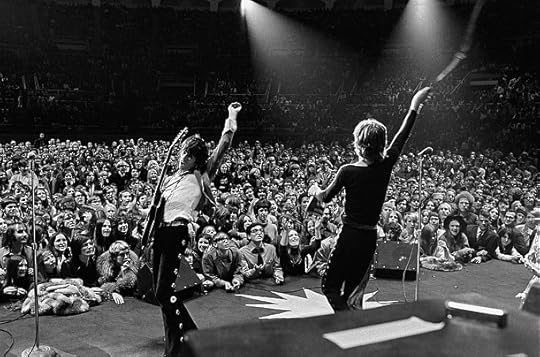
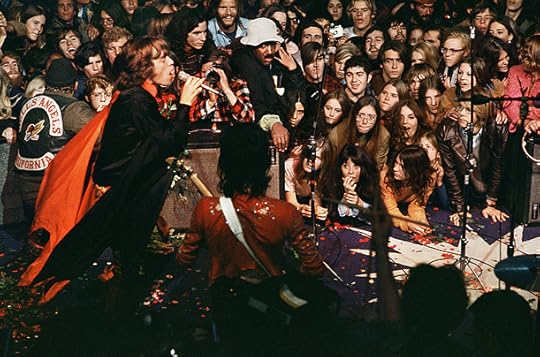
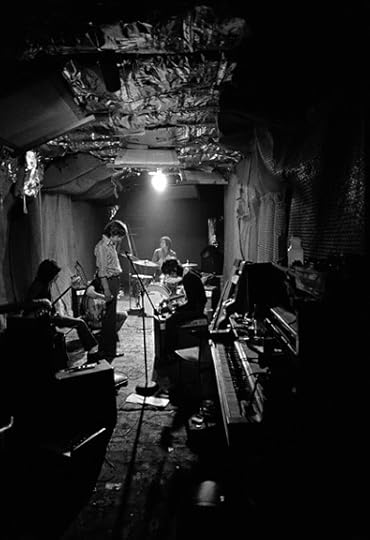
LET IT BLEED takes you where no Rolling Stones book has before. Author and photographer Ethan Russell was one of only sixteen people--including the Rolling Stones--who made up the 1969 tour. He was with them in their hotel rooms, at rehearsals, and on stage. He tells the story of this monumental and historic tour firsthand, including recollections from band members, crew, security, and other sixties icons--like Abbie Hoffman and Little Richard--they met along the way. And he also includes amazing photos of the performers who toured with the Stones that the legendary Tina Turner and B. B. King.
Through vivid quotes taken from his interviews with the band and crew, and through more than 220 revealing photographs, Russell takes you behind the scenes for an uncensored look inside the Rolling Stones' world at the end of the sixties. It was an idealistic time, with an overarching belief that music could bring us all together. But the events that led to the terrible violence and stabbing death at Altamont would change rock and roll forever.
Ethan Russell is a multi-Grammy nominated author, photographer and director. He is a pioneer of music video and the only photographer to have photographed covers for The Beatles, The Rolling Stones, and The Who. He is the author of "Dear Mr. Fantasy" (Houghton Mifflin 1985), LET IT BLEED: The Rolling Stones 1969 U.S. Tour (Limited Edition Rhino Entertainment, Trade Grand Central publishing) 2005/2007, and ETHAN RUSSELL:AN AMERICAN STORY (eBook) 2012.
4,5 Stars! What a great combination of history and sentimentality.
Aptly named by the album of 1969 "Let It Bleed", is a vivid recital of the group's USA Tour in '69 and its tragically iconic end in Altamont.
A retelling not only involving the Stones but also the political and social circumstances, in late sixties. Let's not forget how charged were those times..
Additionally, Ethan Russell is a very well known and widely acclaimed "rock" photographer, and this book is filled with special photos amazing portraits, coming from a beautiful perspective..
Maybe a little sentimentally pervaded, but it wasn't a disadvantage at all. It made me feel like i was a part of the story and that is incredible.
THOUGHTS ABOUT THE BOOK
- A whole photographical spread for the '69 Tour. It shows what a force were the Stones.. - An insightful psychograph. - The Altamont incident is very detailed. - Many people giving their own perspective. - Beautiful pictures.. - It's fantastic how good Ethan Russell capture the essence of the Stones in this book.. The honesty is evident in every paragraph, every story, every photo. - Definitelly a jewel for any fan. An even if you are not a fan this book touches so many themes with such professionalism, it's bound to like it.
Great insider view of the Stones' 1969 US tour. What makes it great is that this isn't sycophantic hero worship, this is the view of a professional getting his first big break as a rock photographer, and the narrative is his journey on that tour and what it meant to him as much as its a venue-by-venue account. Of course it all leads up to the 'anti-Woodstock' Altamont, and this is some of the best writing I've come across on that free concert and makes it abundantly clear why it was always going to be a disaster.
It's a great accompaniment to the film 'Gimme Shelter' (available in full on YouTube), with accounts from Russell and others in the Stones tour group I'd never heard before. If anything Altamont comes across as even more brutal and terrifying than the film suggests.
Also really poignant is the trip Russell makes back to the Altamont raceway decades later. It's clear this was an event that left an indelible mark on him and many others.
My only complaint is I wished there was more - it's a short book and is over far too quickly.
The Rolling Stones caught in their most magnificent and scariest time From 1968 to 1969. Brian Jones just passed away (or murdered) and they hired a new young guitar player by the name of Mick Taylor – and during all of this they recorded their classic album “Let It Bleed.” The book covers from the death of Brian Jones to the death of the 60’s, better known as Altamont. Photographer Ethan A. Russell was another figure who was in the right place and the right time – and his images captures the beauty and horror of the Stones and their world at that time. This is a really cool book. A must for all Stones fans.
This is my second reading of this book. If I'm honest, I probably read through it quickly the first time, not paying too much attention to the writing, mainly looking at the photos. This time I read it properly and took it in...and I have to say, it really was a great piece of rock journalism. Great little titbits of info I didn't know before. It really is a great summary of what it was like to be on the road with The Rolling Stones on their 1969 North American tour and especially the details of the infamous concert at Altamont, along with some superb photos.
A document about artists their art and a strange happening that took the life of an armed audience member named Meredith Hunter (of the lime green suit). What he intended with his firearm was probably self defense in the face of so much gang violence but the movie seems to show aiming at the stage. We'll never know. It was a perfect storm and we're probably lucky it wasn't worse. These are great old photos of a bygone Era. The section about Brian Jones is especially nice. Bad luck there. He was an Interesting cat.
Captures the Stones at Their Hedonistic Peak, May 27, 2010
This book visually tracks the Rolling Stones as they surfed the tumultuous wave that was the year 1969 ... a pivotal year for the band, as well as the society that embraced them.
"Let it Bleed" contains a fantastic collection of photographs (many I've never seen before) that details the eventful last half of 1969 for the Rolling Stones. In those 5-6 months, the band had experienced the firing of one of its founders (Brian Jones), his sudden death, a memorial concert for Jones and the hiring of his replacement (Mick Taylor) ... all before the blitzkrieg that was the 69 American tour which culminated in the miserable free concert at Altamont. The photographs provide an image of the Stones as a well-oiled, sexually-charged machine simply shrugging off Jones' death to continue its mission of being "the Greatest Rock and Roll Band in the World". Relentless and focused early on, but utterly worn-out by Altamont. You are given the sense that there was no rest for the band during this stretch of time and you can easily surmise that drugs and alcohol was the glue that held Keith Richards together. Complimenting the photographs are detailed recollections from those who experienced the journey from the band's inner circle.
The chapter on Altamont was the main reason for me purchasing this book. I have long felt that the tragic event that unfolded on December 6, 1969 was more symbolic of the turbulent 60s than Woodstock, yet it still receives scant coverage; "Let it Bleed" helps in filling that void. In addition to some stock photographs of the Altamont concert, the book generously provides several unseen pictures that vividly depict Altamont as a cold, dark and dangerous place to be ... the polar opposite of Woodstock. Candid commentary from the Stones' security, Tony Funches was particularly revealing ... that he knocked out two Hells Angels and lives to tell about it is amazing by itself. Even the reclusive Mick Taylor contributes to the storytelling ... another plus for the book.
"Let it Bleed" is a graphic one-two punch of a great band at a remarkable period in history ... a fine document of an era. The book should appeal not only to fans of the Rolling Stones and rock music, but fans of contemporary American History as well.
Whoah! Quite a gripping and sometimes harrowing work with many of the photographs being simply stunning (and never before seen). Reading about the Stones' 1969 tour (with Mick Taylor & Ian Stewart on board) - Mick Jagger lamenting about being "so old" back then - is time travel at it's best. You get a sense of the evolving chaos from various perspectives, including photographer Ethan Russell, the band members, security man Tony Funches (who knocked out two Hells Angels and lived to tell about it) and others. The book builds to the final concert, a huge festival held at the Altamont Speedway in northern California on December 6th. I had a nearly chilling visceral reaction to the firsthand accounts of what transpired, with the Hells Angels providing "security" and ultimately stabbing a fan (who had a gun) to death near the stage. The parallels mentioned to getting out of Vietnam by helicopter were right on as this concert was often a scene of mayhem, violence and general disorder. Not a happy scene. Some of the photographs capture fans - some oblivious, many high, some focused on what is happening - from the stage, where the crush of humanity must have been stifling at best. The photo of a stunned looking Bill Wyman in the helicopter about to take off after the show is a real shocker, a moment in time. The polar opposite of Woodstock, I'm not sure how anyone can argue that this event didn't clearly "end the sixties".
Wow, this was published 40 years after the event. Mostly interesting for me because I have always been a big music fan. Every genre. Some more than others. I was 18 years old and living in San Jose, just south of San Francisco. I especially loved the rock bands of SF. There were so many of them at that time. They were sort of mixed into this SF rock music scene, but for an afficianato such as myself I heard vast differences between every band. I had a subscription to Rolling Stone magazine. The first copy I read was number 3. I only knew about Altamont after it happened. Thank god I wasn't there. What a nightmare. Even then I knew somehow that it was a milestone "end of the sixties" kind of event. The music didn't stop, of course, but it was sort of a time of lost innocence. I knew that very few bands would stand the test of time. Right off the top of my head Santana is the main one that comes to mind. Okay, Stave Miller still tours with ever changing band members, Journey the same. I'm sure others still do. But, it's nothing like when these bands released their early records and started touring, playing music festivals like Monterey, Wodstock, etc. This was only four years, five at the most, say 1965 - 69.
Even though I'm not much of a Stone's fan, I bught this book for Altamont. Very nice, and definetly recommend. Felt like much more than a coffee table book, and you'll decidedly want to read "Let it Bleed" to see the end of the Sixties actually happen.
The quality of the pictures are amazing, they come alive, and you can feel the energy behind them. You get some funny quips, stories about people like Jimi Hendrix and what it was like just hanging with him as a friend, or the organizational standpoints of Altamont. The descriptions, by people, high and low, famous or not, tell you the story they actually lived. Thus the festivalis almost too life like, and it's like you're actually there.
I was interested in rock stories before, but since I began teaching a class in rock music history, I've become even more so. One of the most infamous stories in rock history was the Rolling Stones nightmarish concert at Altamont Speedway in December, 1969. To read a firsthand account of the concert is amazing (and frightening) and offers a unique perspective. It's easy to sit aside and place blame, and hindsight allows us to see how badly the concert would turn out, but reality is that many factors led to this disastrous show. Russell was a photographer for the Stones, so Let It Bleed is packed with pictures both professional and sloppy. The photos along with the accounts of the author and other members of the Stones' entourage really makes the reader feel like a part of the tour.
I admit I am as obsessed with the history of the Stones as much as I am with American History. The photographs made this book worthwhile. The on-stage Altamont pictures are gripping, that low stage located at the bottom of a bowl-like arena amidst a sea of people...photos of the band in Las Vegas in a casino where they were generally ignored, lots of candid shots during their tour across America, on-stage close-ups. This book concentrates on primarily the last year of the 60's, with the claim that Altamont brought the 60's to a screeching halt, and that events like Woodstock are the exception rather than the norm.
Just picked this up (my coffee table needed a new tableau) and I really like it. It's great to thumb through it. The pictures are fantastic- a nice blend of studio shots, pro shots and grainy candid pics that really give the "feel" of Altamont. I really enjoy the shots taken over the concert space...post-concert they look like the surface of the moon (with a few cars- hee hee). The interviews are good for showing the personalities of those involved and frantic pace of the concert as it was being organized. The violence the concert-goers faced was tragic.
The photographs are amazing but the text itself is overall lackluster. The best parts are the quotes from Stanley Booth so really you should just read the Stanley Book book which is one of the best things ever.
This book was not the book I initially thought it was. I enjoyed it nevertheless. The author was a photographer and the book has some great shots of the band. At times the book repeated passages and I'm not sure if this was intended or a glitch in the Kindle Version.
Anyone who lived through the 60's (and can't remember it...) needs to read this book. Russell's iconic photographs, along with his own words, make this book worth every penny.