

What do you think?
Classics in Anthroposophy
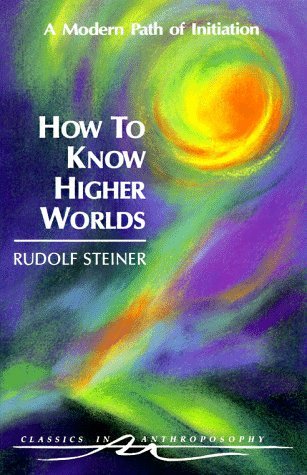
How to Know Higher Worlds: A Modern Path of Initiation
Published in 1904 (CW 10)
This is the classic account of the modern Western esoteric path of initiation made public by Steiner in 1904. He begins with the premise that “the capacities by which we can gain insights into the higher worlds lie dormant within each one of us.” Steiner carefully and precisely leads the reader from the cultivation of the fundamental soul attitudes of reverence and inner tranquility to the development of inner life through the stages of preparation, illumination, and initiation.
Steiner provides practical exercises of inner and outer observation and moral development. By patiently and persistently following his guidelines, new “organs” of soul and spirit begin to form, which reveal the contours of the higher worlds thus far concealed from us.
Steiner in this important work becomes a teacher, a counselor, and a friend whose advice is practical, clear, and effective. The challenges we face in life require increasingly deeper levels of understanding, and Steiner’s text helps readers to cultivate the capacities for such insights and places them at the service of humanity.
This is Steiner’s most essential guide to the modern path of initiation he advocated throughout his life. It has been translated into many languages and has inspired hundreds of thousands of readers around the world. How to Know Higher Worlds has been admired by some of the most brilliant minds of our time.
∞ ∞ ∞
Foreword by Arthur ZajoncPrefaces by Rudolf Steiner
1. How to Know Higher Worlds2. The Stages of Initiation3. Initiation4. Practical Considerations5. Requirements for Esoteric Training6. Some Effects of Initiation7. Changes in the Dream Life of the Esoteric Student8. Achieving Continuity of Consciousness9. The Splitting of the Personality in Esoteric Training10. The Guardian of the Threshold11. Life and The Great Guardian of the Threshold
Epilogue (1918)Afterword by Arthur ZajoncIndex
This volume is a translation from German of the written work Wie erlangt man Erkenntnisse der höheren Welten? (GA 10).
This is the classic account of the modern Western esoteric path of initiation made public by Steiner in 1904. He begins with the premise that “the capacities by which we can gain insights into the higher worlds lie dormant within each one of us.” Steiner carefully and precisely leads the reader from the cultivation of the fundamental soul attitudes of reverence and inner tranquility to the development of inner life through the stages of preparation, illumination, and initiation.
Steiner provides practical exercises of inner and outer observation and moral development. By patiently and persistently following his guidelines, new “organs” of soul and spirit begin to form, which reveal the contours of the higher worlds thus far concealed from us.
Steiner in this important work becomes a teacher, a counselor, and a friend whose advice is practical, clear, and effective. The challenges we face in life require increasingly deeper levels of understanding, and Steiner’s text helps readers to cultivate the capacities for such insights and places them at the service of humanity.
This is Steiner’s most essential guide to the modern path of initiation he advocated throughout his life. It has been translated into many languages and has inspired hundreds of thousands of readers around the world. How to Know Higher Worlds has been admired by some of the most brilliant minds of our time.
∞ ∞ ∞
Foreword by Arthur ZajoncPrefaces by Rudolf Steiner
1. How to Know Higher Worlds2. The Stages of Initiation3. Initiation4. Practical Considerations5. Requirements for Esoteric Training6. Some Effects of Initiation7. Changes in the Dream Life of the Esoteric Student8. Achieving Continuity of Consciousness9. The Splitting of the Personality in Esoteric Training10. The Guardian of the Threshold11. Life and The Great Guardian of the Threshold
Epilogue (1918)Afterword by Arthur ZajoncIndex
This volume is a translation from German of the written work Wie erlangt man Erkenntnisse der höheren Welten? (GA 10).
268 pages, Kindle Edition
First published January 1, 1904
About the author
Rudolf Steiner
4,459 books1,172 followersAuthor also wrote under the name Rudolph Steiner.
https://www.goodreads.com/author/show...
Rudolf Joseph Lorenz Steiner was an Austrian occultist, social reformer, architect, esotericist, and claimed clairvoyant. Steiner gained initial recognition at the end of the nineteenth century as a literary critic and published works including The Philosophy of Freedom. At the beginning of the twentieth century he founded an esoteric spiritual movement, anthroposophy, with roots in German idealist philosophy and theosophy. His teachings are influenced by Christian Gnosticism or neognosticism. Many of his ideas are pseudoscientific. He was also prone to pseudohistory.
In the first, more philosophically oriented phase of this movement, Steiner attempted to find a synthesis between science and spirituality. His philosophical work of these years, which he termed "spiritual science", sought to apply what he saw as the clarity of thinking characteristic of Western philosophy to spiritual questions, differentiating this approach from what he considered to be vaguer approaches to mysticism. In a second phase, beginning around 1907, he began working collaboratively in a variety of artistic media, including drama, dance and architecture, culminating in the building of the Goetheanum, a cultural centre to house all the arts. In the third phase of his work, beginning after World War I, Steiner worked on various ostensibly applied projects, including Waldorf education, biodynamic agriculture, and anthroposophical medicine.
Steiner advocated a form of ethical individualism, to which he later brought a more explicitly spiritual approach. He based his epistemology on Johann Wolfgang von Goethe's world view in which "thinking…is no more and no less an organ of perception than the eye or ear. Just as the eye perceives colours and the ear sounds, so thinking perceives ideas." A consistent thread that runs through his work is the goal of demonstrating that there are no limits to human knowledge.
https://www.goodreads.com/author/show...
Rudolf Joseph Lorenz Steiner was an Austrian occultist, social reformer, architect, esotericist, and claimed clairvoyant. Steiner gained initial recognition at the end of the nineteenth century as a literary critic and published works including The Philosophy of Freedom. At the beginning of the twentieth century he founded an esoteric spiritual movement, anthroposophy, with roots in German idealist philosophy and theosophy. His teachings are influenced by Christian Gnosticism or neognosticism. Many of his ideas are pseudoscientific. He was also prone to pseudohistory.
In the first, more philosophically oriented phase of this movement, Steiner attempted to find a synthesis between science and spirituality. His philosophical work of these years, which he termed "spiritual science", sought to apply what he saw as the clarity of thinking characteristic of Western philosophy to spiritual questions, differentiating this approach from what he considered to be vaguer approaches to mysticism. In a second phase, beginning around 1907, he began working collaboratively in a variety of artistic media, including drama, dance and architecture, culminating in the building of the Goetheanum, a cultural centre to house all the arts. In the third phase of his work, beginning after World War I, Steiner worked on various ostensibly applied projects, including Waldorf education, biodynamic agriculture, and anthroposophical medicine.
Steiner advocated a form of ethical individualism, to which he later brought a more explicitly spiritual approach. He based his epistemology on Johann Wolfgang von Goethe's world view in which "thinking…is no more and no less an organ of perception than the eye or ear. Just as the eye perceives colours and the ear sounds, so thinking perceives ideas." A consistent thread that runs through his work is the goal of demonstrating that there are no limits to human knowledge.
Ratings & Reviews
Friends & Following
Create a free account to discover what your friends think of this book!
Community Reviews
Displaying 1 - 30 of 140 reviews

July 2, 2011
Despite the seemingly poor translation, the heavy, sludge like writing of the early 1900s, and very little organization, this volume contains some of the most descriptive visualizations of supersensible phenomenon. Extremely detailed, often pontificating, and always slow reading, this book is screaming out for a modern translation, or even a remake. But although it took me 10 times longer than a book of similar length to finish, I have never received this level of knowledge from any source.

July 4, 2007
I learned that the path to true knowledge lies outside of the perception of our normal senses. The esoteric knowledge can only result in a quieting of our mind and a focus on the improvement of the individual within us while recognizing the dependence of ourself on the world around us and the traits of others. The meaning of life is the question and not the answer.

April 16, 2009
I have put various Steiner books on my goodbooks shelves - and have read more than I can track down here. Rudolph Steiner was a remarkable man whose unusual ideas about Occult History and the nature of man did not prevent him form leaving a formidable stamp on the practice of education, medicine and agriculture. Indeed it is because his ideas have worked so well (particularly in education - I did a study of a Steiner school for my MA and can attest to its success) in practical fields that it rasies the possibility that his other speculations have merit also. There is a wonderful resource on line that has all his published works available for download. I find that on many topics (of myth, religion, history, civilisation and so forth) he often had really interesting thisgs to stay. His lectures generally stimulate fresh thinking, which is hwat he intended when he gave them.
This was the first book of his that I read and it remains a favourite; I see I have attached it to the CD version, that was not intentional and I know it is still in print as a book.
This was the first book of his that I read and it remains a favourite; I see I have attached it to the CD version, that was not intentional and I know it is still in print as a book.

August 8, 2008
What can I say? Wow. If you ever want to read the very finest book ever written by a not-at-all-flaky clairvoyant scientist genius saintly guy, this would be my highest recommendation. It's almost too much to handle, especially the description of meeting The Guardian of the Threshold. And it's NON FICTION. Don't need no vampires to make this interesting.

February 27, 2010
Practical ways to apply more philosophical advice from Steiner. When I read this book, my life got really intense. Warning, if you don't want to be initiated, don't read this book. Seriously, every lesson I read in here gave me a life lesson as a test. Do you really want to become stronger spiritually? The golden road is a bitch, someone said that to me once, and it is so true. Reading this book will land you on the golden road. Worth it? I think so.

February 17, 2014
I've had this book sitting on my shelf for nearly 20 years. Even though I am familiar with much of Steiner's work, every time I attempted to read this over the years, something always seem to get in the way. I understand now the perfection of timing & the depth of readiness that was necessary for me to receive the knowledge contained in this wonderful book. A must for all serious students on the spiritual journey.

May 4, 2022
If I have said it once, I have said it a 1000 times, Rudolf Steiner is the next best thing to the Master Within. It is a shame that 100 years ago we were headed toward a new Age of Enlightenment until Henry Ford and other self proclaimed elites (whom I refer to as Dark Lodge members) decided this information should be kept from us plebeians. Now it takes a litcheral act of God for one of us to stumble upon the magnum opus of many soldiers a century ago. I think it bears repeating now what Steiner said 98 years ago about how very fucked we are today. “You must consider the whole part played by electricity in nature. Human beings cannot go on developing in the same way in an atmosphere permeated on all sides by electric currents and radiations. It has an influence on the whole development of man. This life of men in the midst of electricity, notably radiant electricity, will presently affect them in a such a way, that they will no longer be able to understand the news which they receive so rapidly. The effect is the damp down the intelligence. Such effects are already seen today. Even today you can notice how people understand the things that come to them with far greater difficulty than they did a few decades ago.”
I would like to point out how little electricity there was in 1908 compared to today’s wifi, 5G and now from Space! Thanks Elon. Wonder how they will weaponize Space X someday? The Master Within is telling me Sound Weapons, but the Master tends to be a liiiiiiiiiiiiiiiiiiiiittle Psychic these days as a Benevolent Lodge Trained Wizard.
I would like to point out how little electricity there was in 1908 compared to today’s wifi, 5G and now from Space! Thanks Elon. Wonder how they will weaponize Space X someday? The Master Within is telling me Sound Weapons, but the Master tends to be a liiiiiiiiiiiiiiiiiiiiittle Psychic these days as a Benevolent Lodge Trained Wizard.

June 13, 2008
This is the second time I've read this. It is more meaningful to me now than in the past.
February 7, 2013
This book captured my life for several years, and changed my way of thinking. I did find a lot of frustration in the practice of steiners ideas and philosophy which delves into the deep waters of Gnosticism, and esoteric metaphysics, as I tried to understand the methods. Still looking back, I know subtle changes did take place. The book does require a lot of introspection, and that is why it is hard to rate it as one would rate a book on its entertainment or literary merit.

February 27, 2015
Reminder that some religious beliefs that are against proper medication have killed many innocent yet ignorant people and those that force these ideals HAVE to stop and research actual biology or seek professional doctors and not con-artists that will lie in your face that your body's bad health is important for your magical powers.

June 12, 2011
This is a great way to listen to this book. Having it on tape made me understand it in a different way, and I listened to it over and over. This book really changed my life because it has exercises in it, that when applied, really work! I cannot recommend this enough, for any student of Anthroposophy, or someone interested in learning about the path of Anthroposophy.

April 4, 2013
Although the language may challange the reader from time to time, the knowledge inside this book is a real gem for the individuals walking on the spiritual path...

November 1, 2019
A fascinating and challenging work that provides direct instruction for how to gain increasing awareness and cognition of the "supersensible" realms. If you're a materialist then there's nothing here for you; but if you're not a materialist, then you recognize the importance of the mental and spiritual worlds that we all inhabit, even if you haven't really thought about them as things that can be actively explored, so to speak. This book tells you how to embark on that journey.
Why? Because man does not live by bread alone. We are spiritual beings, and, whether we know it or not, we are engaged in a long-term path of self perfection. One of the most thought-provoking revelations of this book, for this reader, was that although we are fundamentally spiritual beings, we can only improve our spiritual condition here in the physical world. Our time on Earth matters, every moment of it. So this book is really about how to make the most of it.
Why? Because man does not live by bread alone. We are spiritual beings, and, whether we know it or not, we are engaged in a long-term path of self perfection. One of the most thought-provoking revelations of this book, for this reader, was that although we are fundamentally spiritual beings, we can only improve our spiritual condition here in the physical world. Our time on Earth matters, every moment of it. So this book is really about how to make the most of it.

December 20, 2010
It is interesting to find all the accoutrements of 1980s New Age endeavors in a book first published in 1904! Meditation, chakras, auras, spirit bodies -- the whole shebang. The translation from the German was less than crystal clear, although I do not know if that is because of terminology or the ideas themselves. While I find the text too impenetrable to be useful for my own spiritual growth, it is an intriguing artifact in the history of culture and ideas.

February 18, 2012
What if the internet never existed and cocaine-fueled quacks were given legitimate platforms? Well, welcome to the true sub-text of Waldorf education! If these believers in Anthroposophy simply practiced their freedom of religion/speech/etc. that would be great! However, they pretend to be interested in the education of children, solely for their own eugenic means. Waldorf is a cult! Rudolph Steiner was a drug-addicted lunatic with racist affiliations.

November 27, 2012
A really, really good book that prepares the student and demystifies a lot of rumors and stigma from non-Occultists.

October 22, 2021
A very fuzzy guide that somehow, despite all that, makes sense. Go figure!

May 30, 2018
What are we to make of Steiner’s claims, much less of his curriculum for attaining verification? He is not a moonchild and a dreamer only, nor is he a scientist walking us through his experimental results. In a nutshell, he claims to be able to teach clairvoyance.
Steiner himself pre-empts our doubts about his work at the outset by explaining that it is scientific knowledge for someone who has developed the same abilities as he has, but to those who have not developed those abilities they must take his claims somewhat on faith. So this rhetorical double-bind leaves us relying on feelings and interactions to assess his work. Not a good start.
His path to cognitive verification involves feeling and making time for reflective veneration, devotion, wonder and awe. He says that recollection, quiet time, and tranquility - essentially the Buddhist idea of shamatha - helps develop supersensible cognition. He says we should develop spiritual ears and eyes - whatever that means - in order to verify his findings.
Chapter two concerns developing these organs of cognition in three stages.
In the first stage PREPARATION he makes three directions for developing this cognition: first by meditating on the inner feelings of flourishing and decaying, second by distinguishing the inner quality of living sound versus inanimate sound, and third by listening to other humans selflessly.
In the second stage ENLIGHTENMENT he directs us to cognise the order of a stone, plant, and animal; meditate on the inner nature of a seed and plant; strive to cognise the astral form of a human desire; strive to cognise the astral form of a fulfilled human desire. Many warnings about morality, silence, modesty and basic decency hedge these suggestions.
In the third stage INITIATION Steiner suddenly talks about all kinds of esotericism: three trials by fire, water and air. He talks about strength of character (fire), reliance on some kind of astral writing based on the grammar of the previous two stages (water), and some kind of initiatory commitment (air).
Chapter three gives advice on developing supersensible cognition successfully: patience, gentleness, stability, understanding, observation. Chapter four concerns itself with high quality morality as a help in this cognition.
Chapter five gives detailed advice for using thoughts and feelings to develop the chakras. It is long, detailed, technical, confusing, and a bit overwhelming.
Chapters 6&7 are a short dull digression on sleep and dream. This provides the basis for Chapter 8 where Steiner announces that thinking willing and feeling will become separate persons!
Chapter 9 presents an unusually poetic way of dealing with first personal then collective karma. It seems kind of oddball.
In the appendix he says that the proposed course of action occurs all in thought and the everyday self goes about its business while the inner life flourishes along quite different lines. He justifies the long chapter five on the chakra by saying that knowing these chakras enables one to be aware of their astral body without which one would be a baby.
What to say about all this? I think the main thing is to judge his work on a thorough test or else ignore his ideas. Also, it’s clear Steiner is talking about INNER practice only; spiritual trappings are the opposite of what he has in mind. So clearly he is suggesting an inner course of reflection and contemplation aimed at verifying non-physical realities. And it is up to the reader whether she wants to pursue that course of verification.
Steiner himself pre-empts our doubts about his work at the outset by explaining that it is scientific knowledge for someone who has developed the same abilities as he has, but to those who have not developed those abilities they must take his claims somewhat on faith. So this rhetorical double-bind leaves us relying on feelings and interactions to assess his work. Not a good start.
His path to cognitive verification involves feeling and making time for reflective veneration, devotion, wonder and awe. He says that recollection, quiet time, and tranquility - essentially the Buddhist idea of shamatha - helps develop supersensible cognition. He says we should develop spiritual ears and eyes - whatever that means - in order to verify his findings.
Chapter two concerns developing these organs of cognition in three stages.
In the first stage PREPARATION he makes three directions for developing this cognition: first by meditating on the inner feelings of flourishing and decaying, second by distinguishing the inner quality of living sound versus inanimate sound, and third by listening to other humans selflessly.
In the second stage ENLIGHTENMENT he directs us to cognise the order of a stone, plant, and animal; meditate on the inner nature of a seed and plant; strive to cognise the astral form of a human desire; strive to cognise the astral form of a fulfilled human desire. Many warnings about morality, silence, modesty and basic decency hedge these suggestions.
In the third stage INITIATION Steiner suddenly talks about all kinds of esotericism: three trials by fire, water and air. He talks about strength of character (fire), reliance on some kind of astral writing based on the grammar of the previous two stages (water), and some kind of initiatory commitment (air).
Chapter three gives advice on developing supersensible cognition successfully: patience, gentleness, stability, understanding, observation. Chapter four concerns itself with high quality morality as a help in this cognition.
Chapter five gives detailed advice for using thoughts and feelings to develop the chakras. It is long, detailed, technical, confusing, and a bit overwhelming.
Chapters 6&7 are a short dull digression on sleep and dream. This provides the basis for Chapter 8 where Steiner announces that thinking willing and feeling will become separate persons!
Chapter 9 presents an unusually poetic way of dealing with first personal then collective karma. It seems kind of oddball.
In the appendix he says that the proposed course of action occurs all in thought and the everyday self goes about its business while the inner life flourishes along quite different lines. He justifies the long chapter five on the chakra by saying that knowing these chakras enables one to be aware of their astral body without which one would be a baby.
What to say about all this? I think the main thing is to judge his work on a thorough test or else ignore his ideas. Also, it’s clear Steiner is talking about INNER practice only; spiritual trappings are the opposite of what he has in mind. So clearly he is suggesting an inner course of reflection and contemplation aimed at verifying non-physical realities. And it is up to the reader whether she wants to pursue that course of verification.
This entire review has been hidden because of spoilers.

February 7, 2016
There's real empirical heft to the teachings here. It's kind of grounded. And some of what is being transmitted here is a little bit real. There is energy in the text.
Steiner wrote this before the first World War. Whole worlds away in terms of culture and consciousness. The only really meaningful experience of this book for me was an attempt to empathize with the awareness that could have produced it. The late edition's serial prefaces aid in this.
Steiner demonstrates a creative spiritual intelligence that truly inspires. Some of his personal understanding of layers of consciousness connects with insights that career meditators and hallucinators would not write about for many decades to come. The intelligent combination of mental clarity and spacious awareness makes for a good read even when he seems to gets a little lost in his own idiolect. His constant exhortation that the clairvoyant play MUST NOT take one away from daily life helps explain the worldly legacy he left through writing and institution building, and in this there is a sort of early 20th century grit amid all the chakra spinning.
But to what end? Ultimately Steiner seems to think clairvoyance is a gift from the dubious disembodied ghosts of the astral realms. The book is a preparation to make yourself into a channel for whatever or whoever wants to borrow your bodymind. That's dubious, especially given Steiner's exhortation not to depend on a teacher but to open up your consciousness to occupation. That said, who knows, maybe the astral realms weren't such a dive a hundred years back.
Some of the techniques Steiner offers for dilating the upper chakras are genuinely creative. His warnings against cult tendencies and loss of personal responsibility are more than a little prescient with Crowley and the Theosophists on the horizon. It is wonderful to imagine how readers a hundred years ago might have been opened up to new feelings of the cosmos as a result of Steiner's... clairvoyance.

January 23, 2015
This was one of the first books that led me to spirituality and still remember its first sentence by heart: "There slumber, in every human being, faculties by means of which the knowledge of the higher worlds is attained..." I loved the archaic language it was written in, and felt like I was uncovering a hidden treasure.
Eager to experience some of this hidden potential within me, I immediately put some of it to practice, for example about observing the forces of death and life in everything. I also really liked the chapter on chakras, and how they are slowly developing in us accordingly to our inner merits. How, for example by lying, the petals of some of these chakras become crooked and don't develop harmoniously, which then causes us to have twisted perception of the higher worlds. However, after a while I realized that it didn't provide very detailed descriptions or methods to achieve inner transformation and awakening, maybe due to the time it was published, where some things had still to be kept hidden.
Despite the mentioned limitations, I found a lot of truth in this book and would definitely recommend it to anyone just starting to delve into the mysteries of higher worlds.
Eager to experience some of this hidden potential within me, I immediately put some of it to practice, for example about observing the forces of death and life in everything. I also really liked the chapter on chakras, and how they are slowly developing in us accordingly to our inner merits. How, for example by lying, the petals of some of these chakras become crooked and don't develop harmoniously, which then causes us to have twisted perception of the higher worlds. However, after a while I realized that it didn't provide very detailed descriptions or methods to achieve inner transformation and awakening, maybe due to the time it was published, where some things had still to be kept hidden.
Despite the mentioned limitations, I found a lot of truth in this book and would definitely recommend it to anyone just starting to delve into the mysteries of higher worlds.

Read
June 30, 2022Love > critique
Progress = trials
See with the eyes of the heart. Hear with the ears of the soul.
Progress = trials
See with the eyes of the heart. Hear with the ears of the soul.

Read
January 21, 2025I expected more of a philosophical approach, instead it was manual-like. Definitely did have some interesting things in it.
Though I try to keep an open mind, some other things in here didn’t resonate all that much. I think it can be limiting to follow rules that are based on ancient mystics and manuscripts, humanity is different now, sure at the core we might still be the same but the way we approach life has completely changed. This why I say: move forward. Respect traditions but don’t be afraid to break them when finding your own way. This is not to say that traditional methods don’t have valuable aspects, I’m simply against copying everything.
Overall still interesting to read a different perspective, I would have enjoyed it more if it had a freer writing style
Though I try to keep an open mind, some other things in here didn’t resonate all that much. I think it can be limiting to follow rules that are based on ancient mystics and manuscripts, humanity is different now, sure at the core we might still be the same but the way we approach life has completely changed. This why I say: move forward. Respect traditions but don’t be afraid to break them when finding your own way. This is not to say that traditional methods don’t have valuable aspects, I’m simply against copying everything.
Overall still interesting to read a different perspective, I would have enjoyed it more if it had a freer writing style

Read
December 29, 2024When I was a kid, my dad told me once about having read a book and starting to do the activities recommended in the book, and that it scared him and so he stopped. I never forgot him telling me that. Then, years later, I asked him what book that was, and he claimed that he didn’t know what I was talking about, and that he never said that. But then more recently, I brought it up to him again, and this time, perhaps because he’s getting old and forgetting things, he just instantly sent me a link to this book. So this was the book that scared my dad.
Let me tell you a little bit more about my dad: he spent much of his youth as something of a spiritual investigator. It was the 70s, he joined a cult, he got out of the cult, he meditated, he went to different types of religious services, the whole 9 yards.
He raised us kids without any religion whatsoever. And I was an atheist of the highest order. I wrote articles about it in my college newspaper. I truly didn’t believe in any sort of supernatural phenomenon. And now I’m in my 40s and I’m once again learning a lesson that I have learned many times before, yet I’m still surprised every time I learn it again, which is that everything that I reject the hardest I will eventually embrace. Now I do believe in supernatural occurrences, although I am hesitant to say something like “I believe in ghosts and haunting“ when, in reality, I have no notion of what exactly causes supernatural phenomena and therefore feel a little silly labeling something a “ghost.” All I know is that there is a lot of weird shit out there, that clairvoyance and telepathy do exist, and I strongly suspect suspect that all religions have the capacity to allow their followers to tap into something real that is bigger than any of us. In fact, I think it is all of us. I think we are all one. Or something like that.
Anyway, I gave this book a quick read. I have not tried any of the activities laid in the book. I don’t believe that I am in the right headspace to do it right now. Steiner talks a lot about how you should only do these things if you are coming at them from a non-selfish, help-everyone-in-the-world kind of place. That’s simply not how I’m feeling right now. I have a lot of anger and a lot of desire to see many people come to harm. I’m just being honest here.
I do intend to come back to this book. I’m getting into meditation. Once I feel more comfortable with that, I will read this book again.
Let me tell you a little bit more about my dad: he spent much of his youth as something of a spiritual investigator. It was the 70s, he joined a cult, he got out of the cult, he meditated, he went to different types of religious services, the whole 9 yards.
He raised us kids without any religion whatsoever. And I was an atheist of the highest order. I wrote articles about it in my college newspaper. I truly didn’t believe in any sort of supernatural phenomenon. And now I’m in my 40s and I’m once again learning a lesson that I have learned many times before, yet I’m still surprised every time I learn it again, which is that everything that I reject the hardest I will eventually embrace. Now I do believe in supernatural occurrences, although I am hesitant to say something like “I believe in ghosts and haunting“ when, in reality, I have no notion of what exactly causes supernatural phenomena and therefore feel a little silly labeling something a “ghost.” All I know is that there is a lot of weird shit out there, that clairvoyance and telepathy do exist, and I strongly suspect suspect that all religions have the capacity to allow their followers to tap into something real that is bigger than any of us. In fact, I think it is all of us. I think we are all one. Or something like that.
Anyway, I gave this book a quick read. I have not tried any of the activities laid in the book. I don’t believe that I am in the right headspace to do it right now. Steiner talks a lot about how you should only do these things if you are coming at them from a non-selfish, help-everyone-in-the-world kind of place. That’s simply not how I’m feeling right now. I have a lot of anger and a lot of desire to see many people come to harm. I’m just being honest here.
I do intend to come back to this book. I’m getting into meditation. Once I feel more comfortable with that, I will read this book again.

October 23, 2020
This is the first book by Mr. Steiner that I've read, I recommend it for those who want to learn more on their spiritual paths. A pleasant read that encompasses many subjects that I'm interested in. I was intuitively drawn to it, and , though I don't know yet how it correlates with other works of R. Steiner, as a stand alone piece, it is a comprehensive guide for the sincere seeker.
~~~
Completely off-topic now. Maybe someone needs to hear this "Not all those who wander are lost"
<3
Dream the words...
~~~
Completely off-topic now. Maybe someone needs to hear this "Not all those who wander are lost"
<3
Dream the words...

April 1, 2012
The fourth Steiner book I've read and one of the most straight-forward. Made a lot of good points and always has an interesting and thought provoking perspective. I enjoyed reading this, i like the ideas. Unlike Bees and Agriculture, this is not a series of lectures. Organized as a progression from the starting point as a novice this book doesn't have the asides that the lectures experienced by fielding questions from the audience.

August 25, 2017
The same exercises Steiner recommends can easily be duplicated by meditation on all the parables of Jesus on the Kingdom of Heaven. It would be a much cleaner and purer way of developing that seed within.
I enjoy Steiner's writing, but it ultimately leads souls away from Jesus and Christianity, even though he became very fond of Christianity late in his career.
I enjoy Steiner's writing, but it ultimately leads souls away from Jesus and Christianity, even though he became very fond of Christianity late in his career.
March 26, 2021
Wowowow. I didn’t expect this book to be so great. I am so grateful for life to have led me to Janine’s farm in France, where I found and read this book (among so many others) and was able to get into Steiner. What an interesting man. I am still a bit skeptical, but nevertheless many of his teachings are pure gold. And, interestingly, much of it corresponds in some way to the streams of Eastern thought I have come to love and follow.
So…
First of all, here are Steiner’s 10 commandments:
Gentleness
Reverence (Love)
Feeling
Stillness
Equanimity
Presence
Discernment (Truth)
Self-control
Surrender
Empowerment
… and now some rules for the path to higher knowledge...
Rule #1: Devotion to Truth
Willpower, truthfulness, earnestness.
Rule #2: Focus on the inner experience
Silence the outer life, let the inner life sing.
It is crazy how similar much of this is to the Recognition school of classical Tantra displayed by Christopher Wallis - for example the meditation on savoring the flavor of the experience and following its flow (without jumping to another experience) until it dissolves into stillness. Here Steiner says that "it is necessary that he should seek enjoyment, for only through enjoyment can the outer world reach him. [...] The student of higher knowledge considers enjoyment only as a means of ennobling himself for the world. Pleasure is to him as a scout informing him concerning the world; but once instructed by pleasure, he passes on to work. He does not learn in order to accumulate learning as his own treasure, but not to occupy in order that he may devote his learning to the service of the world."
Concerning knowledge, he continues: "Every knowledge pursued merely for the enrichment of personal learning and the accumulation of personal treasure, leads you away from the path; but all knowledge pursued for growth to ripeness within the process of human ennoblement and cosmic development, brings you a step forward." Or: "Every idea which does not become your ideal, slays a force in your soul; every idea which becomes your ideal, creates within you life-forces."
Rule #2.1: Develop inner tranquility
A sweet, bit naive/innocent/superficial description of meditation or meditative contemplation (compared to the Tantrik approach, for example) follows.
Rule #2.2: Cultivate clear thoughts (the soul's landscape)
This is pretty much parallel to pure vikalpas in Tantra. Steiner doesn't seem to seek to transcend them eventually, but rather let them become the inner landscape and source of wisdom (-> Pratibha?)
And now: Steiner's Spiritual Science.
"Spiritual science gives the means of developing the spiritual ears and eyes, and kindling the spiritual light"
Stage 1: Probation
Turning inside, deepening experience.
"A strict and definite cultivation of the life of thought and feeling through which the psychic-spiritual 'body' becomes equipped with organs of sense activity, in the same way that natural forces have fitted the physical body with organs built out of indeterminate living matter."
Practice: Having attention on the creation/unfolding/flourishing and the dissolution/fading/dying of events in the world. With a one-pointed attention, surrendering oneself to this one event/impression, "marinating" in the inner feeling-vibration that is evoked through the impression - listening to its flavor. What a parallel to Tantrik practice!
"Yet it must not be thought that much progress can be made if the senses are blunted to the world. First look at the things as keenly and as intently as you possibly can; then only let the feeling which expands to life, and the thought which arises in the soul, take procession of you. The point is that the attention should be directed with perfect inner balance, upon both phenomena."
The practicioner will be able to experience a new and deeper layer of thoughts and feelings. The more attention, the more vivid the soul's thoughts and feelings. Steiner says that growing and decaying evoke different kinds of inner feelings: That of a sunrise, and that of a moonrise, respectively. Surrendering to these feelings, one awakens to the "soul-world" or "astral plane", where the impressions of growth and decay transform into distinct spiritual lines and figures (with different forms for each phenomenon). This is the door into the next stage, that of perceiving "things which have no corresponding physical existence, and which therefore remain entirely hidden (occult) from those who have not received suitable instruction and training."
Important: No interpreting or intellectualizing. The student "should look out in the world with keen, healthy senses, and quickened power of observation, and then give himself up to the feeling that arises within him. He should not try to make out, through intellectual speculation, what the things mean, but rather allow the things themselves to tell him."
Steiner remarks that "artistic feeling" is the best condition for the development of spiritual faculties, surpassing superficiality into the depths of the things' secrets.
Also important: One should be clear about the veritable reality of feelings and thoughts: "In the soul- and thought-world, feelings and thoughts react upon each other just as physical objects react upon each other in the physical world. As long as the student is not vividly permeated with this consciousness, he will not believe that a wrong thought in his mind may have as devastating an effect upon other thoughts that spread life in the thought-world, as the effect wrought by a bullet fired at random, upon the physical objects it hits. He will perhaps never allow himself to perform a physically visible action which he considers to be wrong, though he will not shrink from harboring wrong thoughts and feelings, when these appear harmless to he rest of the world. There can be no progress, however, on the path to higher knowledge, unless we guard our thoughts and feelings in just the same way as we guard our steps in the physical world." - now if that isn't next level positive psychology!
Also: Conscious listening - especially to the sounds of living bodies. These not only produce a feeling in us, like all sounds, but also let us sense the inward experience of that living creature - the sound telling a story of experience that is outside one's own soul. The student then must unite his own feeling with the feeling of pleasure or pain that is perceived in the sound, disregarding personal attraction or aversion to the sound (this intermingling is easier for a person sensitive to music). Thus, "through her resounding tones, the whole of nature begins to whisper her secrets to the student. What was hitherto merely incomprehensible noise to his soul, will become by this means a coherent language of nature.“
Another part of listening consciously is also, of course, listening to others when they speak: it must be done with absolute inner silence, equanimity, and selflessness. „The student feels it his duty to listen, by way of practice, at certain times, to the most contradictory views, and, at the same time, entirely to bring to silence all assent, and, more especially, all adverse criticism.“ A wonderful way to practice this is to listen to children - „for even the wisest can learn incalculably much from children.“
Stage 2: Enlightenment
Beholding impermanence.
Continuing the process of the Probation stage, by deeply looking into the workings of nature (especially birth and death = impermanence), and sinking deeply into the inner feelings they evoke, one develops „spiritual eyes“. By this the world becomes „enlightened“: One starts to see the colors, lines and figures of the spiritual world, in the material world, and over time one also notices the spiritual beings.
The control of thoughts and feelings:
„Everyone must say to himself: ‚In my own world of thought and feeling, the deepest mysteries lie hidden, only hitherto I have been unable to perceive them.’ […] Hence it is highly important to give the proper direction to thoughts and feelings, for then only can the perception be developed of all that is invisible in ordinary life.“ One does this by concentrating thought and feeling on the invisible „force of life“ (= desire?) that is hidden inside all things, that makes them grow and unfold, express their nature, whither and die, recycle and create new life, and so on. Allowing the inner feeling coupled with this thought to sink in, an „inner force“ is awakened in the student, allowing new powers of perception.
While doing this kind of spiritual research, „it is necessary that the student should lose none of his qualities as a good and noble man, or his receptivity for all physical reality." „The necessity must be emphasized of maintaining unimpaired and of perpetually cultivating that healthy sound sense which distinguishes truth from illusion.“ This discernment is crucial, shaping the way for the "true path of knowledge".
Steiner mentions a golden rule of spiritual research: „For every one step that you take in the pursuit of higher knowledge, take three steps in the perfection of your own character.“ It seems that this is generally Steiner’s way of self-transformation: the „acquisition of knowledge is not the end, but the means to the end; the latter consists in the attainment, thanks to this knowledge of the higher worlds, of greater and truer self-confidence, of a higher degree of courage and magnanimity and perseverance such as cannot, as a rule, be acquired in the lower world.“ - in other words, EMPOWERMENT.
„Courage and self-confidence are two beacons which must never be extinguished on the path to higher knowledge. No one will ever travel far who cannot bring himself to repeat, over and over again, an exercise which has failed, apparently, for a countless number of times. Long before any distinct perception of progress, there rises, in the student, from the hidden depths of the soul, a feeling that he is on the right path. This feeling should be cherished and fostered, for it can develop into a trustworthy guide.“
Steiner also repeatedly mentions the importance of observing silence concerning one’s spiritual experiences, keeping it all for oneself. „Do not attempt to clothe in words what you contemplate in the spirit, or to pore over it with clumsy intellect. Lend yourself freely and without reservation to these spiritual impressions, and do not disturb them by reflecting and pondering over them too much. For you must remember that your reasoning faculties are, to begin with, by no means equal to your new experience."
Stage 3: Initiation
Developing higher wisdom.
There are multiple steps and trials the would-be Initiate must go through:
The 'Fire-Trial': „The would-be Initiate proceeds to learn how the objects of nature and being gifted with life manifest themselves to the spiritual ear and the spiritual eye. In a certain way, these things then lie disclosed - naked - before the beholder. The qualities which can then be seen and heard are concealed from the physical eyes and ears. For physical perception they are enwrapped as in a veil, and the falling away of this veil for the would-be Initiate consists in a process designated as the process of ‚Purification by Fire‘“ - wow, that sounds so yogic!
The new spiritual sign-language: „The candidate grows into clairvoyant knowledge, in an appropriate way, and, during this growth, a new strength is developed in his soul, as a new faculty, through which he feels himself impelled to decipher the occurrences and the beings of the spiritual world like characters of a writing.“ These „signs" correspond to the forms, colors, figures, etc which the student has learned to perceive in the Probation and Enlightenment stages. „He realized that all he learnt previously was only like learning how to spell, and that he is only now beginning to read in the higher worlds.“ This new language comes with certain rules of conduct and duties, allowing him to act „from out of the higher worlds“, for the good of humanity.
The ‚Water Trial": This inner call of duty moves the student to perform a specific action. „The nature of this action can be understood by means of the hidden writing with which he is now familiar. If he recognizes his duty and acts rightly, his Trial has been successful. The success can be recognized in the alteration produced by his actions in the figures, colors and tones apprehended by his spiritual eyes and ears.“ Without support from outward circumstances, the student is now „floating“ in his activity in the higher worlds, thus making this the ‚Water Trial‘.
Again, importance lies on the purity and inner authenticity of the activity: the student must not in any way introduce any personal ideas, feelings, desires, etc., or else the whole process would be distorted and the sight of the „goal" lost. It is all about the development of self-control - again, how yogic! Steiner here says that „anyone having acquired the faculty of following high principles and ideas, while putting into the background all personal predilection; anyone capable of always performing his duty, with inclinations and sympathies only too ready to seduce him from his duty - such a one is unconsciously an Initiate in the midst of ordinary life.“ One must by now have thoroughly cultivated his faculty of discernment in order to progress further on the path: „Every prejudice, every cherished opinion with regard to the things in question, must vanish; truth alone must guide. […] Dreamers and fantastical people are as unfit for the path to higher knowledge as superstitious people.“ „It is better for the student to be matter-of-fact than excitable and fantastic."
The ‚Air Trial‘: Without rules or goal, this 'indefinite' trial is about finding, sinking into and following the voice of the higher self, the spirit. Steiner says that here for the student „there is no time for doubt or hesitation. Every minute of hesitation would prove that he was still unfit. Whatever prevents him from listening to the voice of the spirit must be eradicated. It is a question of showing presence of mind in this situation, and the training at this stage is concerned with the perfect development of this quality.“ So one could call this the stage of conscious surrender - and it results in „a moment of supreme happiness“. In Tantrik terms, this seems to be the stage of finding ‚pratibha‘. And because there is even less hold and support as in the previous trials, this one is called the ‚Air Trial‘.
Entering the ‚Temple of Higher Wisdom‘, which includes:
The ‚draught of forgetfulness‘: Applying the higher knowledge for the service of humanity - but only this knowledge that springs forth from the spirit in every moment. All other knowledge, e.g. memory, opinions, etc, shall be laid aside, „forgotten". The Initiate „must have full faith in the immediate present." This doesn’t mean fully renouncing memory, but the „ability of judging every new experience wholly according to what is inherent in it, and of letting it react upon him, unobscured by the past. We must be prepared at every moment, that every object and every being shall bring to us some new revelation.“ - in other words, living in the moment with a ‚beginner’s mind‘. „Opinions“ shall only be formed once an absolute (spiritual) Truth has been realized.
The ‚draught of remembrance‘: The Initiate "acquires the faculty of retaining the knowledge of higher truths ever present in his soul.“
Steiner says: „We must unite ourselves and become as one with the higher truths. We must not only know them, but be able, quite as a matter of course, to manifest and administer them in living actions, even as we ordinarily eat and drink. They must become our practice, our habit, our inclination. There must be no need to keep thinking about them, in the ordinary sense: they must come to living expression through man himself; they must flow through him as the functions of life through his organism.“
What else?
* Patience and equanimity
* Integrity and self-honesty („There is only one way to get rid of faults and failings, and that is, by a just recognition of them“)
* Letting curiosity (as a selfish thirst for knowledge) fall away, only asking for knowledge in service of evolution (keeping the delight in and devotion to knowledge, but no attachment to the ends)
* Transforming desire through right knowledge, otherwise silencing it („Do not desire at all until you know what is right in any one sphere“)
* Getting rid of emotional/psychological hindrances: anger, timidity, superstition, prejudice, vanity, tendencies of preaching and judging
* Conscious speech (every word must be considered) and sensitivity in conversation (the person's state must be considered) - always thinking: „The importance lies not in the difference of our opinions but in his discovering what is right if I contribute something towards it"
* Gentleness
* Subtlety and depth of awareness (sinking into stillness) - but at the same time filtering out everything that is not in the focus of attention
* Acceptance
* Trust in goodness
* Environment supporting spiritual growth - preferably nature (which „develops the inner organs in a harmony which can never ensue in a modern city“)
* Studying sacred scripture
* Earnestness and dedication - personal willingness to go through struggle in order to find Truth
* Concentration and meditation
* Holistic Health: Advancement of bodily, mental and spiritual health („sound knowledge can alone proceed from sound human beings“), using pleasure (and pain) only as a means to improve health (= harmony) and wisdom (-> no indulgence and excitement, and no unauthentic renunciation)
* Interbeing: Feeling co-ordinated as a link in the whole of life, all as one (leading to compassion)
* Inner alignment: Thoughts and feelings are as important for the world (in a beneficial or destructive way) as actions
* Faith in spirit and its essentiality (vs. the physical world), allowing distinction between inner duty and outer success (one cannot be directly measured by the other), and finding a „spiritual balance“ between an „open heart for the needs of the outer world“ and an „inner fortitude and unfaltering endurance"
* Selfless steadfastness and perseverance in carrying out a resolution (coming out of Truth)
* Love for work: loving the action itself (the means), not the results (the ends)
* Gratitude
So what?
* Activation and alignment of the chakras - the beginning of clairvoyance, as the chakras are the sense organs of the soul
* Perception of specific desires, ideas, feelings, moods, and other aspects in other people in the form of (spiritual) colors, shapes, sensations, etc
* Perception of spiritual atmospheres of places
* Intercourse with beings of higher worlds
* Entering the spiritual world, allowing for a true understanding of spiritual truths and for the wisdom and will of the spiritual world to directly flow through into the physical world, acting for the benefit of all
* True discernment between truth and illusion
* Disconnecting and separating the powers of willing (desire), feeling, and thinking, and taking away their power (to evoke a reaction), resulting in true equanimity
* Unfolding inner freedom/liberation (from the illusion of individuality and its bounds)
* The ability to see one’s inner world as the outside world (turning inside-out) and to control it accordingly
* Direct knowledge of one’s higher Self (and thus realizing one’s immortality and oneness with everything)
* Coming alive and transformation of one’s dream life and fully lucid dreams - „the difference between dream and waking consciousness grows ever smaller"
Nice.
So…
First of all, here are Steiner’s 10 commandments:
Gentleness
Reverence (Love)
Feeling
Stillness
Equanimity
Presence
Discernment (Truth)
Self-control
Surrender
Empowerment
… and now some rules for the path to higher knowledge...
Rule #1: Devotion to Truth
Willpower, truthfulness, earnestness.
Rule #2: Focus on the inner experience
Silence the outer life, let the inner life sing.
It is crazy how similar much of this is to the Recognition school of classical Tantra displayed by Christopher Wallis - for example the meditation on savoring the flavor of the experience and following its flow (without jumping to another experience) until it dissolves into stillness. Here Steiner says that "it is necessary that he should seek enjoyment, for only through enjoyment can the outer world reach him. [...] The student of higher knowledge considers enjoyment only as a means of ennobling himself for the world. Pleasure is to him as a scout informing him concerning the world; but once instructed by pleasure, he passes on to work. He does not learn in order to accumulate learning as his own treasure, but not to occupy in order that he may devote his learning to the service of the world."
Concerning knowledge, he continues: "Every knowledge pursued merely for the enrichment of personal learning and the accumulation of personal treasure, leads you away from the path; but all knowledge pursued for growth to ripeness within the process of human ennoblement and cosmic development, brings you a step forward." Or: "Every idea which does not become your ideal, slays a force in your soul; every idea which becomes your ideal, creates within you life-forces."
Rule #2.1: Develop inner tranquility
A sweet, bit naive/innocent/superficial description of meditation or meditative contemplation (compared to the Tantrik approach, for example) follows.
Rule #2.2: Cultivate clear thoughts (the soul's landscape)
This is pretty much parallel to pure vikalpas in Tantra. Steiner doesn't seem to seek to transcend them eventually, but rather let them become the inner landscape and source of wisdom (-> Pratibha?)
And now: Steiner's Spiritual Science.
"Spiritual science gives the means of developing the spiritual ears and eyes, and kindling the spiritual light"
Stage 1: Probation
Turning inside, deepening experience.
"A strict and definite cultivation of the life of thought and feeling through which the psychic-spiritual 'body' becomes equipped with organs of sense activity, in the same way that natural forces have fitted the physical body with organs built out of indeterminate living matter."
Practice: Having attention on the creation/unfolding/flourishing and the dissolution/fading/dying of events in the world. With a one-pointed attention, surrendering oneself to this one event/impression, "marinating" in the inner feeling-vibration that is evoked through the impression - listening to its flavor. What a parallel to Tantrik practice!
"Yet it must not be thought that much progress can be made if the senses are blunted to the world. First look at the things as keenly and as intently as you possibly can; then only let the feeling which expands to life, and the thought which arises in the soul, take procession of you. The point is that the attention should be directed with perfect inner balance, upon both phenomena."
The practicioner will be able to experience a new and deeper layer of thoughts and feelings. The more attention, the more vivid the soul's thoughts and feelings. Steiner says that growing and decaying evoke different kinds of inner feelings: That of a sunrise, and that of a moonrise, respectively. Surrendering to these feelings, one awakens to the "soul-world" or "astral plane", where the impressions of growth and decay transform into distinct spiritual lines and figures (with different forms for each phenomenon). This is the door into the next stage, that of perceiving "things which have no corresponding physical existence, and which therefore remain entirely hidden (occult) from those who have not received suitable instruction and training."
Important: No interpreting or intellectualizing. The student "should look out in the world with keen, healthy senses, and quickened power of observation, and then give himself up to the feeling that arises within him. He should not try to make out, through intellectual speculation, what the things mean, but rather allow the things themselves to tell him."
Steiner remarks that "artistic feeling" is the best condition for the development of spiritual faculties, surpassing superficiality into the depths of the things' secrets.
Also important: One should be clear about the veritable reality of feelings and thoughts: "In the soul- and thought-world, feelings and thoughts react upon each other just as physical objects react upon each other in the physical world. As long as the student is not vividly permeated with this consciousness, he will not believe that a wrong thought in his mind may have as devastating an effect upon other thoughts that spread life in the thought-world, as the effect wrought by a bullet fired at random, upon the physical objects it hits. He will perhaps never allow himself to perform a physically visible action which he considers to be wrong, though he will not shrink from harboring wrong thoughts and feelings, when these appear harmless to he rest of the world. There can be no progress, however, on the path to higher knowledge, unless we guard our thoughts and feelings in just the same way as we guard our steps in the physical world." - now if that isn't next level positive psychology!
Also: Conscious listening - especially to the sounds of living bodies. These not only produce a feeling in us, like all sounds, but also let us sense the inward experience of that living creature - the sound telling a story of experience that is outside one's own soul. The student then must unite his own feeling with the feeling of pleasure or pain that is perceived in the sound, disregarding personal attraction or aversion to the sound (this intermingling is easier for a person sensitive to music). Thus, "through her resounding tones, the whole of nature begins to whisper her secrets to the student. What was hitherto merely incomprehensible noise to his soul, will become by this means a coherent language of nature.“
Another part of listening consciously is also, of course, listening to others when they speak: it must be done with absolute inner silence, equanimity, and selflessness. „The student feels it his duty to listen, by way of practice, at certain times, to the most contradictory views, and, at the same time, entirely to bring to silence all assent, and, more especially, all adverse criticism.“ A wonderful way to practice this is to listen to children - „for even the wisest can learn incalculably much from children.“
Stage 2: Enlightenment
Beholding impermanence.
Continuing the process of the Probation stage, by deeply looking into the workings of nature (especially birth and death = impermanence), and sinking deeply into the inner feelings they evoke, one develops „spiritual eyes“. By this the world becomes „enlightened“: One starts to see the colors, lines and figures of the spiritual world, in the material world, and over time one also notices the spiritual beings.
The control of thoughts and feelings:
„Everyone must say to himself: ‚In my own world of thought and feeling, the deepest mysteries lie hidden, only hitherto I have been unable to perceive them.’ […] Hence it is highly important to give the proper direction to thoughts and feelings, for then only can the perception be developed of all that is invisible in ordinary life.“ One does this by concentrating thought and feeling on the invisible „force of life“ (= desire?) that is hidden inside all things, that makes them grow and unfold, express their nature, whither and die, recycle and create new life, and so on. Allowing the inner feeling coupled with this thought to sink in, an „inner force“ is awakened in the student, allowing new powers of perception.
While doing this kind of spiritual research, „it is necessary that the student should lose none of his qualities as a good and noble man, or his receptivity for all physical reality." „The necessity must be emphasized of maintaining unimpaired and of perpetually cultivating that healthy sound sense which distinguishes truth from illusion.“ This discernment is crucial, shaping the way for the "true path of knowledge".
Steiner mentions a golden rule of spiritual research: „For every one step that you take in the pursuit of higher knowledge, take three steps in the perfection of your own character.“ It seems that this is generally Steiner’s way of self-transformation: the „acquisition of knowledge is not the end, but the means to the end; the latter consists in the attainment, thanks to this knowledge of the higher worlds, of greater and truer self-confidence, of a higher degree of courage and magnanimity and perseverance such as cannot, as a rule, be acquired in the lower world.“ - in other words, EMPOWERMENT.
„Courage and self-confidence are two beacons which must never be extinguished on the path to higher knowledge. No one will ever travel far who cannot bring himself to repeat, over and over again, an exercise which has failed, apparently, for a countless number of times. Long before any distinct perception of progress, there rises, in the student, from the hidden depths of the soul, a feeling that he is on the right path. This feeling should be cherished and fostered, for it can develop into a trustworthy guide.“
Steiner also repeatedly mentions the importance of observing silence concerning one’s spiritual experiences, keeping it all for oneself. „Do not attempt to clothe in words what you contemplate in the spirit, or to pore over it with clumsy intellect. Lend yourself freely and without reservation to these spiritual impressions, and do not disturb them by reflecting and pondering over them too much. For you must remember that your reasoning faculties are, to begin with, by no means equal to your new experience."
Stage 3: Initiation
Developing higher wisdom.
There are multiple steps and trials the would-be Initiate must go through:
The 'Fire-Trial': „The would-be Initiate proceeds to learn how the objects of nature and being gifted with life manifest themselves to the spiritual ear and the spiritual eye. In a certain way, these things then lie disclosed - naked - before the beholder. The qualities which can then be seen and heard are concealed from the physical eyes and ears. For physical perception they are enwrapped as in a veil, and the falling away of this veil for the would-be Initiate consists in a process designated as the process of ‚Purification by Fire‘“ - wow, that sounds so yogic!
The new spiritual sign-language: „The candidate grows into clairvoyant knowledge, in an appropriate way, and, during this growth, a new strength is developed in his soul, as a new faculty, through which he feels himself impelled to decipher the occurrences and the beings of the spiritual world like characters of a writing.“ These „signs" correspond to the forms, colors, figures, etc which the student has learned to perceive in the Probation and Enlightenment stages. „He realized that all he learnt previously was only like learning how to spell, and that he is only now beginning to read in the higher worlds.“ This new language comes with certain rules of conduct and duties, allowing him to act „from out of the higher worlds“, for the good of humanity.
The ‚Water Trial": This inner call of duty moves the student to perform a specific action. „The nature of this action can be understood by means of the hidden writing with which he is now familiar. If he recognizes his duty and acts rightly, his Trial has been successful. The success can be recognized in the alteration produced by his actions in the figures, colors and tones apprehended by his spiritual eyes and ears.“ Without support from outward circumstances, the student is now „floating“ in his activity in the higher worlds, thus making this the ‚Water Trial‘.
Again, importance lies on the purity and inner authenticity of the activity: the student must not in any way introduce any personal ideas, feelings, desires, etc., or else the whole process would be distorted and the sight of the „goal" lost. It is all about the development of self-control - again, how yogic! Steiner here says that „anyone having acquired the faculty of following high principles and ideas, while putting into the background all personal predilection; anyone capable of always performing his duty, with inclinations and sympathies only too ready to seduce him from his duty - such a one is unconsciously an Initiate in the midst of ordinary life.“ One must by now have thoroughly cultivated his faculty of discernment in order to progress further on the path: „Every prejudice, every cherished opinion with regard to the things in question, must vanish; truth alone must guide. […] Dreamers and fantastical people are as unfit for the path to higher knowledge as superstitious people.“ „It is better for the student to be matter-of-fact than excitable and fantastic."
The ‚Air Trial‘: Without rules or goal, this 'indefinite' trial is about finding, sinking into and following the voice of the higher self, the spirit. Steiner says that here for the student „there is no time for doubt or hesitation. Every minute of hesitation would prove that he was still unfit. Whatever prevents him from listening to the voice of the spirit must be eradicated. It is a question of showing presence of mind in this situation, and the training at this stage is concerned with the perfect development of this quality.“ So one could call this the stage of conscious surrender - and it results in „a moment of supreme happiness“. In Tantrik terms, this seems to be the stage of finding ‚pratibha‘. And because there is even less hold and support as in the previous trials, this one is called the ‚Air Trial‘.
Entering the ‚Temple of Higher Wisdom‘, which includes:
The ‚draught of forgetfulness‘: Applying the higher knowledge for the service of humanity - but only this knowledge that springs forth from the spirit in every moment. All other knowledge, e.g. memory, opinions, etc, shall be laid aside, „forgotten". The Initiate „must have full faith in the immediate present." This doesn’t mean fully renouncing memory, but the „ability of judging every new experience wholly according to what is inherent in it, and of letting it react upon him, unobscured by the past. We must be prepared at every moment, that every object and every being shall bring to us some new revelation.“ - in other words, living in the moment with a ‚beginner’s mind‘. „Opinions“ shall only be formed once an absolute (spiritual) Truth has been realized.
The ‚draught of remembrance‘: The Initiate "acquires the faculty of retaining the knowledge of higher truths ever present in his soul.“
Steiner says: „We must unite ourselves and become as one with the higher truths. We must not only know them, but be able, quite as a matter of course, to manifest and administer them in living actions, even as we ordinarily eat and drink. They must become our practice, our habit, our inclination. There must be no need to keep thinking about them, in the ordinary sense: they must come to living expression through man himself; they must flow through him as the functions of life through his organism.“
What else?
* Patience and equanimity
* Integrity and self-honesty („There is only one way to get rid of faults and failings, and that is, by a just recognition of them“)
* Letting curiosity (as a selfish thirst for knowledge) fall away, only asking for knowledge in service of evolution (keeping the delight in and devotion to knowledge, but no attachment to the ends)
* Transforming desire through right knowledge, otherwise silencing it („Do not desire at all until you know what is right in any one sphere“)
* Getting rid of emotional/psychological hindrances: anger, timidity, superstition, prejudice, vanity, tendencies of preaching and judging
* Conscious speech (every word must be considered) and sensitivity in conversation (the person's state must be considered) - always thinking: „The importance lies not in the difference of our opinions but in his discovering what is right if I contribute something towards it"
* Gentleness
* Subtlety and depth of awareness (sinking into stillness) - but at the same time filtering out everything that is not in the focus of attention
* Acceptance
* Trust in goodness
* Environment supporting spiritual growth - preferably nature (which „develops the inner organs in a harmony which can never ensue in a modern city“)
* Studying sacred scripture
* Earnestness and dedication - personal willingness to go through struggle in order to find Truth
* Concentration and meditation
* Holistic Health: Advancement of bodily, mental and spiritual health („sound knowledge can alone proceed from sound human beings“), using pleasure (and pain) only as a means to improve health (= harmony) and wisdom (-> no indulgence and excitement, and no unauthentic renunciation)
* Interbeing: Feeling co-ordinated as a link in the whole of life, all as one (leading to compassion)
* Inner alignment: Thoughts and feelings are as important for the world (in a beneficial or destructive way) as actions
* Faith in spirit and its essentiality (vs. the physical world), allowing distinction between inner duty and outer success (one cannot be directly measured by the other), and finding a „spiritual balance“ between an „open heart for the needs of the outer world“ and an „inner fortitude and unfaltering endurance"
* Selfless steadfastness and perseverance in carrying out a resolution (coming out of Truth)
* Love for work: loving the action itself (the means), not the results (the ends)
* Gratitude
So what?
* Activation and alignment of the chakras - the beginning of clairvoyance, as the chakras are the sense organs of the soul
* Perception of specific desires, ideas, feelings, moods, and other aspects in other people in the form of (spiritual) colors, shapes, sensations, etc
* Perception of spiritual atmospheres of places
* Intercourse with beings of higher worlds
* Entering the spiritual world, allowing for a true understanding of spiritual truths and for the wisdom and will of the spiritual world to directly flow through into the physical world, acting for the benefit of all
* True discernment between truth and illusion
* Disconnecting and separating the powers of willing (desire), feeling, and thinking, and taking away their power (to evoke a reaction), resulting in true equanimity
* Unfolding inner freedom/liberation (from the illusion of individuality and its bounds)
* The ability to see one’s inner world as the outside world (turning inside-out) and to control it accordingly
* Direct knowledge of one’s higher Self (and thus realizing one’s immortality and oneness with everything)
* Coming alive and transformation of one’s dream life and fully lucid dreams - „the difference between dream and waking consciousness grows ever smaller"
Nice.

August 3, 2025
They pitched me Steiner as a scientific approach to the esoteric, instead all I got is dogmatic nonsense that I could write myself after a few glasses of wine. The style is bloated, an overdose of useless baseless information. I got one good idea from this book that I'm not sure Steiner even meant, he gave me the allure and I autocompleted it: Meditating about one specific thing you want to learn about, visualizing it repeatedly, exploring it with your mind's eye. Pretty basic. Everything else was insane but not the cool fun type of insane, but the "annoying overconfident & mentally ill."
January 17, 2024
Descripció molt clara i fàcil de seguir de com arribar a percebre aquests "mons superiors". Per contra, resulta molt difícil tenir la voluntat d'arribar-hi, es requereix un acte de fe molt fort per esforçar-se en arribar a un lloc que no sembla fet de res més que fum.

March 12, 2025
Steiner is truly other-wordly
Displaying 1 - 30 of 140 reviews