A vividly colorful portrait of one of the greatest and most fascinating figures of the Renaissance, Lorenzo de' Medici, focusing on his role as a brilliant—sometimes ruthless—statesman who was responsible for the artistic flowering of Florence, the city where the Renaissance first blossomed.
Lorenzo de' Medici—a leading statesman, the uncrowned ruler of Florence during its golden age, a true Renaissance man known to history as Il Magnifico (the Magnificent). Lorenzo was not only the foremost patron of his day but also a renowned poet, equally adept at composing philosophical verses and obscene rhymes to be sung at Carnival. He befriended the greatest artists and writers of the time—Leonardo, Botticelli, Poliziano, and, especially, Michelangelo, whom he discovered as a young boy and invited to live at his palace—and, in the process, turned Florence into the cultural capital of Europe.
Though Lorenzo's grandfather Cosimo had converted the vast wealth of the family bank into political power, Lorenzo's position was precarious. Bitter rivalries among the leading Florentine families and competition among the squabbling Italian states meant that Lorenzo's life was under constant threat. Those who plotted his death included a pope, a king, and a duke, but Lorenzo used his legendary charm and diplomatic skill—as well as occasional acts of violence—to navigate the murderous labyrinth of Italian politics.
Florence in the age of Lorenzo was a city of contrasts, of unparalleled artistic brilliance and unimaginable squalor in the city's crowded tenements; of both pagan excess and the fire-and-brimstone sermons of the Dominican preacher Savonarola. Florence gave birth to both the otherworldly perfection of Botticelli's Primavera and the gritty realism of Machiavelli's The Prince. Nowhere was this world of contrasts more perfectly embodied than in the life and character of the man who ruled this most fascinating city.
"Michelangelo: A Life in Six Masterpieces"is the culmination of a life-long passion for the art and culture of Italy. As a child, I spent five years in Florence, and I have been haunted by the beauty and storied past of this most remarkable of cities ever since.
Over the years I have written for "The New York Times", "The Boston Globe," "The Washington Post", as well as numerous art magazines. For the past decade I've concentrated on the culture and history of the Italian Renaissance, writing biographies of three of the giants of the age: Lorenzo de' Medici ("Magnifico: The Brilliant Life and Violent Times of Lorenzo de' Medici"); Machiavelli ("Machiavelli: A Biography"); and now Michelangelo ("Michelangelo: A Life in Six Masterpieces"). The last in this Renaissance trilogy is perhaps nearest and dearest to my heart, a labor of love and a tribute to the transcendent, unpredictable, and often difficult nature of genius.
“What I have dreamed in an hour is worth more than what you have done in four.” ― Lorenzo de' Medici
Lorenzo de’ Medici
In 1469 Lorenzo de’ Medici at the tender age of twenty became the “de facto” leader of Florence. His father Piero “The Gouty” died after ruling for only five years. Piero was sickly most of his life suffering excessively from the family health issue of gout and arthritis. He preferred to spend his time reading books and gazing upon the fine objects his father, Cosimo, and he had assembled.
When challenged by a rival family, in an attempted assassination, Piero did prove he’d been paying attention at the knee of his father. He quickly bought all the bread and all the wine in the city of Florence and had it brought to his villa. Hungry bellies make for poor followers and soon the “uprising” was quelled by the instigators simply disbanding to go find food and drink. That is a theme that exists throughout the history of the de’Medici family. They always seems smarter, and a decisive move ahead of their opposition. Until of course the family fortune and the future of the city of Florence come to rest upon the indecisive, brash shoulders of Piero “the Unfortunate”, the first born and heir apparent of Lorenzo.
But that is another story.
The oligarchy that managed Florence, some even who had worked with his grandfather Cosimo, decided to support the young lad. They must have seen something in him that made them believe that not only could they work with him, but that he would keep their commercial interests secure. Now what is interesting about Lorenzo coming to power at such a young age is that Florentines did not consider their sons mature enough for responsibility until they reached the age of thirty-four. Lorenzo is fourteen years short of that glorified age.
It certainly wasn’t because he was handsome.
”Lorenzo’s homeliness was proverbial among Florentines. When Machiavelli was describing to a friend an encounter with a particularly hideous prostitute, he could think of no better insult than to compare her appearance to Lorenzo de’Medici.”
The artist might have made this TOO MUCH a true likeness?
My question for Machiavelli was she so hideous that she turned him on? One of those critical tidbits lost to history.
His brother Giuliano was more gifted in the martial arts of war and intrigue. Although Lorenzo was the brains of the de’ Medici empire. They might have proved to be one of the most formidable ruling duos if not for the Pazzi Conspiracy. In 1468 on Easter Sunday members of the Pazzi family in league with the Archbishop of Pisa and with the blessing of that bloody bastard Pope Sixtus IV attempted to assassinate the brothers in the Pazzi Chapel during religious services.
The handsome and athletic Guiliano de’Medici. The sculpture was made by Michelangelo to adorn his tomb.
Giuliano is properly spitted and dies on the floor of the church, but Lorenzo escapes with only a wound to the neck. Imagine what would have happened if Robert Kennedy had been assassinated, but that John had escaped. Once Lorenzo shows the city that he is alive and well it became a blood bath.
What’s that smell? That would be Pazzi’s crapping their pants.
The city mobs tore them to pieces.
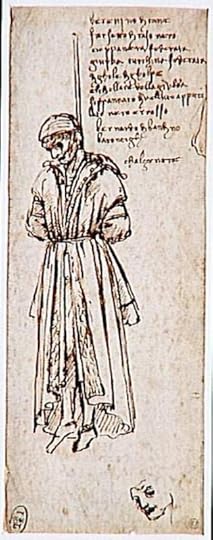
”Over the next few days Florence indulged in butchery on a scale not seen in the city for over a century. Ghastly trophies in the form of assorted body parts began to appear outside the Medici palace as if it were the home not of the leader of the most civilized city in the world but the abode of a cannibal king.”
1479 drawing by Leonardo da Vinci of a hanged Pazzi conspirator Bernardo di Bandino Baroncelli
The ones lucky to live were hanged. All the Pazzi males of the family whether they were involved in the conspiracy or not were exiled from the city forever. The Archbishop of Pisa was hanged in his vestments which made an already enraged Pope see red. He excommunicated the de’Medicis and the whole government of Florence and placed an interdict on the whole city.
Trembling in Florence?
More like a big YAWN.
Sixtus IV, not a complete bastard. He did commission the Sistine Chapel. Still, if he isn’t burning in hell the whole system is broke.
Sixtus then formed a league with the King of Naples. Ferdinand the 1st was batshit crazy. It was rumored that he had his enemies mummified and placed in a room so that he could visit them and remind them of their misdeeds against him. His son Alfonso was several cards short of a full deck as well. What Sixtus didn’t know is that Lorenzo had an ace up his sleeve.
He used to knock boots with Ippolita Sforza the wife of Alfonso and future queen of Naples. Well we don’t know for sure he had carnal knowledge of Ippolita, but we do know they had an enduring friendship built around their love of art and literature. Given the fact that Lorenzo wasn’t exactly pious in regards to the female persuasion and given that Ippolita was married to a raving uneducated lunatic, in a sense, don’t we hope that they dallied.
Ippolita Sforza
Lorenzo in a moment of pure bravery or pure foolishness decided to travel to Naples to put an end to Sixtus’s attempt to destabilize the region. He may have counted on Ippolita’s influence and his powers of persuasion more than I would have been comfortable with, but he came back to Florence a hero of diplomacy.
Lorenzo was a great patron of the arts and commissioned many of the famous names of the renaissance era to build sculptures for his garden. Michelangelo lived with him for five years and later built Lorenzo’s tomb. Lorenzo inherited over 200 manuscripts and added more than 800 more to the collection before his death at the tender age of forty-three.
One interesting thing about Florentine politics is they had an unusual way of selecting government officials.
”The nine purses--one for each of the priors and another for the Gonfaloniere--were brought to the great hall and placed in full view of the current government and the assembled citizenry. As the podesta, the chief judicial official of the state, proceeded to draw a name ticket from each of the purses, tension in the hall mounted. The bags contained scores of names: scoundrels and sages, rabid partisans of one faction or another and those with no known political affiliation, all jumbled together, In this strange procedure lay the heart of Florentine democracy. By choosing their officials at random from a large pool of eligible citizens--and by reducing the term of service for the most important offices to a mere two months--Florentines believed they had perfected a democratic system that would best represent the community as a whole.”
Lorenzo had his ways to increase his chances of having the right names coming out of the bag, not that he could totally control it, but he could skew the odds with a few well placed favors. Political parties were banned, but really that is just a matter of semantics because factions still came together either for or against the de’ Medicis.
A posthumous portrait of Lorenzo by Giorgio Vasari. Vasari captures the anguish of a tortured man overcome with serious health issues.
Lorenzo by his diplomacy, strength of character, and his savvy thinking creating a golden age for Florence that was never repeated. His grandfather died at 77. His father died at 53. Unfortunately Lorenzo only made it to 43. The family problem with gout and arthritis caught up with him early in life. He worked hard and played hard. Even when he had spent the night with a married mistress he was particularly fond of outside the city, he would ride back into the city in time to conduct a normal day of business. I would guess that his rigorous schedule probably brought on the symptoms of his inherited detrimental health faster. Lorenzo handled the difficulties of assuming power very young, of a pope that was working day and night to destroy him, and the constant attempts to undermine his authority by some of the jealous leading families of Florence. He survived assassinations and financial disasters. He never flagged in his determination to find solutions. He earned the title Lorenzo the Magnificent.
Last year, I visited the Medici Palaces in Florence. Walking through Lorenzo's home, I tried to imagine the Renaissance greats like Botticelli, Michelangelo, Angelo Poliziano and more importantly, Lorenzo himself having lived and breathed in these rooms. I think it was after my Florentine sojourn that I became even more fascinated with the Medicis and particularly with Lorenzo, the man whose contribution to one of the greatest periods in history - the most dynamic, alive and creative - was so dimensional. Dying in his early forties, in his short life, Lorenzo managed to be a brilliant political strategist, a poet, a philosopher, a song-writer even, a benevolent patron, a lover of aesthetics. Florence after-Lorenz suffered its great decline in the eyes of the world. From the center of knowledge and culture, it became ravaged and forgotten as the centers shifted West to the New World and the more stable European cities. Presiding over the last great years of Florence, the nearly mythical city, Lorenzo truly did earn the moniker of 'Il Magnifico' - the magnificent.
Magnifico: The Brilliant Life and Violent Times of Lorenzo de' Medici by Miles J. Unger is an objective portrait of one of the greatest Renaissance geniuses - more importantly, it's a very evocative portrait. The writer captures not just the man but the immediate political and social context of Florence and the rest of Italy - which is crucial to understanding how and why Lorenzo rose to power. The turbulent, violent and unpredictable times that Lorenzo grew up in and then ruled over almost makes Westeros look peaceful. One appreciates this man who managed to survive the dis-loyalties, the violence, the attempted murder, the betrayals, the constant political shifts to rise to power and become First Citizen, de facto ruler of Florence - all of this when he was still in his 20s.
At the same time, a lot of the idealistic perceptions I had about Lorenzo were proven wrong. I realized that a lot of the characteristics I was assigning to Lorenzo actually belonged to his grandfather, the original Father of the Nation, Cosimo. Lorenzo was far from ideal, yet his flaws made him all the more human and I grew to appreciate the struggles of this very flawed man - a struggle not just to survive himself but also a struggle to make Florence the greatest city in the world. Arrogant, over-confident and addicted to sensual pleasures in his youth, the Pazzi conspiracy (where his beloved brother was assassinated) led to his transition from youth to the second Father of the Nation.
I think what I came to admire the most and what made him so riveting to me in the first place was that Lorenzo , above all, was a visionary. Beyond his own needs, beyond amassment of wealth and status (which, it is true, he did a great many wrongs to acquire), he was passionately invested in the future of his great city - at times, risking his own finances and life for the sake of his beloved Florence. Above all, he seemed to know that great men do not become great merely through showing off their grandeur. Lorenzo, unlike other rulers in Europe, never became so 'kingly' that he forgot his roots. A big part of his reputation emerged from his ability to charm all kinds of people - discussing intellectual topics with philosophers and poets, and talking political stratagem with politicians on one hand, and engaging in everyday chat, and imparting wisdom to the poor and the common on the other.
The author also brings to light Lorenzo's inner life decoded through his poems and letters. And this is something that helped lower the romance I had assigned to to Lorenzo's seemingly perfect life. Instead, I developed more of an understanding of his agonies, loneliness, insecurities and sadly, the fact that his youth, devoted to Florence, wasted away in fears and paranoia with endless hours devoted to politics, when his real passions and dreams lay elsewhere.
Inspired by the book, now I am all set to visit Florence again this year, and walk the same places I walked last year, but this time with a new understanding.
Renaissance Italy was a powder keg of complex alliances between powerful families, religious and political hypocrisy, propaganda in the form of arts and sciences, and murderous backstabbing enough to make 21st-century politicians and lobbyists blush. Lorenzo de Medici, one of the most prominent figures in this epoch, naturally stands in the spotlight.
Paul II, by no means the worst of his breed, was particularly susceptible to the blandishments of those with ready cash since he was a man less noted for his piety than for his love of jewelry, objets d’art, and fine clothes. His friendliness toward the Medici, as Lorenzo’s uncle pointed out, was directly proportional to his financial need. One benefit the Medici discovered of doing business on the pope’s behalf was that it allowed them to threaten excommunication against those who failed to pay their bills, a spiritual weapon any modern collection agency would be glad to have. “Pope Paul’s head is empty,” wrote an anonymous poet after the pope had himself crowned with a tiara ostentatious enough to throw the papal finances into immediate disarray. “It is then right that it be loaded with jewels and gold.”
Oh and of course the sex:
But spas like Bagno a Morba were not only prized for their medicinal effects: something about the sulfurous vapors seemed to loosen morals as well as muscles, and there is no doubt that Lorenzo left the city in order to pursue some sort of sexual liaison.
“[He] who want[s] a son,” went an old Tuscan saying, “leaves his wife at the baths, where she’ll have fun.”
It would be no exaggeration to say that the dominance and eventual triumph of the Medici, an ordinary Tuscan family, is one of the most wondrous tales of Renaissance Italy. Intimidation, crushing rebellions, political murder, nepotism, simony, splendour, establishing a brand value through art and culture - they used every trick they knew and improvised upon others. Machiavelli, Poliziano, Marsilio Ficino, and others all make their appearances. Like April Blood: Florence and the Plot against the Medici, Unger too takes it for granted that his readers possess a working knowledge of Renaissance Florence.
While every Italian city-state presented its own issues, Florence was a particularly tough nut to crack. The system of government in the Republic was insanely complicated, the successful having to manipulate every committee and council in order to be in power. I can understand how a scion of a non-noble family weaponized poetry and other arts to awe other princes and dukes - hereditary rulers were quite secure in their right to govern. Some readers may disapprove of the fair deal of conjecture and interpolation in the book; however, I appreciated the plausible justifications.
Making love and writing poetry both helped to alleviate his natural moodiness. Often these two passions were combined in bawdy verses that more prudish generations tried to expunge from the record. Typical of this genre is his “Song of the Village Lasses,” an extended double entendre in which a chorus of neglected wives have found substitutes for their absent husbands in their own gardens:
We also have some beanpods, long And tender, morsels for a pig. We have still others of this kind, But they’re well cooked, quite firm, and big, And each will make a foolish clown If you first take the tail in hand Then rub it gently up and down.
It is hard to think of anything less becoming to a traditional head of state than such sophomoric jests, but with Lorenzo the political is never far removed from the personal, and even the most apparently trivial verses could be exploited for propagandistic effect. Like most of Lorenzo’s earthier productions, these lines were meant to be sung in Carnival celebrations. Belted out by raucous celebrants parading through the streets of the city, they formed yet another link between the leader and his people, most of whom no doubt preferred this rude humor to his more philosophical digressions.
Miles Unger takes on the difficult task of putting together the numerous (often biased) sources and, for the most part, succeeds in formulating a more complete image of Lorenzo.
A wonderful story of the life of Lorenzo de Medici. The author takes the reader through all of the major events from Lorenzo's life starting with the death of Cosimo and the conspiracy to unseat Piero, then going through diplomatic dance of balancing the Italian powers, the Pazzi conspiracy and the subsequent war and ending with the rise of Savanarola. It is a well written book that doesn't necessarily shine but does a very good job of detailing the life of this giant of the Renaissance. The quotes at the beginning of each chapter are wonderful.
When I put this book down, I wasn't as impressed with Lorenzo de Medici as I think I was supposed to be. As his biographer, Unger doesn't appear to believe all the hype about him either. There's a sense of forced positivity within the prose of this book; a vague feeling that there's more not said about Lorenzo than there is said.
For the last few nights, my wife and I have binged Netflix’s Medici series.* It brought me back to Garrett Mattingly’s classic, RENAISSANCE DIPLOMACY which argued that the relationship and machinations between Italian city-states was a microcosm of the 20th century in terms of actions resulting in numerous wars and plots. It piqued my interest in one of the most important figures of the Renaissance, Lorenzo de’ Medici the subject of Miles J. Unger’s superb biography, MAGNIFICO: THE BRILLIANT LIFE AND VIOLENT TIMES OF LORENZO DE’ MEDICI which argues that the Florentine leader was able to navigate the Italian city-states and Papal states surviving Papal, domestic Florentine, and other external plots by a Pope, a king, and a duke by employing his charm and diplomatic skill augmented by the occasional use of violence to preside over Florence, a city-state that supported and exhibited artistic brilliance in addition to the squalor of the city’s poor.
Unger describes a city of contrasts pitting artistic beauty and poverty. The author is correct to apply this dichotomy to the life, character and policies implemented by Lorenzo. In Unger’s sweeping account supported by assiduous research enhanced by numerous notes that add detail to the narrative we witness a figure who strides alongside the most important historical figures of the period throughout Europe. According to Unger the success of the Medici family rested in large part on the way “each member of the family worked for a common goal, demonstrating a unity of purpose not always present among ruling dynasties, where jealousy and competition are more important than fraternal affection.”
Unger takes the reader to the court of Cosimo de ’Medici, the family patriarch who built the bank and trade that the family fortune and influence rested upon. He follows with a description of his weak son, Piero, who trained Lorenzo for leadership almost from birth. Lorenzo and his predecessors ruled a city-state that was not the most powerful on the Italian peninsula, but it abounded in artists and craftsmen coveted by foreign courts. By exporting Florentine culture Lorenzo tried to achieve through “the dazzle of art what they could not hope to win through the strength of arms. Throughout his reign his support of the work of Botticelli, Leonardo, and Michelangelo abound. In addition, the intellectual pursuits of men like Pico Della Mirandola.
Unger’s commitment to detail and the ambiance of Florence and the Papal court is an important component of the narrative. Whether he is describing the celebration of the beginning of Lorenzo’s reign, marriage negotiations, the dynastic rivalries that resulted in the Pazzi conspiracy, the hatred between dynastic families, wars with Pope Sixtus IV, and the rise of Savonarola among many topics Unger has the ability to explain the complex and maintain the hold of the reader. Unger delves into the byzantine nature of Italian alliances and politics carefully. He correctly points out how Lorenzo could foster an alliance between Milan under the Sforza’s, Naples, and Florence to offset the disingenuous behavior of the Pope in order to secure Florentine banking and trade interests. Important personalities abound be it external enemies like Pope Sixtus IV, his nephew Girolamo Riorio, and Archbishop Francesco Salviati, and others including Girolamo Savonarola and Niccolò Machiavelli.
Sixtus’ family came from poverty and he saw the papacy as a vehicle to create wealth and prestige for the Riarios and della Rovere, as it seems that the Medici were always an impediment to his goals. The Pazzi family also produced a number of important individuals that Lorenzo had to manipulate to survive. The hatred of Jacabo de’ Pazzi and his nephew Francesco de’ Pazzi is well known for their involvement in the conspiracy that resulted in the death of Lorenzo’s younger brother and confidante Giuliano and Unger unwraps the plot and its participants and the end result of destroying the Pazzi family and its wealth.
Unger possesses a strong command of the shifting alliances that led Lorenzo to thwart Sixtus IV’s plans. A key chapter deals with Girolamo Riario’s attempt to manipulate the King of Naples to destroy the de ‘Medici which saw Lorenzo outsmarting him in saving Florence. This supports Unger’s major theme that Lorenzo was confronted by one crisis after another. Apart from external crisis he had to cope with internal opposition within the Florentine ruling council, the Signoria which the de’ Medici tended to dominate. Revolts, conspiracies, and other actions seem to be a daily occurrence that Lorenzo had to overcome. Despite all that Lorenzo had to confront he effectively weaved a web that he employed to balance his own sense of duty and pleasure. For Lorenzo, his personal need for intellectual enlightenment, reflected by men at court, art and literature, and his duty to Florence were in conflict throughout the narrative. The way Lorenzo navigated these pressures reflects his talent and his genius.
Unger does not neglect Lorenzo’s personal life. The important role played by his mother Lucrezia, his wife Clarice, his children, cousins, and advisors is on full display. The use of family members for diplomatic gain is a tool examined carefully. Lorenzo was a patron of the arts and a creative figure in his own right. He was able to help foster a flowering of art, architecture, literature, and intellectual life that is considered unparalleled in history.
The book is not an exercise in hagiography as Unger examines Medici finances and corruption in detail producing the money manipulation that Lorenzo engaged in to support his obsession with art and architecture, pay off his internal and external enemies, and construct alliances among his many triumphs. To his credit Lorenzo did siphon off funds to assist the poor, but one cannot overestimate his manipulation of Florentine wealth as very questionable. It is important to keep in mind the age in which Lorenzo lived before judging him too harshly. It was a period of tyranny dominated by despots in which one could argue that he stood above all including men like Paul II, Sixtus IV, and Innocent VII.
The key to Unger’s success is research that includes government records, historical accounts, diaries, and Lorenzo’s own memoirs, letters, and poems. The end result is scholarship, analysis, and an amazing eye for detail which will be difficult for Lorenzo’s next biographer to surpass. One must be cognizant of the fact that it took only two years following Lorenzo’s death for the system he developed too unravel as his son Piero, ill-trained, and ill-tempered, was unable to stop its disintegration. It was not surprising because only one man, his father had the depth of personality and skills to maintain it.
*Let us just say that the Netflix series stretches the bounds of historical accuracy!
Thoroughly enjoyed this work on Lorenzo De' Medici of Florence. The author gives great historical analysis of the period through the writings of Lorenzo's friends, enemies, philosophers, poets and Lorenzo himself. He explores why people thought the way they did at certain moments, and how events occurred and overtook the main players in the political arena. While admiring Lorenzo, the author describes his faults, errors in judgment, but ultimately the fact that he was a man doing his best to glorify his family's name while taking care of his beloved city. A patron of the arts, we are shown the physical evidence of such patronage that still exists in Florence today, and how a small city in dis-unified Italy became a cultural beacon of the Renaissance, and how she sunk into darkness once Lorenzo had passed away; fought over by her power-hungry neighbors. Most of all, the portrait painted of the Florentine leader is spellbinding. Riveting stuff!
This book relates the events of the 15th century when Florence and the Medici were at their height of glory and prestige. The story is one of intrigue, art, war, religion and politics. Its cast of characters remains famous 600 years hence.
"Magnifico" is a readable book, but it should be more than just readable. This glamorous and exciting subject calls for a more dynamic text. I think the author is trying to be an even handed historian by refraining from idealizing his subject and the times. This has the effect of making not only Lorenzo a much flatter character than he undoubtedly was, but also waters down what should be a riveting book.
Unger does a good job of relating the history. He stays with the facts. This is the first book I've read on this period that puts it all together. Granted, the other books were about special events or isolated characters and did not purport to be more.
The most compelling writing comes at the end. As Lorenzo winds down, Savonerola winds up and Michelangelo enters the scene. Lorenzo's immediate progeny are more reminiscent of his father than of their dynamic father. The son, for whose career Lorenzo and his daughter make great sacrifices, presides as Pope over the challenge and eventual success of Martin Luther; a nephew as Pope, presides over a sack of Rome. As Unger relates the past to the future, he finally shows some of the passion he undoubtedly has for his subject.
I recommend this for those, who like me, want to know more of this period. Do not expect a page turner like a Chernow or McCullough biography, but a readable book that will introduce you to the times.
Magnifico is a story about ambition, sex, power, oligarchy, art, philosophy, violence, and politics—centered on the life of Lorenzo de’ Medici, but ultimately about something much larger than one man. It is, above all, a manual on how power is acquired, consolidated, and preserved.
The book chronicles the mechanics of oligarchic rule: strategic marriages that strengthen alliances, the deliberate concealment of power to avoid provoking rival elites, and the constant balancing act of suppressing popular unrest while ensuring no competing oligarch grows strong enough to threaten your position. Governance, in this world, is not about representation or public good; it is about capturing state policy and weaponizing it to entrench hierarchy—rewarding allies, isolating enemies, and managing the poor as a problem rather than citizens with agency.
Lorenzo’s Florence is a place where partnerships are temporary and fragile, capable of dissolving within days—or hours—depending on shifting political factions. Loyalty is transactional. Ideals are flexible. Even art and philosophy, though genuinely flourishing, are inseparable from power. Oligarchs often present themselves as patrons of higher values, but this self-image conveniently obscures the reality that such patronage is compatible with, and often dependent on, systems that impoverish the many for the benefit of the few. The ruling class does not merely see itself as wealthier; it sees itself as inherently superior—by lineage, by destiny, or by fortune—and regards the masses as something to be pacified rather than represented.
What struck me most is how little has changed. The oligarchs of Renaissance Florence are strikingly similar to those of the modern era. Where Roman coliseums and Florentine festivals once served as distractions—bread and circuses to dull political consciousness—today’s equivalents take the form of culture-war spectacle. We are encouraged to fixate on marginal, emotionally charged controversies while never asking why healthcare, housing, and education remain unaffordable. Corporate America loudly celebrates “diversity” and “progressive values,” yet aggressively resists any regulation that would threaten monopolistic power or limit price-gouging that harms ordinary people. The form changes; the function does not.
The book is well-written and deeply engaging, but it is not without flaws. While the author frequently acknowledges the corrosive nature of oligarchy, he occasionally slips into apologetics for Lorenzo’s corruption, implying—explicitly or implicitly—that what was good for Lorenzo was good for Florence. This is the central lie of oligarchic rule. Tying one individual’s fortune to the fate of the state creates an unavoidable conflict of interest, not a justification for it. History repeatedly shows that when power and private interest merge, the result is regulatory capture, corruption, and institutional decay—regardless of how cultured or charismatic the oligarch may be.
Despite this caveat, Magnifico is an excellent read. The narrative is vivid, the pacing strong, and the political insights—intentional or not—are sharply relevant. Even when the author softens his critique, the underlying system remains exposed. I thoroughly enjoyed the book, both as a historical account and as an unsettling reminder that the logic of oligarchy has proven remarkably durable across centuries.
There's a piece of advice they give to fiction writers with which I very much disagree -- start with action. This is terrible for fiction, because there's nothing more boring than action before I care about who is engaging in it. But "hook them with action" is what people get told, and lots of them do it too. Terrible advice. It's even worse advice for biographers, and especially when the subject of the biography is so little an action hero that the supposed "hook" action is almost the only action in the whole book, as here.
Apart from that silliness, this is a decent biography of Lorenzo, neither hagiographical nor cynical. I'd recommend Hibbert's The House of Medici instead, better written and more interesting, but this does cover some Lorenzo-specific ground Hibbert does not.
This was a strong biography but not a fluid read. Given the dynamics of this tumultuous period, Unger's prose and flow sapped the dynamism from the story. Lorenzo emerged from this telling as far less dimensioned than he warrants. The man inside Il Magnifico would have been more realized with greater cultural, religious and social context.
There was also some sloppy editing (Cardinal Riaro was said to be 17 and 19 at his installment, and other bits that were unclear or lost in time.
Sigh. It could have been so much more magnificent,
I think Unger would have been happier writing more on the art than on Lorenzo himself. I learned things, but I never really got a sense of place and time.
Honestly, did you really have to mention Hannibal Unger, really? Sometimes too many footnotes is really, really annoying.
It also seems as if Unger is too close to his subject. I liked April Blood much better.
Lorenzo de' Medici, known as il Magnifico, has been one of my favourite historical figures since I learned about him in high school. However, even if I pretty much knew the most important facts of his life, this was the first time I read a whole biography about him. Unger's book does not disappoint: comprehensive, well researched and filled with beautiful pictures and photographs (most of them taken by the author himself), it will serve you just fine if you want to learn more about this remarkable man.
Even if I found some parts more dense and difficult than others, this biography is overall very readable, with some hard-to-put-down chapters: for example the ones about the Pazzi conspiracy and the "Neapolitan gambit". Unger is clearly passionate about his subject, but I did not find him too biased. Instead, he succeeds in bringing Lorenzo to life, to the point that I felt genuinely sorry for him while reading some parts, especially after his brother's murder. The story of this memorable man is accompanied by a fascinating portrait of Florence, its culture, its traditions and its most significant citizens. I especially liked the parts about the literary men who surrounded Lorenzo, like Poliziano (probably because I did an exam about him!).
A thoroughly well-rounded biography of Lorenzo the Magnificent. How he developed from wild youth, viewed with suspicion by other Florentines, to the Statesman of Italy, whose death raised fears that Italy would now be plunged back into war. Sure enough, with Lorenzo's hand removed from the tiller, it was.
I am very impressed by the way Unger's view ranges from broad to personal and back again, showing how Italian personalities and social trends affected each other and the rest of Europe. The reason I only gave it three stars was that the book didn't capture and hold me. Several evenings I skipped reading entirely to focus on other projects. I do feel my understanding has been broadened.
We'll call this 3.5 stars. The writing and research is excellent, but in the end I found the subject of this work less interesting than his reputation. The politics and global events surrounding Florence, as well as its cultural significance to the Renaissance -- ends up being far more compelling than the Medici themselves. They read like a prime time super soap opera, written 500 years too early for television...and I found the family rivalries became dull reading. Perhaps Lorenzo isn't quite the "magnifico" everyone thinks he is...
I watched the first season of DaVinci's Demons on Starz and wanted to learn more about Lorenzo de' Medici and his relationship with Leonardo. Well, Leonardo wasn't mentioned more than twice in the book. However, the book was a totally fascinating glimpse into the world of Florence and Italian politics of the 1400s. It turns out many of the people in the highly fictionalized series on Starz were real - not just characters in a TV show. And some of the situations as well like the many conspiracies and the feud with the Pope. I very much want to go back to Florence and re-visit the art and the palaces now that I have more background of those times. A good match up with Leonardo's Swans - historical fiction but with some of the same characters and situations. I'm determined to read more about Italy and the Renaissance artists, both fiction and non-fiction.
What could be more enthralling than a biographical visit to the Renaissance, and to Florence at that? Unger's book is exceptionally detailed and researched, but stays focussed on the mind and personality of Lorenza de'Medici as he navigates the great minefield of Italian politics in the 15th century. The narrative drive is not as strong as some of the great historical writers; but no book with this subject could ever be dull, and Unger serves as a welcome guide to the big events and the inner life of the last of the great de'Medicis.
Lorenzo de' Medici, The First Citizen of Florence, is a role model for the Nietzsche view of history being shaped by a few great men. The times were full of murder and intrigue, warring families abandoning their feuds only if their current alliance of city-states, fell under attack. These battles took place in the shadow of Rome, where popes like Sixtus, ruled like a baron and brought the weaponry of damnation alongside those of the saber. How this platonic philosopher king like figure survived and thrived is a story worthy of telling and Unger does it with the vigor and aplomb.
There was much to like about this book. Overall, I feel like I know much more about Lorenzo, but part of me wanted more. More of what, I can't put my finger on. There was a great deal of information about how the Medici came to power, and I'm glad to know Cosimo and Piero in greater depth. The end of the story seemed to be missing however, as if one day Florence woke up and three revolutions took place in a single day, leaving them forever to mourn the loss of Il Magnifico and the golden age of his rule. Maybe this is how it really felt.
This was a very interesting biography of Lorenzo de Medici. Clearly Unger knows and loves his subject. He spent time in Italy and speaks Italian so was able to use primary sources. He also has an art history background which makes the book even more lively for anyone who is interested in art as well as history. This would be a great book to read before a trip to Italy - it would really bring more meaning and understanding to the sites seen on the trip.
Well researched and easy to read. Rather too many political factions to get the mind around but then Italian politics were very complicated. A good background reading for the art and Humanism and how life was actually lead at the time. I really enjoyed the man as a poet and thinker.
Several years ago, I stood in front of the Cattedrale di Santa Maria del Fiore in Florence, and stared. The Duomo, as it’s called in the city, is a magnificent structure, crowned by a brick dome created by the architect Brunelleschi, its interior decorated with paintings and sculptures by some of the most famous Renaissance artists in history—most of whom were either born in Florence or came to the city in the hopes of advancing their careers. The marble facade, however, is an entirely different story: a mostly nineteenth-century confection combining green, red, and white marble that makes it look, more than anything, like it was made entirely of candy. Staring at it I couldn’t help but laugh at first, because it’s rather hard to take seriously any building with a facade coloured like a candy cane. This made me wonder what it must have looked like before the facade was put in place.
Fortunately, Florence has many examples of what the Duomo’s facade would have looked like before the candy cane treatment, and most of them are within relatively easy reach if one travels on foot from the Duomo. For example, there is the Basilica di San Lorenzo, once Florence’s cathedral before the Duomo was built. Its facade is plain brick, and though there were plans to give it a new facade based on designs by Michelangelo, those plans never really pushed through, and so the facade remains the same. However, if one looks past the unprepossessing exterior and steps inside, one finds an exquisitely elegant interior. Some of the decorations are obviously from later eras, but strip away the Rococo gilding and Baroque paint, and one sees the church’s beautiful Renaissance bones.
Aside from its artistic history, San Lorenzo is important for one other reason: it was the parish church of the Medici family, and sat at the heart of that part of the city they considered to be their home turf. And if there is one name that is synonymous with all the glories of not just Florence, but the Renaissance as a whole, then that name is most definitely “Medici”.
Much ink has been spilled about the Medicis, and much more will be spilled in the future, as historians continue to research the members of that family and rehash and reframe what’s already known about them. And why not? The Medicis are, in many ways, an excellent example of the classic “rags to riches” story, beginning as humble merchants before rising to the very pinnacle of European power, various members eventually wearing ducal, royal, or papal crowns. They were also famous as patrons of the best artistic and intellectual talent Italy had to offer, giving Florence a reputation for intellectualism and good taste.
But for all that the family itself is famous, and continues to be of interest to both historians and fictionists alike, only one member really stands out: the one everybody thinks of when one hears the name “Medici”. That person is Lorenzo de Medici, otherwise known as Lorenzo the Magnificent. And Miles J. Unger’s book, titled Magnifico: The Brilliant Life and Violent Times of Lorenzo de Medici is an excellent biography of a singularly brilliant man.
Now, one might expect Unger to begin at the beginning: with Lorenzo’s birth. But that would be predictable, would it not? So instead, he starts with this picturesque image of the Tuscan countryside, on a fine summer day:
Late in the morning of August 27, 1466, a small group of horsemen left the Medici villa at Careggi and turned onto the road to Florence. It was a journey of three miles from the villa to the city walls along a meandering path that descended through the hills that rise above Florence to the north. Dark cypresses and hedges of fragrant laurel lined the road, providing welcome shade in the summer heat. Through the trees the riders could catch from time to time glimpses of the Arno River flashing silver in the sun.
A beautiful image, and one that has been so often portrayed in film and television that it has lured about as many travellers to Italy as the museums and the ruins. But the beauty masks a much harsher reality, for August 27, 1466, is the day that Lorenzo de’ Medici, who is leading the horsemen mentioned above, narrowly avoids being murdered by the enemies of his family, who expected to ambush him and his father, Piero, as they returned to Florence to quell an uprising. Historical records are vague, but from what Unger has managed to piece together, Lorenzo escapes, not through force of arms, but through his own intelligence and diplomatic skill. Unger opens the book with this particular event because it foreshadows who Lorenzo would become in later years:
The confrontation at Sant’Antonio may provide the first instance when Lorenzo was able to deflect knives using only his native wit, but it will not be the last. Time and again he showed a remarkable ability to talk his way out of tight situations. With his back to the wall, and his life hanging in the balance, Lorenzo was at his most convincing.
This, then, is a clear indicator of the direction Unger takes in his biography: to focus on Lorenzo’s role as one of the greatest statesmen and diplomats of his time, as well as the troubles he had in those roles, both within Florence and without. He also deals with Lorenzo’s personal life, particularly where it contrasted with his public life, as this quote shows:
[Lorenzo’s] sense of duty was constantly at war with his natural zest for life, his desire to live up to the expectations of those whose approbation he craved in conflict with his taste for sensual pleasures. In the end he pursued all things to the point of near exhaustion. … More psychologically perceptive than the political theorists who remained perplexed by Lorenzo’s irresponsible side is the playwright William Shakespeare, whose portrait of the young Prince Hal wasting his days in the tavern with Falstaff and Bardolph uncannily resembles Lorenzo and his friends at the baths of Macerato or Bagno a Morba.
Unger’s reference to Shakespeare’s work shows the kind of writing one might expect from the rest of the book. He has a remarkably lively tone, dry in some parts but otherwise very readable. There are a lot—and I do mean a lot—of footnotes; it’s hard to say concretely (in terms of page numbers) just how much, as I read this in ebook format, but Unger appears to use footnotes as a way of talking about something that has very little do with the book’s main content, but which the reader might find interesting anyway. In the footnotes he talks about nearly everything, from the realities of Florentine political power:
… At all times Florence was really an oligarchy in which power was held in few hands. Innovations instituted by the Medici systematised and rendered more efficient a form of government already in place. They also gave greater authority to a single man at the top. One aspect that drew the greatest contemporary comment and stirred up the most resentment was that the Medici reggimento had a less aristocratic, more populist flavour, even if the number of families wielding power remained the same. The greatest opposition to Medici rule continued to come from the old optimate families that were no longer close to the centre of power.
…to speculation on the manoeuvring of ordinary citizens:
One wonders if de’ Rossi [a Florentine businessman] slipped some coins into Bibbiena’s [one of Lorenzo’s secretaries] hands to arrange the meeting [with Lorenzo]; the narrator never tells us but that was often the way things worked in Florence.
…to details regarding where certain places might be found—or not found—in Florence today:
From the outside, the spot [where Lorenzo’s sculpture garden was located] looks remarkably similar today—a wall backed by cypress trees. The garden itself is now a commercial plant store.
Some readers might find these constant digressions irritating, but I, personally, find them entertaining. I’m one of those people who always enjoys that little bit of extra information that might otherwise have been edited out of a manuscript, so these footnotes were a pleasant inclusion. Unger’s narration also has something of a meandering quality to it: he tries to paint the picture—whether geographical, political, social, cultural, and/or psychological—for the reader, that they might better understand where Lorenzo stood at any given point in time, and to help said reader understand the whys and wherefores of the decisions that Lorenzo made. Again, these meanderings might irritate other readers, but he doesn’t let it get very out of hand and manages to bring the narration back to where it’s supposed to be: to Lorenzo, and to his life.
I’m also happy with Unger’s decision to focus on other aspects of Lorenzo’s life besides his status as an art patron. He does leave room for that, of course—an entire chapter, in fact—but the truth of the matter is that much of reputation with his contemporaries was just partially based on his art collection and artistic patronage. He was, above all, a savvy politician and diplomat, a shrewd player of the deadly politics that dominated Italy during his lifetime—a game he played without any military might of his own (Florence had no standing army of its own, and had to hire mercenaries if it needed one). He wasn’t without his flaws, of course, and he did make mistakes, but Lorenzo rose above those mistakes and those flaws, and in the end, stood triumphant. It wasn’t just because of his art collection or his wealth (which was dwindling anyway because he wasn’t much of a businessman) that Lorenzo came to be dubbed il Magnifico:
… In time he was simply called il Magnifico, the term of respect used to denote any person of wealth and rank, now clinging to him almost as a title and testifying to his unique claim on the loyalty of his people. His authority had been built over years of careful manoeuvring, but in the end it rested on his countrymen’s recognition that, in the phrase of one of his critics, Lorenzo was the greatest Florentine in history.
Overall, Magnifico: The Brilliant Life and Violent Times of Lorenzo de Medici delivers on what its title promises: a biography that depicts Lorenzo de Medici as the brilliant man that he was, and the dangerous times he lived in that made his brilliance even more necessary to the survival of himself, his family, and his city. Though he doesn’t delve too deeply into Lorenzo’s role as an art patron, Unger does explain how that aspect of Lorenzo’s life played into the more important role of politician and diplomat, and how Lorenzo could—and often did—used his reputation for excellent artistic taste to gain important political leverage both within and without Florence. Though Unger has a tendency to ramble, and though there might be more footnotes than are strictly necessary, the book is still a very fun and interesting read, showing the reader why Lorenzo deserves the title il Magnifico, and why remains, even today, one of the greatest figures in Western history.
后来比较了一下书,发现人物大框架基本属实,但有些情节有杜撰嫌疑。当然真实的Lorenzo没剧中那么帅,到处留情的花花公子(年少气盛)形象倒也差不离。他对诗歌和艺术的热爱也是真实的。那副Medici私人教堂里著名的Gozzoli的博士朝拜图坐在白马上的并不是Lorenzo,Lorenzo的脸其实隐藏在民众中。  书中还提到一个有意思的事,Lorenzo的新娘家是罗马贵族(叔叔是红衣主教),势力大到Medici银行拒绝给其家族提供贷款,因为没有任何(earthly or heavenly)保障可以让他们归还欠款🫢。
Praise is very appropriately lavished on Miles Unger's "Magnifico" in a blurb on the backcover by Ross King (author of "Brunelleschi's Dome"). Both are delightful and could be read in the time of a trans-Atlantic flight. In fact I would recommend to any North American couple bound for Florence to put these two books in their cabin luggage. The husband might read Unger on the trip over while the wife would read King. On the way back they could switch books. "Magnifico" is Unger's second book, the first being "The Watercolors of Winslow Homer". As he readily acknowledges himself Unger is clearly an art lover rather than an historian deferentially describing academic historians in his footnotes as being the sources for his thoughts on the political issues of the era. All of this is perfectly fine. Unger's goal is to explain to art tourist who the great patron of Florentine art was and what part this patronage played in his life as a banker, ruler and diplomat. Each chapter builds towards a work of art that will be displayed after the last page which illustrates a key moment or person of the narrative. Unger does a superb job at describing the paintings, buildings and sculptures that Lorenzo commissioned. However, he is at his very best when he describes the poetry written by Lorenzo de Medici. His chapter on the garden that Lorenzo created which he filled with sculptures antiquity so that the working artists of Florence could study them is particularly fine. Unger provides a lively narrative of plots and intrigues of Florentine politics. His account of the involvement of Pope Sixtus in a failed assassination attempt on the life of Lorenzo is exquisite. His description of the diplomacy and alliances of the five states (Florence, Naples, Milan, Venice and the Vatican) is admirably done. Unger does however have a tendency to include anecdotes of doubtful authenticity into his story and at other times to include material from the realm of legend. At one point he cites the fact that the soldiers who founded Florence built a temple to Mars is a possible cause for the murders and vendettas that afflicted Florence during the Renaissance. "Magnifico" is highly entertaining and informative in a manner of speaking. For the North American tourist interested in the cultural achievement of Florence, it is well worth reading.
Mình có ấn tượng về cuốn sách này không? Có. Mình có ấn tượng về Lorenzo không? Không.
Cảm giác của mình không phải là sự sùng bái dành cho một vĩ nhân, mà là sự thú vị về một thời đại rực rỡ được tái hiện tỉ mỉ. Nếu bạn đang tìm một cuốn sách để hiểu về DNA của thời kỳ Phục Hưng, đây là một lựa chọn không tồi. Một cuốn biên niên sống động về xã hội và văn hóa Ý thế kỷ 15.
Điểm cộng lớn nhất, và cũng là lý do mình kiên trì đọc hết cuốn sách khá dày này, chính là giá trị lịch sử. Từ những cuộc tranh chấp quyền lực giữa các gia tộc, sự trỗi dậy của nghệ thuật, cho đến những chi tiết nhỏ về lối sống của con người thời bấy giờ, nơi mà lằn ranh giữa sự sáng tạo và những âm mưu chính trị cực kỳ mong manh. Trong bối cảnh đó, không thể phủ nhận vai trò trọng yếu của gia tộc Medici trong việc định hình dòng chảy chính trị, kinh tế và văn hóa của cả khu vực. Cuốn sách khắc họa dấu ấn của Lorenzo trong vai trò nhà bảo trợ đại tài đã tạo ra vườn ươm cho những thiên tài như Leonardo da Vinci hay Michelangelo tỏa sáng. Nếu không có bệ đỡ kinh tế và tầm nhìn từ gia tộc Medici, có lẽ diện mạo mỹ thuật thế giới đã rất khác. Đây là di sản không thể chối cãi mà Lorenzo đã để lại cho nhân loại.
Tuy nhiên, khi bóc tách nhân vật dưới góc độ cá nhân, mình lại thấy một Lorenzo không quá khác biệt với những thanh niên bộp chộp thời nay. Tác giả thường xuyên sử dụng lối ngụy biện tích cực hóa: khi Lorenzo sai lầm hay ăn chơi thì là do hoàn cảnh đẩy đưa, nhưng thành tựu thì lại mặc định là nhờ tài năng của ông. Mình cảm nhận được sự vận hành của một ekip hậu thuẫn cực mạnh đằng sau hơn là sự xuất chúng đơn độc của cá nhân ông như cách sách mô tả. Ngay cả mảng thơ văn cũng được phân tích theo lối tập làm văn phổ thông, cố tìm kiếm những tầng nghĩa cao siêu, tung hô gượng ép trong khi có khi chính chủ nhân lúc viết cũng chẳng nghĩ xa xôi đến thế. Cách tiếp cận này làm mất đi tính khách quan cần thiết của một tác phẩm tiểu sử. Sau khi nghiên cứu thêm thì dưới cái nhìn khắc khe, mình còn cảm thấy thế hệ của ông chính là sự khởi đầu cho việc suy thoái về quyền lực chính trị và tài chính của gia tộc Medici tại Florence.
Tóm lại, "Lorenzo De' Medici" là một cuốn sách giúp nắm bắt bối cảnh lịch sử và văn hóa Phục Hưng, nhưng đừng để mình bị cuốn trôi theo những diễn giải mang tính cá nhân của tác giả về nhân vật chính. Lorenzo có thể là một phần quan trọng của lịch sử, nhưng ông cũng chỉ là một con người với đầy rẫy khiếm khuyết, và thành công của ông là kết tinh của cả một hệ thống chứ không chỉ là một cá nhân đơn độc. Một cuốn sách hay để tham khảo, nhưng cần đọc với một sự hoài nghi lành mạnh.
I’ve been fortunate enough to read some excellent biographies in my time. It’s been a while since I’ve been so utterly drawn into the recreation via words of a man long dead. I couldn’t put this book down. Nor could I remain detached. My sympathies were caught by Lorenzo de Medici, fixed by Unger’s account of him. From the assassination of his brother to having to cope with the gout, I found myself drawn into his life, the conflicts he found himself facing.
When I read about his reaction to Plato, I started to cry.
Yes, I wept at the realization I had something in common with this great man. Forgive me for being too personal in a review, but my reaction to this book was deeply personal. I didn’t just understand Unger’s explanation of Lorenzo de Medici’s interest in Plato. I emphasized with it, keenly and almost painfully.
My love for this particular biography feels uniquely personal. Much of what was written resonated for me.
Another reader might not react the same way I did.
Like the other two biographies by Miles J. Unger, Magnifico was lively, engaging, and painted a colorful picture of a certain time period and the man at the center of it all.
It’s definitely worth reading.
As for myself, I’m resolved. Anything Miles J. Unger writes, I want to read.
I’ve been fortunate enough to read some excellent biographies in my time. It’s been a while since I’ve been so utterly drawn into the recreation via words of a man long dead. I couldn’t put this book down. Nor could I remain detached. My sympathies were caught by Lorenzo de Medici, fixed by Unger’s account of him. From the assassination of his brother to having to cope with the gout, I found myself drawn into his life, the conflicts he found himself facing.
When I read about his reaction to Plato, I started to cry.
Yes, I wept at the realization I had something in common with this great man. Forgive me for being too personal in a review, but my reaction to this book was deeply personal. I didn’t just understand Unger’s explanation of Lorenzo de Medici’s interest in Plato. I emphasized with it, keenly and almost painfully.
My love for this particular biography feels uniquely personal. Much of what was written resonated for me.
Another reader might not react the same way I did.
Like the other two biographies by Miles J. Unger, Magnifico was lively, engaging, and painted a colorful picture of a certain time period and the man at the center of it all.
It’s definitely worth reading.
As for myself, I’m resolved. Anything Miles J. Unger writes, I want to read.