Jump to ratings and reviews
Rate this book

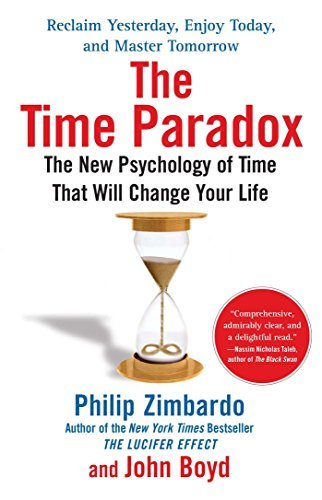
The Time Paradox: The New Psychology of Time That Will Change Your Life

Rate this book
Now in paperback, this breakthrough book on the new psychological science of time by one of the most influential living psychologists—the New York Times bestselling author of The Lucifer Effect —and his research partner launched on the front page of USA TODAY "Lifestyle" with a Time Survey and on CBS Morning Show.

This is the first paradox of time: Your attitudes toward time have a profound impact on your life and world, yet you seldom recognize it. Our goal is to help you reclaim yesterday, enjoy today, and master tomorrow with new ways of seeing and working with your past, present, and future.

Just as Howard Gardner’s Multiple Intelligences permanently altered our understanding of intelligence and Malcolm Gladwell’s Blink gave us an appreciation for the adaptive unconscious, Philip Zimbardo and John Boyd’s new book changes the way we think about and experience time. It will give you new insights into how family conflicts can be resolved by ways to enhance your sexuality and sensuality, and mindsets for becoming more successful in business and happier in your life. Based on the latest psychological research, The Time Paradox is both a "big think" guide for living in the twenty-first century and one of those rare self-help books that really does have the power to improve lives.

400 pages, Paperback

First published January 1, 2008

Loading...
Loading...

About the author

Philip G. Zimbardo

131 books916 followers
Philip George Zimbardo was an American psychologist and a professor emeritus at Stanford University. He became known for his 1971 Stanford prison experiment, which was later criticized severely for both ethical and scientific reasons. He authored various introductory psychology textbooks for college students, and other notable works, including The Lucifer Effect, The Time Paradox, and The Time Cure. He was also the initiator and president of the Heroic Imagination Project.

Ratings & Reviews

What do you think?
Rate this book

Friends & Following

Create a free account to discover what your friends think of this book!

Community Reviews

5 stars
795 (27%)
4 stars
975 (34%)
3 stars
750 (26%)
2 stars
240 (8%)
1 star
90 (3%)
Displaying 1 - 30 of 229 reviews
Profile Image for Nicky.
4,138 reviews1,122 followers
January 17, 2015
I read this last week or so, before the terrible events in Paris. At the time I thought of it as a self-helpy kind of book, with some relevant psychology; I picked it up because I’d watched some interviews with Philip Zimbardo about the Stanford Prison Experiment, which has always been fascinating to me. I wanted to see more of his work, I guess; get a feel for how a respected psychologist could create a situation which was so evil and not notice it without outside help, get a feel for what work he’s done aside from that. This is pretty far from all of that, though at times insights from that situation do come up when it comes to time perspectives.

Which is what I’ve taken away from this book most: time perspectives. There are several: past-negative, past-positive, present-fatalistic, present-hedonistic, future. And why has this stuck with me? Well, because there is a whole section on terrorist attacks and the explanations in terms of time perspective, which adds one more option (transcendental-future) and gives something of an answer to the issue, and it stuck in my head because of the attacks on Charlie Hebdo, stirring up reminders of 11/7/2005 and 9/11. Here’s a section:

Since the future is our primary motivational space, destroying a person’s expectations of the future can substantially undermine motivation. [Example of WWII, in which the Axis had solid future goals, which the Allies then destroyed; this eroded the Axis powers’ motivation and led to them losing the war.] This will not be the case with the current war on terror. We now face an enemy whose visions of the mundane future lie smouldering in the ruins of Palestine, Afghanistan, and Iraq. This enemy’s remaining hope lies squarely in the transcendental future. As we have seen, there is no way to prove, disprove, or destroy belief in the transcendental future. Fighting an adversary with strong transcendental-future goals by destroying its mundane future goals ensures that transcendental-future goals alone are obtainable. We will win the war on terror not by destroying our enemy’s future but by nurturing it. The motivational power of the mundane future must be restored if mundane future goals are to compete with transcendental future goals. Only by building a mundane future full of hope, optimism, respect, health, and prosperity can the motivational power of the transcendental future be balanced. Without mundane future goals, Muslims have little desire left to preserve this life and, understandably, look to the transcendental future to realise their dreams.


There are parts I’m uncomfortable with here, mostly the fact that they’re still talking about the “war on terror”, without even any scare quotes, like this is something we can/should be seeing as a war. The automatic identification of people with this time perspective as Muslim. But there’s sense here too: the goal of terrorism is to cause fear, which any Yoda will tell you leads to hate, and to suffering. And by doing this, people who commit terrorist acts, particularly if they sacrifice themselves, believe themselves to be attaining a better future for themselves and their families.

How can we fight that by making the present worse? By going along with that fear and hate, perpetuating a cycle?

Right now, I wish I could set up a dozen think tanks and set them this book to read, with that chapter particularly highlighted for discussion. Let them all come up with ways to improve the present for the susceptible population, rather than punishing them for crimes committed by people already dead, or for crimes not yet committed. All of that only increases the appeal of a transcendental-future orientation.

Most of the psychology of time perspectives I’ve learned here I’m applying not to myself, but to people around me; identifying behaviours and motivations, working out how to adjust my reactions to people based on what they orientate themselves on. I thought it’d be a light pop psychology read, probably a bit too light because of the self-help-y vibes I got from it. But now I’m thinking about this and I can’t stop, especially as more and more commentary flows in (do we assign blame to Charlie Hebdo, how far do we allow free speech, is it apologism to point out root causes…)

I know I’m going to be looking out for Kiva loans in areas low in mundane future, looking for charities that do aid work in places we’ve devastated, looking for my own small ways to address the damage that’s been done, particularly in the name of the war on terror. And I’m going to be talking about this book.
Profile Image for Sense of History.
649 reviews959 followers
Read
October 21, 2024
Zimbardo and Boyd are academic psychologists of some renown (although Zimbardo's fame has waned after it was revealed how he manipulates his experiments). This book about different time perspectives of people is based on decades of experience. So they know what they are talking about. Zimbardo and Boyd start from the observation that each of us experiences time in a special way. “Time perspective is the often nonconscious personal attitude that each of us holds toward time and the process whereby the continual flow of existence is bundled into time categories that help to give order, coherence, and meaning to our lives”.

There is nothing wrong with that, nor with the observation that the experience of time perspectives has an essential impact on human existence. But, on the basis of their own experiments and those of others, Zimbardo and Boyd dare to draw rather far-reaching conclusions: “Future-oriented people tend to be more successful professionally and academically, to eat well, to exercise regularly, and to schedule preventive doctor’s exams. In general, present-oriented people are more likely to engage in risky sexual behavior, to gamble, and to use drugs and alcohol than future-oriented people are. They are also less likely to exercise, to eat well, and to engage in preventive health practices such as flossing their teeth and getting regular doctor exams. The situation is more complicated when we consider people whose primary time perspective is the past. For some, the past is filled with positive memories of family rituals, successes, and pleasures. For others, the past is filled with negative memories, a museum of torments, failures, and regrets. These divergent attitudes toward the past play dramatic roles in daily decisions because they become binding frames of reference that are carried in the minds of those with positive or negative past views.” Zimbardo and Boyd ultimately distinguish 7 categories of people, depending on their time perspective: Past-negative, Past-positive, Present-fatalistic, Present-hedonistic, Future, Transcendental-future and holistic present.

That all sounds fairly coherent and acceptable (though perhaps a bit too graphic), but Zimbardo and Boyd turn those time perspectives into the decisive indicators of human action, and things go wrong there, because that is pure reductionism. It gets even worse because they do not limit themselves to analysis, but take it one step further and argue that you can manipulate your time perspective: “how you spend today determines both your past and your future, so when you have control over your present, you can control your past and your future. In fact, you can reinterpret and rewrite your personal past, which can give you a greater sense of control over the future.

In other words, you can ‘reset’ your time perspective, and the authors propose a flexible use of time as an ideal: “A balanced time perspective will allow you to flexibly shift from past to present to future in response to the demands of the situation facing you so that you can make optimal decisions.” In practice, the authors seem to express a clear preference for a positive future perspective. Ha! What a big surprise is that! (my apologies for my sarcasm). Here I quit, this is normative, patronizing, and gives the false hope that people can substantially change their lives. I do not follow this too simplistic voluntarism, based on tips and tricks. Actually, this book was completely in line with that of Victor Frankl. Man's Search for Meaning, and the ‘logotherapy’ he developed in the 1950’s en 1960’s, so it wasn't very original. As an antidote, I can only recommend David Lowenthal's book. The Past is a Foreign Country - Revisited (revised edition, 2015). That may be a bit more chaotic-descriptive, but it does not give people any false hopes.
Profile Image for Marc Lamot.
3,516 reviews2,068 followers
September 25, 2019
Timeperspective reductionism
I hate self-help books. How is it possible that I have been tempted to read this book? Right from the start I felt like closing it, especially after reading this sentence: “We will first help you identify your personal time perspectives and then we will offer you exercises designed to expand your time orientation and help you make the most or your precious time". Jesus, how is it possible that someone can be so naïeve as to think that you can change your life just by using your time perspective differently?

And yet I kept on reading, because of course, the analysis of time perspectives and the role these play in a man/woman's life is not completely unsound. But I have to admit that I lost my nerves towards the end, in the really 'live-changing' therapeutic part. See my review in my Sense-of-History account at Goodreads: https://www.goodreads.com/review/show...
Profile Image for Carrie.
9 reviews3 followers
January 22, 2009
I was looking for the positive antidote to Zimbardo's Lucifer effect, and since I'm a chronic procrastinator with ballooning anxiety issues, I figured unraveling the time paradox so as to change my life wouldn't be a bad place to start. Problem is, the book never really got going. I kept waiting for that big ah-hah, but instead I got some fairly common-sense ideas about how to have a positive outlook on time.

I did learn a couple things - some about time and some about myself.

(1) A past-negative perspective is an unhealthy time perspective. I've recently had a shift towards a more negative perspective of my past, so I found Phil's advice that I find something to learn from the negative experience and get over it helpful.

(2) Another way to gain a strong past-positive perspective is to keep daily gratitude lists. I imagine this is an idea that predates psychology by a few thousand years, but I still found it useful.

Depending on who you are, there may be a few other nuggets in here, but if you're going to go looking, I suggest you do just that: look for nuggets. Don't go in reading every word and completing each exercise in anxious anticipation of The New Psychology of Time That Will Change Your Life.
Profile Image for Merilee.
334 reviews
October 6, 2012


I was very disappointed w this book. I really liked The Lucifer Effect but this book really seems to have very little that wasn't obvious.
Profile Image for Wren.
186 reviews9 followers
March 30, 2016
I quite enjoyed reading this book, so if a star-rating is an attempt to reflect the reading experience I'd be forced to give it five our of five. However, I feel I ought to talk more about the merits and faults of the book itself, which ends up falling squarely at the "eh" point on the meter.

When I first heard that the famed Philip Zimbardo was tackling the subject of time in psychology, I was so excited that I stayed up late one night listening to hour-long lectures on the internet and immediately added this book to my purchase queue (I'm a dork, I know). Partly as a result of this and partly due to my scientific disposition, I was more than a little disappointed with this book when it came time to actually read through it.

Its main issue is that, while the book is thoroughly grounded in the actual science of psychology (insofar as psychology can be said to be a proper science), it is written and constructed in such a way as to read much more like one of those dreaded and rightfully derided self-help books. I was a bit surprised not see an endorsement by Oprah.

However, this in itself is not enough for the book to fail as an enterprise. Despite my disdain for the genre, I am nowhere near close-minded enough to write something off simply because it makes use of conventions which do not appeal to me. What let me finally dismiss this was the fault in the science itself. I do not know enough about the actual experimentation that resulted in many of the statistics and analyses in the book itself, so I sadly cannot speak as to how research into this book's central topic can be improved. This is unfortunate, as I think the topic itself is fascinating, however flawed the conclusions of the book might be. My issue with the science of the book, however, lies with its transparent and largely unaddressed bias.

I laud the authors' inclusion of the Holistic Present as an experience worth addressing, but so much of the rest of the book shows if not an ignorance of cultures outside the authors' then at least an offhand dismissal of them. The authors associate being religious with a high tendency toward the transcendental future, something that applies only to the Abrahammic religions and even then only to the mainstream interpretations thereof. They isolate Buddhism as worth examining (an excellent idea) but lump Hinduism and all Chinese religions into a vast and nebulous "other" category. I understand if this is due to the statistical sample used for the development of this theory, but if that's the case then they really should have pursued broadening such data to refine their theory long before going so far as to publish a pop-science book about it. Furthermore, even within the religious and cultural paradigm that the authors grew up in (white, wealthy, Christian, western countries), oversimplifications of subcultural distinctions abound. For instance, Zimbardo (being of Italian descent) briefly examines the differences between southern and northern Italy, and offers a disturbingly simplistic view on this complex relationship. He does something similar with the economic differences between dominantly Catholic and dominantly Protestant countries, which feels almost like stereotyping.

Perhaps worst of all, though, is a much more personal type of bias that displays itself throughout the book: a time-perspective bias. While the authors spend some time addressing its negative influences (surely anticipating this particular criticism), the vast majority of the book makes the Future time-perspective (specifically the "planner" archetype) look like the Philosopher's Stone of modern psychology. Extensive lengths of text are devoted to the ways in which "Futures" are superior to the rest of us, and how we can all be more like them. I have never in my life been less shocked by a twist than when the authors reveal their own time-perspective profiles and they are astoundingly close to what the book portrays as the "ideal" balance.

I must admit, at this point, that much of the data displayed in the book supports these conclusions. In fact, the authors are excellently deft at backing up their assertions with the results of experiments or research they've conducted. This is admirable. However, I cannot help but to be conclusion-shatteringly skeptical of any result so clear-cut and so seemingly advantageous. "Oh, look at that," one might say after an experiment, "it just so happens that we're perfect." This is something that any decent scientist should immediately find suspect.

All that said, I did quite enjoy reading this book. This is one of the few books I've ever read that demands to be written in. I don't just mean because of all the little puzzles and exercises the authors throw at you, either. There are also just many sections in which you'll find a result so completely counterintuitive, a statement so spurious and ripe for mocking, or a test that begs to be performed on your friends that you'll want to whip out a pen and annotate the whole book. This is what I did, something I have never done with any other book before or since, and I don't regret it.

I would say that those interested in time as a subject or modern psychology as a discipline would do well to read this book, but I offer this recommendation with two substantial caveats. The first is that any reader would be well-advised to enter this book in a very skeptical mindset, and the second is that anyone reading this book ought to have a pen at hand. Don't be squeamish about writing in it. It's the best way to do this. Those who are easily swayed in their opinion by lots of numbers or simple conviction should stay away.

Regardless, I hope the authors and their many colleagues continue to do follow-up research on this subject, both to see if these ideas hold up to deeper inspection, and also simply to gain greater insight into the human experience.
Profile Image for Mag.
449 reviews59 followers
November 18, 2012
Each one of us has a different relationship to the present, past and future. We may be classified as predominantly: present, past or future oriented. Then this orientation may be fatalistic or positive. Most of us are mixtures of the above, but we all seem to have a dominant tendency. For the record, futures are the healthiest, presents most inclined to be late or take drugs, and pasts (fatalistic) to be stuck in life and depressed.

The new Zimbardo-Boyd book is a crossover of a popular science book and self help manual. It discusses what a healthy balance is, offers inventories to check what orientation the reader predominantly has and then strategies to change unhealthy tendencies.

Even though this book was far from the promise of changing my life, there were some things that I enjoyed there: Time inventories were fun. False memories were revisited- there is a lot of research pointing to the fact that memories can be both implanted (with apparently little effort) and recovered. The caveat with those is that both true and false memories can be recovered. An analysis of a suicide bomber was quite interesting as well, even though it was obvious enough, just clad in a different lingo.
3.5/5
Profile Image for Ashley.
33 reviews
November 1, 2008
For those who have studied psychology as an undergraduate or graduate student, you know Zimbardo, and probably from peer-reviewed journals. This book is a nice gift to the mass market. Zimbardo attempts to write in a way that is digestible to the general public, but certainly the scientist in him shows. I find his work fascinating. The use of individuals' time perspectives to describe their abilities to understand, engage in, and respond to problems, both at the individual and societal levels, is simply interesting. He offers analysis of some rather intense problems, such as describing the possible orientation of suicide bombers, among many other situations by which we are all bothered. I also like the appeal to the mental health field. Zimbardo presents research on happiness and how to improve, using the concepts of time perspective, your overall well-being.
Profile Image for Erika RS.
889 reviews272 followers
January 3, 2013
This book was full of good content that was lost in the presentation. Even when I first got the book (as a promotional item), I was suspicious of it. The title and the reviews on the back work together to make it sound more self help oriented than science oriented. The content supported this instinct. The opening chapters on the different time perspectives are well written, but the rest of the book contains a bunch of loosely related ways to use time perspectives to improve your life. They would have made for great blog posts, but they only made for an okay book.

That said, unlike a lot of self-help books, this book at least has the advantage of being based on real and interesting science. Zimbardo and Boyd both have backgrounds as researchers who have studied time perspectives. Citations abound, and the authors do a good job of making the research accessible. This could have been a great book, and I was quite disappointed that it turned out to be only an okay book.

Zimbardo and Boyd have found time perspectives can explain a lot about behavior. In some ways, this is just yet another way of slicing and dicing people to understand how they behave (that's a good thing; every new perspective gives insight). However, time perspectives have an advantage over many of the currently popular ways of slicing and dicing: they can be changed. Thus, the authors spend a fair amount of time discussing the different time perspectives and outlining the "ideal" time perspective.

Zimbardo and Boyd have found six major time perspectives. The time perspective of an individual is a mixture of these six types. The time perspectives they present are:

Past positive: strong positive feelings associated with the past. Family and group oriented. Fond of tradition.

Past negative: strong negative feelings associated with the past. May have feelings of guilt, resentment toward the past. Feels trapped by their past.

Present hedonistic: focuses on the present, rather than on the past or the future. Committed to enjoying themselves. May be perceived as irresponsible.

Present fatalistic: believes they cannot escape their present. Subject to depression that is made worse by the feeling that it is inevitable.

Future oriented: focuses on outcomes, consequences, planning and saving. Sacrifices in the present for the future. Subject to stress.

Future transcendental: focuses on the distant, impersonal future whether through religion or a concern for future generations.

Zimbardo and Boyd believe that the ideal time perspective is high on past positive, fairly high and balanced on present hedonistic and future, moderately high on transcendental future, and low on the negative perspectives. They authors spend a fair amount of time going into why this is a good time perspective, but their suggestions are, largely, consistent with common sense. Overall, I found this book a useful read, although I could have got by with skipping the second half of the book.
Profile Image for Book Calendar.
104 reviews10 followers
March 14, 2010
The Time Paradox The New Psychology of Time That Will Change Your Life by Philip Zimbardo and John Boyd


This book is about changing your perspective on time. It focuses on different views of the past, present, and future. The basic views discussed are Past-negative, Past-positive, Present-fatalistic, Present-hedonistic, Future, and Transcendental future. This is an organization schema which I find interesting, but a bit contrived.


The authors claim that having an overly present view of time can lead to hedonism and low impulse control, having a negative view of the past can create depression and stress, having an overly future orientation can limit your enjoyment of the present. Their goal is to help a person have a more balanced view of time. They claim that time is your most valuable asset because it cannot be recovered.


I liked the idea of a Transcendental future viewpoint, a view that there is more to this world than our current life time, either in the religious or philosophical sense leads to greater happiness. People who believe in god, religion, or have a clear positive philosophy tend to live better lives. This includes ideas like environmentalism, ethics, and a world view embracing hope.


This book does not tell you how to manage your time. It helps you think about and unveil what your own viewpoints on time are. The authors give several questionnaires and exercises to make you think about planning for the future, how you see your place in time, creating goals, and have an inventory on time to complete; the ZPTI (Zimbardo Time Perspective Inventory).


This book is written for a general audience. It is a popular psychology title. There is an extensive bibliography and index. I enjoyed reading it. There was quite a bit to think about.
Profile Image for Library Journal magazine.
6 reviews12 followers
July 11, 2008
Managing Editor Heather McCormack has noticed the increasing sophistication of the self-help genre: "Zimbardo's book goes beyond the usual do-this, not-that approach to incorporate actual science on improving one's life."

What can explain the behavior of suicide bombers, successful investors, and depressives? According to psychologists Zimbardo (emeritus, Stanford Univ.; The Lucifer Effect: Understanding How Good People Turn Evil) and Boyd (director of research, Yahoo!), it’s their attitude regarding time—past, present, and future. Here, Zimbardo, a past president of the American Psychological Association renowned for his 1971 Stanford Prison Experiments, and research partner Boyd describe six major time perspectives. Through a questionnaire called the Zimbardo Time Perspective Inventory, readers can determine whether they are primarily driven by concerns with the past, the present, or the future as well as whether they view each time period positively or negatively and how that perspective might be influencing their behavior. The authors further explore what has been learned to date about how to achieve a set of perspectives that seems most likely to help people become happy and successful. So little self-help material based on real science is published that, when something like this comes along, we owe it to our patrons to make sure it is readily available. For all public and most academic libraries.—Mary Ann Hughes, Neill P.L., Pullman, WA
1 review
Read
February 17, 2009
What a fascinating book! I learned to see time management in an entirely new way. Rather than a "how to fix this problem" book, the authors explain how our perception of time affects how we live as individuals and how members of entire cultures view and interact with each other based on perception of time. In addition to helping readers see how to recognize the value of time, the authors discuss the best ways for readers to get the most out of the time they have, based on the individual's time perspective. I particularly enjoyed reading about time perspective regarding how it relates to suicide bombers and terrorism, the low success rate of youth drug use prevention programs, political campaigning and the success/failure of recipients of public assistance. I recommend watching Phil Zimbardo's presentation at Google on YouTube. This is one of those books I wish government leaders would read as a way to come up with solutions.
Profile Image for Robert.
Author 1 book5 followers
January 21, 2016
The recommendation here, based on extensive research, is to increase your self-awareness and enjoyment of life by cultivating a combination of positive recollection and re-framing of your past (past- positive), a healthy enjoyment of the present (present hedonism) and a wise investment of future-oriented time perspective.

Counterproductive time perspectives (like past negative and present fatalism) left unattended will probably continue to shape your life negatively. The simple remedy offered here is to consider cultivating and consistently developing those time-perspectives which offer positive rewards for past, present and future, while discarding, re-framing and transforming the rest.

'Present holism' is mentioned which transcends and unites all these time perspectives but no great advice is offered on its cultivation. I think this book does a good job of simply making us self-aware.
65 reviews3 followers
August 12, 2011
Really solid theory and research on our perspectives of time and what that entails (or at least implies), from its links to personality traits to explanations for suicide terrorism. As a psychology student, this was the perfect balance for me to learn the proper psychology while still being relatively easy to read/understand.

I am a little surprised by the lukewarm reviews, but it seems most came into the book with certain expectations because of the cover or Zimbardo's name/fame. This is NOT a self-help book, although it does have helpful things and may be just what some people need (myself included, hopefully). This is NOT a 'scholarly work' (ie academia-only), although the arguments and research ARE impressively solid and rigorous. It is a framework through which new and classic studies have been reinterpreted in terms of the psychology of time-- a very condensed summary of decades of research. It's pretty much a (very decent) starter to the entire field.
Profile Image for Niena Aniesza.
207 reviews8 followers
November 1, 2021
Time became a commodity that could be saved, spent, wasted, earned, and even lost.


1) Penulis percaya perspektif kita terhadap masa menentukan tindakan kita pada hari ini dan masa depan.

2) Penulis mengklasifikasikan manusia kepada tiga golongan iaitu orang yang hidup pada masa lalu (past), orang yang hidup pada masa ini (present) dan orang yang hidup dengan memandang masa depan (future). Ada soal selidik dalam buku ini yang boleh dijawab bagi melihat kita berada dalam golongan yang mana satu. Atau boleh juga jawab di sini my link text

3) Bagi orang masa lalu, penulis membahagikannya kepada past-positive dan juga past-negative. Orang yang ada past-negative cenderung mengalami stress dan depresi. Orang yang past-positive pula melihat masa lalu dengan pandangan positif, tetapi cenderung untuk mengekalkan status quo dan tidak mahu mengambil risiko.

4) Orang yang hidup dengan perspektif hari ini terbahagi kepada dua iaitu, present-fatalistic dan present-hedonistic. Present-fatalistic cenderung melakukan benda berbahaya seperti menghisap dadah. Golongan present-hedonistic pula boros kerana tidak fikir tentang masa depan.

5) Orang yang mempunyai perspektif future-oriented pula, terbahagi kepada future dan Transcendental-future Time Perspective (orang yang percaya kepada kehidupan selepas mati seperti agama Islam dan Kristian). Orang yang future-oriented dipercayai terlalu kuat bekerja sehingga lupa menikmati hidup, kurang rehat dan mengabaikan masa berkualiti bersama keluarga.

6) Persepsi kita terhadap masa boleh diubah. Penulis berpendapat orang yang seimbang adalah orang yang mempunyai past-positive yang tinggi, present-hedonistic yang sederhana, dan juga future-oriented yang sederhana.

Di akhir buku, ada dilampirkan tentang bagaimana untuk menyeimbangkan perspektif kita terhadap masa.

Profile Image for Amanda Austin.
79 reviews11 followers
October 28, 2008
I often think about time, how it's a currency more valuable than money (an idea the authors confirmed for me!), how often people abuse and waste time, how sad it makes me to hear people wish time would pass by quickly when faced with boredom or something unpleasant...it's like wishing your life away. But I'm off topic. This book--especially the first half--is fascinating. I never considered how each person has a dominant time frame and how this perspective influences every decision in life. I thought I'd definitely have a future perspective, but it turns out that I'm past positive with future right behind. I got worried until I found out past positive with future perspective in second place is the ideal mix for success and happiness in 21st century America! But enough self-congratulation...things are so fast paced these days, and this book provides great insight into how you live your life. I lived in New York City when I picked this up and was about to head back to Pennsylvania in part because I wanted a saner pace of life. I always believed that life in NYC was so turbo paced that it chipped away at people's humanity, mine included. And I was right!

Boston, New York, and other northeastern cities lead the list as the fastest cities in America...Consistent with the findings of the Good Samaritan research, Levine found that in general, cities with the fastest pace of life were the least helpful. New York, New York, ranked third in terms of pace of life, was rated the least helpful city in America.

Reading this put into words what I had long suspected and made me see my decision to move as an attempt to have a more healthy relationship with time. There are lots of other interesting points made in the book, but they are almost exclusively in the first half. The authors take strange detours in the second half, expounding on how to save for retirement and how to age gracefully. The first half is much more philosophical and idea-oriented and less preachy. Pay closer attention to the first half.
Profile Image for Dana.
121 reviews
January 29, 2011
This book required a lot of TIME to read - I have been reading it for months! Yet I found it worthwhile enough to keep going and I am glad I did - some of the thoughts really did "change my life" as the authors claimed. It helped me to better understand my own personality type and how that may complement/conflict with other people. I also realize that my personality and time perspective are changing as I get older - and that is a good thing. Here are some key points I took away:

1) "What you are, they once were. What they are, you will be." Inscription found in a Roman Church beside the Crypt of the Capuchin Monks. Don't fret so much - it really doesn't matter in the end...
2) Time is our most valuable "possession" - don't feel obligated to just give it away - i.e.have the strength to spend your time in the ways you really want...value your time for yourself/family/close friends
3) Future Time Perspectives should be moderated somewhat to enjoy the present...
4) Find the Good in the Past and focus on that - otherwise you will punish yourself for no good reason - So we all have the choice of taking the High Road or the Low Road - I am going to try and laugh stuff off more - and I fully realize that Paxil also helps!!
5) "We will win the war on terror not by destroying our enemy's future but by nurturing it."

Profile Image for Maneka Balasooriya.
228 reviews5 followers
May 21, 2024
Time is finite indeed. It's the only resource that we cannot reproduce or gain back. Therefore it's essential to use it wisely. The insights in this book will help you to realize what type of person you are present-hedonistic, future-oriented person, etc.. While one type might not be greater than the other it might be a good idea to absorb some characteristics from each to your life to live a full life.
Profile Image for Mateus Noel.
10 reviews
January 3, 2021
Some interesting ideas but the presentention is a bit presumptuous. The book could be at least half as long for the same (or better) impact. The "time perspectives" seems like a useful framework to have for self-development, but the examples are obvious or boring. I enjoyed the first chapters and then I was just wishing for it to end.
Profile Image for Kevin Bessey.
238 reviews8 followers
January 13, 2026
I enjoyed a great deal of content and structure to this book; however in hindsight I think I would have had a better experience reading a physical copy so that I could take advantage of the quizzes and tables.

I appreciated that both Zimbardo and Boyd both started the book with their personal interest and perspective on time, sharing what motivated them to write the book and citing other experiences. The beginning of the book started off well with their personal touch as well as a brief history in how humans have measured and experienced time over generations.

The only drawbacks I had (other than not having the questionnaires and tables to access for reference) was the few number of personal opinions on climate change. Chapters 4 and 6 also included many loose assumptions around religious people and how they respond to present and future planning. To be fair, I found the chapter on religious fundamentalists and terrorists pretty interesting. I suppose I mainly struggled with the generalizations that were supposed to blanket many religious groups and people.

There were unfair generalizations and bias towards capitalism, politics, and environmental policies in Chapter 10 that I did not wholly agree with, and felt was off topic and unneeded for this book.

I greatly enjoyed Chapter 5 that presented outlines for various time perspectives (especially with a bias towards future oriented people, since I am one). I'm always interested in thoughts on time perspective, specifically around observations and objective data between future oriented and past or present focused individuals.

Pros: interesting thoughts, discussion, and outline for time perspectives and how that affects people's behavior.
Cons: the polarizing issues around religion and politics could have been avoided.
Bottom line: I would like to read this book again, but maybe next time using a physical copy so that I can get more from the reading.
Profile Image for Christie Flora.
12 reviews1 follower
August 13, 2025
Ever wondered why time feels so different from one person to the next?

This book digs into the psychology behind that feeling. It explores how our internal time orientation shapes the way we think, work, rest, and relate. Something I'll be pulling into my own work for sure.

Zimbardo and Boyd explain that we each lean toward a particular mental “time zone” — past, present, or future focused. Each one brings its own strengths, challenges, and blind spots. The insight comes from noticing how yours plays out in daily life.

It helped me understand why some clients feel energised by planning, while others need more room to move. Why some are always scanning the horizon, and others get caught replaying what’s already happened. It’s not a flaw. It’s a lens.

When we get curious about how we relate to time, we can stop trying to squeeze ourselves into systems that don’t fit. Instead, we can start shaping habits and supports that actually work with us.

The tone is a little academic, but the insight is well worth it. I’d recommend it to anyone who feels out of sync with time or who’s looking for new language to describe what’s going on beneath the surface of productivity.

Does your mindset lean more past, present, or future focused?
Profile Image for V Janse.
37 reviews
August 30, 2020
Zimbardo and Boyd use research to present their ideas of time, but more specifically our perception of it.

They propose that our present perception can be divided into different categories namely the past, present, future and transcendental future. People either score high or low in each category, which supposedly explains their behaviours, thoughts and feelings.

It is an interesting take on the possible reasons why people act in certain ways, however this cannot fully account for all the factors involved.

What is great about the book is the helpful tips and numerous quotes, passages and proverbs dedicated to time. The authors also advocate a positive and balanced outlook across all 4 time categories which is conducive to living a happy and fulfilling life.

A good read for those curious about time.
Profile Image for Roni Matar.
88 reviews4 followers
July 17, 2022
Fascinating and educational.
This is one of the books that adds a lot of perspective on how we differ as humans because of our time filters. What I learned was to differentiate how the people I am interacting with are perceiving time, and reacting based on that.
In addition to that, the book helped me spot additional variations of behaviour that might be driving the problems my coaching clients face.
4 rather 5/5 because of some useless bits of advice here and there that are mainly applicable in the Western world and the worldview of the authors.
Profile Image for Scott Breschini.
11 reviews
April 15, 2026
I just finished The Time Paradox and it genuinely changed how I see my day to day life.

There’s a personality test in the book that breaks you into six time perspectives and it’s the first one I’ve taken that felt completely accurate.

What clicked for me is this idea that everyone is living in a different relationship with time. Some people are rooted in the past, some chase the future, others live for the present. A lot of our disagreements suddenly make more sense when you see that.

The part I keep thinking about is the balance:
The future gives you direction.
The present gives you energy and joy.
The past gives you identity and grounding.
Most self improvement pushes you to just “be present,” but this makes a better argument.

A good life isn’t one perspective. It’s a blend.
When those three are working together, that’s when things actually feel aligned.
Profile Image for Jenn.
179 reviews
July 4, 2019
The idea that people have different time perspectives that affect outcomes in life was new to me but makes sense. This is possibly a more useful way to categorize people than the various personality tests that are more familiar.
44 reviews
October 16, 2018
Not what I was expecting but some interesting insights about how our perception of time can affect our attitudes and how we can also change.
This entire review has been hidden because of spoilers.
Profile Image for Alexej Gerstmaier.
188 reviews21 followers
September 13, 2020
Musings on the most valuable resource one has.

Disagree with the authors that present hedonistic is desirable; I go all in on the Future perspective
Displaying 1 - 30 of 229 reviews