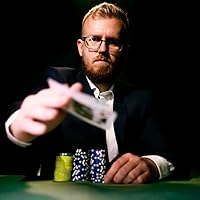
Inside the intriguing world of poker lies a fascinating exercise in strategy and extreme concentration--many of the same principles that underpin the one-thousand-year-old philosophy of Zen spirituality. Zen and the Art of Poker is the first book to apply Zen theories to America's most popular card game, presenting tips that readers can use to enhance their game. Among the more than one hundred rules that comprise this book, readers will learn to: * Make peace with folding * Use inaction as a weapon * Make patience a central pillar of their strategy * Pick their times of confrontation Using a concise and spare style, in the tradition of Zen practices and rituals, Zen and the Art of Poker traces a parallel track connecting the two disciplines by giving comments and inspirational examples from the ancient Zen masters to the poker masters of today.
An ad-hoc collection of quotes about zen, loosely applied to poker. Most of the practical advice can be summarized as "minimize tilt." The author believes that luckiness is a meaningful concept in poker strategy, and advises: "It can’t hurt to monitor one’s luck and the general trend of it: how hot or cold you are is a legitimate factor in the decisionmaking process."
Great book for the mental side of things. Poker is largely about self-control and patience, and that is what this book teaches...as well as some stuff about Zen, a topic that I've read a lot of books about, actually.
This book is well worth buying if you play poker.. I've read it 3 or 4 times...a short, easy read, and mildly humorous in spots.
Probably worth reading even for the non-poker player.
Yes you can bring your spiritual practice to the poker tables! This book taught me how to stay in the flow whilst playing poker and not abandon who I am whilst I'm playing but bring my Self into the game and remain balanced.
I read some of the lower star reviews on here and it seems that the point if this book may be missed by some people. That’s really to bad. I started playing poker on a couple of apps. I got obsessed with the game so I bought a book on the technical aspects of poker. I became a better player with the technical side of things, no doubt.
While one day I arrived for an appointment early; I saw a used book store. I decided to go in just to see if I could find any Star Wars books or anything else that might be interesting. While walking though I dawned on me to ask one of the store clerks if they had s poker section. He showed me to the game section where I found 2 books about poker. 1 was more technical knowledge and the other was Zen and The Art Of Poker. At the time I was thinking I really wanted to learn about ranges. But for some reason this book was just grabbing me from the inside. Plus it was cheaper. Which is like a bonus.
Since I read this book my game has leveled up tremendously. A lot of it is applicable to life as well. After reading this book I can see and feel a rhythm to the table and the cards. It’s crazy. It’s like a stepping stone to something magic. Very cool book. I highly recommend it for any competitive sport or just life in general.
The quote sums it all up. This book is worthless, the technical advice is terrible and the mindset advice is also pretty lame. If you want to beat the games and make money playing poker, avoid this book.
"Since poker involves so many borderline decisions, often occurring one after another, it doesn’t hurt to ask yourself from time to time (when trying to make up your mind about which way to go in a hand): “How is my luck running?” Asking yourself this can be helpful in maximizing your good days and minimizing your bad days. As noted, some players ignore this completely. They play each hand independently, regardless of how their luck is running. You see these players betting along nonchalantly, playing each hand by the book, despite being down a lot of money. They have not retreated, despite the negative flow of events."
I am glad I read this one. I haven't played much poker in reality, for the stakes in general have been too high for my comfort level. However, I thought this book was a good introduction to the terminology that poker players like to use such as holding them or folding them. (That means keeping the cards you're looking at or discarding them.) It spurred my interest in the field. It recommended a few other books on the subject, so you can keep exploring the subject from here.
I have always found poker much too fearsome to explore in the past, but zen is extremely reassuring to me.
So - I'm truthfully not sure, if you're already an advanced poker player! I honestly don't know since I don't think I am myself. However, in the future, perhaps I will be able to tell if this book is worthwhile. At the moment I think it was a worthwhile read because beforehand I was too scared whenever anyone said the P word to make a move.
This book helped my game. I am way too emotional when I play and I take my bad luck personally. I am still a work in progress, but I will be referring back to this book often for gentle reminders. A must for any poker player's shelf.
Light reading. Lots of quotes that makes sense. You might pick up something that helps your play. As they save "Every mickle makes a muckle."
As one reader has said after reading it has reduced his headbutting of annoying and crap players by 37%. If this is all you learn it will improve poker for everyone else.
This book taught me that getting angry at the cards when the cards aren't good will not make you a happy, well adjusted person. But apparently, becoming one with the flow of poker will. Even though it sounds like good advice, I've decided to remain angry at the cards.
This book doesn't guarantee to make you an instant winner at poker but it does attempt to help you to gain mastery over yourself and that is an important ingrediant in enjoying the game.