Fiction is much more enlightening about a country and its people than are statistics, and if we want to find out and understand what a nation is really like, we must read its literature. In French Tales , Helen Constantine offers a panoramic view of French society and culture as seen through its short fiction, ranging through all twenty-two regions of France and featuring the work of an engaging collection of writers.
Here are stories as varied as the regions of France themselves--dramatic, tragic, comic, poetic, ghostly, satirical. Readers will find both famous and little-known writers--among them Guy de Maupassant, Emile Zola, Daniel Boulanger, Didier Daeninckx, and Colette--and will wander the country from Provence and Alsace to Ile-de-France and Normandy. The themes are timeless--marriage and the dealings between the sexes; the nature of friendship; the misery and the memory of war--and the stories themselves reflect the rich ethnic diversity of France. Thus, Christian Garcin's story set in Lille has Flemish associations; Prosper Mérimée's Mateo Falcone , about an honor killing in Corsica, is in many respects more Italian than French; and Marcel Aymé's story about Arbi, an Arab in Paris living at the bottom of a cul-de-sac, illustrates only too well the plight of many North Africans who settled in the larger cities--Paris and Marseille especially.
Following the model of the highly successful Paris Tales , also translated by Helen Constantine, each story is illustrated with a striking photograph and there is a map indicating the position of the French regions. There is an introduction and notes to accompany the stories and a selection of further readings.
Helen Constantine read French and Latin at Oxford. She was Head of Languages at Bartholomew School, Eynsham, until 2000, when she gave up teaching and became a full-time translator. She has published volumes of translated stories, Paris Tales, and French Tales and edits a series of City Tales for Oxford University Press. Paris Metro Tales will be published in March 2011. She has translated Mademoiselle de Maupinby Théophile Gautier and Dangerous Liaisons by Choderlos de Laclos for Penguin and is currently translating Balzac’s La Peau de Chagrin for OUP. She is married to the poet, David Constantine and with him edits Modern Poetry in Translation.
A collection of twenty-two French short stories, one for each department (province) of France. "Frenchness" is the only common denominator for a collection of stories that are old and modern and written in varying styles. Some stories offer psychological depth, some are fantasy. Some offer geographic insight into the region they depict; many do not, leaving one to wonder why they were chosen for a work that is supposed to portray local color.
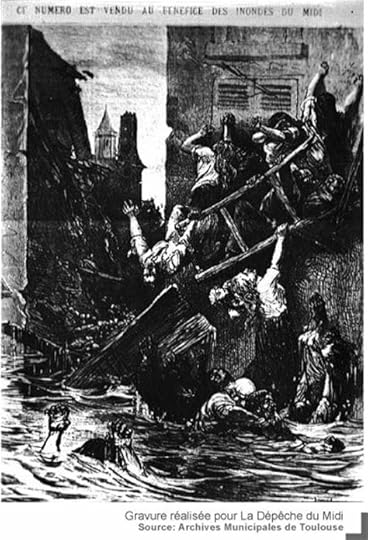
There are a few gems that offer both a good story and some geographical insight. Two of the better stories are ancient: one story by Zola is based on a devastating flood along the Garonne in 1875. Another, by Prosper Merimee, about an honor killing in Corsica, was published in 1823. One of the better modern stories, by Anne-Marie Garat, is a tale of a hunting murder set in the pine woods near the border of Basque country.
The stories vary greatly in the quality. While all have been previously published, a few read like community college literary magazine material, but most are worth a read.
sketch of the 1875 flood in Toulouse from toulouse-inodation.org (edited review from an earlier posting)
Compilations of short stories around a central theme can be a hard thing to pull off. Helen Constantine’s collection had mixed results - I like the idea of selecting a story from each region, but some stories paled in quality to others.
Highlights: Rue de l’Évangile - Marcel Aymé We Can’t Go On Like This - Anne-Marie Garat Mateo Falcone - Prosper Mérimée
This is a collection of random short stories, mixed and matched with classical writers.
The short stories that are from contemporary writers (whatever that means) are pretty bad. Most are if were homework in a fiction writing class in the USA.
The classical works are sparkled here and there in the book. As if intentionally added to give you a moment to breath and clear your mind out of pretentious copy-cat writers.
I have reviewed the stories that I found interesting. Some of the short stories were written in the nineteenth or early to middle twentieth century, and still have the ability to upset today. For instance, Prosper Mérimée’s story, written in 1829, which I thought excessive, concerned an honor killing, or Marcel Aymé’s story, Rue de l’ Evangile, about the plight of a homeless Arab in Paris, written with xenophobic and crude characterization, in 1943. Aymé tried to add a light touch with the laughable, ludicrous behavior of the café owner’s wife.
More homelessness is written in The Voiceless. Author Christian Garcin, did not describe the problem of Emmanuel’s homelessness. Emmanuel had been staying in Lille for the last three days with unattached Karla, single mother of a three-year-old, and a teacher. He and Karla had not seen each other in six years. She lived in an area where property had run down. Both were lonely, and seemed to enjoy each other’s company. It appeared probable that Emmanuel was a parasite; he hoped to say for a while.
Guy de Maupassant, one of my favorite short story writers, wrote A Norman, about the unkind Father Mathieu, also known as “Father Boozer,” an inebriated priest who made a mockery out of religion and his parishioners. A Mother’s Tale told of an aged mother abandoned by her only son, who probably still held on to his unhappy childhood, forced on him by his father.
Daniel Boulanger wrote about looking for love in the twilight of one’s life in Made for Two.
Four Walls, by Claude Michelet, revealed a young couple, with one toddler and another child on the way, in a quandary whether to buy a turnkey residence or renovate a sixteenth century home.
There are stories concerning marriage relationships in Jacques Chardonne’s 'bland' story, Julie, a wife now ill, who might have had an affair, and whose husband had left her, or Anne-Marie Garat’s We Can’t Go On Like This, told in first person by the husband, who had driven off course, and found a home, hidden in a stretch of pine trees, “perfect” for him to have peace of mind. Stories about World War I, particularly, Stéphane Emond’s House in the Woods, gave a mother’s vividly illustrated point of view concerning her son, a soldier.