Maurice Sendak was a visionary American illustrator and writer best known for transforming the landscape of children's literature through his emotionally resonant stories and distinctive artistic style. He gained international acclaim with Where the Wild Things Are, a groundbreaking picture book that captured the emotional intensity of childhood through its honest portrayal of anger, imagination, and longing. Widely recognized for his ability to blend the whimsical with the profound, Sendak created works that resonated with both children and adults, challenging conventional notions of what children's books could be. Born and raised in Brooklyn, Sendak was a sickly child who spent much of his early life indoors, nurturing a love for books, drawing, and storytelling. The son of Polish-Jewish immigrants, he was deeply affected by the losses of the Holocaust, which shaped the darker emotional undercurrents in his work. His art was influenced by a range of sources, from comic strips and Mickey Mouse to Mozart, Blake, and German Romanticism. Though he began his career illustrating other writers’ books, he soon transitioned to authoring his own, beginning with Kenny’s Window and then The Sign on Rosie’s Door. It was Where the Wild Things Are, published in 1963, that solidified Sendak’s reputation as a master of children’s literature. The book, which won the Caldecott Medal, was initially controversial due to its depiction of unruly behavior and ambiguous emotional tone. However, it was later recognized as a revolutionary work that respected children’s inner lives and psychological complexity. This theme continued in his later works, including In the Night Kitchen and Outside Over There, which formed a loose trilogy exploring the emotional and imaginative experiences of childhood. These books, celebrated for their dreamlike narratives and lush illustrations, often tackled fears, fantasies, and the challenges of growing up. Throughout his career, Sendak illustrated more than a hundred books, working with authors such as Ruth Krauss and Else Holmelund Minarik. His visual style—characterized by its intricate detail, dynamic line work, and expressive characters—evolved over the decades, but always retained an unmistakable emotional intensity. He also designed sets and costumes for operas and ballets, bringing his imaginative worlds to the stage. Notably, he created productions for works by Mozart and Prokofiev, combining his love of classical music with theatrical design. Sendak was known for his sharp wit, fierce independence, and deep empathy for children. He openly criticized the sanitized and moralistic tone of much of children's publishing, insisting instead that young readers deserved stories that acknowledged their full emotional range, including fear, grief, anger, and wonder. He was also an openly gay man in a long-term relationship, though he only spoke publicly about his sexuality later in life. Later in his career, Sendak continued to produce new work, collaborate with artists and institutions, and advocate for intellectual freedom. His final books, including Bumble-Ardy and My Brother’s Book, reflected both a return to his childhood memories and a meditation on aging, love, and mortality. Though his stories often ventured into the dark or surreal, they remained rooted in a deep respect for the emotional reality of children and a belief in the power of imagination to confront life's challenges. Maurice Sendak’s legacy endures in the countless writers and illustrators he inspired, the cultural impact of his stories, and the enduring affection readers of all ages hold for his wild things, mischievous children, and tender monsters. Through his work, he redefined what children’s literature could be: rich, honest, haunting, and, above all, deeply human.
Well, I've previously read a book written and illustrated by Maurice Sendak, and I might be disappointed because I've liked the other one, which was "Where the Wild Things Are".
I've liked "Where the Wild Things Are" so much and I enjoyed everything about it. The plot was amazing, the story telling was nice, and the art was unique.
However, compared to that one, this was a HUGE disappointment, and I fear he'll keep disappointing me now.
I gave this one two starts because the art is still beautiful, and not gonna lie, I enjoyed it! However, plot-wise and all, it didn't have much to offer, but well. It's not exactly written for people my age, is it? :>
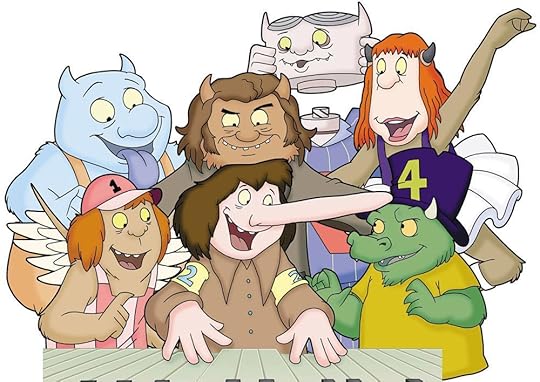
Short, sweet, and not especially robust, although I imagine that the combination of repetition and variation across the seven monsters works well for a very young audience. But this is the charming and gently weird side of Sendak and, particularly because the monsters are reminiscent of Where the Wild Things Are, it's endearing.
Who doesn't love a good monster book? I'm not sure which came first, this little counting book or Where the Wild Things are but surely there must be some correlation. The drawings seem hastily done in pen and colored pencil. The paper is rough and an odd shape. All of these factors coalesce to make it seem as though Sendak sketched these out on napkins during a meal. Who knows. Anyway, I like monsters (remember making those folded pictures where each person draws a different part?). I think the next time I am in a bad mood I'm going to sit down and draw some of my own.
What is really strange about this book is I wrote a poem very similar to the "story" as a second (?) grader. But I think mine was about penguins. Whatever they were, I also wrote that one of them "just screwed off his head." Weird, right? Anyway, this was one of the reference books I went all the way down to the Central Library to read. I think it was altogether worth it.
I grew up watching the Tv Show and always wanted to read the book that inspired it all. Well, I read it, and it wasn't bad, but I just can't help feeling a little disappointed. Great if your child only knows how to count to seven!
This book seems like an afterthought of "Where The Wild Things Are". The illustrations are on tiny sheets of paper and seem little more than sketches. I was pretty disappointed with this.