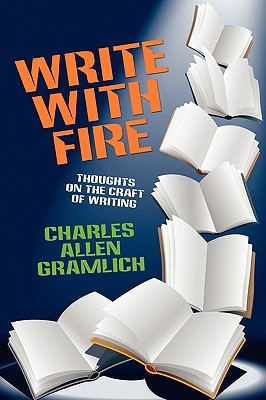
When first approached to review Write With Fire, I wondered at what I might be able to say about it. As an author and publisher, I read books about writing frequently, and while I like some more than others, few offer any unique perspectives into the craft. Even more importantly, none have provided me with a cheat sheet for becoming a success. So readers be warned: Write With Fire contains no revolutionary insights into the use of the semicolon, no grammar pneumonic to take the place of years of persistence and rigorous practice, and no list of important contacts who will slingshot an aspiring author to fame with a simple 'Charles wanted you to see this'. What Write With Fire does offer is a series of well-thought-out essays about writing and the world of writers, some reflections on the craft by a hard-working wordsmith, and some tough-love advice for would-be authors.
Two things make Write With Fire stand out. First of all, despite having numerous publications—both fiction and non-fiction—to his credit, Gramlich is not a household name, nor do his books sell a million copies in pre-order (yet!). Like most authors, he does not have so large a readership that he can dispense with a day job; writing is a beloved task that must be squeezed in between the demands of life. He is like most authors. Nevertheless, he is both prolific and successful; successful, that is, if an author's success is judged by the quality and quantity of his works and not by the paycheck he earns from them. He neither condescends about the innate ability that propelled him to success far beyond that of the average writer nor does he wallow in faux-humility, accusing luck and fate of providing him with every opportunity. While inherent talent and luck certainly can affect an author's fortunes, I find that the hard work, perseverance, and commitment Gramlich cites as the keys to success are far more in tune with my own perspective on writing.
Secondly, since the incorporated essays were produced over a lifetime of writing—some for other publications, some written or updated specifically for this book—Write With Fire shows in vivid detail the evolution of a writer. From a youth on a farm in the Ozarks to the dark months following Katrina that stole the will to write from those us who lived through it, readers get a personal tour through the events that shaped Gramlich as an author, and can see how he used those events to his advantage. His sound advice reflects years of near-daily writing and constant submission, the understanding that success at getting published first and foremost means putting your writing out there and bracing yourself for the inevitable rejections to come. The wisdom he shares, if not always what a writer wants to hear, reflects the realities of the publishing world. Anyone considering a career in writing—or even anyone with aspirations of publication—would do well to have a copy of Write With Fire in their personal library.
In the end, like all other writing guides, Gramlich's words alone will prove insufficient to turn a writer into a millionaire, or even into a famous-but-not-well-paid author. But reading Write With Fire did force me to reevaluate my own writing habits and adjust how I utilize the little bits of spare time I am provided. As a result, my own writing has improved—possibly in quality, and certainly in quantity—since I first picked it up. What better endorsement for a book on writing can there be?