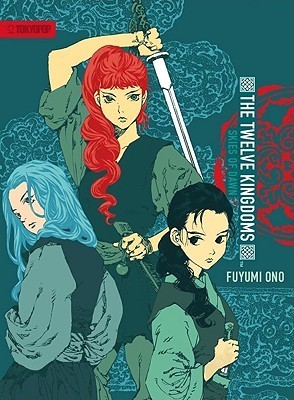
After a year of depending on her ministers to govern the kingdom of Kei, Yoko follows Keiki's advice and descends the mountain to live among her people, eager to learn how to be a better leader from the village's wise-man, Enho. However, when Enho is kidnapped, Yoko finds herself thrust into an all-out war between the kingdoms. Friendships and alliances are put to the test during the Battle of Wa Province. Can Yoko summon the strength to take up her responsibilities as Queen?
Fuyumi Ono (小野 不由美, Ono Fuyumi) is a Japanese novelist who is best known for writing the Twelve Kingdoms (十二国記, Juuni Kokuki) series, on which a popular anime is based. Her name after marriage is Fuyumi Uchida (内田不由美, Uchida Fuyumi), but she writes under her maiden name.
Ono was born in Nakatsu, Ōita, Kyūshū in 1960. She graduated from Ōtani University in Kyōto with a degree in Buddhist Studies, and in 1988 was employed by the publisher Kōdansha. Her debut story is titled Sleepless on Birthday Eve.
Ono is married to Naoyuki Uchida (内田直行, Uchida Naoyuki), a mystery novelist who writes under the pseudonym Yukito Ayatsuji (綾辻行人 , Ayatsuji Yukito).
Before she started work on Twelve Kingdoms, Fuyumi Ono wrote The Demonic Child (魔性の子), a horror novel about a boy from another world. She later worked certain events from this novel into the Twelve Kingdoms series. Short stories set in the various kingdoms include: Kasho, Toei, Shokan, Kizan and Jogetsu. In February, 2008, the first new Twelve Kingdoms short story, Hisho no Tori (丕緒の鳥) was published in Shinchosha's Yomyom magazine.
According to an interview at the Anime News Network, she is "currently rewriting a girls' horror series (she) wrote long ago."
This book just arrived and omg, y'all, this book is COMICALLY HUGE. I pulled it out of the box and sort of stared at it in disbelief and then burst out laughing. I was unaware the author had pulled a Harry Potter!
Okay, finally finished! Good god, this book is a brick, and I thought I would never finish it. That said, I don't see how it could have been any shorter, considering that it essentially consisted of three different, interwoven novels (Yoko's, Shoukei's, and Suzu's), until those narratives all merged near the end. This one was a bit info-dumpy at times, but the overall pace felt pretty brisk, and I was never bored. I continue to be impressed by how interested in political intrigue this series can make me. It usually just makes my head hurt.
I love how hardcore Yoko's gotten, and I love how she never even gives Keiki pause for breath when she's on a roll and how he's just flailing helplessly in the background. Keiki's passive-aggressive sighing and prissy whining are pretty much adorable, as are Yoko's smackdowns. It's like they're learning how to work together through the power of bitchfests. (I especially loved the bit near the end where Keiki's all, "But won't the officials feel slighted?!" and Yoko's like, "Yeah, well, sucks to be them I guess, 'cause I sure don't give a shit." You tell 'em, Yoko. :|d)
Although they don't have the same kind of charisma as Yoko, I also liked Shoukei and Suzu - I did question whether Shoukei would have changed so completely over the course of the story, though, and the moral lesson-ish-ness of both of their narratives seemed a little heavy-handed at times.
One thing that nagged at me a bit was the fact that in one of Enho's info-dumps, he explains in-depth how marriage works and its purpose and how most lovers who don't want children just don't get married, etc., etc., and it was so in-depth that the lack of any addressing of how homosexuality fits in was pretty glaring. I mean, how do same-sex pairings get on? Is it taboo or no? Are there lavender marriages in this world so that gay people can have children? These things should have really been covered...
Another thing that nagged at me was the typos. Good lord, where WAS the editor? Sleepwalking?
Anyway, this was a great installment, and I am full of woe that we'll probably never see the next volume over here in the English-speaking world. SADFACE. :(
As with the other books in the series, it is awesome and fantastic, with an immersive world (down to creating units of measure and new birthing techniques with the social repurcussions!), a big over-arching plot of the troubles of ruling a kingdom, with the personal stories of three very different girls who converge at the height of the conflict.
I knocked a star off because this is by far the worst editing job Tokyopop has done to date. The other books had typos as well, but this one really surpasses them. Names are mixed up, particles are dropped/scrambled, words misspelled....but the worst part? IT IS MISSING A WHOLE CHAPTER.
Between chapter 16 and 17, there is a bizarre plot skip. Though the story survives without it, I felt a little weird until I searched online and found a fan translation of it (by Eugene Woodbury).
Very bad, Tokyopop. Will they ever fix it in the next edition? Who knows. I'm irritated that my nice hardcover (of cheap paper) is hiding pieces of poo in it's depths, but this series is fabulous enough that I would pay for the paperback too to make it right.
Three girls have praaaaablems. One's spolit, one's weak, and one's incompetent. What'll fix it? I know! Let's go see the Glory-King! (When you are the Glory-King, that's pretty easy, yeah?)
Along the way, everybody learns Valuable Life Lessons. And overthrows a corrupt government. (When the government is yours, that's not so easy, yeah?)
Skies of Dawn is a good blend of the politics, action, intrigue, annoying people with hearts of gold who turn out okay, and wacky anthropology we've grown to know and love from the Twelve Kingdoms. The main characters travel a lot in the first half of the book, so we get to see more of the other Kingdoms.
This volume suffers from the English edition being a double volume instead of two books as the Japanese was originally published. Characters spend much of their time explaining their life stories for those readers who would have had time between books one and two to forget who all these people are. And there are a lot of people. Many of the people and places are also confusingly named. There is a Kei province in the kingdom of Kou, for instance.
Also, the editor needs to be strung up (I'm talking about you, Kara Stambach). If this wasn't a rush job, I'll eat my hat. Many grammatical problems, misplaced words, and in one spot, they apparently forgot that there are usually kanji spread about. I wouldn't be surprised if this the cause for the confusing names, either. These books have taught me that in Japanese, writing down a word doesn't mean you transmit how it should be pronounced. Most egregiously, I've read some other reviews of this book and discovered there's a whole chapter missing.
Anyway, Fuyumi Ono, more please. But I do hope that the next volume changes things up a little. I'm getting a little tired of Valuable Life Lessons for annoying people with hearts of gold who turn out okay.
This book is by far my favourite in the series, absolutely amazing in terms of both plot and (especially!) character development. Which is why I feel it would be unfair to lower my rating because of the quality of the translation/editing, even though it was quite outrageous: whole words and, I hear, in the case of the hardback edition, a whole chapter missing. So there, five stars no thanks to TokyoPop, and I recommend double-checking dubious passages with Eugene Woodbury's online translation.
I would have given this book a 2.5. However, I went with a 3 since the world the author created is amazing. Here are some of the problems I found with the book.
This book was a difficult read for me. I struggled to keep track of all of the people, provinces, kingdoms, etc.
The heroes, aside from Yoko, aren't likeable. Even though they overcome their flaws, I didn't find myself rooting for them. I much less even cared about them. In addition, my opinion is that since the author took too much time for the characters' growth, it left the ending rebellion rushed and seemingly too easy.
What I enjoyed about the first three books was how much of a climax there was. The ending of this book made me feel rather disappointed. Don't get me wrong, winning the rebellion was important, but I just felt that something was missing from the end.
Lastly, the ending was way too predictable. The three girls become friends and they all work in the palace together? Give me a break!
This entire review has been hidden because of spoilers.
i love this series but there is one thing that irks me with this particular volume - the princess (i can't remember her name) & the way she's treated, as if her parent's wrongs were also her wrongs and she should have done something to right them despite the fact she was raised in ignorance (and if memory serves correctly, was not even heir to the throne). that's the nature of ignorance: you're not aware. there is no way she could be expected to learn what her parents were doing (exactly what the civilians expected her to do) when she was just a child who didn't even know there was anything going on to learn about. and then at the end when she "realises" and "accepts" that it was "her fault." like fucking hell it made me so mad. i don't care if this is even a cultural difference it makes me mad. it was not her fault and she was treated horrible. a king was horrible so murder him and his wife in front of their child and blame the child, yes, perfectly reasonable and it all works out at the end when the child finally comes to terms with the fact that it was in fact her fault. SCREEEEEAAAAAMMMIIIIINNGGGGGGGGGGGGGGGGGGGGGGGGGGGGGG
This entire review has been hidden because of spoilers.
The character development and world building are amazing! Though some parts are a bit... ngh. All the names are way too similar for me. Maybe they're not confusing at all in the original, but all the Shou's, Kei's, Sai's -something were too much. I was on page 400 and would still mix the names of one the heroines and one the villains. I can't remember them even now, and I just finished it! Thank God for context. That aside, I don't think it's fair of me to judge some narrative elements of a story that was translated from a language I can barely undersand. Suffice to say if this was in my mother language, 4 stars would be way too generous. But it isn't, and I love it!
Although I really love the Twelve Kingdoms series, Skies of Dawn, was my least favorite. The editing was horrible and overall, the story didn't pack the magical punch of the other three books.
I really appreciate a medieval fantasy book about a political rebellion having three female protagonists. Truly, I love it and we need more of this. That said, two of them could be cut out of this novel. Suzu and Shoukei are interesting and could be amazing protagonists, but their character development is way too abrupt, pushing and pulling in different directions as the story needed it instead of them leading the story as they change and grow. At the end, my brain said "one is with team A in this city, the other one is with team B in that one" and that was it, completely interchangeable. One was royal, the other one a servant, but their backgrounds don't add much to them once they join their respective rebellions. Also their reasons for doing so felt weak; Suzu's bond with the kid whose name I don't even remember was hard to believe. She describes him as a brother, but the book barely presents him as that annoying brat you found on the side of the road and for some reason became attached to your hip. I wish they could have met sooner, at the very least.
Youko, on the other hand, is the best character here, which is no surprise. Her progression feels genuine and you can put yourself in her shoes very easily, both when she celebrates her victories and when she drags herself through the mud of political manipulation and royal drama. Her interactions with Keiki are awesome, you can really feel them trying to learn how to work with the other.
I liked the story and aspects of the rebellion, although that is just a very small part of this book, the last third I'd say. The worldbuilding is awesome, but it's not well incorporated into this story (which is a common occurance in this saga), so it feels like the plot sat back so for five pages you can learn how marriage works in a novel where nobody gets married or is in a relationship (seriously, I just noticed, everyone is single in this, and there are dozens of characters). I think a third of this book could be cut without losing anything of value, even if you don't take Suzu and Shoukei's stories out of this.
One more thing: if you're the type of person that reads the first and last syllabes of a name and don't truly focus on the middle details, this book will kill you. There are TWO lands named Kei, one a prefecture and the other one a kingdom, they're on different corners of the continent and they're both relevant, but that's just the start of your torture. Koukan, Koukei, Koushou, Shoukou, and Shoukei will see you to your grave.
2.5 / 5 stars One of the hardest reads that I’ve been through recently I REALLY loved this series but it is now clearer than ever that i won’t continue with it anymore For many reasons • the relationship between the characters, it feels like they’re coworkers, even those were introduced as the tightest friends have absolutely no connection deeper than a colleague relationship It’s fine that there’s no romance here, i actually respect the author’s choice because it’s about time we have a story that isn’t mainly focused on romance, but the way there’s really interesting themes and ideas that could benefit from a romantic arc is just sad to see wasted like that • redundancy, i believe if 50% ( at least) of the books contents got edited out we would have the same story delivered without any detail lost • pacing ,also since the first book i noticed that a trivial event would get more attention than major events and pivotal moments in the story that would get like two sentences at most I struggled with this book especially with this , why did we have to learn what happened to tai from every character’s perspective when it adds nothing new to our knowledge , i took breaks several times due to that I honestly loved the world building every thing about it was intriguing the author is truly genius for that but now it feels just wasted potential ( i don’t know if this review could contain potential spoilers ) ( also if it’s not obvious already, English is not my first language so sorry if made an offensive mistake lol)
This entire review has been hidden because of spoilers.
There are 4 books published in english and I find this one to be the most weak of them all. I do like Yoko —how credible her character is: being a poor king because she knows nothing about the Twelve Kingdoms and how she struggles to know her people and to rule properly— and Suzu and Shoukei —two common girls with opposite feelings towards the Glory-king that finally change completely due to the events and lessons they get through their lives. But even though the idea sounds good (this book has corruption, rebellion, Rakushun again <3), I don't think it is totally well constructed and many events have such coincidence that they lack credibility (even in a magic word with kirins and babies growing on trees). But again, I do love this series and I find myself with the last book published in english out of 8 published in Japan. I really want to know more about Yoko and the other kingdoms and now I will finally start the story I don't know a thing about!
I love the series but I take exception to the translation. Constantly translating the “king” names literally (i.e., “Glory King”) smacks of racism. Native American names in fiction likewise are literally translated; my own name (“Matthew”) could be literally translated as “gift from God” (which is what the original Greek means) but that’s not done. It’s ridiculous for English-speakers to constantly hyper-translate non-English names. Names are names. Get over it. Also, “sirei” should be “shirei.” The use of “si” for “shi,””tu” for “tsu,” and “ti” for “chi” leads non-Japanese speakers to mispronounce words with these sounds.
After reading the previous journey of Youko, we'd think that her journey has now come to a bright and more even path. However, the story continues with her struggles to learn about the new world and at the same time to manage the imperial court. Who would have thought it has so much chaos and risks as well. It is interesting to see how she manages to build her group of trustworthy officers and pushes through the first big hurdle of a new coronation.
Overall, I'd think the book is a nice adventure to walk along with Youko and her new friends.
This entire review has been hidden because of spoilers.
Popsugar 2020 Reading Challenge: a book with a map, a book told from multiple POVs ------------------------
I would have rated this much higher if it wasn't for the massive amounts of info-dumping. I've come to accept info-dumping as a common trait of this series, but in this book in particular it seemed especially tedious. Still, a great fantasy setting with solid world-building, and an awesome cast of dynamic characters. I'll try to find the rest of The Twelve Kingdoms books online, and in the meantime, I'll go check out the anime adaptation.
I just adored the first 3 books (and gave them 5 stars) that I expected this to be as perfect. The amazing character development in Book 1, the charming/lovable characters in Book 2, and the beautiful dialogue in Book 3, are all missing in this book. It felt like Fuyumi Ono's magical touch was gone. I just gave this an additional star because of Yoko, Rakushun, and the consistent world building of the author.
Even though the author's message about self-pity was the point, I thought having two different girls consumed by it in the same novel was overkill even though they both overcome it.
Born in Japan but swept into the Twelve Kingdoms at the age of fourteen, Suzu has known little but hardship. From her roots in poverty to three years of wandering as a constant outsider to a full hundred years in the service of a cruel mistress, she is convinced she is the most miserable person alive. Only the new Glory-King of Kei, a girl about her age who was also from Japan, can truly sympathize with her.
Shoukei was a pampered princess---until a rebellion ended the life of her father and mother and the chief executioner sent her to live among common folk. Bitter over the finery she lost, she hears of the new Glory-King of Kei, a common girl about her own age who has ascended to the throne. Shoukei vows to strip the Glory-King of her throne, even as her own father's throne had been taken, and live in luxury once more.
Yoko is the new Glory-King of Kei. Having inherited a court that has weathered the previous disasters upon the throne, she finds little favor with her ministers. Her rule is further hampered by her own ignorance of the Twelve Kingdoms in general and Kei in particular. Desperate to remedy the situation and become more than a puppet upon her own throne, she takes matters into her own hands in a move that will shake the very foundations of her kingdom.
The story alternates between all three, layering political intrigue with adventure and plenty of new material about the Twelve Kingdoms. This is the most expansive book of the series, weighing in at 642 pages, and it is also the most diverse. The story spends a great deal of time in multiple kingdoms, and reveals a lot of information about the histories of those kingdoms, their kings, their customs, and their laws. Each kingdom has its own personality, strengths, and weaknesses.
And the people in those kingdoms are even more interesting. Suzu and Shoukei in particular don't seem the sort of people that are easy to like, but there's more to them than self-pity and bitterness, and the story has a very understated way of addressing those emotions directly. Usually someone confronts them over it, challenging their assumption that they have a right to these emotions. The alternating narrative keeps tension high, and the segments are generally short, which helps to keep each strand of the plot firmly in mind.
In regards to the anime, this book covers the longest arc of the series, from episodes 24-39. As with previous novels, there are a few additional details included in the book; unlike previous novels, the anime did add substantially more material in several places. Aside from including Asano, the assassination plot against Yoko was changed a bit, a rather important confrontation between Yoko and the rebels was included rather than implied, information about the previous King of Kei was changed some to include additional information (but also left out a bit), the enemies had better and clearer motives, and Keiki didn't spent the entire time acting like a drag. All in all, though the book certainly provides a wonderful story, the anime is in many respects superior.
There were a good handful of formatting errors, particularly towards the end. It almost felt like the editors got tired of checking the book after the halfway point, and what had been clean prose started to show a few weeds. One other translation error that is only visible with knowledge of the previous stories is that Hourin is referred to as "he", when the earlier stories had made a point to mention male kirin always have names ending in -ki and female kirin with -rin. The story also jumps over a scene that is such a turning point in Yoko's relationship with the rebels that its loss feels like a big gap in the plot (Having checked into this online, it appears Tokyopop left out an actual chapter there, so this may be rectified in the paperback). The ending lacked the direct build-up it got in the anime, making Yoko's incredible First Edict a little more confusing and random.
For fans of the anime, this is still a must-read for all the additional details lovingly displayed. For those following the novels, this first chapter of Yoko's kingship is even more explosive than her struggle to take the throne. For new readers I would recommend starting with the first book, Sea of Shadow, although it would be possible to start here without getting terribly lost. This story is rightfully the capstone of the anime, the novels released so far, and potentially the series as a whole. I rate this book Highly Recommended.
IMPORTANT NOTE: The hardcover edition of this book is actually MISSING a chapter (this is why the scene with the rebels was so puzzling the first time I read it). The softcover version does include this chapter. So if the softcover is available, read that one.
This is the fourth book in the Twelve Kingdoms series by Ono and is portrayed in the anime series (season 2) pretty much story for story. It's also long--looks like a brick without its cover--and has lots of random typos. I found a "w" all by itself once. But that's to be expected when your publisher is "Pop Fiction" and you're translated from Japanese. The story goes slowly, which is one of the reasons it's so enormous in print, but it goes and the ex-princess and the kaikyaku do finally grow up and become helpful to Yoko. Keiki is portrayed as a rather spoiled child in this volume, but it serves as a foil to the other kirin in the book. So if you're reading the series, have at it. Or you could watch the second season and be just fine.
Finally! The continuation of Yoko's story that I've been waiting for since the first novel. And, it doesn't disappoint. The story is gripping, building the storylines of Yoko, Shoukei and Suzu toward their inevitable intersection and a splendid finale.
My only disappointment with the book isn't due to the actual story content, but rather to Tokyopop's release. There is a short chapter missing between chapters 16 and 17. This has been confirmed by Anime News Network, and the missing chapter can be found online in an unofficial translation. The story is comprehensible without the missing material, but it contains a pivotal scene where characters meet and explanations are given. Here's hoping it will be included in the paperback edition.
I REALLY liked this, but like others said it does get bogged down with explaining how the world works toward the middle. Just very dense at time with explaining the politics. Which made it lose a star from me.
But more Yoko who I love. Two other lady characters are added in with their own story and arcs that ultimately collided with Yokos.
This is very politic and governance focused book. And I'm really sad more of it wasn't translated. We do get to see some of the characters we met in the first book and some references to the characters in the 2nd book. I really wonder where this story was ultimately going. And I have loved all the books I've read.
It's my second time reading this book and i enjoyed it as much as I did the first time round. This book was always my favorite arc of the anime and, and regardless of the medium, every time I get to the end when I feel so satisfied and happy for Youko taking a strong step in the right direction.
I wish there were more Youko centric novels because I would love to read more about how she slowly reigns in the poverty and corruption in the Kei kingdom, but alas, I guess it was not meant to be.
this book continues the adventures of yoko as she continues to learn how to reign in her new kingdom of kei. along with yoko two other girl's stories are told in this volume as yoko searches the kingdom in order to see what it is like. the two girls eventually meet up with the newly appointed king of kei and yoko gains two more allies in her new reign. i love this series and it continues to get better!
f you've seen the Twelve Kingdoms anime series and wondered what in the world was going on in the last story arc, then you should read this book. Beyond that, I don't have much to say. This was an enjoyable piece of fiction. The editing of the Tokyo Pop translation left some things to be desired (e.g., sometimes characters went by multiple names and the wrong name was used given the context), but not so much to significantly impact my enjoyment of the story.
Awsome. I loved it just as much as when I read it the first time. However, I noticed this time around a lot of typos, which I'm guessing is because of the translator and editors of the company. If felt as if they were rushing the project. There was even a spot where there should have been Kanji characters, and instead there were computer symbols which was an error in the program. But anyway, I love this series. Very creative and engaging.
Very long & hard to keep all the characters straight - the story switches back & forth between 3 young women so often that I feel like I need a scoreboard to keep track of everything! Everyone has several different names & they all move around from kingdom to kingdom. This is the last of the Twelve Kingdoms light novels to be translated into English. I was hoping that someone would take over after Tokyopop went out of business, but nothing so far.
I didn't like this as much as the previous three books--got a little boring towards the middle when it had less action and more description of the traditions/cities/etc. I will say however that the ending had me completely hooked again. There was so much tension and buildup that I just couldn't put it down until I hit the last page. I'll definitely continue reading the series!