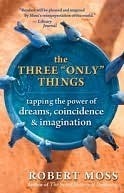
Have you ever said something was only a dream, only a coincidence, or only your imagination?
In this book you'll discover that these "only" things can be keys to finding and living your bigger story. You'll learn to tap into the nine powers of dreaming, the nine rules of coincidence, and the seven uses of imagination. You'll be inspired by stories of how innovators and world changers have used these gifts, and you'll learn wonderful games to help you access your intuition, heal yourself, and bring juice to your everyday life. When we claim the power of the Three Only Things, we reclaim tools that are profoundly simple yet have the power to remake our lives and the world.
A collection of fanciful ruminations about dreaming and the theory of energy work. It reads like an entire blog entry collection binded into a small book. Lacks any practical techniques and sound advice for lucid dreaming, which is what it promised but didn't deliver.
If you like the idea of a simplistic motivational infomercial that rah rah rahs the idea of believing in dreaming, then this could be for you.
Robert Moss is one of my favourite authors. I love his writing style with his delightful stories from his seminars, clients, and those he meets and chats with on his travels.
In this book he tells us about dreams, coincidences and imagination.
We are given the nine powers of dreaming, the nine rules of coincidence and the seven open secrets of imagination.
Everything in life has connection with everything else. Moss dreams about Churchill and has a novel about Churchill with an Indiana Jones touch with him to read on his flight; then he sees a man at the airport dressed like Indiana Jones, and this is the person who sits beside him on the plane after switching places with someone else. The man informs him that his clothes and gear were made by Churchill´s bodyguard.
It turns out that when he was 14, Winston dreamt that one day he would lead the country and “save the capital and the empire”.
The author is extremely erudite, a former Professor of ancient history, and gives us the benefit of his vast knowledge by means of continued references to famous dreamers and dreams in history. In indigenous cultures, dreaming is about waking up – to a larger truth and a larger reality than are accessible to ordinary consciousness.
The Seneca Iroquois Indians say “The dream world is the real world”. Dreams “offer a place of encounter between humans and the more-than-humans, and they may be prophetic, revealing events that lie in the future”. Among the Iroquois, to dream is to bring yourself good luck, and a dreamer is also a shaman, a healer, and a physician.
We solve problems in our sleep. Dreams coach us for future challenges and opportunities, and warn us of future problems.
Octavian, the great-nephew of Julius Caesar, was saved from a surprise attack when lying in his tent by a friend who had dreamt of what would happen. He listened to the warning, left his tent, and was saved: shortly after, soldiers burst into the tent and “plunged their swords into his camp bed, shredding it to ribbons”.
In Spain, in the time of Philip II, a young noblewoman called Lucrecia de Léon became renowned as a vidente (seer). She dreamt of the destruction of the Spanish Armada and the death of its admiral a year before these events. In her dreams she functioned as a psychic spy, travelling to the home of Sir Francis Drake in England “to eavesdrop on the plans of Spain´s enemies”.
Moss gives us examples of dreams that saved both his own life and that of others.
Dreams diagnose possible health problems before physical symptoms are detected. Dreams give us the right prescriptions – tell us what to do.
When the author Wanda Burch was a child, her father dreamt that a prescribed tonic was poison. He took it back to the pharmacy, and it was found that there had been a mix-up and the tonic was rat poison.
This same lady, Wanda, was scheduled to have surgery to get a mole removed from her foot, which surgery she did not wish to undergo. Before sleep she asked “Why do I have to go through this? Isn´t there another way?” In a dream a hand appeared and with a pencil drew a circle around the mole, whereupon it popped off and disappeared. On awakening, she checked and the mole was gone.
Moss gifts us with several accounts of inventions and discoveries instigated by dreams.
The illustrious writer Robert Louis Stevenson was given his stories by dream Brownies, and when the bank began to plague him with requests for money, his Brownies worked overtime and provided him with many marketable stories.
Moss offers us the “Lightning Dreamwork Game” which we can play with two or more people, and also explains to us the Dream Re-entry Technique.
In a chapter about the nine rules of coincidence, we are given innumerable stories of amazing coincidences (we would probably term them “synchronicities”) that have happened both to the author himself and his clients and contacts.
And this book contains much, much more!
I don´t think I could name a more fascinating story-teller than Robert Moss, and this book is a prime example of his talents.
I highly recommend that you read this book if you are at all interested in dreams, “coincidences” or imagination!
This is an easy and enjoyable read with lots of snippets of interesting facts, these include; info on Pauli and Jung, the story of Bach's Chaconne, dreaming and Islam plus many more. I award 4 stars and not 5 because as in the case with several other of Robert's books a fair amount of the information is a repeat of things contained in his previous works, for example; discussion on Harriet Tubman, The exercise of the market place/question to Hermes, to name two. I do recommend this book but if you have not yet read Concious dreaming by Robert Moss then this is where I would direct you, by far his best book
I am a huge fan of Robert Moss' teachings. This book shatters the thoughts "it's only a dream", "it's only a coincidence", and "it's only your imagination". This book is full of practical application, with enough real-life stories, both historical and modern, to satisfy my skeptical nature. Love it!!!
I always enjoy Robert Moss' writing about the power of dreams and imagination. However, I found this book a little tedious after having read Active Dreaming and The Secret History of Dreams as he covers a lot of the same techniques discussed in the former and many of the same famous dreamers (I.e. Winston Churchill and Mark Twain) from the latter. Still, Moss' work helps to put me in mind of one of my favorite Rilke quotes: if your daily life seems poor, do not blame it; blame yourself, tell yourself that you are not poet enough to call forth its riches...' When I approach life with an attitude of active playfulness, magical things happen.
A good book for someone who is getting started with the topic (dreaming/imagination/imagination-->real life). Inspiring, sampling from many sources and pointing in many directions, this book seemed like a 'candy sampler' to me. Personally I prefer a bit more structure and staying on one topic, but nevertheless I enjoyed the book and found it inspiring.
I believe strongly in the power of the imagination and meaningful coincidences, though some of the examples seemed more extreme than what you'd typically come across in daily life.
This comment from Edward Herman and Gerry O’Sullivan’s 1989 The “Terrorism” Industry, makes it clear that Robert Moss may not be the shamanic dream master he is selling himself as. He has no real affiliations to the shamanic cultures he appropriates from, but a very real and long background in CIA covert propagandist activity. Funny how this long career of his is never mentioned on his blog, his webinars, or in his books. Do approach his writings with suspicion and do a little googling before accepting him in his new persona as a dream guru.
“Robert Moss has been a major figure in the organization of terrorism think tanks and in the dissemination of the right-wing version of the Western model of terrorism. In fact, as Fred Landis has pointed out, “For a price, Moss would go to Rhodesia, South Africa, Iran, and Nicaragua and tailor his standard KGB plot to local circumstances, thereby justifying repression of the political opposition and denial of human rights.”
Moss withdrew from the world of make-believe threat-conjuring in 1987 to write books and run workshops on the power of dreaming. But with his cutting edge expertise in seeding the collective unconscious with lies and fabrications for political and financial purposes, can it really be assumed that Robert Moss’s dream work is only about helping people to receive wisdom and gifts for your life?
Robert Moss’s Students, and those reading his books should be asking these questions.
This is the perfect entry to the world Of Robert Moss's Shamantic Dreamworkings. I started with this book and it was a great introduction into understanding the importance of dreams and imagination, what coincidence really is and what it can tell us. If you have read any of Moss's other books, you might find this text to be redundant (he covers much of this material elsewhere), but I still pick up this book from time to time. It is clearly written, and covers the essential points that one tends to forget.
I think Moss is doing important work here, but it may be too "out there" for many. The Three Only Things brings you gently into his mindset, with the research to back it up, so I recommend this book as a gift for anyone you think might be receptive to his work. Highly recommended.
While not a terrible book, it seemed both a vehicle for promoting the author’s workshops and an avenue for recounting the many wondrous coincidences he has observed in his life. If we look for life’s rhymes, if we are attuned to the way coincidence occurs and when we listen to the voice of intuition in our gut, the world is waving at us constantly, practically shouting Yoo-hoo!.
Robert Moss is basically a wizzard. This was a really interesting book. You can tell the author is a sweet individual who has an interesting world view and a lot of compassion. I look forwarding to reading more of his books. "It's about playing better games." Seems like that was something I really needed to hear.
I approached this book with a lot of skepticism, but I'm about two-thirds of the way through and I'm intrigued. The references to scientist Wolfgang Pauli and to Carl Jung are interesting, and I'm rethinking my understanding of time and space as a result of reading this.
No era lo que pensaba, es un libro que habla de historias reunidas por el autor de la importancia de los sueños. Comencé a leer este libro pensando que iba a obtener técnicas, sin embargo son experiencias reunidas que ha tenido el autor y sus pacientes, si te gusta este tipo de libros es para ti
This book changed my life. There are exercises, techniques, and methods that truly work to help connect you to....well...so many things. If this book calls you, you won't regret reading it. 💚
He reuses some of his material from previous books adds some new material. I like his approach to thinking about synchronicity, dreams and imagination. Definitely worth reading.
How many times have you wished that you knew exactly step by step how to change your life or the particular action that would lead you towards success? That perhaps someone would drop off a nice manual (with full colour illustrations) detailing exactly what you need to do to live a healthy, happy, fulfilled life. Likely, far too many.
Unfortunately, there is no such text. Still, that doesn't mean there isn't an excellent resource available to us. The truth is that we have all the guidance we need right here and right now. No guru is necessary and there's no fancy equipment to buy. To make full use of this resource, we only have to delve into three things: our dreams, coincidence, and imagination.
The Only Three Things asks the reader to become aware of themselves, their unique potentials, and open to all that the world has to offer. So often in our striving, we lose track of our original intention. We forget that happiness isn't defined by having the most toys. Our views of life and living become narrow. We become closed to the opportunities that life brings.
I felt lighter after reading this book. I used the author's exercise asking for guidance on a particular problem that has been on my mind of late. I was pleasantly surprised by the result. Within half an hour, the universe gave me three very strong reactions. Even in my stubbornness, I couldn't dispute the answer.
Good book about some of the hidden wonders and workings of the world of the unseen and how it impacts our lives, and one authors perspective and expertise on how to be vary and access it more. Good read and enjoyed even if not 100% agreeable content - certainly still great wisdom to be discovering and a path to begin to learn more beyond this book as it didn’t seem quite complete or groundbreaking as much as I found his other book ‘conscious dreaming’ which introduced to me his work (great read)
👆🏼 P.S - If you found this review helpful - I’d like to invite you to discover more on our blog. Where the community share some of our most important insights to level up each others knowledge 💡- from experience in studying books like this, training programs, podcasts and much more - visit the blog link above to find out more.
P.P.S 😅 - You probably noticed from my profile that I’ve reviewed a LOT of books over the years now - if you love seeking knowledge like me I’d love to connect with you further as a like minded person (send me a friend invite! 😀) - Also if you are curious - here is my preferred and recommended resource for seeking timeless wisdom - Check it out via the website invite link below 👇🏼 (You’ll be able to claim some awesome books for free 📚)
I read this book after having read a few other Robert Moss books. As such, I believe I did this out of order. The other Robert Moss books I read are very in depth and detailed. This book, however, is Robert Moss Lite; it is more of an introduction to deeper work contained in many of his other books.
Although much more elementary, this book was enjoyable. Robert makes many good points to introduce the reader to the fascinating realm of Dreams, and his writing style flows smoothly. Historical anecdotes are used to illustrate how important dreams and the imagination have been throughout time.
If you are a first-time Robert Moss reader, or new to the work of dreams, I recommend this book as a jumping off point.
I like the direction that this book pushed me in when it comes to thinking about the possible meaning and significance of dreams and coincidence. I've had my fare share of bizarre coincidences and precognitive dreams, and found Moss's discussion of them being part of a plane of existence outside of standard space/time interesting and well written.
That said, Moss's writing tended to bring out the cynic in me due to his frequent reference to individual case studies and questionable examples from the past. His narrative lacks focus and would jump from one claim to the next in a way that felt very wishy washy, so that I would never recommend this to any of my more critical friends.
I found out about this book when researching Conscious Dreaming. When I got it from my library hold shelf it wasn't really what I was expecting. It was a bit cheesy at times, but it interesting, nonetheless. There's a whole lot of inarguable evidence that creative people - such as Da Vinci and Mark Twain - moved through a realm of dream and coincidence that a lot of people are turned off to. Still this book has that weird self-betterment style of talking that you get into with New Age and self-help writing, which I'm knee-jerk skeptical about. I would like to move onto something a little more intellectual from here. Maybe it's time for Jung.
This book has such a positive approach in telling us ways to tune into our own lives through the world around us and within us. It has a spiritual aspect, almost without seeming to know it. My one caution to myself is to keep things in perspect according to my religious beliefs, so as not to turn adherance of the ideas in this book into pagan worship, but to put the ideas of this book into the context of my beliefs and use them within that context.
Extremely well thought-out treatment of the relationship between lucid dreaming, synchronicity, and thoughtforms. This book helped me make a lot of connections I was having trouble seeing on my own! Very practical and informative. This is the best book I have read on the practical applications of synchronicity/coincidence.
I bought this book directly from the author at a workshop he gave in Ithaca on "Dreams, Coincidence, and Imagination". Robert Moss is a thoroughly engaging, sparkling, and droll speaker; we all hung, openmouthed, on his every word during his fascinating stories. The workshop was so much fun.
Every page of this book draws the reader in. Every time you read it, you gain more awareness. I enjoy picking it up and randomly selecting a few pages to read. It invariably is the section that was meant to be read at that time. No mere coincidence!
This is fun, engaging read that encourages us to begin to notice the inklings of our intuition. They are not "only" your imagination, rather they are interior prompts from your deep self that can help you live more authentically
Really enjoyed the humor of the author. A great book for those just getting into dream and shamanic work. Even if you are an "expert," it's still a fun book to read with a lot of great examples and case stories.