Wager was best known as an author of mystery and spy fiction; his works included 58 Minutes (1987), whose story was used as the basis of the action film Die Hard 2 in 1990. Two of his other novels became major motion pictures in 1977: Viper Three (1972), which was released as Twilight's Last Gleaming, and Telefon (1975). Wager wrote a number of original novels in the 1960s under the pseudonym "John Tiger" that were based on the TV series I Spy and Mission: Impossible.
Born Walter Herman Wager in the Bronx, NY, he was the son of Russian immigrants, and he attended Columbia College at Columbia University. He graduated in 1944 and later earned a law degree from Harvard; the practice of law interested him less than aviation, however, and Wager subsequently entered a fellowship program at Northwestern University through which he earned a degree in aviation law. He attended the Sorbonne for a year under a Fulbright scholarship at the end of the 1940s, and then turned his attention to earning a living. Wager spent the early '50s working as an aviation law consultant to the government of Israel, and from there moved to an editorial job at the United Nations, where he oversaw the editing of that organization's myriad publications. His interest in writing got him into radio at the tail-end of that medium's era of prominence, authoring scripts, and in his spare time he wrote stories.
He was also a writer and producer for CBS Radio, CBS television, and NBC television and was editor-in-chief of Playbill from 1963 to 1966. In addition, Wager worked in public relations for ASCAP and the University of Bridgeport.
Of COURSE the book was terrible - from its paper-thin plot to its awful writing to its blatant racism, sexism and homophobia. And YES, Bill Cosby suffered a well-deserved fall from grace only matched by Harvey Weinstein, Jeffrey Epstein and (just making a prediction here, assuming there is ANY justice in the world) our soon-to-be-Ex-President.
And yet...there's always been a special place in my heart for I SPY. As a soon-to-be-teenager in the mid-60s, Kelly and Scotty were the cool jazz to The Man From U.N.C.L.E.'s bubblegum pop. I SPY was one of the first TV shows to actually film on location, and so not only was it a cooler show than U.N.C.L.E. and Mission: IMPOSSIBLE, but it gave me my first close-up look at places like Hong Kong, Athens, Tokyo and Morocco, and planted the travel seed that would bloom a decade later and keep me going until the present day. (Which is the only possible explanation for that second star, because this really is a truly terrible book.)
Granted, Wager cranked out these and his IMPOSSIBLE tie-ins at a breakneck speed - so who has time for editing? Or perhaps thinking twice about such sentences as:
"Unlike the American Ku Klux Klan or the British homosexuals, it's members never sat for television interviews or appeared at legislative hearings."
...or:
"The thought of one of those mustachioed female scientists in horn-rimmed glasses repelled him..." (although don't worry - she turned out to be a total babe!)
On top of this (and SO many other things), Wager can never just refer to anyone or anyplace simply by name - as "Scotty" or "Strauss" or "the CIA chief" or even "Tokyo." It's always "the ebony linguist" or "the thin West German cloak and dagger professional," or "the pot-bellied Chicagoan," or "the Nipponese capital."
And as I look back on all those quote in the last paragraph, I am reminded...what's with all the quotes?? As I mentioned in an earlier review, Wager can't avoid putting anything that is the least bit slangy or technical in quotes, so that by just page 6, we're getting paragraphs like this:
Captain Gordon waited calmly as the anesthetist put the patient "to sleep." He'd performed dozens of appendectomies as a surgical "resident," and the fact that the body belonged to a Pentagon "bird colonel" didn't bother him a bit. The fact that this was an emergency left the young surgeon equally "unshook..."
I mean seriously: W T "F"?
If you still have any interest in these books, you can save yourself a whole lot of trouble by reading my other reviews in the series:
(And yes, #3-5 aren't up there because while I read them as a kid, I haven't reread them since...but being the glutton for punishment that I know I am, I'm sure I'll get around to it someday!)
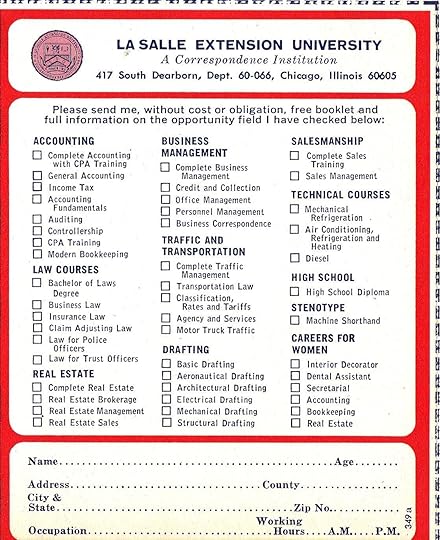
POSTSCRIPT: I LOL'ed at the perfect capper to this book, a tear-out/mail-in postcard for the late, great La Salle Extension University, (below). Note that last among the many course offerings is a special section on "Careers For Women," who back then could be everything from Dental Assistants to Secretaries to Bookkeepers to Interior Designers, (apparently female physicists - whether hot-blond or mustachioed - were still unimaginable beyond to the realms of fiction). To quote the famous Virginia Slims advertisements which were to proclaim (just a year after this book was published), "You've Come a Long Way Baby!"
A very solid novel based on the series, not an adaptation of an episode however.
Kelly and Scott find themselves tracking down a group they've faced in the past, Force One. This is a "Fourth Reich" kind of group, very popular in fiction back in the 60s and 70s. This group was international though, compromising fascists from Italy and Japan as well as Germany.
Both men find themselves getting involved with women, but Scott is the one who has the fortitude to resist. It was an interesting aspect of the show as well, with Scott having the edge on his white counterpart in every aspect except when it came to dropping corpses. Also present is the camaraderie in the TV show, with both men having a solid respect for each other, and giving everyone else around them a hard time for not being as smart or quick as themselves.
A definite read for folks who love the TV show, tie-in books, nuclear countdowns, and reading about Nazis getting shot, beat down, and just generally broken into smaller pieces for easier transport to jail or the morgue.
As with Masterstroke, which was #2 in this I Spy series, the science was awful, and remarkably unconvincing. This one involves the invention of explosive nuclear devices small enough to plant inside human bodies in simple surgical procedures, but somehow not noticeable later. Never mind the fact that this was WAY below the "critical mass" needed for a fission explosion. These small widgets were supposedly capable of a Hiroshima-sized explosion out of something the size of a pen case, and triggered really strangely...The method for getting these into the targets was to stage accidents and then, under cover of surgical intervention, implant the bombs. Okay, but in the story none of the targets seem to have contacted their own physicians to, you know, check and see if these foreign and totally unknown surgeons might have left anything undone? Since the bombs would show up very easily on an X-ray, that was a pretty forced plot point. Weirdly, too, the cover story of the I Spy team seemed remarkably thin, and I was amazed that the various bad guys hadn't figured out by now that wherever the odd tennis bum with a black trainer turned up, spy things happened. I mean, if you really just ignore the things that cover your rear end, your espionage career doesn't seem too likely to be survivable. But I digress... At the core of the story was a plot of former Nazi and Japanese nationalists who hadn't given up on that World War II thing. Okay, I could believe that, for a 1960s story. What I had more trouble believing was that they managed to take over a few actual military units, or that they expected this weird plan of theirs to actually work. I mean, if a number of small nuclear devices had gone off in key military installations around the world, during the Cold War, wouldn't the likely response have been some version of World War III? It seems unlikely that Germany would have been a good place to try to take over at that point in time. And don't get me started on how flaky the Japanese part of the plot seems to have been. There were a few good scenes in the book, but only its short length kept me from giving up on it.