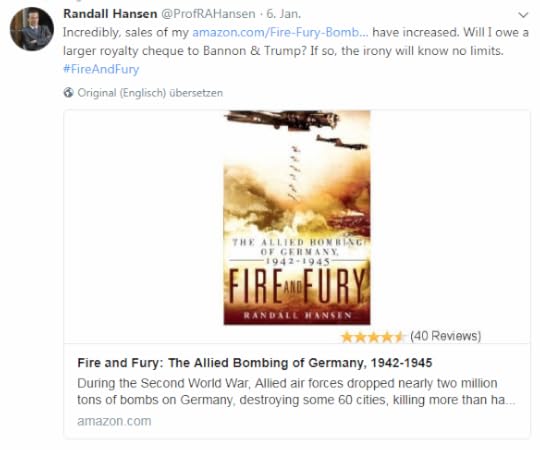
During the Second World War, Allied air forces dropped nearly two million tons of bombs on Germany, destroying some 60 cities, killing more than half a million German citizens, and leaving 80,000 pilots dead. But the terrible truth is that much of the bombing was carried out against the expressed demands of the Allied military leadership, leading to the needless deaths of hundreds of thousands of civilians.
Focusing on the crucial period from 1942 to 1945, Fire and Fury tells the story of the American and British bombing campaign through the eyes of those the military and civilian command in America, Britain, and Germany, the aircrews in the skies who carried out their orders, and civilians on the ground who felt the fury of the Allied attacks. Here, for the first time, the story of the American and British air campaigns is told-and the cost accounted for...
This is a really good and important book. Every WWII reader knows that the US Bombed Nazi Europe by Day, and the British Bomber Command bombed by Night. But this book traces the development and history of the entire Allied bombing effort in Europe. He details how the US proved that precision bombing is an effective tactic and strategy- and more importantly- HOW THE BRITISH EFFORT WAS NOWHERE NEAR AS EFFECTIVE. Area Bombing is simply not that useful in war. And yet it continued and was only discredited after the war. A great read and something that any reader will find fascinating.
Fire and Fury by Randall Hansen is an excellent, well- written historical inquiry into the differing strategies of British Bomber Command and the USAAF in the bombing of Germany World War II. Very briefly, the British bombing plan was to carpet bomb entire German cities into rubble, causing as much destruction and death as possible. The announced intention was to destroy the morale of the German people. The American Strategic Air Forces plan was one of daylight precision bombing attacks on military targets such as aircraft factories, manufacturing facilities, oil installations and transportation hubs, all in order to eliminate the German ability to continue the war.
I will not presume to re-tell Mr. Hansen's story here. That would not do justice to the research he did into his subject or to the masterful presentation of the facts leading to his conclusion. That conclusion seemed evident to me, but it may be controversial to some.
There is not a dull page in this book; it is fascinating for any fan of WWII history. Facts are clearly presented, and conclusions clearly drawn. In the 297 pages ( photos, also) great battles are fought over Germany, and between the Allies, indeed, within the British command structure itself. I bought the book a few years ago, but I am sorry I waited so long to read it. If you are at all interested in the air war in Europe, read it.
Randall Hansen's book is an important contribution to discussions of military history and World War Two. It is impossible to read it, in my view, and believe that Arthur Harris was not a war criminal, though others may disagree. However everyone who reads this can only conclude that the strategy of mass bombing of cities was an utter failure that probably prolonged the war.
War is hell. This fact is graphically demonstrated by the bombing of Germany during the Second World War. These atrocities should have been enough for the Allies themselves to be charged and tried for war crimes.
In March of 2001 the world was outraged by the Afghan Taliban destruction of the monumental Buddhas of Bamiyan, a UNESCO World Heritage Site. "Horror," proclaimed the world press, condemning this act as a violation against the cultural heritage of all nations. I too grieved this heinous act of savagery.
In our own time, the nations of the world are appalled to see the destruction being wreaked against the lands of Gaza in retaliation for its brutal attack on the people of Israel.
How soon we forget. These are far from unusual events in recent history when such massive instruments of war are so readily available. Our forgetting is abetted by systematic efforts to suppress our own acts of savagery. Even amongst our so-called advanced civilizations, none of us are entirely innocent.
In March of 1945, three weeks before the end of World War II and clearly beyond any demonstrated need, 236 British Royal Air Force bombers delivered 1,127 ton--tons--of bombs and 370,000 incendiaries in 17 minutes on Wurzburg, Germany, population 36,850, nearly all women and children. There was no strategic purpose, and the operation was carried out in specific defiance of policies and orders from the highest levels of command.
Destroyed were 21,000 homes, 35 churches, and the Wurzburg Cathedral. 89% of the thousand-year-old town was turned to 2.7 million cubic meters of rubble. 5,000 people lost their lives.
Wurzburg had no military or industrial centers or uses. Its destruction was simply an effort to demoralize the German people, an effort that Allied commanders had long since conclusively determined was counterproductive and of no meaningful use in war planning. The decision to ignore all orders and policies was made exclusively by one man. Arthur Harris, Head of Bomber Command, was committed to his personal goal of wiping every city in Germany off the face of the map.
Wurzburg thus joined Chemnitz, Dessau, Essen, Dortmund--and scores of ancient towns and cities across the nation, with no or minimal industrial capacity or contribution to the war effort, in being systematically and intentionally obliterated beyond recognition, women and children among the prominent victims.
Though the work of one specific and identifiable responsible person, the actions were clearly recognized at every level of the chain of command in Great Britain, up to and including the later lionized Winston Churchill. Not one person made a significant effort to stop the inhuman level of destruction. The entire British Command structure was implicated and guilty. And not one single person has ever admitted it or recognized it for the heinous cultural and human damages it caused.
I'm just recently returned from travels in Germany, taken there by family matters. Like the 35 million other visitors to that country each year, I was profoundly touched by the historical depth of civilization there. One cannot spend time there without being awed by history. In the United States we proudly celebrate buildings and companies that have existed 100 years. 1,000 years? So far beyond our ability to grasp we simply close down our thinking. Destroying this heritage? Unthinkable.
Reading this book, Fire and Fury, has left me so outraged I could barely think about writing a review. I've delayed it as long as I could.
"The Good War" mythology has been shattered for me. While American bombing practice was by the book and above reproach, learning of the British practice of area bombing has completely shattered my lifelong faith in Great Britain as an honorable country. I can no longer see them as having a trace of moral authority, and certainly have a greater understanding for those who have been critical of that country. That they have worked so systematically and thoroughly to hide the historical record only emphasizes the culpability and shame they live with.
Implied in all of my thoughts is the totally persuasive documentation that this author marshals in support of his case, that British and American bombing strategies were at odds with each other, despite the two nations agreeing on a united philosophy under a single command. In his conclusions he does not shy away from the possibility of a war crimes tribunal to hold the British accountable, though immediately recognizes the improbability of any such action.
A brief word about the book itself, aside from the profound contents: it's not particularly a story-telling book. It should most properly be judged as a legal treatise, a presentation of evidence in support of an argument. With this objective in mind, it's a decent read--well spoken, carefully phrased and reasoned, measured in emotion. It wouldn't be a book I'd consider listening to for entertainment.
I was prompted to read this book by a map I stumbled across after my travels, wanting to know more about the War and its effects. The book met every hope and expectation I had of understanding how many cities were destroyed, and why. I did not expect to be confronted with so much evidence of savagery, incompetence, and cowardice. On the part of our supposed Allies.
As with all such encounters with truth, it has served to enhance my sympathies for the peoples who were once our opponents and avowed enemies.
Very intelligent and well written book. As an aeronautical engineer who lived in (nearby) two bombed out cities (Rotterdam/ Darmstadt) I was always interested in the topic. I knew that the effectiveness of the (European) bombing campaign was modest (eg comparison of airmen lost versus damage and victims inflicted on the Germans). But the Germans in my mind initiated the terror bombing (Rotterdam) and I always felt they should be paid back in some way….
However the book is great in its more analytical approach (not moralizing) stating that a more targeted effort could have had a more effective impact on the war; eg by focusing (much more) on key industries (oil, ball bearings - referring to the Schweinfurt attack). Repeat attacks - however costly with high casualty rates for the airmen - could have had a significantly higher impact on the German war effort. The book describes the debate notably in England (between bomber Harris and men like Portal and Churchill) that took place about precisely about the topic and that a change in approach could have been possible, certainly from late 1943 and after D Day…
In Asia the Americans followed a British approach, with non precision bombing killing many civilians; but also there and then there was little effect on the progress of war, or even on morale and support by the civilians for the war.
There is only one question that I would find interesting to debate: post WWII, unlike post WWI, Germany accepted defeat. After the first war, the German mother country was largely intact. Perhaps the devastation- however horrific- had that effect on the people to this time accept defeat peace and to ultimately prosper… not sure whether that is a valid argument but would have welcomed the debate…
An interesting commentary on the British night area bombing and the US daytime (usually) precision bombing strategic air campaigns against Germany. It contrasts the American bombing of mainly industrial targets (oil, transportation, ball bearings) quite favourably against Harris, of the RAF's Bomber Command, and his obsession with obliterating German cities in a stated attempt to defeat morale. Hansen makes both the moral and effectiveness argument in favour of the US approach. A bit much of the middle is taken up with the memo war between the wimpish Portal, trying to get Harris to bomb the industrial targets, and the seemingly insubordinate Harris. It is a useful companion to Tillman's "Whirlwind", where the Americans did use Harris' city-killing approach in fire-bombing Japanese civilians. Different race, different morality? Or were the Brits in favour of blowing Germany to bits in retaliation for the Blitz and V-1s and V-2s, and the Americans feeling the same after Pearl Harbor and other attacks directly on the US and its dependencies in the Pacific. Probably a bit of both.
Not sure how to review this one, the book was a quick and easy read with plenty of detail, facts and eyewitness accounts of those who orchestrated the bombing campaign and those who survived being on the receiving end. I think the frustrating thing for me are the two pivotal personalities responsible for bomber command, Portal and Harris. I guess frustrating because I see the tactic of area or carpet bombing of cities as unethical and of less value to achieving military goals. This account clearly illustrates Portals wavering and ambiguous dealings with a man under his command who was willing to flount his orders to carry out a campaign against German citizens rather than military targets. After all arguments are in it is clear to me that this period is a dark stain on the history of Britain and certainly of bomber command.
The first chapter of this pulls you in with stark force. I knew little about the allied firebombing of Germany. I blandly bought the idea that civilians naturally would die in such a circumstance. I had to unlearn a great deal, and that was an exciting exercise for me that I hope you won’t have to replicate to the same degree if you read this.
This is a magnificent relatively short military history that should be on the reading list of even the most casually interested military historians. I claim absolutely no expertise in World War II air power, but this book left me both proud of American leaders in Europe and shaken when they caved and did the unthinkable. The ultimate winner in this book for me was Gen. Jimmy Doolittle, the same Jimmy Doolittle who launched the raid on Tokyo in 1942. As is too often the case with my reviews, my enthusiasm for this book means that the review has suffered so far. Let me try to redeem it:
The first chapter is a stark look at a specific set of people in a German bomb shelter during the war and the horror unleashed in a nighttime British bombing raid. It will forcibly pull you into the book; that’s how propulsive it is.
From then forward, you’ll learn about a debate among British and American aviation leaders. The Americans insisted that, if they bombed in daylight only, and if they hit only strategic sites that largely left civilians alone, the war would end quicker. Americans wanted to hit oil fields, transportation hubs, manufacturing facilities, and any other businesses that would help the Nazi war effort.
Arthur Harris, one of the top men in the echelons of British aviation, insisted that carpet bombing or aerial bombing would destroy the morale of the German people and bring the war to a much quicker end. He seems to ignore the fact that Britons boosted their morale because of Hitler’s bombings in 1940.
The more you read this, the more sickened you become As Britain insisted on nighttime destructions of cities while the Americans largely kept their bombs from falling on civilians. Sadly, Harris even ultimately influenced the United States when its leaders approved the bombing of Dresden. American planes took part in that without apology or apparently regret. That’s the point in the war in which Doolittle argued vociferously for a return to strategic bombing. He insisted that was what his crews had trained for.
The author portrays Arthur Harris in a negative light, as well he should. You should read this to see how the politicians treated Harris after the war ended. This was a fascinating book by every measure, and it is by no means boring or dense.
I suspect the topic of this book is pretty easy to guess by the cover. Hansen covers the British and American bomber attacks on Germany through the end of WW2. I will say that he spends a LOT more time on the British side of things so if you are looking for a lot of details on the American side this probably isn't the best place to get it, but he does cover both.
In addition to telling things from the Allied perspective, Hansen tries to incorporate the views of the German civilians who were affected by the bombings. While I appreciate the effort, and the suffering was certainly something people should be aware of, I didn't think those sections added a lot to the book itself. Most of them were very personal accounts of losing loved ones, homes, etc. and were more specific and less tied into the war effort as a whole.
With that being said, Hansen spends a LOT of time questioning the morality of the bombings in general, which I think is warranted and well done. One note is that Hansen comes down hard on the British efforts, and Arthur Harris in particular, and generally is much easier on the Americans from a moral perspective. I have no reason to doubt his information, and I can definitely see the distinction that he's making, but the book pushed the narrative hard enough that I questioned whether there was some bias at play. I'd be curious to read another take looking at the same information and see if the distinction is as stark as portrayed.
Hansen also spends a lot of time discussing the effectiveness of the bombings, and I think it is another strength of the book. Hansen makes some good arguments that not only were the area bombings of cities less effective and arguably less moral than more targeted strikes, but that there was more than enough information on the Allied side for them to have recognized this much earlier and acted upon it. Hansen attributes a lot of the blame to Harris, but has plenty left over for those in the British government who chose to let it continue even if they didn't directly support it.
The book was well written and while some passages came across a bit dry, I think the whole was very well done. I could have done with less quoting of Harris' correspondence with his superiors, but at the same time I think those documents helped support the author's argument and represent primary sources so it is hard to argue with excluding what is available.
Overall, a very good book and one that I definitely learned a few things from.
This is a thorough and careful history of the Allied bombing campaign against Germany, and it doesn’t stint on analysis. There are two conclusions:
1. There was a very definite difference in intent between RAF’s Bomber Command and the USAAF campaign. Bomber Command preferred to kill civilians rather than bombing industrial targets, and often passed up the opportunity to do serious damage to German war production in order to kill a few more people. Meanwhile, the USAAF commanders were laser-focused on German economic and war production targets, and did very little deliberate “area bombing.”
2. Bombing of economic targets was far the more effective strategy, besides being more moral. The text cites German documents to point out that, had Bomber Command unbent enough to follow up successful American raids on industry, the war would have been definitely shortened. Instead, Bomber Command actually prolonged the war by their campaign of frank terror bombing.
The USAAF is almost single-handedly responsible for the defeat of the German Air Force, and that is due partly to their concentration on aircraft production-related targets, and partly to the deliberate strategy of drawing out German fighters in order to destroy them.
The United States doesn’t have clean hands, even in the European theater, much less in Japan where carpet-bombing with incendiaries was the standard tactic. (In our own defense it should be noted that Japan built mostly with wood and paper, which is resistant to serious damage by high explosive, and the centers of industry were much more diffuse than in Germany.) Furthermore, perhaps 10% of USAAF bombing missions in Europe were deliberate area bombing, as opposed to inadvertent area bombing due to overcast or other poor targeting conditions.
But the conclusion of this book is clear: the United States had the more effective bombing strategy, and the RAF’s Bomber Command actively obstructed that strategy by their preference for terror over the destruction of industrial targets.
(Audiobook) This is the second book titled "Fire and Fury" that I read this year, and this one is a better book than the other one (Michael Wolff's tabloid-style account of the early Trump White House). This one focuses on the Allied bombing campaign against Nazi Germany during World War II. It offers extensive detail of the people involved in the planning and execution of those campaigns, as well as those who dealt with the effects of that bombing. It can get a bit academic in reading, but not a shock given the detail of sources. Hansen takes the stance that the bombing was ultimately ineffective in achieving its aims of bringing about the strategic defeat of Germany it promised to do (mirroring several key surveys in the immediate aftermath of the war). His is critical of all parties involved in the war, but does not blame the young men who executed those missions. The reader does okay with the material, which can get a bit dry at times. A book that should be read by airmen across the world at least once, but maybe not one to be reread.
Not so much a description of the Allied bombing campaign against Germany as it is a look into the thinking behind it. It draws a stark comparison between the American strategy of precision bombing of military targets with the implied minimizing of civilian casualties with British Bomber Command's policy of total destruction of German cities by area bombing, intentionally killing as many civilians as possible. The British plan being to shorten the war by undermining morale of the German people. The reader is also exposed to what it felt like to be on the receiving end of these raids, by the inclusion of eyewitness accounts of German civilians as fire storms destroyed their homes and cities. It is a thought provoking book which left me, not for the first time, wondering why in this day and age, supposedly civilized nations still seem to think war is a good idea.
A spectacularly researched and gripping take on the morality and logistics behind the allied bombing campaign against Germany during the Second World War. As other reviews point out, Mr. Hansen makes both a moral and practical argument in favor of the United States' bombing strategy against Germany, in comparison to that of the United Kingdom. The best part is that this argument is not solely conjecture, as the author provides myriad evidence for his points.
Do not be dismayed by the seemingly academic topic of this book - it is a well written and easily understood piece that can be read and understood by everyone, from the average person to the seasoned historian. Hard to put down. Highly recommend.
This book presents the air war from three points of view. The German, world conquest. British, area bombing, I think this was based on revenge for the war that was brought to England. Then the American, precision daylight bombing. We came late to the fight, which we did not want, trying maintain the moral high ground.
The author tries to show the difference in the British and American ideals and approach ending the war. From my point of view, being born in 1951, I thank the heroes of the Second world War for the world I grew up in.
Disappointing read.....title would have been more aptly named the feud between Harris and Portal on bombing targets. Author spent the better part of the narrative with back and forth between Harris & Portal. I had expectations of reading about the exploits of the 8th air force and bomber command....I was wrong. Capping off this weak effort was the authors opinion of the morality of the European air war......and his opinion is wrong.
This is an excellent narrative of the bombing campaigns in Europe and Japan. Hansen is an articulate author who has brought to life some very detailed research all the while giving voice to the human factor throughout these devastating times. The book keeps moving, is Immersive and entertaining to read and highly recommended for anyone wanting a balanced view of the horrors associated with the WWII bombing operations.
An interesting, detailed account of the bombing of Germany during World War II and the different approaches taken by the British and the Americans. It reads like a novel, but is chock full of pertinent information and the disagreements of the two countries' approach to the air war. Highly recommended.
Covers the strategy, tactics, and results of the bombing campaigns. The main thrust is that area bombing was ineffective and unnecessary, and the author marshals facts, documents showing the leaders' intentions, and the horror of eyewitness accounts to back this up. Not a fun read, but well-written and generally accurate.
This was good to read after reading the Big Week. I learned more about Bomber Harris than I ever expected. I've been reading WWII history most of my life having Uncles who served during that time. Fire and Fury is very much a higher level so that we understand the thoughts behind the leaders who planned everything. Read this if you like strategy.
A great read for WW2 buffs, aviation fans, and history readers. A good balance as to the good and bad side of the bombing of Germany from both sides. Fascinating history on the egos of military leaders….at times scary.
This book was very informative, like a high school history book. Also like a high school history book, it was long, dull, and completely unamusing. If you are looking for a dates and figures book, this is for you.
I’ll fess up now - this is NOT the book I read. I’m just trying to mess with Amazon’s algorithm. Besides, everyone’s reading that “other” Fire and Fury.
Excellent book about the strategic bombing of Germany. The author makes the argument about the usefulness of the American precision day bombing and the uselessness of the British area night bombing. I really liked the writing style and the author makes his argument without feeling too repetitive or browbeating the reader with his conclusion. He also presents the experiences of some German victims of area bombing.
Bomber Harris' frequent arguments with his superior (Portal) over what he should be bombing and why are covered in detail. Unfortunately, I found this to be the one weak point of the book. The Portal-Harris arguments felt very repetitive, although this is probably a fault not as much of the writer as the history itself.
I also felt some of the presentation was uneven between the American and English air forces. The argument is well made in the book but might have been even better with more coverage of the experiences and successes of American bombing.
The author does a magnificant job of giving the reader an unlimited amount of data so they can decide their own conclusions as to who was the real danger in the bombing of Germany during World War 2. The author introduces us to the men who made the decisions on who to bomb and when. Done in a writing style that lets your average reader follow the timelines and moments of clarity, the reader will see the views from both sides of the battles. Any fan of World War 2 books will enjoy reading this book. As a bonus, there is a nice middle section of photos so you can put faces to the men you're reading about.
An excellent analysis of the different philosophies between the two major allies. To a degree,I could see where Harris was coming from. His country was bombed during the Blitz and later by the V1 and V2 weapons. Still, after the early results showed that area bombing was not having the effect they thought it would, Harris largely disregarded orders from his superior and kept up his firebombing attacks on population centers instead of military targets. Interesting too on how Allied leaders were concerned about world opinion then and how they would be viewed after the war. Highly recommended.