

What do you think?

Truck Stop Rainbows
Combining adventure and scathing social commentary, unforced pathos and irrepressible eroticism. Truck Stop Rainbows is a surprising look at the children of Marx and Coca-Cola who are transforming the face of Eastern Europe.
279 pages, Paperback
First published January 1, 1992
About the author
Iva Pekárková
56 books15 followersIva Pekárková, česká spisovatelka, překladatelka a publicistka, se narodila v Praze roku 1963. Ve dvaadvaceti letech předčasně ukončila studium mikrobiologie na Přírodovědecké fakultě Univerzity Karlovy a emigrovala. Usadila se ve Spojených státech, kde se živila mimo jiné jako číšnice, sociální pracovnice nebo taxikářka. Své české prózy publikovala v exilových časopisech a psala i anglicky do řady magazínů včetně The New York Times. Jejím románovým debutem se stal v exilu napsaný příběh Péra a perutě (1989).
Po sametové revoluci přispívala do českých periodik (Playboy, Marianne, Cosmopolitan nebo Esquire) a v roce 1997 se na čas vrátila do Prahy, kde působila jako publicistka a překladatelka. Od roku 2005 žije v Londýně , kde také pracovala jako taxikářka, nyní především tlumočí.
Po sametové revoluci přispívala do českých periodik (Playboy, Marianne, Cosmopolitan nebo Esquire) a v roce 1997 se na čas vrátila do Prahy, kde působila jako publicistka a překladatelka. Od roku 2005 žije v Londýně , kde také pracovala jako taxikářka, nyní především tlumočí.
Ratings & Reviews
Friends & Following
Create a free account to discover what your friends think of this book!
Community Reviews
Displaying 1 - 28 of 28 reviews

May 9, 2019
Set in Czechoslovakia (before Slovakia split away) this is fundamentally a novel about prostitution. A young woman, age 25, goes through three stages as a prostitute. First she just enjoys the sex. She thumbs rides with cross-country truckers and accepts gifts of Western cigarettes, cosmetics and chocolates as incidentals.
She has a male friend who has multiple sclerosis. Their relationship is intellectual and chaste because of his disease. And like some other Eastern European novels of this time, I’m sure that disease is intended as a metaphor for the political situation in the country. Her friend needs a wheel chair. The state will give him one in ten years, but he’ll be dead by then. In this second stage she wants hard Western currency for a wheelchair and negotiates her price.
In the third stage, largely brought about by one Swedish trucker who visits her repeatedly and gets serious with her, she suddenly has an epiphany and realizes ‘she’s a whore.’ But this is still a communist world and we can’t expect any happy endings.
So we have a half-dozen graphic sex scenes. I thought the author handled them well and I didn’t find them repetitive. I did find it unusual that only once does she mention having an argument with a driver. She never recounts a story of violence, when she was fearful, or of having to fight someone off.

We get the usual perspective of life under communism. She and the grandmother she lives with stand in line for hours to get basic goods. Empty stores, empty shelves. The petty squabbles in stores. The poor quality of goods. The run-down apartments. The idiotic bureaucracy. Her grandmother is so inured to poverty that she eats moldy food and drinks curdled milk.
The young woman is also a photographer contracting to sell botanical photos. But she specializes in mutant plants – a metaphor for the environmental damage done to the landscape by acid rain from coal plants, massive collective farms, road, bridge and dam construction. (Some real construction projects are mentioned.) The housing developments lie in a sea of polluted mud.

Between her work as a photographer and her trucker travels she is well-known to the police. The are constantly taking her in for questioning, confiscating her photos and hassling her about her paperwork. She’s an on-and-off again student but loses interest in her studies. Her ability to speak the basics in several languages is important. And she enjoys her conversations with truckers in other languages.
A pretty good read. All in all a bit grim but it kept my interest.
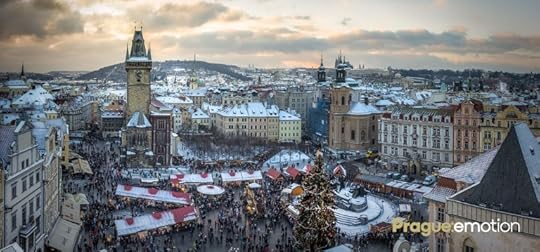
Photo of Prague from prague.eu/en
Map of major trucking routes across old Czechoslovakia from anerleybc.org
Photo of the author from wikipedia commons
She has a male friend who has multiple sclerosis. Their relationship is intellectual and chaste because of his disease. And like some other Eastern European novels of this time, I’m sure that disease is intended as a metaphor for the political situation in the country. Her friend needs a wheel chair. The state will give him one in ten years, but he’ll be dead by then. In this second stage she wants hard Western currency for a wheelchair and negotiates her price.
In the third stage, largely brought about by one Swedish trucker who visits her repeatedly and gets serious with her, she suddenly has an epiphany and realizes ‘she’s a whore.’ But this is still a communist world and we can’t expect any happy endings.
So we have a half-dozen graphic sex scenes. I thought the author handled them well and I didn’t find them repetitive. I did find it unusual that only once does she mention having an argument with a driver. She never recounts a story of violence, when she was fearful, or of having to fight someone off.
We get the usual perspective of life under communism. She and the grandmother she lives with stand in line for hours to get basic goods. Empty stores, empty shelves. The petty squabbles in stores. The poor quality of goods. The run-down apartments. The idiotic bureaucracy. Her grandmother is so inured to poverty that she eats moldy food and drinks curdled milk.
The young woman is also a photographer contracting to sell botanical photos. But she specializes in mutant plants – a metaphor for the environmental damage done to the landscape by acid rain from coal plants, massive collective farms, road, bridge and dam construction. (Some real construction projects are mentioned.) The housing developments lie in a sea of polluted mud.
Between her work as a photographer and her trucker travels she is well-known to the police. The are constantly taking her in for questioning, confiscating her photos and hassling her about her paperwork. She’s an on-and-off again student but loses interest in her studies. Her ability to speak the basics in several languages is important. And she enjoys her conversations with truckers in other languages.
A pretty good read. All in all a bit grim but it kept my interest.
Photo of Prague from prague.eu/en
Map of major trucking routes across old Czechoslovakia from anerleybc.org
Photo of the author from wikipedia commons

December 12, 2013
A lovely little book, set in 1970s or 1980s Czechoslovakia, about a young psychiatrist in her twenties who, for fun, hitchhikes on the truck routes bringing west-of-the-Iron-Curtain truckers through Czechoslovakia so she can have sex with them. Then, once her best friend, a nihilist artistic type living with his mother, develops multiple sclerosis and finds the bureaucracy of getting a wheelchair out of the supposedly-cradle-to-grave socialist state insuperable, she decides to turn those one-night (or, more properly, 15 minutes in a truckstop) stands (hence the title) into full-fledged hustling to raise the money for the wheelchair herself. In the process, she falls in love, for the first time ever, with a Swedish trucker. One of the most impressive things about this book is that the trapped-in-a-wheelchair/trapped-behind-the-Iron-Curtain metaphor not only isn't beaten to death but in fact completely sneaked up on me, almost after the fact: this book is not about politics but about people and emotions and what it means to have an inner life. The author, Iva Pekárková, now drives a cab in the United States and this seems to be the only book she's ever written. I'm guessing it is to some degree autobiographical. I hope it isn't the only book she has in her. It's a delight.

January 27, 2022
I read this when I was living in the Czech Republic and it gave me a glimpse into the country as it had been just before I arrived, in 1994. The good thing about living in a Socialist country is that you get what you need but the bad thing is that it's the government who decides what you need and when you'll need it and this is based on the old saying (which applies to any system of government), "Everybody's equal but some are more equal than others." Fialka is a young woman who enjoys sex with Czech long-haul drivers, hitchhiking from Prague to truck stops where they pass, and later frequents truck stops where Western long-distance drivers stop on their way from Germany and points north to Austria and points south. (A map will show you that Czechoslovakia was between the two and Prague is further west than Vienna.) She demands Western currency from these in order to help her friend, Patrick, who has MS and needs a wheelchair. (The government has offered him a top-of-the-line wheelchair, the most modern available, and it will be ready for him in 8 or 10 years - when, of course, he'll probably be dead. When I lived there, there was still a Tuzex store in my small city; these only accepted Western currency or vouchers, not Czech currency, and this was the only way to get some things Western, unless you "knew" someoine and could arrange one of the famous swaps which Czechs made for services or goods unavailable by government channels. For example, home or car repairs; when I lived there, the average age of a car on the road was 20 years.) Apart from the political aaspects of this book, there is also the erotic as Fialka is a woman who loves sex and there are lyrical and graphic passages which demonstrate that. It's certainly a book well-worth the effort if you can find it, both for its politics and eroticism.

February 11, 2010
Beautiful gems can be found in different parts of the world, in places where you least expect to find them. An epitome of this beautiful gem is the brilliant author, Iva Pekarkova with her astounding novel, Truck Stop Rainbows.
Set in Czech Republic around Velvet Revolution, the protagonist Fialka believed in “serendipity”. In between college days, she ventured into hitchhiking across the Northern road in search for “rainbows” she thought she would find in her affairs with truck drivers. She fell into prostitution as her means of raising funds to buy wheelchair for her friend who is suffering from multiple sclerosis. In the end, she gave up her dreaded profession and chose to settle down and find peace in her hometown.
Part historical and part philosophical, Truck Stop Rainbows will surely take us to the beautiful roads and sites in Czech Republic, particularly Prague. It will make us appreciate the history and beauty of Bohemia. Iva Pekarkova’s writing is deep and substantial – this is no waste of paper and ink. Surely, we have found in her the modern female counterpart of Milan Kundera.
http://flipthrough.wordpress.com/2010...
Set in Czech Republic around Velvet Revolution, the protagonist Fialka believed in “serendipity”. In between college days, she ventured into hitchhiking across the Northern road in search for “rainbows” she thought she would find in her affairs with truck drivers. She fell into prostitution as her means of raising funds to buy wheelchair for her friend who is suffering from multiple sclerosis. In the end, she gave up her dreaded profession and chose to settle down and find peace in her hometown.
Part historical and part philosophical, Truck Stop Rainbows will surely take us to the beautiful roads and sites in Czech Republic, particularly Prague. It will make us appreciate the history and beauty of Bohemia. Iva Pekarkova’s writing is deep and substantial – this is no waste of paper and ink. Surely, we have found in her the modern female counterpart of Milan Kundera.
http://flipthrough.wordpress.com/2010...
July 15, 2020
This novel grasps that atmosphere of late-socialist slop very well of which I caught some remnants as a child growing up in Hungary in the early 90s. It evoked the mental images of the apartments in the block-of flats, the monstera plants, the used, brown furniture and most of all the political apathy, neighbors policing one another and the overall failure of the system damaging peoples' mindsets, eradicating empathy for one another and creating a penny-pinching attitude between those who truly lack prospect and don't see any other way to get ahead but by pushing the others down. That said, I was tired of the plot not going anywhere and the narrator coming back again and again to just whine about the system and how soul-killing it is. We get it. It was shit. It was destroying your individualism. But is this story even going somewhere else or is it going to repeat over and over again how shit everything is? I abandoned the book somewhat after the halfway point.
The main character's particular way of resistance did not sit well with me and I did not appreciate the stereotyping of the Eastern-bloc "prostitute" (event though she was not just doing it for the money, because she was "not like other girls", it was her personal "drug" and getaway). This story did not age well in my opinion.
Our protagonist was not very likeable, and perhaps a product of her era and society as much as the other people around her she was constantly complaining about. I felt sorry for her but I was more annoyed at her.
The main character's particular way of resistance did not sit well with me and I did not appreciate the stereotyping of the Eastern-bloc "prostitute" (event though she was not just doing it for the money, because she was "not like other girls", it was her personal "drug" and getaway). This story did not age well in my opinion.
Our protagonist was not very likeable, and perhaps a product of her era and society as much as the other people around her she was constantly complaining about. I felt sorry for her but I was more annoyed at her.

July 31, 2025
A truly special novel. Stunner prose that surprises with its depth far too often. Gives you that good feeling below the ribcage when all your beliefs in the world's beauty are vindicated.

September 10, 2012
After finishing the book, I was unsure how to rate this book. There were some aspects I really didn't like, such as the main plot, rambling as it was, and the main character being so erratic. I found it hard to place who this main character Fialka and her best friend were. New chapters almost meant a new personality for the character. You could hardly trust anything. But then there were these moments that made me keep reading. For example:
That came near the end of the book, where yes, you finally get some growth and change in Fialka, feel like there was movement instead of just randomness of character. Early on we learn how important rainbows are to Fialka and Patrik "The rainbow was sacred to us." Then, "The rainbow is the quintessence of unpossessible beauty." And perhaps these were the only good moments of the book, when contemplating rainbows. Well, this may not be enough to recommend the book at anyone, so I give this book 2 stars.
We search for rainbows. We crawl after them, lift our eyes to them, try to smell any time a tearful cloud covers the sun. But what if the most brilliant rainbow of all is right inside us, what if we could learn how to make contact with the things around us--not only with the surface of our bodies, but with our insides, like a glove?
That came near the end of the book, where yes, you finally get some growth and change in Fialka, feel like there was movement instead of just randomness of character. Early on we learn how important rainbows are to Fialka and Patrik "The rainbow was sacred to us." Then, "The rainbow is the quintessence of unpossessible beauty." And perhaps these were the only good moments of the book, when contemplating rainbows. Well, this may not be enough to recommend the book at anyone, so I give this book 2 stars.
February 23, 2020
This is a rare gem of a book and it is a real shame that it isn‘t more widely known or read. It was unlike anything I’ve read before and this character will stay with me for a long time to come. At first I had a hard time following the style of this storyline but once I approached it as more of a memoir than a novel, I appreciated this story much more. Especially in her descriptions of the „rainbows“ Fialka and Patrik seek, there are some absolutely gorgeous passages.
I find it fascinating to read the reviews here and see just how differently people respond to this book. I couldn’t disagree more with those who say this is a novel about prostitution or sex. For me it was a book about liberation, the lines between individuality and community, the relativity of courage and the power of living one‘s own truth, regardless of what that might be. I can see that this would be an ideal book club book which would lead to lots of lively discussion about how differently people see this character and the choices she makes. A unique and unforgettable read I would definitely recommend.
I find it fascinating to read the reviews here and see just how differently people respond to this book. I couldn’t disagree more with those who say this is a novel about prostitution or sex. For me it was a book about liberation, the lines between individuality and community, the relativity of courage and the power of living one‘s own truth, regardless of what that might be. I can see that this would be an ideal book club book which would lead to lots of lively discussion about how differently people see this character and the choices she makes. A unique and unforgettable read I would definitely recommend.

October 7, 2015
Tahle kniha mě už od začátku fascinovala. Představte si okřídlená slova, která se vznášejí na totalitní realitě, krouží kolem živočišných vztahů a nekonečných pocitů a naráží do skla, za nímž září svoboda. Přesně takový je příběh prožitý v komunistickém Československu a vydaný v americkém exilu. Když jsem knížku četla a někdo ze spolužáků mi nahlédl přes rameno, smála jsem se tomu, abych zamaskovala červeň, která mi prostupovala tvářemi. V tichu domova jsem však cítila, že ty stránky o tak nějak nevyrovnané mladé dívce, jejíž metody úniku by spousta lidí odsoudila, mají mnohem větší hloubku, stačí se zamyslet. A právě to neustálé zamýšlení mě na knížce tolik baví.

January 12, 2015
This book is reminiscent of The Unbearable Lightness of Being, as is pointed out directly on the cover. It contains lots of sex and lots of philosophy. But it is a more personal narrative than The Unbearable Lightness of Being, I think. It is a story of life in Czechoslovakia under Russian occupation. It contains thoughtful social commentary of that time and that place, without being too overtly philosophical.

September 5, 2007
A well-written story. Viola lives in gray, drab, prefab housing in Prague just before the Fall of Communism. She is a photographer and a hitchhiker and likes to have sex with truckers. She starts charging for her trysts when her best friend is diagnosed with MS and can't weed through the bureaucracy to get a wheelchair. Sad and eloquent.
January 11, 2015
It's an odd read. As someone who was born in the 80s in Prague, it made me remember things I forgot - and made me understand couple more. This is the first book by Iva Pekarkova, and I read the original Czech one, including the unpublished chapter.It's true, that her style has really improved since. But I think it's the sincerity of the book, the raw emotions, that make it great to read.

February 27, 2008
One of the best books I've ever read. It's the first in a 'series' of 3 that I believe are a bit autobiographical. This is by far the best. To me, it's about maintaining individuality. I would highly recommend this!
August 18, 2012
two and a half. which i guess means not really worth seeking out. but if you find it at a book exchange or something, worth a read. certainly a very interesting portrait of czechoslovakia back when it was czechoslavakia and under the soviet occupation.
July 30, 2011
read this a long time ago and loved it!

August 31, 2019
One of the best books I have read in the last 5 years.

May 29, 2022
Fialka's a trip, a ray of light in the otherwise totally bleak and uniform world of socialist Czechoslovakia, living in Prague a few years before the historic Velvet Revolution would peacefully free the country from its vassalhood to the Russians.
When she's not out taking photographs of acid rain-poisoned anemones in the countryside, or at university trying not to become one of the aspiring bureaucratic lemmings, she's hanging out with her friend Patrick in his Gropiusstadt-esque apartment.
Within the confines of his bedroom, Fialka and Patrick have formed a special sort of haven, a place where their mix of cynicism about their homeland mixes with dreamy-eyed reveries about the world that lies beyond their country's borders.
They prop each other up, help to break the monotony and drab tedium imposed by the world around them. But they sometimes snipe at each other, too, and shoot one-another down, having intense conversations about everything from politics to sex to reincarnation. Then one day Patrick starts developing a battery of strange systems, pains in his limbs that go from agonizing to debilitating. It turns out that Patrick has developed MS, and needs a wheelchair.
The problem, though, is that there's a five to ten year waiting list for non-politburo bigwigs. Fialka, already seized by wanderlust, and familiar with the Republic's Northern Road, sets out to do more than hitchhike this time when she leaves Prague. She decides to become a prostitute, in order to earn money to get her friend a black market wheelchair, but also as a way to discover herself and to explore the strange link between sex and commerce, what it says about not just economic systems like capitalism or socialism, but about the human condition.
"Truck Stop Rainbows" is a fiercely interior, brilliantly solipsistic bit of psychological realism, capturing perfectly the bittersweet years in the life of a young woman whose mind is opening and whose heart is breaking. Ms. Pekarkova writes quite well, and excels at showing her character's intense and reflexive psychological state. The book's only weakness is that sometimes the introspection meanders a bit too much, and we're trapped too long in the character's head, rather than seeing the world and people around her. But in a way, that's quite understandable. When one is living in a land where their every utterance could perhaps get them put on a list, or even imprisoned, their world of thoughts and dreams must become a closely held secret, shared almost with no one.
Recommended, for those who want to get a look at what life was like in the twilight years of the socialist-communist experiment, when there were fewer executions and brutal show trials, but plenty of aggravations, drudgeries, and minor humiliations to be had by all.
When she's not out taking photographs of acid rain-poisoned anemones in the countryside, or at university trying not to become one of the aspiring bureaucratic lemmings, she's hanging out with her friend Patrick in his Gropiusstadt-esque apartment.
Within the confines of his bedroom, Fialka and Patrick have formed a special sort of haven, a place where their mix of cynicism about their homeland mixes with dreamy-eyed reveries about the world that lies beyond their country's borders.
They prop each other up, help to break the monotony and drab tedium imposed by the world around them. But they sometimes snipe at each other, too, and shoot one-another down, having intense conversations about everything from politics to sex to reincarnation. Then one day Patrick starts developing a battery of strange systems, pains in his limbs that go from agonizing to debilitating. It turns out that Patrick has developed MS, and needs a wheelchair.
The problem, though, is that there's a five to ten year waiting list for non-politburo bigwigs. Fialka, already seized by wanderlust, and familiar with the Republic's Northern Road, sets out to do more than hitchhike this time when she leaves Prague. She decides to become a prostitute, in order to earn money to get her friend a black market wheelchair, but also as a way to discover herself and to explore the strange link between sex and commerce, what it says about not just economic systems like capitalism or socialism, but about the human condition.
"Truck Stop Rainbows" is a fiercely interior, brilliantly solipsistic bit of psychological realism, capturing perfectly the bittersweet years in the life of a young woman whose mind is opening and whose heart is breaking. Ms. Pekarkova writes quite well, and excels at showing her character's intense and reflexive psychological state. The book's only weakness is that sometimes the introspection meanders a bit too much, and we're trapped too long in the character's head, rather than seeing the world and people around her. But in a way, that's quite understandable. When one is living in a land where their every utterance could perhaps get them put on a list, or even imprisoned, their world of thoughts and dreams must become a closely held secret, shared almost with no one.
Recommended, for those who want to get a look at what life was like in the twilight years of the socialist-communist experiment, when there were fewer executions and brutal show trials, but plenty of aggravations, drudgeries, and minor humiliations to be had by all.

January 1, 2024
Definitely a fresh voice in post-Communist Czech literature. Fialka, the main character and narrator, comments on the situation of Communism and youth, the ways in which it invalidates human agency and limits personal potential. Many of the points of discussion come off as didactic - as if the required elements for a Czech novel were presented in a checklist and the author included all those elements: Sovietization, bread/soup lines, occupation mentality, inability to travel the world.
The points of the novel which were most touching, poignant, and revealing the most vulnerability on behalf the narrator centered around her escapades hitchhiking along the main highways, seducing truckers (mainly international cross-country) and later, doing so for money. The interactions described reveal much about the narrator's inner psyche, desires that translate from the flesh to the worldly and the political. At times you really feel for the narrator's predicament, particularly later in the novel when she admits to falling in love with a Swedish trucker who becomes more than the usual hookup and visits her with some regularity.
As a photographer, the narrator has another photographer friend who has multiple sclerosis; part of Fialka's mission is to gather the funds necessary to secure him a wheelchair. The friendship outlined between the two is really touching, sensitive, and intelligently written.
The ending provides something of a conundrum ... I think I know what happens, but I believe that the author made it a bit ambiguous to leave a few questions in the mind of the reader.
All in all, a worthy addition to a burgeoning Czech post-Communism literature reflecting on a difficult period in the country's history.
The points of the novel which were most touching, poignant, and revealing the most vulnerability on behalf the narrator centered around her escapades hitchhiking along the main highways, seducing truckers (mainly international cross-country) and later, doing so for money. The interactions described reveal much about the narrator's inner psyche, desires that translate from the flesh to the worldly and the political. At times you really feel for the narrator's predicament, particularly later in the novel when she admits to falling in love with a Swedish trucker who becomes more than the usual hookup and visits her with some regularity.
As a photographer, the narrator has another photographer friend who has multiple sclerosis; part of Fialka's mission is to gather the funds necessary to secure him a wheelchair. The friendship outlined between the two is really touching, sensitive, and intelligently written.
The ending provides something of a conundrum ... I think I know what happens, but I believe that the author made it a bit ambiguous to leave a few questions in the mind of the reader.
All in all, a worthy addition to a burgeoning Czech post-Communism literature reflecting on a difficult period in the country's history.

December 15, 2024
I read this novel when teaching English in post-communist Czech Republic. Novel accurately describes many aspects of ordinary life under the communist regime and the yearning for freedom; it is not a novel about prostitution, as described by other reviewers.

March 12, 2023
ความสัมพันธ์ที่ลึกลับสวยงามระหว่างคนแปลกหน้า ภายในรถบรรทุกท่ามกลางค่ำคืนที่ในตก อ่านฉบับแปลไทยภาษาสวยงามเส้นเรื่องดีเร้าใจมาก..

July 23, 2026
This was beautiful. Raw. Descriptions were immaculate and immersive. For not having read the description before I bought it, this was a great, great pick!

June 7, 2008
Love the great journey stories
July 26, 2008
Rather dark, literary views of life in Communist Czechoslovakia. Reminiscent of Kundera.

August 13, 2008
A female, estern-euro version of the road novel. That's all i rememebr.

June 30, 2013
Skvělé čtení o zkurvené době.

July 2, 2013
Na prvotinu klobouk dolů, moc se mi to libilo, asi proto, že jsem v tý hrozný, bolševický době prožil většinu života

March 25, 2016
Já nevím, příběh vlastně moc o ničem nebyl, ale stejně se mi to líbilo a přišlo mi to vtipný.
November 26, 2018
Captures the essence of life in the Communist era
Displaying 1 - 28 of 28 reviews