

What do you think?
Popular Culture and Philosophy #45
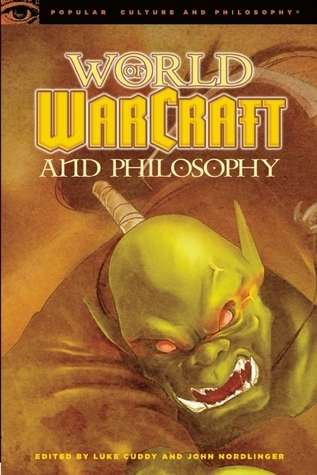
World of Warcraft and Philosophy: Wrath of the Philosopher King
Recognized by the Guinness Book of World Records as the most popular MMORPG (massively multiplayer online role-playing game) in videogame history, World of Warcraft is everywhere — from episodes of South Park and The Simpsons, to online series like Watch the Guild, accolades and awards from game critics, and prime-time commercials with Mr. T. Inevitably, such a cultural phenomenon triggers deeper questions. When does an assumed identity become real? Does the Corrupted Blood epidemic warn us of future public health catastrophes? What are the dangers when real life is invaded by events in the game? What can our own world learn from Azeroth’s blend of primitivism and high-tech? In these lively essays, a specially commissioned guild of philosophers, including Yara Mitsuishi, Monica Evans, Tim Christopher, and Anna Janssen, tackles these and other complex questions arising from WoW.
288 pages, Paperback
First published October 27, 2009
Ratings & Reviews
Friends & Following
Create a free account to discover what your friends think of this book!
Community Reviews
Displaying 1 - 13 of 13 reviews

July 13, 2023
This was a fascinating, educational, and entertaining read. As with any anthology of academic essays, readers will find some more interesting than others. My two favorites were "A Meaningless World... of Warcraft" by Luke Cuddy and "Boredom, Power, and Self-Actualization in Azeroth" by Paul Brown. Both essays blended commentary on ethics with commentary on the experience of gaming and the philosophical theme of the meaning (or meaninglessness) of life. Cuddy brought in Johan Huizinga's concept of "the magic circle," which refers to the way that games are defined by arbitrary rules that are inviolate and seem to create a sub-world, a world where the rules apply. Cuddy connected this concept to Nietzsche's concept of the the "transvaluation of values." He essentially argues that playing MMORPGs can help us process the meaninglessness of the world that was addressed by Nietzsche and move toward an affirming state where we create our own meaning. There were a lot of moves in that essay that I can't summarize here; however, it did convince me that playing WoW just might not be a complete waste of time (philosophically speaking). Brown's essay overstates the case but is vitally argues that gaming can be a form of self-actualization, i.e. gaming can aid us is proceeding through Maslow's famous "hierarchy of needs." (I'm not convinced that it can have much of an impact here). There were several other interesting essays that treated Adam Smith, gender, metaphysics, the social and power dynamics of playing (and administering) MMORPGs. This was very nostalgic. This was written in 2008, when WoW was at its peak. It transported me back to that time by many references to being completely invested in that world.

May 22, 2012
This was a fun book to read and it's not just for WoW players. It is a great example of trying to explain if the virtual world is in fact real aka legit, other topics covered: can the government tax WoW players or characters? What kind of leader makes a great guild leader? Also, war in warcraft is it real?

February 18, 2016
I picked this book up after a friend recommended it to me in the wake of my review of "Halo and Philosophy: Intellect Evolved." While I think this concludes my foray into pop culture philosophy for a while, I did enjoy this book considerably more than "Halo Philosophy." The nature of MMOs as shared simulated spaces (alliteration intentional!) invites several intriguing discussions, especially with regards to the metaphysical. Furthermore, so much of what makes MMOs interesting is the people that play them, and even though a first person game like Halo is also multiplayer, it's really in the MMO space that one can seriously consider questions of character, identity, and self.
As you might expect, not every essay in this book is going to impress, but there are some true gems. In particular, the essays on the relationship between the character and the self really intrigued me. I've played a wide variety of characters over the year, including characters of an opposite gender. Thus, I paid particularly close attention to the essay written by a male player who, rather unintentionally, "toured" as a perceived female gamer for several months.
Is this a book I'd recommend to a non-WoW player? Eh, probably not. The authors generally do a good job of not relying "too" heavily on the game terms, but the largest appeal of these pop culture/philosophy books is how the content of your favorite game (or show, or movie, or whatever) can become the fuel for a philosophical discussion. If you're not already a WoW player, I'm not sure why you'd be interested in picking up a book about it. That said, this is a very solid philosophy primer and if you're an MMO player (of any game, really), you'll find something to mentally gnaw on.
Quick aside: it was a little silly, but I really enjoyed the chapters presented in WoW's "0/1" quest tracker style, as well as the "+3 to intellect" for completing the chapter. It was a fun bit of attention to detail.
As you might expect, not every essay in this book is going to impress, but there are some true gems. In particular, the essays on the relationship between the character and the self really intrigued me. I've played a wide variety of characters over the year, including characters of an opposite gender. Thus, I paid particularly close attention to the essay written by a male player who, rather unintentionally, "toured" as a perceived female gamer for several months.
Is this a book I'd recommend to a non-WoW player? Eh, probably not. The authors generally do a good job of not relying "too" heavily on the game terms, but the largest appeal of these pop culture/philosophy books is how the content of your favorite game (or show, or movie, or whatever) can become the fuel for a philosophical discussion. If you're not already a WoW player, I'm not sure why you'd be interested in picking up a book about it. That said, this is a very solid philosophy primer and if you're an MMO player (of any game, really), you'll find something to mentally gnaw on.
Quick aside: it was a little silly, but I really enjoyed the chapters presented in WoW's "0/1" quest tracker style, as well as the "+3 to intellect" for completing the chapter. It was a fun bit of attention to detail.

October 30, 2012
"Quest: Read a philosophy book! Rewards: +21 intellect. We know what you're thinking, but isn't the inherent joy of gaining knowledge worth it?" Heh.
This book has some very interesting essays and is a fun, lighter way to learn more about philosophy. I'm mostly interested in essays concentrating on the ethics & morality (for example ninjaing/virtual theft, and the "Serenity Now funeral crash incident"), identity/pseudonymity and role-playing in the virtual world. Like those who play WOW know, the social aspect of interacting with people in-game is very important and one of the reasons WOW is so popular. A good read, also for those who aren't that into World of Warcraft (though it does help you understand the references better ;)).
This book has some very interesting essays and is a fun, lighter way to learn more about philosophy. I'm mostly interested in essays concentrating on the ethics & morality (for example ninjaing/virtual theft, and the "Serenity Now funeral crash incident"), identity/pseudonymity and role-playing in the virtual world. Like those who play WOW know, the social aspect of interacting with people in-game is very important and one of the reasons WOW is so popular. A good read, also for those who aren't that into World of Warcraft (though it does help you understand the references better ;)).

March 12, 2012
I have a mild obsession with pop culture and philosophy books. I'm no philosopher, but I enjoy seeing how philosophical ideas can be conveyed through pop culture. Reading through these essays, it's clear the writers are avid fans of WoW, and you probably should be, too, to better understand what they're saying.

July 23, 2012
As is typical of 300+ page books filled with philosophy essays, this one has some gems and some dogs. There's a lot in here that you could use in a class, and it isn't a terrible introduction to the literature on MMOs, online gaming, online societies and the in-and-outs of how a game like World of Warcraft works. I was sometimes stimulated and other times was left flat.

December 28, 2010
This was a great book to work on; great authors and some very provocative articles.

March 19, 2012
A must read for the (intellectually) serious gamer.

August 28, 2012
Fun, but quality on the essays was not at all consistent.

July 24, 2014
So apparently I only had one more essay to read in this one. At any rate, if you like pop cultural metaphors for philosophical concepts AND you like WoW, you'll probably like this.

March 12, 2026
World of Warcraft & Sophistry
Two favorite hobbies of mine - Philosophy and World of Warcraft - unite in a book I’ve been reading the past few days: “World of Warcraft & Philosophy: The Wrath of the Philosopher King”. The book is part of the Popular Culture and Philosophy series, which uses familiar media to introduce complex, abstract concepts. An example of such a concept would be John Stuart Mill’s Utilitarianism in relation to a player’s reputation.
When I first picked up the book, I wanted to explore the rich philosophical and esoteric meanings behind this game, since there is so much of it in the storyline and accompanying quests. Truly, I feel that the game’s continued development and updates are directly tied to the ever-evolving zeitgeist of mankind. However, I quickly came to the bitter realization that the book focuses far more on game mechanics and the philosophical ideas tied to such mechanics. While interesting, these analyses could apply to almost any game. The unique mythological and symbolic depth of World of Warcraft itself is largely left unexplored.
The philosophical analysis of the game mechanics can be tied more to sophistry or “Mandarin Philosophy” in an attempt to populate pop culture with academic language to preserve the “fiction” of elite authority, and to divert the serious student from rigorous philosophical contemplation of the nature of reality and the self.
Philosophy is a tool for me to contemplate the nature of existence and the feedback between external reality and the internal self. However, philosophy can easily become intellectual entertainment rather than a disciplined search for truth. Sophistry - an appearance of depth over actual insight - is nothing more than pseudo-intellectualism, and unfortunately, has taken hold over all intellectual institutions.
Not all books are life-changing. But even a disappointing one can clarify the path and recalibrate our minds on works that pursue wisdom rather than simply discuss it.
Two favorite hobbies of mine - Philosophy and World of Warcraft - unite in a book I’ve been reading the past few days: “World of Warcraft & Philosophy: The Wrath of the Philosopher King”. The book is part of the Popular Culture and Philosophy series, which uses familiar media to introduce complex, abstract concepts. An example of such a concept would be John Stuart Mill’s Utilitarianism in relation to a player’s reputation.
When I first picked up the book, I wanted to explore the rich philosophical and esoteric meanings behind this game, since there is so much of it in the storyline and accompanying quests. Truly, I feel that the game’s continued development and updates are directly tied to the ever-evolving zeitgeist of mankind. However, I quickly came to the bitter realization that the book focuses far more on game mechanics and the philosophical ideas tied to such mechanics. While interesting, these analyses could apply to almost any game. The unique mythological and symbolic depth of World of Warcraft itself is largely left unexplored.
The philosophical analysis of the game mechanics can be tied more to sophistry or “Mandarin Philosophy” in an attempt to populate pop culture with academic language to preserve the “fiction” of elite authority, and to divert the serious student from rigorous philosophical contemplation of the nature of reality and the self.
Philosophy is a tool for me to contemplate the nature of existence and the feedback between external reality and the internal self. However, philosophy can easily become intellectual entertainment rather than a disciplined search for truth. Sophistry - an appearance of depth over actual insight - is nothing more than pseudo-intellectualism, and unfortunately, has taken hold over all intellectual institutions.
Not all books are life-changing. But even a disappointing one can clarify the path and recalibrate our minds on works that pursue wisdom rather than simply discuss it.

July 19, 2020
Half way through and I think I'm going to call it quits on this book. I LOVE Warcraft, and I love philosophy. Got a degree in it from Portland State. But reading this book is a chore. It just isn't fun to read. Yep, the mage is running from the rogue in Alterac Valley and has a notion of Zeno's pardox against crossing an infinite number of 1/2 way points. Okay, a classic philosophical problem. But for me, the delivery of this was unenjoyable.
Case in point. If you go to the DnD and Philosophy book, you are instantly given the question of evil when considering the existence of a Pit Fiend. Good stuff. Or the Walking Dead and philosophy, where the nature of suicide and selfless sacrifice are looked at. But this book, man, it jumps all over the place. The writing just doesn't do a thing for me.
I noted that there were two different 'World of Warcraft and Philosophy" books, different editors and publishers. I went with this one arbitrarily. Going to go check out the other one.
Case in point. If you go to the DnD and Philosophy book, you are instantly given the question of evil when considering the existence of a Pit Fiend. Good stuff. Or the Walking Dead and philosophy, where the nature of suicide and selfless sacrifice are looked at. But this book, man, it jumps all over the place. The writing just doesn't do a thing for me.
I noted that there were two different 'World of Warcraft and Philosophy" books, different editors and publishers. I went with this one arbitrarily. Going to go check out the other one.

October 9, 2024
As a person who absolutely loves Warcraft, after reading this book I think philosophy should be outlawed.
Everything philosophy does is spend an absurd amount of time discussing something that can be concluded with a couple of words.
It sucks that Warcraft is mentioned in the context of this pseudo science. An absolute waste of time.
Just my opinion.
Everything philosophy does is spend an absurd amount of time discussing something that can be concluded with a couple of words.
It sucks that Warcraft is mentioned in the context of this pseudo science. An absolute waste of time.
Just my opinion.
Displaying 1 - 13 of 13 reviews