Contents include: The Science Fiction Blowgun by Isaac Asimov / A Loint of Paw by Isaac Asimov / The Advent on Channel Twelve by C. M. Kornbluth / Plaything by Larry Niven / The Misfortune Cookie by Charles E. Fritch / I Wish I May, I Wish I Might by Bill Pronzini / FTA by George R. R. Martin / Trace by Jerome Bixby / The Ingenious Patriot by Ambrose Bierce / Zoo by Edward D. Hoch / The Destiny of Milton Gomrath by Alexie Panshin / Upstart by Steven Utley / How It All Went by Gregory Benford / Harry Protagonist, Brain-Drainer by Richard Wilson / Peeping Tommy by Robert F. Young / Starting From Scratch by Robert Sheckley / Corrida by Rober Zelazny / Shall the Dust Praise Thee? by Damon Knight / Bug-Getter by R. Bretnor / The Deadly Mission of Phineas Snodgrass by Frederik Pohl / Fire Sale by Laurence M. Janifer / Safe at Any Speed by Larry Niven / The Masks by Jams Blish / Innocence by Joanna Russ / Kin by Richard Wilson / The Long Night by Ray Russell / Sanity Clause by Edward Wellen / If at First You Don't Succeed, to Hell with It! by Charles E. Fritch / The Question by Laurence M. Janifer & Donald E. Westlake / The Perfect Woman by Robert Sheckley / The System by Ben Bova / Exile to Hell by Isaac Asimov / Inaugural by Barry N. Malzberg & Bill Pronzini / Martha by Fred Saberhagen / Kindergarten by Fritz Leiber / Landscape with Sphinxes by Karen Anderson / The Happiest Day of Your Life by Bob Shaw / The Worlds of Monty Willson by William F. Nolan / Punch by Frederik Pohl / Doctor by Henry Slesar / The Man from When by Dannie Plachta / Crying Willow by Edward Rager / January 1975 by Barry N. Malzberg / Mail Supremacy by Hayford Peirce / Mistake by Larry Niver / Half-Baked Publisher's Delight by Jeffrey S. Hudson & Isaac Asimov / Far from Home by Walter S. Tevis / Swords of Ifthan by Jams Sutherland / Argent Blood by Joe L. Hensley / Collector's Fever by Roger Zelazny / Sign at the End of the Universe by Duane Ackerson / Stubborn by Stephen Goldin / The Re-Creation by Robert E. Toomey, Jr. / The Better Man by Ray Russell / Oom by Martin Gardner / Merchant by Henry Sleasar / Don't Fence Me In by Richard Wilson / The Die-Hard by Alfred Bester / The First by Anthony Boucher / Eripmav by Damon Knight / Feeding Time by Robert Sheckley / The Voice from the Curious Cube by Nelson Bond / I'm Going to Get You by F. M. Busby / The Room by Ray Russell / Dry Spell by Bill Pronzini / Bohassian Learns by William Rotsler / Star Bride by Anthony Boucher / Latest Feature by Maggie Nadler / Chief by Henry Slesar / After You've Stood on the Log at the Center of the Universe, What Is There Left to Do? by Grant Carrington / Maid to Measure by Damon Knight / Eyes Do More Than See by Isaac Asimov / Thang by Martin Gardner / How Now Purple Cow by Bill Pronzini / Revival Meeting by Dannie Plachta / Prototaph by Keith Laumer / The Rocket of 1955 by C. M. Kornbluth / Science Fiction for Telepaths by E. Michael Blake / Kindergarten by James E. Gunn / A Little Knowledge by Paul Dellinger / A Cup of Hemlock by Lee Killough / Present Perfect by Thomas F. Monteleone / A Lot to Learn by Robert T. Kurosaka / The Amphibious Cavalry Gap by James E. Thompson / Not Counting Bridges by Robert L. Fish / The Man Inside by Bruce McAllister / The Mars Stone by Paul Bond / Source Material by Mildred Downery Brozon / The Compleat Consummators by Alan E. Nourse / Examination Day by Henry Slesar / The Man Who Could Turn Back the Clock by Ralph Milne Farley / Patent Rights by Daniel A. Darlington / The Sky's an Oyster: The Stars Are Pearls by Dave Bischoff / Alien Cornucopia by Walt Liebscher / The Last Paradox by Edward D. Hoch / Course of Empire by Richard Wilson / Synchronicity by James E. Thompson / Sweet Dreams, Melissa by Stephen Goldin / The Man on Top by R. Bretnor / Rejection Slip by K. W. MacAnn.
Works of prolific Russian-American writer Isaac Asimov include popular explanations of scientific principles, The Foundation Trilogy (1951-1953), and other volumes of fiction.
Isaac Asimov, a professor of biochemistry, wrote as a highly successful author, best known for his books.
Asimov, professor, generally considered of all time, edited more than five hundred books and ninety thousand letters and postcards. He published in nine of the ten major categories of the Dewey decimal classification but lacked only an entry in the category of philosophy (100).
People widely considered Asimov, a master of the genre alongside Robert Anson Heinlein and Arthur Charles Clarke as the "big three" during his lifetime. He later tied Galactic Empire and the Robot into the same universe as his most famous series to create a unified "future history" for his stories much like those that Heinlein pioneered and Cordwainer Smith and Poul Anderson previously produced. He penned "Nightfall," voted in 1964 as the best short story of all time; many persons still honor this title. He also produced well mysteries, fantasy, and a great quantity of nonfiction. Asimov used Paul French, the pen name, for the Lucky Starr, series of juvenile novels.
Most books of Asimov in a historical way go as far back to a time with possible question or concept at its simplest stage. He often provides and mentions well nationalities, birth, and death dates for persons and etymologies and pronunciation guides for technical terms. Guide to Science, the tripartite set Understanding Physics, and Chronology of Science and Discovery exemplify these books.
Asimov, a long-time member, reluctantly served as vice president of Mensa international and described some members of that organization as "brain-proud and aggressive about their IQs." He took more pleasure as president of the humanist association. The asteroid 5020 Asimov, the magazine Asimov's Science Fiction, an elementary school in Brooklyn in New York, and two different awards honor his name.
Aeons ago, I'd scramble up the green tile steps of my hometown's public library and scuttle up to an ancient green-screened PC with hard, calcified keyboard whose keys needed an extra oomph to peck in my message: "TITLE: short short stories"
This quick title search forever and always populated this Asimov-edited gem of a collection, "100 Great Science Fiction Short Short Stories," which was (almost) always stored safely on-shelf at location "SF/Short" - a reliable staple for yours truly and top-tier imaginative summer reading. I was only occasionally burned by finding some other patron'd checked it out, was why I felt the need to search it up each trip even though I knew darn well where exactly in the stacks to find it.
There's this one story where a guy gets contacted by a microscopic civilization living between the knuckles of his hand.
There's another where a vampire gets marooned on a tiny moon that's always in direct sunlight.
Then there's 98 others, and they're all whittled down to the most effective essence of storytelling, like the finest jokes: intro, setup, punchline/end. Tiny little mostly comedic but sometimes shocking mini-stories, the kind that are like Lay's chips in that you'll never be able to eat just one.
An oddball collection of really really short science fiction stories. Some of the authors are well known and others I've never heard of. Most stories are from the 50's 60's and 70's with the ocassional 1930's story.
Some show flashes of brilliance while others not so much.
Depending on how much you read the ending of some of them is obvious while others are may sophisticated. So if like your science fiction in small bites this is the book for you.
100 Short short stories collected by one of the Grand Masters of golden age of science fiction. It can only go one way; stratospheric highs, combined with hellish lows and fair about of stories with their feet firmly on the ground. And that is exactly what I got.
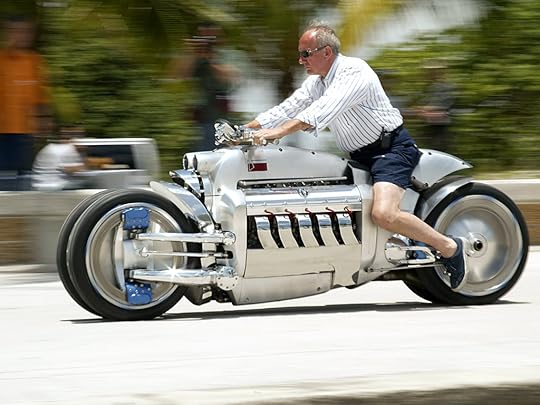
There are some truly enjoyable stories in this collection, real imaginative works of art from the medium and format. Of course the short short story lends itself quite readily to the creation of truly awful puns or three pages of setup for a punchline that is so bad your eyes become the wheels on the (appropriately futuristic) Dodge Tomahawk.
But the majority of them are forgettable fluff, enjoyable as brief entertainment but as my brain will attest to almost immediately forgotten.
But also there are names that I would never have thought to associate with science fiction, Anthony Boucher, Bill Pronzini and Donald E. Westlake, making this a more important collection than I give it credit for with my 3 star rating.
It's a curio, a museum piece, something that says "we were here, without us you could not be" and it's an entertaining one at that.
Short stories, very short, most in the range of one to four pages each. I missed the date of the earliest stories, but the latest was in the late seventies. Companion to 100 Great Fantasy Short Short Stories. Short of.
This is a tricky book to categorise - like the title says it consists of 100 short stories which vary in length but none are longer than a few pages.
So why the challenge - well as you can imagine they vary greatly in quality or readability or just appeal I guess that part is subjective to the reader and for me - well it was easy to rip through the book as well you can do but there were whole groups of stories you could easily just forget.
Then again why not just right the book off- yes there there was the fair share of good stories both from famous and no so famous authors but did that out weight the mediocre ones or the ones I just didn't get, well thats the point I didn't notice.
What I did notice was Asimov's fascination with short stories and what they represented. You see (and he made a very compelling argument) that with a short story you are limited to the amount of time (and more importantly the number of words) you can use, not only to set the story up but also to complete it.
You see Asimov's argument was that with such constraints you had to be short, sharp and concise and it was only the true masters of their profession would could pull this off. Hence this book, good or bad, love or hate consisted of the work of authors who knew short stories and how to write them.
Suddenly it makes you see the whole book in a totally new light and I for one was made to appreciate things I had not stopped to think about. I know I often say this but sometimes a books is made by its introduction (or end notes) more than its contents and this is a perfect example. If you picked it up just for a collection of short stories, but if you read a little further you would realise this is something more.
Isaac Asimov wrote an entire introduction advancing the proposition that the effectiveness of short-short stories rests upon their "punch line." He then for some unfathomable reason decided to add pithy quips preceding each story, ranging from non sequiturs to facile jokes to complete giveaways of stories' punch lines. ("God damn it, Asimov," was a shamefully frequent thought of mine while reading this book.) Do your damnedest to ignore the blurbs — if you can manage it, you'll be much better off.
Mediocre povestiri - in cel mai bun caz. Ce ma mira este ca Asimov a fost antologatorul principal; oare lui chiar i-au placut ? Pare ca da, din moment ce are si el una in lista de povestiri - si tot mediocra, ca si restul. Nici macar un sfert nu au farama de SF enuntata in titlu !
An anthology will normally only give you a dozen or so stories, so this collection of 100 flash fiction stories gives a much broader view of SF from the 50s to the 70s. As expected, a lot of them are now dated, and many have not aged well at all. Few could be described as ‘great’. Several other trends became apparent too:
- A lot of the stories are set-ups for a pun or a joke (as warned against in modern submission guidelines). Most of these are groan-worthy, but often they are also disappointing when you realise there is no resolution to what was an interesting concept. - There are a lot of firsts: first man on the moon, first man going to Mars or Proxima Centauri, first time traveller, first alien encounter. It’s as if that was sfnal enough and few seemed to think about what might happen further down the line. - A lot of the characters are astronauts or scientists. - Only 4 of the stories were written by women. - There are only 2 female protagonists in the whole collection. One of them is the newly-inaugurated President of the USA, but the only ‘speculative’ elements in that story are that she had been an astronaut and was now the President! - All other female characters are either housewives, nurses or secretaries. - There are a lot of pact-with-the-devil stories, or other appearances of angels, demons, God or the Devil. There’s even a story where an author tries in vain to sell a pact-with-the-devil story to an editor whose had enough of them. - The only two characters specifically mentioned as being non-white are an Indian holy man and the chief of a cannibal tribe. - All of the protagonists are either alien or American. - There are several stories framed as correspondence between an author and an editor. I get the impression this format was a bit of an in-joke, especially as they often included real-life characters.
Altogether, an interesting piece of SF history, but not one I would particularly recommend for any other reason.
When you factor in the Gee Wizz factor, Most Old SF goes from Sturgeons 90% BS Probability Law, to upwards of 99.9%.(To one against and Falling) Some people just willfully overlook the extreme naivety of actions/dialog of characters, from these stories(more power and reads to them).
It's much like the original The Thing movie. Now that was a good film for "THA DAY", but you're not going to get away with a character assigned to watch over a Alien being while being dumb enough to accidentally/willfully place a Heated Blanket on said block of Ice, One that contains the Worried About Specimen. ("Shemp, Get over heeeere, Guard this Block of Ice and here's a heated blanket so you don't freeze", "Gee Thanks, but I can't stand looking at the thing, So I'm going to place this here heated blanket on the block of ice and turn my back so during these hours of guarding. I don't have to look at it's ugly......Blanket". Wooo Woooo Woooo Mememememememememe...
Frankly, I am happy this stuff really doesn't fly today. (2020's you did something right). Now you might get stories that have no good reason winning awards or being praised for other things than the writing today. Regardless, they probably will spare you having to suspend belief so much that you have to take seriously, having the 3 Stooges being played straight.
I hate trusting reviews enough to waste my time in finding out, that I too, was duped into ignorantly placing a heated blanket on a block of ice, sitting on top of my head, to ease a headache (Picture Shemp recovering after a Moe Slap Happy). But I'm a glutton for punishment I guess.
Nuff Said.
1 tired ole heated blanket out of 5 blocks of ice.
This one was a super slog. I loved the companion book "100 Great Fantasy Short Short Stories", but for some reason this one was insanely difficult to get through. It may be because I'm not a huge sci-fi fan, especially 60/70s era sci-fi, but man, even though these stories are super short, normally only last 3-5 pages, I felt my eyes glazing for most of this book. Some of the twists were fun, but for the most part it was a rough read.
"In the short short story, everything is eliminated but the point. The short short story reduces itself to the point alone and presents that to you like a bare needle fired from a blowgun; a needle that can tickle or sting and leave its effect buried within you for a long time." - Isaac Asimov, 100 Great Science Fiction Short Short Stories
Once more I had found myself within the dusty backlogs of my library cleaning-as one usually does when they are simply bored to death-when I uncovered a worn paperback of an Asimov novel. As is usual with the books I rescue from the neglect they receive lost in the scattered book piles that surround said library, I immediately had cracked its worn pages open to uncover a world of insight into the art of the short short story. Being an avid fan of Asimov's Foundation series, I was interested to view how he might go about directing a much shorter snapshot into a world within a mind and how he would go about orchestrating his signature "point". This, coupled with my feverish love for science fiction in any medium, perhaps drove my interest to relentlessly read this collection of tales despite other books having occupied urgent positions on my growing reading list. For this review, I find it difficult to narrow down a short I could call my favorite, and due to the vast fluctuation in the style of authors and story, it proves impossible to focus in on an all-encompassing theme. As a result, I have decided to present to any and all who might care to read a highlight from this picture book of worlds that encapsulates the style of story, instead of a specific theme.
"How It All Went" - Page 37 Besides having an ingenious blurb from Asimov in reference to the classic "I Have No Mouth, and I Must Scream" the story revolves around the reliance on a supercomputer for solving the end of the world crisis, the snuffing out of phytoplankton. And as a result, this reliance narrowly causes disaster, until it is revealed that disaster was inevitable and an asteroid crashes into the Earth. This and-then effect is a universal attribute of the short stories that find themselves within the book, something that allows for the use of thematical constructs in quick and pointed ways, shortly conveying what is needed through the connection of the much larger exposition to the reasoning behind its existence as a story.
Finally, to conclude this review, I would like to recommend this book to all, as this book appeals to the limitless imagination of the younger generation while attracting older readers with cleverly constructed pieces of wit sharpened into a piercing point. Although it may not carry with it the page-turning thrill of a novel or series, it effectively portrays the transmission of a story, a short short story if you will, in some of the most creative and thought-provoking manners possible. And now, since it would make no sense to have a review longer than the stories it advertises and describes, and having made my point-I'll stop.
This is an old collection of very short scifi stories - what would be called flash fiction if it were published today. Given that the book was published in 1978, I think, it mostly contains work from the so-called Golden Age of science fiction, which - with few exceptions - is frankly not a patch on the best scifi being produced at the moment. That may sound snobbish, but of the hundred stories here, I was impressed by three: "Sanity Clause" by Edward Wellen, "I'm Going to Get You" by F.M. Busby, and "Examination Day" by Henry Slesar. And while they were better than the rest, they didn't reach outstanding.
The rest were distinctly average, and there was rather a lot of repetition. Too many stories reliant on letters to publishers, or puns, or twist endings that can be seen a mile off. Look, I've published a couple of flash stories myself. They are hard, and I say that as an experienced short story writer. They're not my natural length, but there are some speculative writers out there who absolutely excel at them. I suppose I should be glad that the form has improved since this book was put together, but then it would have to. Most of these just aren't worth reading again, I'm afraid. And I can count the number of women included here on one hand, which is disappointing.
I don't know... I suspect the appeal of the "100 X stories" idea was such that Asimov, perhaps, grabbed at whatever he could to make up the numbers.
100 very short stories, most of them science fiction (some of them are not meaningfully sci-fi, and are more generally fantastical or fable-like). The "great" in the title is more than debatable: the stories here were obviously chosen for their length rather than their quality per se, and at the length these stories are (running from a single paragraph to about five pages total), "greatness" isn't really possible. The stories have to function like jokes or brief anecdotes to work at this scale, and very few of them are actually very funny or striking- there are lots of feghoots, lots of "the characters were actually aliens/robots!" type twist endings, lots of bits that probably would've worked better as episodes in longer works. George R. R. Martin's "FTA" is the only one I'd single out as being of particular quality, and worth reading in its own right.
For all that, though, I got a copy of this for two dollars at the Friends of the Library book sale, and read most of it as light reading during downtime at work, and it was perfectly functional in that role.
a perfect mix of old school sci-fi tropes and late '60 early '70s paranoia brewed with vaudevillian humor and bad puns preambled with Dr. Asimov's dry wit. while some of the stories are memorable others are quite forgettable, wallowing in a mire of the eras cliches and a pre-Star Warsian obsession of hostile aliens, vengeful gods, ironic fantasy ideation and apocalyptic scenarios reminiscent of Twilight Zone episodes and pulp tales and B-movies. best read with a grain of salt and a good sense of humor mixed with the absurd. at the end of many of the stories I often heard a muted trombone going wah-wah-waahhhh...
This book was good, but not as good as I had hoped. Most of the stories were *too* short. There wasn't enough time to get invested in any story. There are some really good ones in here, but there are also some that are no more than a set-up and a punchline to a joke. There's nothing wrong with that, I just wish some of the stories had more time to explore their premises. Although, since the book is a collection of "Short Short Stories," if I am disappointed by the length of the stories, that's on me.
In an anthology of Science fiction short-short stories inevitably the emphasis will be on a twist of some sort. In this collection sometimes the point will be memorable. But frequently that final twist will be silly, predictable or dated. Oddly, one of the masters of this form, Frederic Brown, isn’t represented at all.
Asimov’s short general introduction is adequate but some of his one line prefaces to individual stories are clever.
This was a great collection of short short stories from various authors. Some were interesting, some funny. There was even a single line story, which was funny. Some of the stories were a bit dated, but still good.
100 Great Science Fiction Short Short Stories edited by Isaac Asimov.
An amazing collection of short short stories. Many just plain weird or out there ideas, many with a humorous angle. An excellent book and great for reading while travelling to pick up and put down.
The vast majority of these stories are utterly lame. Especially the ones about frustrated writers being denied by editors. The one star is for a handful of gems scattered throughout the barren landscape of short story misery.
An interesting book. The collection of really short science fiction stories. Some stories are brilliant, others are quite predictable. Overall, a very nice book. Loved it.