Drizzt DoUrden has forsaken his subterranean home for the harsh unknown of the surface. The young warrior begins a sojourn through a world utterly unlike his own—and finds that acceptance among the surface-dwellers will only come at a great price...
As one of the fantasy genre’s most successful authors, R.A. Salvatore enjoys an ever-expanding and tremendously loyal following. His books regularly appear on The New York Times best-seller lists and have sold more than 10,000,000 copies. Salvatore’s original hardcover, The Two Swords, Book III of The Hunter’s Blade Trilogy (October 2004) debuted at # 1 on The Wall Street Journal best-seller list and at # 4 on The New York Times best-seller list. His books have been translated into numerous foreign languages including German, Italian, Finnish, Greek, Hungarian, Turkish, Croatian, Bulgarian, Yiddish, Spanish, Russian, Polish, Portuguese, Czech, and French.
Salvatore’s first published novel, The Crystal Shard from TSR in 1988, became the first volume of the acclaimed Icewind Dale Trilogy and introduced an enormously popular character, the dark elf Drizzt Do’Urden. Since that time, Salvatore has published numerous novels for each of his signature multi-volume series including The Dark Elf Trilogy, Paths of Darkness, The Hunter’s Blades Trilogy, and The Cleric Quintet.
His love affair with fantasy, and with literature in general, began during his sophomore year of college when he was given a copy of J.R.R. Tolkien's The Lord of the Rings as a Christmas gift. He promptly changed his major from computerscience to journalism. He received a Bachelor of Science Degree in Communications from Fitchburg State College in 1981, then returned for the degree he always cherished, the Bachelor of Arts in English. He began writing seriously in 1982, penning the manuscript that would become Echoes of the Fourth Magic. Salvatore held many jobs during those first years as a writer, finally settling in (much to our delight) to write full time in 1990.
The R.A. Salvatore Collection has been established at his alma mater, Fitchburg State College in Fitchburg, Massachusetts, containing the writer’s letters, manuscripts, and other professional papers. He is in good company, as The Salvatore Collection is situated alongside The Robert Cormier Library, which celebrates the writing career of the co-alum and esteemed author of young adult books.
Salvatore is an active member of his community and is on the board of trustees at the local library in Leominster, Massachusetts. He has participated in several American Library Association regional conferences, giving talks on themes including “Adventure fantasy” and “Why young adults read fantasy.” Salvatore himself enjoys a broad range of literary writers including James Joyce, Mark Twain, Geoffrey Chaucer, Shakespeare, Dante, and Sartre. He counts among his favorite genre literary influences Ian Fleming, Arthur Conan Doyle, Fritz Leiber, and of course, J.R.R. Tolkien.
Born in 1959, Salvatore is a native of Massachusetts and resides there with his wife Diane, and their three children, Bryan, Geno, and Caitlin. The family pets include three Japanese Chins, Oliver, Artemis and Ivan, and four cats including Guenhwyvar.
When he isn't writing, Salvatore chases after his three Japanese Chins, takes long walks, hits the gym, and coaches/plays on a fun-league softball team that includes most of his family. His gaming group still meets on Sundays to play.
Perhaps the trickiest one of these books to adapt as it bounces between settings and introduces numerous colourful characters, including none less than the blustering dwarf Bruenor Battlehammer and his adopted human daughter Catti-Brie.
Pour one out for Mooshie. Gone too soon.
Still an enjoyable chapter in the Legend of Drizzt, will definitely check out the high adventure of the following volumes.
This one was pretty solid. Best of the three I have read so far. I’m doing Crystal Shards in novel format, and may then move on to other Icewind Dale books. I really enjoy reading books about winter during winter.
Anyway, back to this book. Drizzt’s underdog status is enhanced here, and his attempts to enter into friend circles in vain make him charming.
The relationship with the ranger is incredibly short, and again, you can feel the brevity with which they penned this graphic novel adaptation. I haven’t read the novel, but I can feel the lack of a well-developed character arc shining through in the graphic novel, which is why I’m switching over to the novels after this one. But I might return to the graphic novels in a pinch.
I will forever be indebted to the first volume for introducing me to this iconic D&D character. I had heard of him before, but never really got into fantasy much until Game of Thrones. But I have played Magic for over 20 years, so this feels like home to me.
The third book in Drizzt's origin trilogy, where he tries to make his way on the surface. It's not easy for him because everyone assumes he must be evil due to the fact that he's a drow (actually a quite reasonable assumption since drow are almost universally evil). But he finds an old ranger who takes him in and teaches him ranger beliefs and practices (which Drizzt was already following on his own, he just didn't know it).
Once again, highly abbreviated but still enjoyable if you loved the book. The story leads up to The Chrystal Shard, the first book published featuring Drizzt, but I don't know I'll continue with the graphic versions there. Not enough Drizzt in them.
Though not as deep as the first two, this was still a very good read. It went by very quickly as Drizzt now becomes a fugitive, of a crime he did not commit (when you look at it that way, it does sound like a few tv series). The strength of the series continues to be the character development, and Drizzt's character is done very well. He now has to learn the ways of living in the surface world. I am seriously considering reading the novels at some point. And I will go look for the next volume in this series of graphic novels.
Dark elf Drizzt Drizzt Do'Urden seeks a new home on the surface of the Forgotten Realms world of Faerun in this adaptation of the third novel in R.A. Salvatore's Dark Elf Trilogy.
When his first attempts at finding peace and friendship end in tragedy, Drizzt finds himself hunted again, this time by a ranger and her party of adventurers, along with a rugged frontiersman who blames Drizzt for the injury that left his face scarred.
The long pursuit will bring Drizzt face-to-face with some classic Dungeons & Dragons creatures, and will lead to his discovery of the path of the ranger, and finally to a last refuge in a place called Icewind Dale.
The Icewind Dale trilogy was written before the Dark Elf trilogy, and this volume completes the prequel, bringing together the characters and the setting that originally introduced the character of Drizzt.
There is a lot happening in this story, and supporting characters are sometimes written out rather abruptly. Still, there is a lot of good character development for Drizzt, and some very memorable members of the supporting cast. The characters in this volume, with a couple of notable exceptions, come across as smart and nuanced, and are not defined just by their preconceptions about Drizzt.
I am loving this series. It feels like I'm seeing all the cool events unfold that I imagine when I'm preparing to DM, except this protagonist isn't a paranoid lunatic like an actual player. It's great.
The artwork of this third installment of the Legend of Drizzt graphic novels brings the story to life like never before. Without the restrictions of the gloomy and drab Underdark, the artists have much more freedom with lighting, weather, and color than in the previous two books.
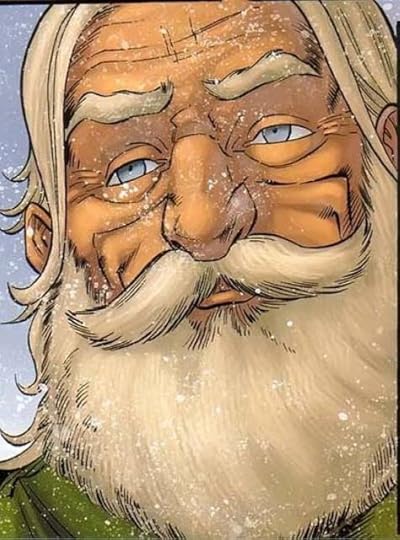
As Drizzt leaves the Underdark and ventures forth into a strange new world, he finds that life will not be as peaceful as he had hoped. With good reason most people distrust and fear drow elves and Drizzt realizes he is going to have a hard time finding a home. As Roddy McGristle tracks him over countless leagues, Drizzt learns quickly of the cruelty frequently encountered in the world. He does however find a companion in the old Ranger Montolio Debrouchee. We also meet Cattie-brie and Bruenor Battlehammer for the first time in this volume.
A story of new beginnings for Drizzt, adapted in a beautiful way that is sure to please.
This book is about a dark elf, who is used to living underground with his evil race who despise him for abandoning their evil belifes, but he is one of the few that are trying to abandon the evil that come with his kind. When he gets to the surface he finds that being accepted there is near impossible for his kind is both feared for their reputation for murdering all the weak just for the fun of it.
AMAZING. This is BY FAR the BEST graphic novel series I have EVER read. I loved the novels, but I love how this actually brings the characters I know and love to LIFE. I cannot wait to read the next ones. These are so addicting. Drizzt is my hero. And hopefully, people who have never heard of Drizzt pick these up and find a role model or hero in the purple eyed drow who goes against the grain of his people to be good. <3 I LOVE THIS ELF AND I LOVE SALVATORE!!!!!
Sojorn Graphic Novel by R.A. Salvatore completes the Dark Elf Trilogy as the hero Drizzt finds his way to the surface world in hope of finding a new life. The discrimination that Drizzt recieves because of his herritage is something that can be relatable to real life. We get the pleasure of seeing the world that R.A. Salvatore creates and how the Hero Drizzt develops into a Ranger and starts down the path to be the legend that he is meant to be.
The Drizzt graphic novels are the most read in my library. I love the stories, the art, and covers. Devil's Due has done a fantastic job with Bob Salvatore rewritting his Drizzt classics into graphic novel form. I loved this third book Sojourn (along with volumes 1 & 2) quite a lot.
Bravo and I will own all the rest of the books in the series.
Drizzt buddy ole pal... This review is where I drop the eloquent speech, don't write any reviews, and totally show what a dork I am. I love this character! I don't really like to use exclamation points, but it's appropriate here. Artemis Entreri is a great nemesis and the whole lot of it's all great. Dork out on these if ya get the chance!
I really liked this book. The Legend of Drizzt is best read in Salvatore's own words, but the art and imagery in this book made up for what eloquence and cleverness was lost to the text. It made a long book into a short story without sacrificing the pay-off. I love to see fantasy worlds realized in art and this book accomplishes that.
I am loving this artist and story. It captures the essence of the novels. Drizzt finally finds a home, after battling McGristle, a quickling, an orc army with worgs, and the people around him who think he is a threat. I feel sorry for the rogue Drow in his quest to find a place he can settle comfortably.
Lo mejor es la tenacidad de McBrasas, pero este tomo tiene algunos planos generales que están dibujados con la mano tonta. Veo menos calidad en general. También es cierto que este libro luce menos en una versión en novela gráfica que los anteriores.
The last installment of the initial three book set that introduced us to our beloved Drow, Drizzt.
Tells the tale of how he discovered his place in the world of Faerun, the human who took a chance in him and taught him about being a Ranger and who his Goddess was.
I am flying through these books! Since this is a reread I am puzzled by how eady the read seems to me. I remember most of the fighting scene much bloodier than I think of them now. Drizzt is still one of the most likeable characters I´ve ever read. He is so kind and so pure!
In retrospect of rereading the novel, I feel that it has the slowest start of all the original Drizzt novels. The beginning involves a more idyllic, pastural setting, and feels like the Forgotten Realms equivalent of the 1990s Star Wars Christmas special. If you haven't heard of it, I would keep it that way. The most satisfactory portion of the novel is the middle part, in which Drizzt begins his training as a ranger. The main antagonist of the novel feels somewhat stale compared to the later development of Artemis Entreri, Drizzt's wicked counterpart. That isn't to say I didn't enjoy the novel; but it reads at times as if it falls short of the first two novels in the series.
One highlight of the book was the emotional tension it produced in terms of Drizzt's constant rejection in terms of the various human settlements found near the Underdark cave, where he first journeys into the open air of the surface world. The emotional state of Drizzt resembles that of someone who has been scarred by many years of isolation, surviving in the dark tunnels of the Underdark and the lonely woods of the surface world after that. His emotional reaction to his encounters with dangers come across as strikingly convincing, as someone who *must* believe in his ideals, even despite evidence to the contrary. Drizzt's principles are what drove him to the surface world in the first place; to betray them would, in essence, be to betray his father Zaknafein, and the hardships he endured to sojourn to the surface world in the first place. It almost feels as if the Drow Ranger is caught in the half-throes of insanity, made temporary only by his later discovery of friendship with Bruenor and Cattie-Brie.
While the first portion of the review suggests that I did not like the novel, I don't wish to give that impression. The book is probably among one of my favorites; it provides a testament to the human spirit, pardon the pun, and the desire to strive for the best that lies inside of us. The novel also sits among an uncomfortable nook between the emotionally filled conclusion of Exile and the appearance of the Drizzt we know in the Crystal Shard. What one anticipates, I imagine, is the action-packed adventures with the Companions of the Hall, and a much more emotionally mature Dark Elf Ranger, who has subsumed the killer survival instincts of the Hunter beneath the warmth of acceptance and friendship.
The emotional ambivalence that Drizzt encounters with his first meeting with Bruenor can be saddening to someone who read The Crystal Shard before Sojourn. That said, the tension that Salvatore builds in Drizzt's run ins with the denizens of the surface world read very differently 18 years later. What one first read as infuriating appears to one's more mature judgment as very good writing, one which builds tensions appropriately; perhaps that is why one reads the novel as being somewhat anticlimactic. Exile builds tension to enormous heights with its ending; and the tension is not discharged in the opening or the middle of Sojourn.
While I enjoyed all three graphic novels in the trilogy, I firmly believe that reading the original books is essential. The core plot is adequately depicted, but the graphic novel, particularly the third installment, lacks the emotional depth of the original novel. Drizzt's internal struggles, his feelings of isolation and despair, are significant in the novel but are less pronounced in the visual medium format. I felt the complexity was lost.
The graphic novel omits certain events from The Sojourn, such as Tephanis's trap and the encounter with the red dragon. This omission is understandable, as these events, while intriguing, are not central to the overall narrative.
Drizzt Do'Urden has journeyed to the surface in order to escape from his evil kin. Honestly, this is my least favorite of the three Homeland trilogy novels. The absence of House Do'Urden severely undermines this one and not even the presence of Dove makes up for it. We also lack Cattie Brie until the very end. Still, the art is extremely beautiful.
I enjoyed this one more than the last, I think. It was a little less high stakes for sure, but it made me feel more for Drizzt. He just wanted to find a place to belong *sob*. This one also introduced a few good side characters, even if one is already gone too soon.
For some reason I didn’t like this one as much as the previous one, maybe because despite being so short there were so many stories (poor Drizzt has to move a lot!), but in the end it was really good and I liked the very last bit of the story with his new friend(s).