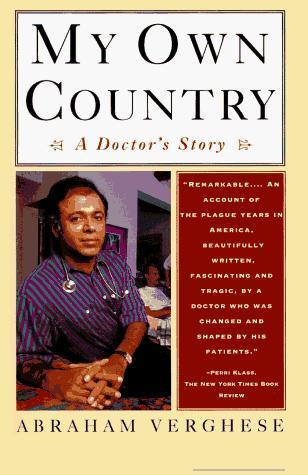
This is Abraham Verghese's first book - the story of being a doctor, and specifically, a doctor to young AIDS patients. It is a book about illness and treatment, about internism, doctor-patient relationships, the body in decline, the ritual of examination and how Verghese, as a doctor and a humane man, copes with dying.
Abraham Verghese, MD, MACP, is Professor for the Theory and Practice of Medicine at the Stanford University School of Medicine and Senior Associate Chair of the Department of Internal Medicine.
Born of Indian parents who were teachers in Ethiopia, he grew up near Addis Ababa and began his medical training there. When Emperor Haile Selassie was deposed, he completed his training at Madras Medical College and went to the United States for his residency as one of many foreign medical graduates. Like many others, he found only the less popular hospitals and communities open to him, an experience he described in one of his early New Yorker articles, The Cowpath to America.
From Johnson City, Tennessee, where he was a resident from 1980 to 1983, he did his fellowship at Boston University School of Medicine, working at Boston City Hospital for two years. It was here that he first saw the early signs of the HIV epidemic and later, when he returned to Johnson City as an assistant professor of medicine, he saw the second epidemic, rural AIDS, and his life took the turn for which he is most well known ? his caring for numerous AIDS patients in an era when little could be done and helping them through their early and painful deaths was often the most a physician could do.
His work with terminal patients and the insights he gained from the deep relationships he formed and the suffering he saw were intensely transformative; they became the basis for his first book, My Own Country : A Doctor's Story, written later during his years in El Paso, Texas. Such was his interest in writing that he decided to take some time away from medicine to study at the Iowa Writers Workshop at the University of Iowa, where he earned a Master of Fine Arts degree in 1991. Since then, his writing has appeared in The New Yorker, Texas Monthly, Atlantic, The New York Times, The New York Times Magazine, Granta, Forbes.com, and The Wall Street Journal, among others.
Following Iowa, he became professor of medicine and chief of the Division of Infectious Diseases at Texas Tech Health Sciences Center in El Paso, Texas, where he lived for the next 11 years. In addition to writing his first book, which was one of five chosen as Best Book of the Year by Time magazine and later made into a Mira Nair movie, he also wrote a second best-selling book, The Tennis Partner : A Story of Friendship and Loss, about his friend and tennis partner?s struggle with addiction. This was a New York Times' Notable Book.
Because I'm finding that as I read a book, like this one, I keep asking myself why someone would waste so many words to say, essentially, nothing that sheds light on the story.
Why do I need to know every time the author got in his car to go somewhere, that he turned right on such and such street, then left onto that highway, and then there was a bend in the road...
For real?
I understand that he was trying to give the reader a sense of 'His Country,' but it became excessive. He often went on long tangents to describe things, like the intricacies of a tobacco business, that, in the end, lent nothing to the story. I kept feeling like I was traveling down a road, fully expecting it to go somewhere, only to find that I had to mentally back myself out of a dead end and re-orient myself to the story.
And oh, my with the naming of every bit of flora and fauna!
This is not to say the book was completely uninteresting. Many parts were enjoyable. The book is best in its opening pages when the reader is brought right into a mysterious medical case. The stories he tells of his work with AIDS patients, and about the patients themselves are often interesting and sometimes even insightful.
But by the middle of the book, the story still isn't turning. The author is still introducing the reader to new patients. You begin to sense that the book is going to carry on the same way until the end: he is going to keep stringing stories of patients together, breaking the monotony by throwing in passages about the scenery in rural Tennessee or brief, predictable updates on his failing marriage (which never seem to bring him to much personal reflection or action.)
The strength of the book is that it gives people with AIDS faces, stories, lives. I appreciated that, and found most of their stories at least interesting.
I give it two stars because I really liked it in the beginning, waited for the story to 'come around' in the middle, and read to the end only because I didn't want to leave another book unfinished.
Abraham Verghese's Cutting for Stone was one of the best books I read last year. I'm not sure if it was my very favorite, but it was in the top two or three, for sure.
Although Cutting for Stone was fiction, My Own Country is a memoir, focusing on the years when Verghese, born in Africa to Indian parents, is a young infectious diseases doctor in rural Eastern Tennessee, right at the beginning of the AIDS epidemic. As one of the only physicians in the area willing and able to take care of the men and women suffering from the disease, Verghese becomes almost like part of their families as he nurses them to their deaths.
This may sound cheesy, but Abraham Verghese has a gift. As I read the Whitney books, I read a lot of good, solid books by good, solid writers. But when I read for my own pleasure, I tend to read mostly what others have recommended as the best of the best. As a general rule, the quality of the writing in the things I normally read is a degree higher than the quality of what I read in the month of March. Abraham Verghese's writing definitely falls on the highest end of my spectrum, even when that spectrum is comprised many of the good stuff. I know that lots of writers (and I'm sure Verghese would include himself in this group) become good by working hard and revising and thinking and putting in sweat equity. But there's just something about the way he writes that makes me want more. In fact, I just ordered his other memoir.
Another thing I thing I thought was interesting about My Own Country is the way that Verghese treats his relationship with his wife Rajani. During the years that the book takes place, he and Rajani go from being happily married to realizing that their marriage has problems. By the time the memoir was published, the couple was divorced. So I think it's interesting for him to write about some of the good years of their marriage (both of their sons are born during the Tennessee years) from the perspective of someone who is newly divorced. Although I don't think he shrinks from his role in the collapse of the marriage, he also doesn't portray Rajani as the "and she never complained" kind of self-sacrificing spouse that people like doctors and bishops are supposed to have.
My Own Country: A Doctor's Story is Abraham Verghese's (author of the fictional Cutting for Stone) moving account of his years as a doctor in Tennessee, specializing in working with patients with AIDS. Verghese recounts his growth from a relative innocent first encountering AIDS to an exhausted veteran who has to come to terms with the fact that he could not save his patients. The years are the mid- to late-1980s and AZT is only beginning to be used at the end of this time and no other drugs have been developed.
Verghese shares the back stories of his patients in a vivid, affecting way as well as his own struggles within his marriage to a woman made uncomfortable by his contact with this deadly disease. Verghese is constantly scrutinizing his attitude towards his patients and despite his commitment to and acceptance of his patients, he wonders if he is open and accepting enough. And it is only as his patients begin to die that he fully accepts the horror of AIDS and his helplessness in the face of it.
I found the stories fascinating and moving and was drawn to Verghese-I felt I came to know and care about him. The writing is excellent and I will read his well-received Cutting for Stone soon.
This book captures a time and trauma that are well worth thinking about. And the stories Verghese tells are powerful. This is an excellent read.
Dr Verghese - Eloquent, extraordinarily compassionate, likeable and highly intelligent person. This book exceeded all expectations.
Abraham Verghese goes from strength to strength when it comes to impressing me. I first became a fan when I read the Foreword he wrote for Paul Kalanithi's memoir When Breath Becomes Air. This was soon topped by his fabulous novel Cutting For Stone - one of my all time favourites. Having such high expectations I briefly worried whether I might be disappointed with My Own Country: A Doctors Story. Incredibly it surpassed my expectations on so many levels. Not only is this man eloquent but he comes across as an extraordinarily compassionate, likeable and highly intelligent person.
As an Infectious Diseases specialist in the 1980's Dr Abraham Verghese became the go-to guy for all things HIV/AIDS in Johnson City, Tennessee and surrounding regions. At this time in country America AIDS was a new and terrifying disease. It was largely unknown and, if they thought of it at all, most people considered it the homosexuals disease. The adage there are two sides to every story is quite incorrect in this case. In the HIV/AIDS story there are so many elements and Dr Verghese captured all of them in a heartwarming and at times heartbreaking manner. Introducing readers to patients who'd acquired the disease in various ways - gay men via unproteted sex; females via their husbands or lovers, haempheliacs and surgical patients via blood transfusions - he showed the different ways the disease manifested and tore through their bodies. He shared examples of the grief experienced by patients and their families at diagnosis then later upon their loved ones passing. He incorporated the good, the bad and the ugly of societal attitudes. Stigmatisation born of fear "naked, ignorant and shameful prejudice" at the hands of assorted health professionals (this was the real shocker) dentists, pharmacists even morticians. Yet he also managed to incorporate examples of tremendous support and positive stories about the ways in which the illness had helped bridged chasms within families and strengthened community spirit. He forced readers to consider their own attitudes by contemplating the concept of guilt versus innocence (For example did the words "innocent victim" come to mind when I mentioned the patients infected by blood transfusion?). Layer by layer he revealed the burdens and costs of this disease in a highly readable and informative manner.
If you've stuck with me this far you must surely have noticed I'm somewhat in awe of Dr Abraham Verghese and congratulate him on producing a book I can highly recommend without hesitation.
This book pretty much fits the bill for my absolute favorite type of reading: passionate people writing beautifully about whatever they care most about and the way in which they are transformed by that caring. Also I love a good medical memoir so I hit the jackpot with this one.
I looked for this book after reading Verghese's Cutting for Stone recently. That novel was brilliant and, as I didn't want it to end, I went looking for more of Verghese's writing. It would be hard for me to say which book I enjoyed more. The novel was lovely and engaging, but the real life memoir was no less so.
There are so many themes in this book that it's hard to pin them all down but Verghese's exploration of what it means to belong to a place is perhaps the most poignant.
The book is filled with well drawn portraits of individuals struck by the first wave of HIV/AIDS and we get a sense of how both a doctor and a community are transformed.
If I could give it a 6 I would...stories and passion from the frontlines of the AIDs epidemic in areas that were unknown and uncovered, not the big cities, but the small towns where there was much less support and recognition...but then maybe not.
"I have lived for five years in a culture of disease, a small island in a sea of fear. I have seen many things there. I have seen how life speeds up and heightens in climates of extreme pain and emotion. It is hard to live in these circumstances, despite the acts of tenderness that can lighten everything. But it is also hard to pull away from the extreme, from life lived far from mundane conversation. Never before AIDS and Johnston City have I felt so close to love and pain, so connected to other people."
"My tools - the hammer, the flashlight, the stethoscope - are scattered on his bed. As I pick them up one by one, I realize that all I had to offer Luther was the ritual of the examination, this dance of a Western shaman. Now the dance is over, and the beeps and blips of monitors register again, as does the bored voice of an operator on the overhead speaker summoning someone stat."
In the 1980's when HIV was spreading around the country a young doctor by the name of Abraham Verghese started his practice in a community in Tennessee. Very little was known about HIV at the time and there was no cure and only minimal treatment. Verghese is an Indian doctor who grew up in Africa and studied in Boston. When he came to Johnson City, TN and I am quoting the blurb on the back of the book. . ."as a doctor unique in his abilities; as an outsider who could talk to people suspicious of local practitioners; above all as a writer of grace and compassion who saw that what was happening in this conservative community was both a medical and spiritual emergency". I learned so much from this book. He is such an intelligent and thoughtful physician. Grace and compassion.
Okay - so my brother Greg recommended I read Abraham Verghese's "Cutting For Stone". Since Greg has excellent literary taste I looked up the book and recommended it to many of my friends. However, I was "afraid" to read it because I thought it might make me sad. So instead I decided to read his non-fiction account of treating AIDs in Tennessee during the 1980s, "My Own Country". Cause yeah that wouldn't be sad! My gracious friend Molly had a copy of the book which she lent to me. I just finished it and had to share it with you (because I have no life outside of books!).
It is an amazing book. Verghese took a sabbatical after his AIDs experience and attended the Iowa Writer's workshop. I suspect the emotional honesty and self-reflection in this book came about in part, from his experience there. He writes so openly about his journey from typical hetero ignorance of gay culture, the humbling experience of being a doctor who could offer no treatment to his patients, learning how to help patients die a good death and the strain on his marriage. And yet, gut wrenching as this all was, the bigger impression made on me was how Verghese, his patients and the medical staff grew stronger throughout the book.
Reading this was also a great refresher for me on how shamefully AIDs was handled by the government, the medical profession and society in general. Here in the US AIDs has a much lower profile now, infection rates have stabilized, infection routes and risks are better know and we can treat some aspects of the disease. Because of this I tend to forget the fear and hysteria of those early years. I think it is important to remember how big an impact denial and bigotry can have on our response to a crisis.
The book also reminded me of my experiences working on AIDs in the pharmaceutical industry. Back in the late 80's the little research firm I worked for got the contract on one of the first AIDs drugs. Most of our data entry staff were country girls from Nelson County, VA. They were poorly educated and extremely conservative. The data we entered on the drug contained information on the sexual habits of the AIDs patients. How many partners, what type of sex, how frequent the sex. This was being recorded in an attempt to determine infection rates and routes. I remember listening the entry staff express their disgust over this data and distaste for these patients. But as the study continued I heard their comments change. Although these patients were only anonymous numbers on a page, we all became caught up with their struggle. We followed their weight loss and gain, their battle with infections, their hospitalizations, and often their deaths. By the end of the study the entry staff were crying when the patients died. We all were. In the end our study failed, the drug had no effect on the AIDs virus. We were all so depressed that management held a company wide meeting to discuss the failure, and to remind us that other drugs were coming down the pipeline. AZT was approved not long after that.
So - read the book if you get a chance. It is great! And maybe now I will work up my emotional courage and tackle "Cutting For Stone".
This is a story of Aids in Eastern TN at the near beginning of the epidemic. its the story of a non-urban community, the patients and the young doctor that served them and who learned from them.
in one way it's period piece late 80's to early 90's. it's not new - the devastating effect of AiDs is known - and yet this book touched me deeply. The effect on Abraham Verghese's life trying to help his patients with limited resources at first and overcome his own ignorance and views and mtg. with the fear around Aids and judgements and the gulf that happens in his marriage because of it. it's a story I won't forget. His patients come alive as he tells their stories from his perspective. it's a story about how people deal with the disease. it's rich and hard at times to read. I still can only imagine living through his story day in and day out. seeing so much death and tragedy. appreciated he told of people who had blood transfusions before screening came into play.
on the down side - at times - it felt the book very long and I didn't feel engaged and thought of stopping about 2/3 through. it lost some energy - tho it's understandable in a way - the beginning so full of unknowns and new cases. and then the middle part when it when things are more expected in the disease because there is more known. during some of his long spiels I lost attention and boredom set in, except one on purple cauliflowers.
I appreciate most the authors compassion and care. wish there were more doctors like him in our medical system today. with such good hearts. and that brings the 5 stars.
Thanks Goodreads for butchering another review. There was nothing here that was a spoiler.
The author of this book is an Indian doctor, working at a hospital in Johnson city, Tennessee, at the start of the AIDS epidemic. His account is of being the only infectious diseases physician in a rural community at a time when the first wave of HIV-positive gay men were returning to their hometowns from New York, San Francisco, and Los Angeles. His observations of the men and women who come to him for care, and the relationships that have grown between them, are insightful and vivid. Though he is heterosexual and married with two small children, his intuitive compassion for people with AIDS is a lesson in what it is to be nonjudgmental.
However, the crisis for him is to live in a place and time where his curiosity and compassion are shared by almost no one else, both within and outside his professional community. Through his work, he comes to a deeper understanding of homophobia and the irrationality that drives people's fear of disease and disability. As an African-born Indian, happily Americanized, he finds in the social isolation of his patients something of his own status as an "outsider." We also see the demands that professional commitments can make on marriage and parenting.
An outgoing and obviously dedicated, self-sacrificing physician, the author is slowly overcome by the growing solitude of his professional and personal journey and the weariness of battling a disease with no cure. Although sometimes a triumph of dignity against all odds, the deaths of his patients are heart-breaking. This is a richly detailed book full of suspense, sorrow, and humor and beautifully written.
This is a fine book about the early days of the HIV epidemic, and how perplexed and conflicted many were as they came to terms with their own feelings and reactions to the disease and those who contracted it. However, it also is a book in the longstanding tradition of HIV books that are self-congratulatory, maudlin, and self-pitying. The irony of HIV has often been that, while pleading for it to be treated as just another disease in order to normalize those who suffer from it rather than marginalizing them, those who work with HIV patients have simultaneously asked for special treatment, special consideration, and willingly accepted the badge of sainthood conferred upon them. (In the interest of full disclosure, I should say that I am a Registered Nurse who has been dealing with HIV patients intermittently for 20 years, and exclusively for the last 10).
Verghese has fallen into this trap, that of the HIV provider as somehow outside the mainstream, isolated and therefore both special and persecuted, taking onto himself burdens impossible for any one man to bear alone, all in the name of serving his clients. But in the process, he (rather predictably) neglects his family, threatens his career, and eventually burns out to the point that he must abandon his beloved clients completely! That he does so with some rather lame philosophizing only makes the whole matter less forgivable rather than more.
As a story, this is a sad one, well told, skillfully written, though when he enters into the long slog of caring for patients with a chronic disease, the author's interest seems to wane, and therefore ours does, too. But as a story of HIV, it is both self-serving and dishonest; Verghese seems to have little stomach for self-examination or self-criticism, only for justification and self-indulgence. A shame, really, for this could have been a much better book but for that.
I decided to read this book for two reasons. One, I really enjoyed Verghese’s “Cutting for Stone,” and two, a medical student (now MD) friend that I highly respect told me this book had influenced his career choices. The book was full of complexity for me and I related to the story on many levels. I have a long-standing interest in public health, so the story of AIDS coming to a rural southern town was quite powerful. The story covers about 1982-1990 so AIDS was not understood and basically untreatable for most that time. I loved that Verghese really got to know his patients and was aware of the cultural issues of AIDS in a small, rural community. There was a sense of being a doctor at another time and place – like being the leprosy doctor in the middle ages or being my father in rural Saskatchewan in the 1920’s with nothing to do for pneumonia (or so many other conditions) but hold the patient’s hand and be there at the bedside. I loved that Verghese loved his small, southern town, that his best friend was a red-neck gas station owner, that he considered it “his country.”
Another piece of the book that was important for me was the actual medical information – how he approached each patient and what the procedures were like and what the side effects of drugs might be. He describes in detail the deaths of many of the patients – that sounds dramatic, but it did not seem that way to me. I am facing the death of my husband within the next 6 -12 months and my husband and I have talked a lot about how we want to die and so many of the issues are brought home in Verghese’s descriptions. Again, he loves his patient and he cares about how they live and how they die and how the caretakers are cared for.
And, I related to his difficult introspection about what a doctor should do – what does he owe to his patients, to himself, to his wife, to his family. My father was an obstetrician in solo practice in the 1940’s and 1950’s when I was growing up. He was not home a lot, but he was beloved by his patients. For years I was often called “Dr. McKenzie’s daughter” as if I had no name and no identity except through him. He was a kind, and gentle person. My best image (theoretical not a true image)of my relationship with him is that he is sitting on a stool surrounded by his patients and they are all asking him questions and he is talking to each of them and touching their hands and smiling at them. I am way at the back of the circle raising my hand and trying to get him to notice me. I felt that Verghese’s wife and to a lesser extent his children (they are very young still) are in that same position – “Call on me! I am here too!” He knows this, but doesn’t know what to do about it. He is torn and agonizes over what to do.
Incredible detail, beautifully told and agonizingly real.
Wow - a fascinating account of one doctor's experience during ground-zero of the AIDS epidemic. Incredibly well-written and personal, Verghese paints a captivating picture of the utter fear, devastation, and hope in the early days of AIDS.
A specialist in infectious diseases, Verghese did not anticipate that his life in rural Johnson City, Tennessee would soon be consumed by AIDS. The disease was thought to be a problem of the big cities on the coasts. And of the gay community, which was nearly invisible in Johnson City. At a time of great scientific investment and medical advances, it was also believed that a cure was right around the corner.
When HIV/AIDS patients began trickling into Verghese's practice, very little was known about the disease and treatment was essentially nonexistent. His accounts of watching patients deteriorate and eventually succumb to the disease were heartbreaking; a doctor with no cure.
As the de facto AIDS expert of Johnson City, Verghese’s work soon became all consuming. He quickly realized that this disease required more than the typical impersonal clinical experience. He made a major effort to get to know his patients, to hear their stories. He developed friendships with some and made house calls. He advocated for their participation in Duke’s first AZT studies. And he spent significant amounts of time engaging the public about AIDS prevention. All this came at a great personal toll. This was not the life his wife signed up for and towards the end of the book, his marriage began unraveling.
An immigrant of Indian descent from Ethiopia, Verghese’s integration and separation from the community at large was also very interesting. Surprisingly few incidents of racism occurred, but he still often felt like an outsider.
Along the way, it was interesting to witness Verghese struggle with various issues. Confronting homophobia (his own and that of the community), struggling with end-of-life care, and (rather unsuccessfully) attempting a work-life balance.
I don’t throw this word around easily, but Verghese is a hero. At a time when the medical community didn’t know how HIV was spread (or even what it was), Verghese dove in and provided intensely personal care. His drive to help his patients went above and beyond the call of duty. His work made a profound impact on the patients and their families. I look forward to reading more from him.
Dr. Verghese earned four of my stars for his fictional Cutting for Stone, but I only offer three for this memoir. He tells of his years as a rural Tennessee internist, in the era of the discovery of HIV. Verghese shares many vignettes of the HIV patients he managed and the resistance and fear often encountered in the community.
The story is historically interesting, as HIV/AIDs is discovered in urban centers and migrates silently to small-town America. Certainly Verghese performed an enormous service to the Johnson City, TN area in accepting patients otherwise shunned and educating the community concerning the illness. His story must represent many similar scenarios that played-out throughout the United States.
However.
The book became an exercise in tedium and redundancy. And sadly, I often find that physicians often come-off as self-serving when presenting autobiographical material. This may be my problem, because Dr. Verghese is an excellent writer and apparently, a compassionate and gifted physician. Per his memoir. Just sayin'.
I read this book immediately after finishing "Cutting For Stone" because I was so impressed with Verghese's writing and by the man too.
Reading "My Own Country" you can see clearly how much Verghese's own life story informed the story of his novel - particularly the life of an immigrant doctor in the second or third tier hospitals and rural areas of the United States. You can also see how Verghese was able to write so eloquently in his novel when he writes about his connection with his patients in Johnson City, Tennessee with such poignancy and compassion.
"My Own Country" reads like a novel as Verghese follows several of the first AIDS patients in Johnson City through the early years of the AIDS epidemic. The stories he shares are touching and frightening and it is all leavened with heavy doses of self-reference, doubt and personal pain from Verghese to make it utterly compelling. I am looking forward to eventually reading Verghese's third book. I can highly recommend the two books I have read by this author.
I wasn't expecting much literary prowess from a book I was required to read for medical school, but was pleasantly surprised by Dr. Verghese's seminal account of treating AIDs patients in 1980s rural Tennessee. His accounts delve into so many of the nuanced issues surrounding medicine: patient-doctor relationships, cultural values, work-life balance, but what makes him a good writer (and no doubt a good physician as well) is his painstaking attention to detail. He puts you into his head during the diagnostic process, showing you how the minutest details can lead him to his diagnosis. Above all, one can sense the love he has for his patients. He is concerned with more than just prescribing drugs; Dr. Verghese genuinely desires to understand his patients and soak in their stories. As a nascent medical student, Verghese's account serves as an inspiration as I begin my own career in medicine.
Abraham Verghese is an infectious disease doctor of Indian ancestry who grew up and attended medical school in Ethiopia, then immigrated to the US for his medical residency and subsequent career; he has written many memoirs about various stages of his life including 1999's The Tennis Partner which was one of my favorite reads of 2024 (see my review here).
1994's My Own Country precedes the events of The Tennis Partner, and is about the late 1980s when Dr. Verghese started his independent practice as an infectious disease doctor in rural Johnson City, Tennessee, coinciding with the spread of HIV infection from major US cities into rural life. It goes without saying that HIV infection in the late 1980s was almost always a guaranteed death sentence, as effective cocktails of antiviral therapies were not yet available; therefore, practically every patient story Dr. Verghese recounted in this memoir has a tragic ending. These early years of practice were thus extremely formative, confrontational, challenging, draining, and rewarding for the author, as he reflects on his various and interconnected identities as doctor, husband in a struggling marriage (it's not surprising within a few years, he and his wife would divorce), father, immigrant and therefore 'outsider,' person of color, and advocate for the often-stigmatized gay population who comprised most of his HIV+ patients. Dr. Verghese eloquently articulates the tension reconciling his various identities while also depicting emotionally complex, very human portraits of the other characters of his story (though, unsurprisingly, his wife comes across as probably the flattest character of the story -- I am unsure whether that was an intentional narrative choice to protect her or a genuine obliviousness to her character and feelings).
Further reading: Third Girl from the Left by Christine Barker | my review - another exquisite memoir about the early days of the HIV/AIDS crisis, written by a Broadway performer who lost her brother and many friends to the disease
My statistics: Book 298 for 2025 Book 2224 cumulatively
Excellent narrative of a young doctor who -- by virture of his infectious diseases specialty, his "foreign-ness" and his deep and utter compassion for others--becomes the "AIDS expert" in a small rural setting of East Tennessee in the mid-1980s, when the number of HIV-infected patients begins to rise. Though it's a nonfiction account, it reads like a novel while providing a fascinating and unflinching look at how AIDS affected the gay community, how it made its way from the urban centers into the rural communities -- and how the American public responded to the public health crisis. I'd give it 6 stars if I could -- I can't recommend it highly enough. One caveat, however: don't read it while you are eating, if you are squeamish.
'At times I was angry with the town - how could I be in this landscape of death, the unholy minister to a flock of dying people, while Johnson City went on with business as usual?'
I’m full of admiration for this book, and there’s no single reason. It’s an AIDS memoir, told from the standpoint of the doctor who cared for the patients, and who just happened to be a gifted writer who would later write a bestselling novel. It tells the story of the patients in a completely sympathetic way, even though Verghese arrived at this job knowing little about AIDS or about gay culture. The way Verghese is honest about his initial naiveté is endearing, and he shows the same kind of honesty throughout the book, a quality that I find rare in memoirs.
He talks initially about his arrival in Johnson City, Tennessee—not a likely hotbed for AIDS—and the kind of people he found there. You might think they would be prejudiced against a dark-skinned man who is Indian by birth, was raised in Ethiopia, and did his medical training overseas as well, but most people were completely accepting, and he settled into the “good old boy” culture that he found (?); one of his best friends was a guy who owned the local gas station and would take him into the back room to sip a little moonshine.
There was a subculture of Indian people in the city, mostly involved in the medical profession, and Verghese writes about them as well, the way they stuck together, regularly socialized with one another, had a kind of social hierarchy. He speaks also of his relationships with nurses, some of whom were reluctant to treat AIDS patients, or refused altogether, others who threw themselves into the work and were completely willing.
He was frank also about his own marriage, which was slightly shaky even when he had arrived; it had been semi-arranged, as was common in Indian culture. He proposed after the third date, when he admitted he hardly knew his wife, and still felt he hardly knew her seven years later, as they settled into this new job and situation. His wife didn’t like him working with AIDS patients in the mid-eighties, when there was all kinds of superstition and misunderstanding about how the virus could be transmitted. She didn’t like the way he became obsessed with the disease, and it took over his life.
When he began his stay there had not actually been an AIDS patient at the hospital where he worked. When he left four years later, he had cared for 80 people in various stages of the disease, and a number had died.
Verghese is that rare doctor—rare as hen’s teeth—who not only cared for his patients but got to know them, called them constantly, visited their houses, got to know their partners (who often became his patients as well). All of that seems weirdly old-fashioned, as if this were a story about a kindly physician in the 1930’s or something, not the AIDS epidemic of the eighties. He was completely open to gay culture and to the people he treated (apparently kept notebooks about their illnesses and their lives). I can’t help thinking this kind of care was important to the healing process. Not the process of getting cured—nobody did that—but of accepting the disease and living with it as well and as long as one could. Not everyone did that—there was one a notable exception—but many did.
The most memorable for me (among many memorable characters) is a woman named Vickie McCray, who shows up throughout the book. Only a superb writer like Verghese could have captured this woman on paper. Most people would describe her as trailer trash, though she is feisty and strong and brave and has a wild verbal gift. She first showed up at the hospital when her husband was so far gone with AIDS that he was demented and not making much sense. When Verghese asked Vickie if Clyde had ever had sex with a man, she said, “Hell, no!” to which Clyde responded, in a moment of lucidity, “Yes. I’ve had sex with men. With Jewell, all the time.” That was the first Vickie had heard of such a thing, and her life began to unravel. Somehow this remarkable woman didn’t let it fall to pieces altogether.
Jewell was an older man, an important businessman in his community, who had apparently abused Clyde when he was young and continued having sex with him throughout his life. He was the kind of bisexual man who would have sex with just about anybody, men and women, maybe an animal or two. Clyde was like Jessie, had spread his seed all over the place; he’d actually had an affair with Vicki’s sister, and Vicki discovered them in bed. Clyde and Vicki still lived in a trailer, and Clyde in his dementia was reduced to the status of a child, played with their children almost as one of them. The children, fortunately, had not been infected by the virus. Both Vicki and her sister were.
The story of Clyde and Vicki and Jesse and her sister and their children is a little vignette—there could be a whole book about them—but there are multiple stories in this book, told with just as much detail, and as much sympathy and attention. I appreciated Verghese’s revelations about himself and his family, the Indian community and hospital life, but mostly I appreciated the stories of these patients, who nearly all followed the same trajectory. They had grown up in this backwater, where they never felt at home because they were gay. They left for some larger city where they could live with like-minded people, and where they had often been happy, but had also gotten infected. Then they came home to die, and their families had to come to grips with—accept or reject—the people they had been all along. It was one prodigal child after another. But they were prodigal because people wouldn’t accept them in the first place.
I admired Cutting for Stone and wrote about my admiration here; one of my readers wrote back and said, “This guy’s a great writer. You should read all his books.” I’m now doing that, and I have to say I prefer My Own Country to Cutting for Stone. Verghese is a marvelous novelist. But the kind of honesty and sympathy he exhibits in this memoir is rare.
Finally finished after reading most of it in the summer :) Loved the author’s patient stories that gave insight on the sacrifices physicians make, especially during the AIDS epidemic. I feel like I learned a lot about both the science and humanism in medicine. Shoutout UFCOM for the recommendation!!!
A riveting and deeply human story that took me a long time to get through. Sitting with both the humanity of his patients and their symptoms, every single one of Verghese’s words is both so devastating and so beautiful.
This is a great autobiography by an infectious disease specialist, who finds himself in eastern Tennessee, when the AIDS epidemic was beginning. There are a lot of different themes here, and I particularly enjoyed descriptions of humanity from the perspective of a primary care doctor, who loves his patients. He is a really interesting storyteller, describing his encounters with each patient in great detail; and highlighting them, their struggles, and their battle with HIV.
It also describes the fear and unknown of aids and especially as it pertained to a small town and the homosexual community. A really great history of the origin of AIDS.
Read years ago. Abraham Verghese's humanism is what I remember even today. HIV/AIDS was a developing disease then. I can still recall several incidents from the book. (Not adding dates as I don't remember the exact dates.)
After reading and loving Cutting for Stone, I had high expectations for this earlier Verghese book. I was frankly a bit disappointed. I still want Verghese to be my physician. He is compassionate, courageous and he loves his chosen vocation. He also is intelligent and knows how to write well. But this was not Cutting for Stone. It is not nearly as well written, although it may be unfair too compare the two. CFS was a novel and this book is a memoir; also CFS was written after My Own Country and Verghese has more experience and has become a better and a more mature writer. The problem with this book is that it suffers from a need to edit. The stories of unfortunate AIDS victims in Johnson City, TN go on and on and on. Sure they are different, as all humans are different from each other, but not THAT different that we have to keep going over and over the individual stories of suffering and death, which really are very similar in their essence. I got a bit burned out on it all and started to lose my empathy after a while. Not good when one of the points of this memoir is to raise consciousness. And, I’ve been to Johnson City, and it is not that interesting. Lovely locale but I found the excruciating detailed description of this provincial little town to be just that, excruciating. Although admittedly, I do have a deep bias against hypocrites who fancy themselves Christians but have no clue what the spirit of the word means. While I understand the fear of AIDS and the unknown, particularly during the late 80s when not a whole lot was known about the disease, the shunning of gays and those suffering from HIV illness is a bit much for me to handle. To refuse to care for another human being, even after learning how AIDS is and is not transmitted is the height of hypocrisy. I wonder how these Christians reconciled their revulsion, loathing, and actions in their own heads when Christ himself spent time healing lepers. Verghese is a smart man and this is a bit more than a memoir of the AIDS years, homophobia and the fear that crept through the U.S. during that time. It is also a story about a fish out of water. He is an immigrant physician living in a place and time where his compassion and his interest in AIDS and what could be done for those who suffer from it is shared by no one within and outside of his professional community. He is a brown person in a sea of white. His social isolation is mirrored in that of his patients but in a different way. The community needs him because he is a physician in a place that U.S. educated physicians are not flocking to, and more importantly he is willing to take care of the “untouchables.” But the nasty little prejudices and biases come out eventually, underscoring his own status as outsider. In telling about his personal life he writes about the demands that professional commitments can make on marriage and parenting and he is candid in exposing the cracks in his own relationship with his life. Indeed, he is almost brutally frank about them, and we are not optimistic about their future as a couple or as a family. All in all I would have enjoyed this book a lot better had it been told in half the pages with far less detail. Although it is well written, it got tedious and found myself drifting off. Perhaps the best parts of the book were not the repetitive tales of the AIDS sufferers, but those about Verghese himself. What it means to be a physician – a thoughtful physician, and what a doctor’s life does to human relationships was very compelling reading.
(More review at the end) Verghese's writing is so rich, every paragraph chock full of wonderful detail such as this:
"In their herald migration, my parents individually and then together re-enacted the peregrination of an entire race. Like ontogeny repeating phylogeny -- the gills and one-chamber heart of a human fetus in the first trimester re-enacting man's evolution from amphibians -- they presaged their own subsequent wanderings and those of their children."
-- Or this:
"The patients were earthy and appreciative and spoke a brand of English that made diagnosis a special challenge. Who knew that 'fireballs in the ovurus' meant uterine fibroids, or that 'smiling mighty Jesus' meant spinal meningitis? Or that 'roaches in the liver' meant cirrhosis? Soon, "high blood' (hypertension), 'low blood' (anemia) and 'bad blood' (syphilis) became part of my own vocabulary as I obtained a patient's medical history."
While I started out thinking this much detail would be wonderful, it soon became clear that nothing was left out of any description, whether it be the scenery, a tobacco barn or an early 80s gay dance club. If I had been his editor, I would have suggested break-out sections for all the patients whose life stories he told in intimate detail, including graphic descriptions of medical issues; he must have had a tape recorder running all the time or else he has a photographic memory!
Verghese tamed some of this need to not leave anything out in "Cutting for Stone," but the novel was still too long. I'm wondering what's happening in book editing these days because this problem comes up in almost everything I read, especially fiction. Perhaps we former newspaper copy editors could help out with this verbosity epidemic!