What do you think?
Rate this book


192 pages, Paperback
First published January 1, 1830
Being pinched with hunger, I one day strolled to a place where sometime before some cattle had been slaughtered. Here I had the good luck (or rather bad luck, as it turned out in the end) to find an ox’s milt [spleen], which had escaped the hogs and dogs. With this prize I steered off to my tent, threw it upon the fire and broiled it, and then sat down to eat it without either bread or salt. I had not had it long in my stomach before it began to make strong remonstrances and to manifest a great inclination to be set at liberty again. I was very willing to listen to its requests, and with eyes overflowing with tears at parting with what I had thought to be a friend, I gave it a discharge. But the very thoughts of it would for some time after almost make me think that I had another milt in my stomach.This thing is filled with stories told in this droll manner which makes it a delight to read, and I suspect he told them so often over the course of 50 years that his delivery was also perfected, complete with winks, nods, and eye twinkles.
The men were now exasperated beyond endurance; they could not stand it any longer; they saw no other alternative but to starve to death, or break up the army, give all up, and go home. This was a hard matter for the soldiers to think upon. They were truly patriotic; they loved their country, and they had already suffered everything short of death in its cause; and now, after such extreme hardships to give up all was too much, but to starve to death was too much also. What was to be done? Here was the army starved and naked, and there their country sitting still and expecting the army to do notable things while fainting from sheer starvation.He mentioned the army was also "naked," and that isn't exactly an exaggeration.
Almost every one has heard of the soldiers of the Revolution being tracked by the blood of their feet on the frozen ground. This is literally true; and the thousandth part of their sufferings has not, nor ever will be told... I think the country... showed but little modesty at the time alluded to, for she appeared to think her soldiers had no private parts; for on our march from the Valley Forge, through the Jerseys, and at the boasted Battle of Monmouth, a fourth part of the troops had not a scrip of anything but their ragged shirt flaps to cover their nakedness, and were obliged to remain so long after.I never really thought of the Revolutionary War soldiers as having to deal with the same kind of hardships that the Confederates had to deal with during the Civil War. I had learned about the starvation and ragged clothes, but I guess it had never sunk in, perhaps because I had been told about it instead of shown it. Martin does a good job of showing such things. Photography wasn't around in the 18th century, and any paintings show the soldiers decently clad and not looking completely emaciated.
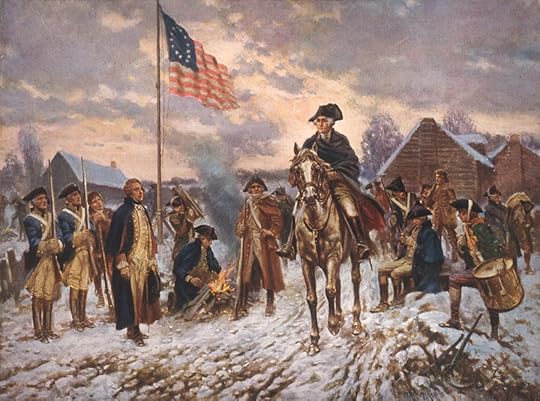
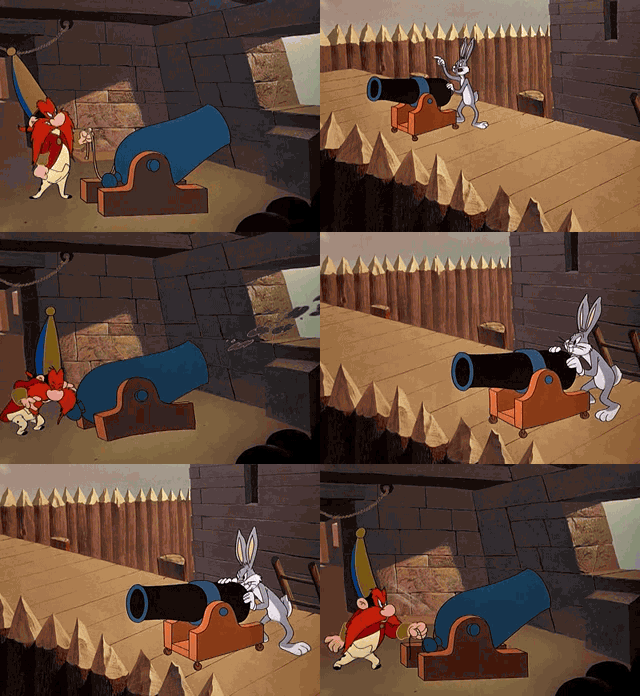
...a 32-pound cannon in the fort, but had not a single shot for it. The British also had one in their battery upon the Hospital Point, which, as I said before, raked the fort, or rather it was so fixed as to rake the parade in front of the barracks, the only place we could pass up and down the fort. The artillery officers offered a gill of rum for each shot fired from that piece, which the soldiers would procure. I have seen from 20 to 50 men standing on the parade waiting with impatience the coming of the shot, which would often be seized before its motion had fully ceased and conveyed off to our gun to be sent back again to its former owners. When the lucky fellow who had caught it had swallowed his rum, he would return to wait for another, exulting that he had been more lucky or more dexterous than his fellows.You must remember these were just boys (Martin was only 15 years old when he started his service and retired at the ripe old age of 22), and they behaved as boys do even when death was on the line. Besides, what else are you going to do? If retrieving a cannon ball and firing it back, and getting a couple shots of liquor is the only amusement available, wouldn't you take advantage of it? Still, I couldn't help but think of the soldiers waiting on the side lines like ball boys at Wimbledon, and dashing off to retrieve the shot the second it landed, maybe even fighting over it. If the Continental and British armies had had better aim, they could've been in the same class as Yosemite Sam and Bugs Bunny in "Bunker Hill Bunny":
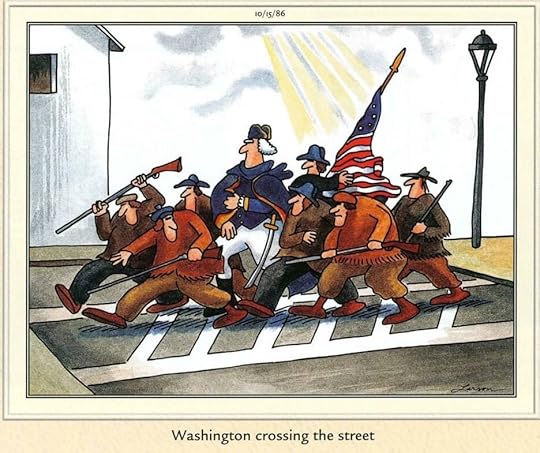
...ordered us to desist and remain where we were, and be sure not to straggle a foot from the spot while they were absent from us. In a few minutes after their departure, there came a man alone to us having on a surtout [long overcoat], as we conjectured (it being exceeding dark), and inquired for the engineers. We now began to be a little jealous for our safety, being alone and without arms, and within 40 rods of the British trenches. The stranger inquired what troops we were, talked familiarly with us a few minutes, when being informed which way the officers had gone, he went off in the same direction, after strictly charging us, in case we should be taken prisoners, not to discover [reveal] to the enemy what troops we were. We were obliged to him for his kind advice, but we considered ourselves as standing in no great need of it; for we knew as well as he did that Sappers and Miners were allowed no quarters, at least are entitled to none by the laws of warfare, and of course should take care, if taken and the enemy did not find us out, not to betray our own secret. In a short time the engineers returned and the afore-mentioned stranger with them. They discoursed together some time when, by the officers often calling him “Your Excellency,” we discovered that it was General Washington. Had we dared, we might have cautioned him for exposing himself too carelessly to danger at such a time, and doubtless he would have taken it in good part if we had. But nothing ill happened to either him or ourselves.Martin enlisted for only six or so months for his first tour and was allowed to go home on December 25th, 1776. (He reenlisted for the duration of the war the following spring). This means he missed the Trenton campaign and Washington crossing the Delaware by just one day, but at least he got to witness this about five years later: