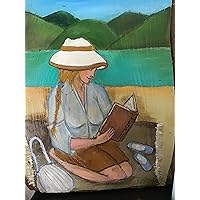
This was written in 1994 and first published in 1997. The author’s debut novel, a work of fiction, about a brave woman, small in stature (best to fit in the protective cage while taking shots) who had joined a group of nature photographers in a Canadian tundra, to take photos of dangerous polar bears in their natural habitat. The description of the harsh environment is excellent but I was more amazed that the principal character, Beryl, was able to vividly imagine what the future shall bring to it, a future which is now before us, almost 30 years thereafter:
“Beryl knew that in the future world of small things, the polar bear would probably not exist. The greenhouse effect will warm the North Pole by up nine degrees. The ice that bears live on during the winter won’t form until later in the year and will melt earlier, depositing the bears one by one into a bay a thousand mile wide. The seals that the bears live on won’t be able to survive without the firm ice. They will have nowhere to sleep at night, nowhere to birth their calves. They’ll swim, exhausted in the slowly freezing water, pregnant, wiggling their weight onto stiffening ice not quite ready to take them. The ice will bend slowly beneath them until the seals are once again left swimming. They’ll drown, the weight of their unborn calves spiralling them down in the dark arctic waters.
“The cod that the seals eat live off the algae that grows on the ice. The algae will have no place to grow. The Arctic is a rigid world: only a few species live there year-round, can thrive in its short growing season. In the Arctic the tire slashes of a single truck stay for years; the winter ice only deepens them. The ver-increasing marks of humanity—the tracks of snowmobiles, bulldozers, pipelines—are easily seen. In a climate where the camps from the early polar explorers have frozen into permanent museums, where their huskies still lie curled, their hair fluttering in the wind, where a human shit takes thirty years to disappear, where the smell from a seal’s corpse can last for a hundred frenzied arctic summers—in a climate like that a single tossed Coke can could outlive civilization.
“The ice that melts from both poles as a result of the greenhouse effect will fill the oceans, raise the waters. Beryl lived in Boston, a harbor town. When she walked along the streets, she imagined the tops of the trees swaying gently with the water, cushions floating by, a child’s toy slapping against the roof of a steeple. The light flickered, blue and solid.
“The water encroaches on all coasts. Weather patterns change. The Great Plains become desert. Food prices rocket up. Winter becomes more hesitant, with plants trying to grow in February. Annual migrations are confused and freak storms appear: thunder in January, blizzards in May. Some species—polar bears, moose, salmon—are wiped out. Others—cockroaches, rats, sea gulls—propagate wildly.
“This was the unbalanced, wounded world Beryl expected in the future; this was the world she thought she’d been made for. A world meant only for small, patient survivors, all things wondrous left only in books, the photographs strange as fables.”