As the last light of All-Hallows’ Eve falls on a small town at the tip of Cape Cod, Father Manuel Furtado begins his nightly ritual of gin and pills, prayer, and hours spent writing feverishly in his ledger. With the deep luxury of the chemicals in his body, he copies passages from Saint Augustine and Martin Heidegger, disciplined in his desire to flesh out his ever-building demons.
But, unlike his usual uninterrupted reflection, this night there is a crash, sudden enough to pull Father Manny from the rectory and toward his church, Our Lady of Fatima. He finds a man there — his childhood friend Sarafino, whom he has not seen in decades — frail with illness and desperate to tell the priest about his recurring visits from the Virgin Mary. Despite Father Manny’s grave doubts about Sarafino and his visions, he lets his old friend into his home and his life, and this single act ignites a series of events that challenge the faith of this fishing village, the parish, and of Father Manny himself.
Striking and lovingly detailed, Stealing Fatima is the story of a priest’s search for redemption in a town where, even in these modern times, the divine is possible.
Here you'll meet Father Manny Furtado, a pill-popping Catholic priest, trying to hold together the remnants of his Portuguese American parish in Provincetown, Massachusetts. As Manny wrestles with his faith, guilt and parish budget (not to mention harsh winters, his gin and his pills), the town itself plays a major role.
The story delves back into Manny's (and the author's) boyhood in 1950's - 60's Provincetown, a Portuguese American fishing village at the tip of Cape Cod, and contrasts it with the modern P-Town: a gay mecca and Cape Cod tourist-trap. Along the way, Gaspar, who has also published several books of poetry, gives us beautiful, lyrical writing. ("The houses stood serene in the early morning light, the surfaces of the street dark, as though some pigment of the night had soaked into it and hadn't returned to the air yet. The day promised to be rinsed and empty.")
The plot, about a stolen statue and the return of a childhood friend, long thought dead, reads like a mystery story and becomes a real page-turner in the last third of the book. This is Gaspar's second novel and his second about Provincetown; the first is Leaving Pico.
Stealing Fatima has something for everyone: lots of New England color, well-developed characters, a good mystery, and truly excellent writing. Its religious theme makes it an excellent novel for discussion by Catholic reading groups.
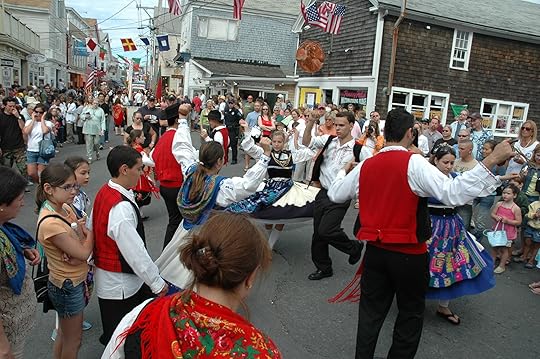
Folk dancers at P-Town's annual Portuguese festival from thefuriesonine.com Bottom photo from everfest.com
A fascinating exploration of faith and redemption. I loved the whole cast of imperfect characters, the little bit of mystery, and the process of understanding miracles and belief.
To be honest, if the subject matter wasn’t so heavily immersed in Christianity, I suspect I’d be giving this 5 stars. Those are my prejudices, but I figure I’m allowed since I am the product of 13 years of Catholic school.
This is beautifully, stunningly written. Page after page of gorgeous descriptions of Provincetown, subtle metaphors, and a constant engagement with the philosophical and the human condition— these are all things I love. However, Father Furtado gets a bit tedious at times— I wish the author had considered multiple POV— especially since addicts are kind of boring by nature. In any case, a great book.
Gaspar's first novel is a strong debut, with deft characters in an interesting situation, which at times relies too much on a well played plot device: people don't come clean with each other and then there's a day of reckoning. Still the novel's focus on the life of a priest and his Roman Catholic parish that welcomes the misfits, the homosexuals, etc is a refreshing look at what the best the Catholic church can offer while simultaneously not ignoring the real world problems of individual priests and parishioners both.
I'm so torn about how to rate this novel. There were times when the poet's cadence felt like a 5 and then other times when the novelist's desire for consummate detail brought it down to a 3.5. Knowing Provincetown makes it much more fun, as does understanding Catholic theology. But to make it all pull together, the parts that felt like memoir need to be entwined with all the rest.
I have to say that I like Gaspar's poetry better than I do his fiction. That said, this was an interesting read. I liked the main character, a priest who despite a crisis of faith remains loyal to his duties. I like the way Gaspar gradually introduces the back story that is propelling the front story, which is about the return of the priest's childhood friend to the town in which they grew up and how the past interrupts the future. I like the supporting characters, the priest's sister and her husband, and also a church volunteer who works diligently with the priest to help solve the parish financial difficulties and who also happens to be a lesbian, not so strange in Provincetown where the story is set but disconcerting in a catholic story. The volunteer's partner, who is not a church member, also figures into the trajectory of the plot.
Overall the story is unique and relatively compelling, but I had trouble with the pacing. This poet's spectacular ability to describe with beautiful images got in the way of the forward motion of the tale. Still this is a book worth reading at a time when you are willing to read slowly and savor.
A book which at its core is about faith and belief. Fr. Manny is an addicted priest with a nightly ritual of gin and opiates. He can only keep his addiction in check for a while. As his addiction spirals out of control so does his life. A boyhood friend, their relationship has homsexual overtones, returns after a lifetime away and is dying of AIDS. Secrets long buried come to light. I found the book slow and ponderous. I never cared for the characters and found myself in the end saying, so what?
I enjoyed this novel about Father Manuel Furtado and his church Our Lady of Fatima in Provincetown on Cape Cod, especially the descriptions of the surrounding scenery. Provincetown is one of my favorite places to visit so it was comforting to "go there" via the story. For me, the plot was interesting enough to keep me wondering what the ending would be. Father Manny's childhood friend arrives at the church, sick and frail - the plot thicknens from there.
Character centered novel, deliberate measured pacing. Set in at fishing village in Cape Cod, Father Manual Furtado struggles with his addiction to pain pills & gin. Childhood friend Sarafino Pomba returns to town with secrets to tell, among them visions of the Virgin Mary. Although the story starts slowly, the plot becomes more complex as the lives of the characters are revealed to the reader.
I really wanted to like this book as it had a lot of promise. There was just too much detail early and I'm amazed that I stuck with it. This book could have been 150 pages shorter and 100 times better. Okay, the priest has issues, then someone from his past breaks into his church. Jeepers, tell the story and get on with it. I wanted to like it but can't recommend it.
An absorbing story of a priest struggling with addictions, family troubles and an enigmatic "fixer" priest. Meanwhile, a childhood friend who sees visions of the Virgin Mary and is dying, comes to complicate things further. I was caught up in the suspense as to whether Father Furtado could keep his parish and would be have a visitation.
There is some very sparse prose in this book. While I don't know Portuguese Provincetown, I do know many Portuguese Americans and even though Gaspar is from the same background somehow the Portuguese folks in this text came across as if they were written by an American not of Portuguese descent.
I really liked this book. I was vacationing on the Cape when I bought it and appreciated the detail about the area and the characterization of the people who were the founders and yet are never mentioned, or credited with creating the beauty and the community.
Gaspar is a poet first and foremost, and in this role he thrives. "Stealing Fatima" has brilliant moments but overall the plot lags. It could have achieved its purpose with a shorter length - perhaps 100 pages shorter.
Enjoyed this look at Catholisim and the Portuguese Fishing Community in Provincetown MA. Gained insight into an area not often highlighted in tourist guides.