In the winter of 1847, the cloisters of Westminster Abbey enjoyed a sudden growth in popularity, though the visitors who streamed in were not of the usual kind. They were naturalists, come to see the very first marine aquarium in England, a large collection of madrepores and sea sponges kept in glass cases in the drawing-room of Ashburnham House. The Abbey aquarium was established not by the Revered Lord John Thynne, the Sub-Dean of the Abbey, but by his extraordinary wife Anna, a great beauty and mother of 10 children, who by a process of serendipity, discovered how to keep and breed her pet sea creatures in glass tanks in central London. Anna's invention of the aquarium coincided with a major philosophical turning point in history. Married to a clergyman, she found herself working in a field which cut right through to the heart of the prevailing conflict about the origins and development of life on the planet.
Rebecca Stott was born in Cambridge in 1964 and raised in Brighton in a large Plymouth Brethren community. She studied English and Art History at York University and then completed an MA and PhD whilst raising her son, Jacob, born in 1984.
She is the author of several academic books on Victorian literature and culture, two books of non-fiction, including a partial biography of Charles Darwin, and a cultural history of the oyster. She is now a Professor of English Literature and Creative Writing at the University of East Anglia. She has three children, Jacob, Hannah and Kezia and has lived in Cambridge since 1993. She has made several radio programmes for Radio Four.
Her first novel, Ghostwalk, is published by Weidenfeld and Nicolson in the UK, is the launch novel of the new fiction list of Spiegel and Grau in the US (a new division of Random House) and is being translated into 12 different languages including Russian and Chinese. She is writing her next novel, The Coral Thief.
What does the word “aquarium” make you think about? Maybe a restful tank of fish, used almost as decor either in your home, or perhaps one creating a feeling of calm in a public environment? Or perhaps you envisage a large attraction, full of immense tanks of fascinating and exotic marine creatures – or the recent exciting ones, containing larger fish and sharks, with tunnels to walk through – where the humans almost seem to be the exhibits, surrounded by aquatic life. The aquarium nowadays is a microcosm of the sea; either a bit of the ocean scooped up into our living rooms, or in specially created huge indoor displays.
But our knowledge about such marine life is comparatively recent. A few generations ago, only a few explorers and scientists would have had the opportunity to examine aquatic life at such close quarters, and had any specialist knowledge about what they were seeing. It was originally an Eastern idea to admire beautiful vivid fish swimming from the comfort of an interior setting. The Chinese created elegant dishes, which soon evolved into glass bowls, shaped to stop the fish jumping out, and used a whistle to summon the fish to feed, so the spectators could enjoy the spectacle.
In 1845 Anna Thynne transported some stone corals from Torquay to her London home, and had to devise a way to keep them alive. Thus the idea of the modern contained aquarium was born. In Theatres of Glass: The Woman who Brought the Sea to the City, from 2003, Rebecca Stott tells Anna Thynne’s story. The author is a British academic, broadcaster, novelist and university professor, who writes both fiction and nonfiction, across both the Arts and the Sciences. For instance, she has published thrillers, and nonfiction works on Lord Tennyson and Elizabeth Barrett Browning, in addition to “Darwin’s Ghosts: in Search of the first Evolutionists”, and “Darwin and the Barnacle”.
As so often happened throughout history, any females responsible for scientific progress were rarely credited for their work. Instead, the ideas and work became channelled through the respectable professional male establishment. It is well known now that Mary Anning was responsible for many fossil discoveries, the Men of Science increasingly looking to her for her expertise and work to assist them. We can never know from our historical perspective, how much credit for discoveries may have been incorrectly attributed; sometimes the famous person was merely the best at self-promotion. (The latter point applies to both genders.)
Anna Thynne is such a person. “Lady John Thynne” was the wife of the Reverend Lord John Thynne, who was the Canon and Sub-Dean of Westminster Abbey from 1831 to 1881. She was born in Northern Ireland, the daughter of a rector with aristocratic ancestors, and well used to a comfortable life. Anna was one of a large family, with six other siblings all of whom were under ten years of age when her mother died. The rector remarried, choosing a famous beauty who had featured in Sir Joshua Reynolds’ painting of “The Three Graces”, and the couple had a further eight children in the next eleven years, before his second wife also died.
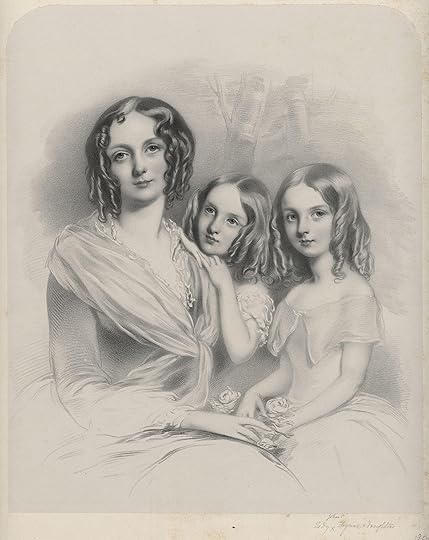
It seemed opportune for some of these children to be cared for by other members of the family. This was not an unusual arrangement within larger families in the late 18th and 19th centuries. For instance, we see Fanny Price, Jane Austen’s heroine in “Mansfield Park”, having a similar upbringing. Anna Thynne was fortunate in the home she was offered by her aunt and uncle in England. Harriet and George Byng lived in a huge Palladian mansion, “Wrotham Park”, in Barnet. They also owned a four-storey 18th century mansion in one of the most fashionable and wealthy squares in London. Anna had fallen on her feet, and she grew up in a household devoted to scientific pursuits, and surrounded by books. The earliest portrait of Anna shows her posing in the library at Wrotham Park.
Her aunt and uncle were keen that she should be educated and encouraged in her wish to pursue her love of scientific enquiry, and she was given full access to books, microscopes and telescopes. No expense was spared in acquiring geological specimens and collecting cases. In common with many upper class Victorian women, Anna developed a fascination with the natural world, collecting examples and making careful observational drawings of them.
A month before her 18th birthday, Anna married into another wealthy family, the Thynnes. Lord John Thynne, her husband, was 8 years older than her, and the third son of the second Marquess of Bath (Lord Thomas Thynne) of Longleat. The family seat of Longleat is still home to the seventh Marquess of Bath, Alexander George Thynn (who dropped the ‘e’) and the grand Elizabethan house was the first stately home in the country to open to the public. Interestingly too, the Longleat estate includes the first ever drive-through safari park outside Africa. It opened in 1966, with giraffe, monkeys, rhino, lion, tigers and wolves. The family interest in zoology has perpetuated down the generations.
The Thynne family’s interest in natural history had already been established. John Thynne’s great grandmother was the Duchess of Portland, who had put together one of the largest natural history collections in Europe, also herself associating with scholars, philosophers and naturalists. When she died, her collection was sorted into over 4000 lots of minerals, fossils, shells, insects, birds’ eggs and nests. It took over five weeks just to complete the sale! This was an increasingly fashionable occupation for aristocratic females, originating with Queen Charlotte, the wife of George III, who was interested in botany, geology and zoology.
But Anna Thynne is not just one of history’s forgotten female fossil collectors. She amassed a huge collection, but was also a competent and knowledgable marine zoologist. Rebecca Stott pieces facts together from the extant material, to show that she was responsible for originating the idea of our modern aquariums. She also suggests that Anna may have had to curb any enthusiastic impluses with regard to the origins of sea creatures. The invention of the marine aquarium coincided with a major philosophical turning point in history. Anna Thynne, married to a clergyman and part of the establishment at Westminster Abbey, found herself working in a field right at the heart of the conflict about the origins and development of life on the planet. Perhaps this may lie at the root of her disinclination to claim credit. She wisely narrowed her enquiries and research to living specimens.
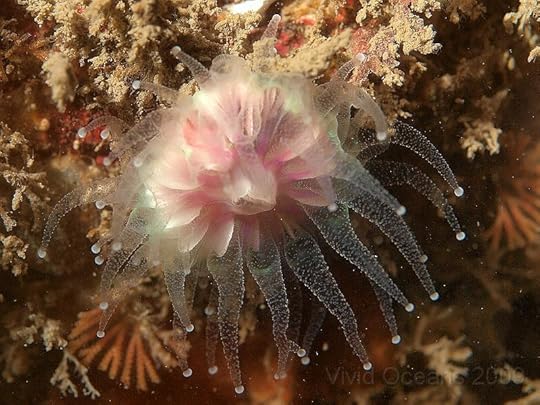
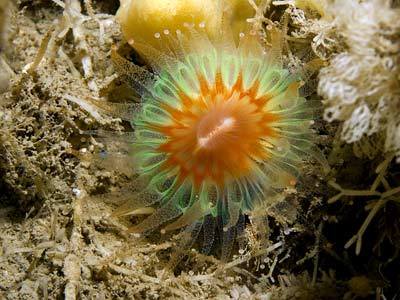
Anna’s interest in coral and madrepores started one summer in Devon. In 1846, Anna took her children, specifically her daughters Selina and Emily, on a holiday to Torquay. Whilst she was searching for fossils in the cliffs, her children were playing in the rock pools, fascinated by the seaweeds and the living creatures which scuttled about under the rocks. They found a "Caryophyllia smithii", a Devonshire cup coral, maybe half an inch long:
“its cup is fringed with exquisitely formed pale brown tentacles with white tips. Inside this cupped cavity there is an oval disc marked with a zig-zag and in the centre of the ring is a mouth, a white crenulated slit. It is almost all mouth – a mouth like a still eye at the centre of its tentacle-pulsing storm”.
Anna Thynne explained to her children (there were seven of them altogether, the others all accompanied by various nursemaids) that this creature was a “madrepore”, (from the Latin, meaning “mother of rock”) a kind of coral, like the tiny fossil madrepores in her collection at home.
Something must have prompted her to carry this living creature back home, and attempt to take care of it outside its natural enviroment. Perhaps it was the children’s natural curiosity, or perhaps her own; mesmerised by the difference between her fossils and such a beautiful fragile creature, blindly but gently probing her fingers in case they might be edible. Or perhaps she had a notion that she might show it to her friend, Mary Buckland, the wife of the Dean of Westminster. William Buckland was one of the most brilliant geologists of the century, and Mary was an accomplished marine zoologist in her own right.
All nine of the Buckland children kept exotic pets, such as snakes, eagles, monkeys, ferrets, owls, rats, guinea pigs, rabbits, foxes, tortoises, chameleons and lizards. When they moved to Westminster Abbey from Oxford, some were left behind, but many came with them, as well as a huge collection of ammonites and other fossil creatures. The family regularly entertained eminent scientists and inventors, such as Sir Humphrey Davy and Michael Faraday, Edward Forbes, Richard Owen, Sir John Herschel, Robert Stephenson and Sir Charles Lyall:
“Sometimes during luncheon, the Dean even entertained his guests with chloroform experiments conducted on animals from the family menagerie.”
Anna was now 40 years old, and had borne seven children to her husband. She had always been fascinated by natural history and the exciting new discoveries in scientific research. One of the Thynne family’s homes was in Clifton, one of the oldest and most affluent areas of the city of Bristol, in the West Country. In 1835, a physician, fossil-collector and philosopher Dr. Henry Riley founded a zoological society, with ambitions to build a zoological garden for the general public “to promote the diffusion of knowledge by facilitating observation of the habits, form and structure of the animal kindom ...”. The “Clifton Zoological Gardens” in Bristol opened to the general public the next year, a decade before the London Zoological Gardens. Soon to be known as the “Clifton Zoo” this is acknowledged as one of the first uses of the word “zoo”.
Anna also knew of Mary Anning, who had collected an astonishing collection of fossils at Lyme Regis, between 1810 and 1847 (the year she died), drawing hundreds of amateur fossil collectors and eminent geologists to her shop. She had discovered the first virtually complete example of “Plesiosaurus”: a huge marine reptile, pterodactyls: winged flying reptiles, and a fossil fish which was a link between sharks and rays: a “Squaloraja”. Yet journals by her friends record that Mary Anning became increasingly angry that her class and gender excluded her from the professional societies, and also from publishing under her own name in scientific journals:
“And yet these men of learning had no reservations about using her work without crediting her”.
Anna was well aware of the exciting times she lived in, but also of the dangers a young woman in her specific privileged position would face; not only dangers of suppression but also of accusations of audacity. By the 1830s both geology and zoology agreed about the significance of skeletons sealed in the rocks. But there was about to be more than a geological seismic shift; rocks were in danger of rocking the Church’s foundations.
Science had to be reconciled with religion. By 1836 William Buckland had worked for six years to reconcile any apparent differences between geology and religion, publishing his treatise, “Geology and Mineralogy Considered with Reference to Natural Theology” to great acclaim. The young naturalist Charles Darwin, prominent because of his discoveries on the “Beagle” voyage, had started to classify and anatomise barnacles. But although he had formulated his theories about how evolution worked, he was reluctant to publish them. His was well aware of the smoking gun his controversial theories were, and decided to wait and prove himself with solid research on barnacles. His professional reputation needed to be impeccable first.
Anna Thynne knew of the “Clifton Zoo”, and of the fossil shop in Lyme Regis stocked with Mary Anning’s discoveries. She had read Charles Lyall’s “Principles of Geology” in 1830, and was familiar with the Comte de Buffon’s immense 44 volume encyclopaedia “Histoire Naturelle”. She used William Paley’s “Evidences of Chrisitanity or Natural Theology” with her children. The temptation for Anna to be a part of this great new unfolding of scientific knowledge, to have her own live collection of a relatively unstudied species, and to discover new facts about how they reproduced and survived, must have been well-nigh irresistible.
Anna had resources many scientists could never dream of. She and her children collected thirty madrepores over the next few days, while the cook was persuaded to allocate her entire collection of pie dishes to prove temporary accommodation:
“Carefully she began to stitch each madrepore on to a sea sponge with a needle and thread, to protect them in transit, then placed each sponge in a glass jar filled with sea water and sealed with a pig’s bladder and string”.
The servants were all instructed to collect barrels of seawater to take back home. Back at Westminster Abbey, Anna experimented on what would keep the madrepores alive, and discovered that they thrived on a diet of finely-shredded boiled shrimps. Sea water was shipped by fishermen up the Thames for her, and she instructed her horrified servants to help her aerate it by hand, repeatedly pouring it from bowl to bowl every day. Whatever their official designations, housemaids or butlers, all were recruited to assist their eccentric mistress Lady Anna Thynne’s obsession with caring for her “pet” madrepores.
By 1849, Anna Thynne’s drawing room attracted zoologists from all over the country. Anna’s attitude was strictly scientific, carefully recording minute differences in the behaviour and appearance of her madrepores and writing up copious notes. Rebecca Stott describes the knowledge gained over the next three years, referencing both scientific reports and Anna’s own diaries.
One early breakthrough came when Anna ordered a variety of marine specimens from a firm in Torquay. Anna was surprised to realise after a few days, that the inclusion of seaweed meant that she did not have to aerate the water so often for her colonies to remain balanced and healthy. She watched entranced as some madrepores laid eggs, others split to reproduce, and one grew and looked healthy for a while but then declined and lay inert for days at the bottom of the tank, before:
“it produced a bright spot on its side and threw forth a sporule which attached itself to the rock and formed into another young sponge: ‘In a short time a full-grown young Sponge stood beside its parent,’ she recorded with delight.”
Having built the first stable sustained marine aquarium in 1846 Anna Thynne maintained her vastly reproducing collection of corals and sponges for over three years, (to the dismay of her servants, routinely recruited for increasingly extraordinary tasks to do with her research).
In the Spring of 1849 a young naturalist called Philip Henry Gosse (whose son was to be Edmund Gosse) was in London, beginning to work on aquatic pond creatures. Four or five years later, he would refer to Anna’s tanks in his accounts of the invention of the aquarium. He had already published two books, “Introduction to Zoology” and “The Ocean”, and had a particular interest in corals, reading Charles Darwin’s recent theories about reef formation. He was a member of a Calvanist group called the “Plymouth Brethren”, and had a keen desire to use his knowlege of natural history to “celebrate the wonder of God’s creation”. He was published by the “Society for Promoting Christian Knowledge”. (Interestingly Rebecca Stott herself was born into a community of fundamentalist Christians: a branch of the Plymouth Brethren known as the “Exclusive Brethren”. Her family left the sect in the 1970s.)
In the same year of 1849 Anna moved to Tenby in Pembrokeshire, possibly because by now cholera was endemic in London. She took her entire collection of live aquatic specimens with her, housing them temporarily in marble baths. In these they grew at an alarming rate. Anna speculated that the warmth and better food had caused this:
“Within days the two bloated and distended madrepores began to split. Anna’s journal records her distress and fascination: ‘The mouth is so distended that a four-penny piece might be laid inside it ... it appears... as though it were going to tear itself asunder into four unequal portions ... I suppose it must be really dying; or can it be a form of spontaneous fission? Oct 6th - The little creature is now nearly torn asunder.”
Carefully drawn diagrams accompany Anna’s notes, chronicling how the original two madrepores went through a process of bloating and splitting into more and more madrepores, each part, or new little creature, grabbing on to food which was presented to it.
By May 1852 Anna had 278 madrepores, still subdividing daily, and still healthy. She decided that her experiment was complete, and since the family had moved their main home to the Cartaret estates, Hawnes Park, in Bedfordshire, she would concentrate on being lady of the manor.
“In her marble bath at Tenby, Anna had witnessed and recorded for the first time the complex and sophisticated reproductive process of budding, splitting and woodsmoke ejaculation of sperm and eggs whereby coral islands were made. And in the process she had not only invented the aquarium but also contributed to the eruption of one of the most bizarre and short-lived obsessions of the mid-Victorian age; in the late 1850s Britain became gripped by aquarium mania as leisured and newly wealthy Victorians took trains to seaside lodging houses everywhere and delved into rock pools.”
In 1853 the first public aquarium had opened up in Regent’s Park. Ladies in their crinolines and gentlemen in their frock-coats could marvel at the wondrous denizens of the deep, safe in the knowledge that the aquarium was, “an attraction as chaste as it is beautiful, as refined as it is irresistible”.
“Aquarium mania” spread throughout the country, and this was encouraged by Philip Henry Gosse’s manual, “The Aquarium: and unveiling of the wonders of the deep sea” which was first published in 1854. Leaded aquariums were set into windows, or dangled like watery chandeliers. Others, in the manner of modern flat-screen televisions, were set into walls, or were constructed inside elaborate cabinets. Some examples of each of these designs still exist. In fact as with so many stories of Victorian inventions, it soon became a fad, and Britain led the way.
The second edition of “The Aquarium” was published in 1856, and in this edition Gosse credited Anna Thynne as one of three pioneers:
“The individual to whom is due the merit of having introduced marine vivaria into London is Mrs. Thynne,”
and three years later, in 1859, Anna Thynne and Philip Henry Gosse together published “On the increase of Madrepores” in “The Annals and Magazine of Natural History”.
Anna Thynne died at her home in Hawnes Park, at the age of sixty, in 1866. Rebecca Stott concentrates her thoughts on Anna’s tomb in Bedfordshire, but I cannot help but wonder what Lady Anna would have made of our modern aquariums: places in which to wander, and to wonder. They still owe a lot both to Anna Thynne and also to the “showmanship” of the Victorians.
Stott, author of the novels Ghostwalk and The Coral Thief, brings her knowledge of history as well as her narrative gifts to this brief but satisfying nonfiction account of the life and work of Anna Thynne, the British woman who in the mid-nineteenth century discovered the way to keep creatures alive in salt-water aquaria.
In addition to being a fun read for anyone who loves the 19th century and/or is interested in its accomplished women, "Theatres of Glass" is the perfect gift for a younger woman or girl interested in pursuing a career in science. As it proves, women fascinated by science today are part of a long if sometimes overlooked tradition. Readers who enjoy Stott's smart, science-themed fiction will also enjoy seeing her intelligence brought to bear on this historical topic.
At the start of the narrative, Thynne decides to transport living madrepores--a species of coral--from the seaside to London. This required her to find a way to keep the water suitably fresh and briny. As she succeeded, she was able to study them in a more extended and intimate way than had been possible before, discovering for example how they reproduced.
The small details Stott shares of Anna's inventiveness and curiosity are always vivid and telling, and her discussion of the larger context of the time is sound and beautifully written. Stott deftly depicts the tradition of 19th-century women fascinated by, and actively engaged in the study of, natural history--a fun and useful correction for all of those who picture Victorian women as little more than fainting, corseted denizens of the drawing room. As she demonstrates, female reality was much more complex and interesting than that, and the era more generally was much more contentious, questing, and "modern" than clichés suggest.