A deluxe edition of Orochi , featuring all nine of the classic interconnected short stories by horror master Kazuo Umezz, the creator of The Drifting Classroom !A mysterious young woman slithers her way into the lives of unsuspecting people like the legendary multitailed serpent for which she is named—Orochi.The fourth and final volume of Umezz’s classic horror manga begins with “Eyes,” in which Orochi encounters a girl who can see more than anyone expects, despite being blind. And “Blood” brings Orochi into the strange twisting lives of two sisters, neither of whom is what she seems to be.
Kazuo Umezu or Kazuo Umezz was a Japanese manga artist, musician and actor. Starting his career in the 1950s, he is among the most famous artists of horror manga and has been vital for its development, considered the "god of horror manga". In 1960s shōjo manga like Reptilia, he broke the industry's conventions by combining the aesthetics of the commercial manga industry with gruesome visual imagery inspired by Japanese folktales, which created a boom of horror manga and influenced manga artists of following generations. He created successful manga series such as The Drifting Classroom, Makoto-chan and My Name Is Shingo, until he retired from drawing manga in the mid 1990s. He was a public figure in Japan, known for wearing red-and-white-striped shirts and doing his signature "Gwash" hand gesture.
Not quite as strong as the previous volumes, but the longer story, Blood, does an interesting job with the old question of whether monsters are born or made.
The fourth and final instalment of Kazuo Umezu's Orochi includes short-stories Eyes and Blood. In Eyes a man gets killed in the house of a blind young girl and her father gets wrongfully imprisoned for it. Will the younger girl be able to find the real murderer with the help of a little friend? In Blood a younger sibling is constantly criticised and berated for not living up to her older sister's exemplary standards. Years later, Orochi's spirit returns in the body of another girl. The two sisters are now grown women ..
I'd been waiting for this series to hit its stride and it really ends with a bang in the final volume. The story "Blood" is incredible and I can see why it was published alone previously. It's the most complex narrative yet (relative) and makes massive leaps in its visuals from previous volumes. Orochi finally becomes a character as well. It's a satisfying ending and absolutely the best arc in the series by far. Fortunately, at four volumes in this Perfect Edition, it's a relatively short series and worth reading in its entirety even if it drags in the middle. If you've already read Drifting Classroom you can tell how much Umezz was heading in that direction and it's interesting to see those ideas take shape in those moments even if they aren't that exciting. Ultimately your enjoyment here depends on how much you can or want to see this kids go through terrible things. It's so cartoon-y and ridiculous that it's hard to take that aspect too seriously here.
Ends on a high note. “Eyes”, a murder mystery centered on an epistemologically endowed but socially compromised protagonist, often plays like a richer and subtler variation on the suspense narrative that fueled “Key” in vol. 2, with an awkward but effective stab at social commentary in its final moments (another critique of postwar Japanese society, recalling “Combat”). “Blood” is the tour-de-force, though. Umezu pulls out all the stops: large, entrancingly detailed panels nonetheless frequently veiled in shadow; the most sophisticated use of his spotlight technique in the series; Beardsley-esque hallucinatory ornamentation; demonic faces contorted in agony; Gothic atmosphere for days, etc. etc. etc. It’s a full return both aesthetically and narratively to the concerns of the first story in the series, “Sisters”, but it puts a haunting and occasionally even poignant twist on the theme of sororal cruelty by involving Orochi in a very direct, startling way. Amazing last line, too. It’s crazy that this series only fully blossomed in its first and last chapters. The rest is admittedly hit-and-miss, but they do reveal a consistent and startlingly pessimistic vision about the violence embedded in the nuclear family. I’ll eagerly reread all of it at some stage.
it was really funny to realize, so late in the game, that this is the same freakin author who wrote cat eyed boy!!! throughout this 4-volume experience, I kept thinking vaguely back to that series and wondering, "was this a story telling convention of the genre at the time? having a main character who isn't actually the focus or protagonist in their adventures, but more of a side observer wandering into the goings-on of others?" turns out it's just the same author lol
I'm not sure how much I jive with it. I do feel it's meant to simply connect a series of short stories more cohesively, which I actually appreciate, but it also means frustration at the way orochi is more of a passive character (or even deus ex machina- even if she doesn't always have a saving effect) in terms of development and backstory. we get a little more about her in this volume, but not enough to tie it all together meaningfully.
overall, I think 4 volumes was a perfect amount og stories to encapsulate this series and what it had to offer. there is a lot of graphic abuse depicted in domestic or school situations, especially against children, and the ramifications of that violence later in life. characters were often overly violent and villainous, in my opinion, and the behavior towards children felt mildly gratuitous, and likely triggering to those sensitive to that. and many characters appeared very physically similar; there wasn't a lot of distinction in appearances between the characters.
There are two stories here, both are solid. Eyes is a fairly straightforward thriller but Blood is the stand out here, with its nasty, wicked twists and outlook on humanity.
Quick recap: Orochi appears to be an ordinary, generically pretty young woman, but is actually a seemingly ageless being with vaguely defined supernatural powers. She has a gift for spotting people who are going to have interesting things happen to them and following their lives. See my reviews of previous volumes.
This is the final volume in the series, containing two long stories.
“Eyes” has Orochi’s attention caught by Keiko Taguchi, a blind girl in her teens. Keiko’s been blind since birth and goes to a special school, having become quite adept at navigating her dark world. She lives with her father (no word on what happened to Mom) in company housing for the factory he works at. Her one close friend is the much younger Satoru, who used to go to the same special school before he had an operation that restored his sight.
One night, Keiko’s father is delayed coming home from work. A friend of his knocks and asks to hide from someone trying to kill him. Unfortunately, Keiko is not able to close the door fast enough, and his pursuer enters as well. This is lethal for the friend, but the intruder spares Keiko when he realizes she’s blind. Keiko passes out from the shock. When Mr. Taguchi arrives home, he foolishly picks up the murder knife, getting his fingerprints over it. It’s at this point the police arrive and arrest him.
Keiko’s wild tale of a stranger and the description she gives based on hearing and smell clues are dismissed by the police, especially as none of her neighbors saw any such person. They’re very comfortable with the suspect they have, thank you. They don’t even do a search of the house for clues.
Later, Keiko finds the real killer’s ID card which he dropped in the struggle, but the name kanji are too difficult for Satoru to read, and the card is accidentally destroyed before she can get it to the police, who scoff at the possible existence of such a thing.
Meanwhile, the killer realizes he’s lost his ID, and where that must have happened. (But of course, doesn’t know that it’s been destroyed.) The rest of the story is a cat and mouse thriller between him, Keiko and Satoru.
This is intense, exciting stuff. The killer’s motivation and the reason Keiko can’t get help from the neighbors is very Seventies. But Orochi is barely in the story, and only observes the goings-on. There’s no supernatural element other than Orochi’s observation.
“Blood” is about the Monzen sisters, Kazusa and Risa. Kazusa is a couple of years older, and the very model of a good little girl that brings honor to her prestigious family. Risa is…not. Risa is constantly compared unfavorably to her older sister and emotionally abused by her relatives and the servants. Unsurprisingly, this results in Risa acting out, which gets her labelled as “difficult” and “wicked.” Only Kazusa is ever kind to Risa.
Orochi has infiltrated the mansion, initially to see what was inside, then to observe the sisters. No one seems to notice. She watches for decades as the sisters reach adulthood, get married and lose their husbands. (Kazusa by becoming a widow, Risa through divorce.) Orochi senses that the worst is yet to come. Risa drives drunk, and is about to crash when Orochi intervenes for the first time, protecting Risa with her body.
While Orochi survives the experience, we finally learn one of her limitations. Once every hundred years, she must sleep for a couple of decades to keep from aging. While her actual age isn’t specified, we do learn she’s been around since the 18th Century. Due to the severe injuries from the car crash, the sleep has been triggered early. It’s all Orochi can do to find a cave to hide in.
While Orochi’s body undergoes the Orochisleep, her consciousness somehow finds itself inhabiting the body of Yoshiko. Yoshiko is a teenage orphan whose foster parents are exploiting her labor. This doesn’t last too long as the wicked stepparents are only too eager to sell Yoshiko to a stranger who claims to be related to her. Orochi, while awake and able to see and sense everything Yoshiko’s body does, cannot actually control the body or affect Yoshiko’s actions.
The stranger turns out to be Risa, now an older woman. She explains that Yoshiko is a distant relative of the Monzen family (there is a resemblance) and she was touched by the girl’s plight, so bought her as a companion for the now bedridden Kazusa.
Treated well for the first time in her life, Yoshiko quickly bonds with Kazusa and works as her companion faithfully. Unfortunately, the better Yoshiko gets on with Kazusa, the more angry and abusive Risa becomes, seemingly framing her for small crimes to have an excuse to berate and abuse her.
When it looks like Kazusa’s heart is about to finally give out, Yoshiko trips on the stairs and starts dying herself.
Orochi wakes up back in her own body, rotting clothing and all. She’s convinced the Yoshiko thing was not a dream and hurries back to the Monzen mansion. Sure enough, there’s the now elderly sisters and the dying body of Yoshiko. Orochi is emotionally invested in a way she’s never been before, having experienced Yoshiko’s life directly.
And then there are a series of reveals, including Yoshiko’s actual thoughts that Orochi never heard, that hammer home the tragedy of the situation. Stunned, Orochi walks away but no one there notices, only a passerby as she faded from view.
A very bizarre story to finish the collection. Who and what Orochi actually is, we will never know. Presumably, she is still out there, watching humanity.
The art continues to be excellent, highly detailed when it needs to be, and giving the feeling of the darkness surrounding the characters.
Because the last story is about abuse, sensitive readers should exercise caution.
Overall, Orochi is more of a “horror host” than an actual character in the stories, and they tend to be light on the supernatural, so this collection may appeal more to people who like horror-tinged thrillers than to the supernatural horror fan. Some fine work though.
With its final pages providing a glimpse, although a rather muted one, of a concluding statement, Volume 4 managed to continue briefly the strong quality of its preceding volume, but only to find itself stumbling back to its melodramatic formulas of the series' initial tales. That being said, Umezz seemed to have found further confidence throughout the series, with Orochi's purpose as a storytelling device and her distinction from those observed greater defined. While the author-artist finds himself returning to an over-involved presence in his final story, it remains restrained in comparison, saving itself from potentially being another loathsome readthrough.
That was the last book of the series and probably the best two short stories in my opinion. This as a manga series is definitely worth reading, the stories are intriguing and the art work is detailed.
I would say I would want more from the main character Orochi herself. I want to know more about her life, where she came from, what she is. But then maybe it’s not about that, maybe it is about these things she witnesses.
Overall, Orochi as a series gets a 4 out of 5 and to say these are originally from the late 60s / early 70s, it’s very impressive.
This entire review has been hidden because of spoilers.
“It's red! I knew my blood would be red! It's not black or blue! It's no different at all from Kazusa's. It's the same... so why is she so clever and I'm not? Why am I so different from her?"
4.50 / 5.00 stars
Orochi is a mysterious observer. Taking the form of a young woman, this ghost-like entity uses her supernatural abilities to snake her way into the lives of seemingly ordinary people. But behind every person, there are secrets waiting to be discovered. This is the last volume of the 4-part Perfect Edition, containing the stories “Eyes” and “Blood.”
"Eyes" is the story of a young blind woman who gets in over her head when her house is broken into. "Blood" is a tale of two sisters who are very different yet hauntingly the same. Only time will tell how...
This volume will always be my favorite as it contains "Blood." "Blood" was my first introduction to Umezz (credited as Umezu in that edition) when I read it as a standalone story in the mid 2000s. It was my first foray into the world of horror-manga and definitely ignited the flame for me. Having read the entire series, I can see why "Blood" was previously translated to English as a stand-alone story as I feel it's the most complex and engrossing story in the whole collection.
Umezz has a very engrossing slow-burn style to his work. First published in the ‘60s, Orochi’s artwork is definitely a product of its time in the best possible way. I love that each of the stories in this series is unique, and there’s no set order to read them in. I find myself picking a story to read at random when I need a good chill.
My biggest criticism is that there is no explanation of where Orochi, or her powers, come from. I wish this last volume contained more of her origin.
I recommend this manga if you enjoy a good horror story, if you’re looking for something similar to Junji Ito’s style, and if you always thought Gossip Girl would have killed as a horror story!
The final volume in this manga series leaves me very impressed with the illustrations, as always, but much more conflicted about its stories. Volume 4 is the best this series has been since Volume 1, with character, storytelling, artwork and horror all impressing a lot more than in Volumes 2 and 3, but as a sequel, and as a finale, it does still leave a lot to be desired.
The biggest issue here is that the two stories included in this last volume are quite similar to previous stories. Thankfully, they are much better than those earlier stories, being both better written and better paced, as well as feeling creepier and having some really interesting visuals. 'Blood' in particular, the final story in this series, is especially interesting, in large part as it brings Orochi herself back into the forefront of the story, and developing her as a character, although this still doesn't quite work as she doesn't tangibly affect the events like in that first volume.
In fact, Orochi's character and her undeveloped role in the series from Volumes 2 onward is the biggest reason this last volume doesn't stick the landing - there are no ties, that cliffhanger is left by the wayside, and there were no resolutions or conclusions Orochi shares about humanity having watched us this whole time. The horror picked back up in this very last entry to a certain degree, but there's little feeling here that the stories as a whole fit together as a unified collection.
Overall I'm left pretty conflicted on my feelings towards this series. That first volume left a big impression that still stays with me, and the series as a whole makes for a solid collection of interesting but undeveloped conceptual stories. The artwork is worth checking out, and conceptually I loved Orochi's character - so on those merits, I'll recommend Orochi.
This volume contains two stories, "Eyes" and "Blood". Thus far, the best Orochi stories tend to involve children, since Umezz's stiff dialogue and illustrations of stilted movement just work much better with them. Both "Eyes" and "Blood" involve children as the main characters, and both were solid horror stories.
"Eyes" features the character Keiko, a blind girl who "witnesses" a murder happen. Since she cannot give testimony to the appearance of the murderer, someone else takes the fall. Keiko's attempts to bring the true killer to justice puts her in some dicey situations, and quickly becomes a horror/thriller in the vein of films like Hush and Don't Breathe. The pacing of the story is well done, and the often use of silent panels when the killer is lurking is great sequential storytelling.
The second story, "Blood", follows the emotional and physical abuse of a girl who is perpetually compared to her much more beloved elder sister. Despite her treatment there is no apparent resentment towards her elder sister, at least at first. "Blood" is a much more tragic story compared to previous Orochi stories, and it has some of the most interesting yet bizarre twists yet. Orochi herself plays a much more inserted role in "Blood", marking a departure from previous stories. We even learn more about Orochi's existence, providing some fairly interesting development for the character.
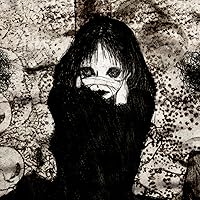
Umezz's artwork of course is a standout as expected. The compositions are rich in detail from the crosshatching and ink brushes, but the results look unnaturally simple. This is likely due to Umezz's fantastic use of contrasts, especially in pages where the backgrounds are sparse. There is a sophistication to the simplicity of the art style, and it works incredibly well in conjunction to the surreal quality of the Orochi stories.
Leave it to Umezz to make a slice of cake look ominous. This volume contains the following 2 stories: - Eyes: a small town turned against an innocent blind girl after she was roped into a whistleblowing incident at the local factory. Kind of reminds me of Blindness (Jose Saramago), a reflection on sight / morality. - Blood: this echoes the first story in this series, exploring jealousy between sisters. This is the only story that revealed more on who Orochi may be, but a lot of her identity still remained unknown.
I was worried when I saw there were only two stories in this volume, but there's lots of good orochi content in here. the second story actually focuses on her quite a bit instead of her showing up only every few pages! I also got a few laughs at the total melodramatic absurdity that occurs, which is a major reason I read this series. there's not a ton of her nonsense powers, but the stories themselves are compelling and very gothic so this definitely ranks higher than Vol 3.
Eyes are surprisingly tense story with some cool ideas. Blood is another remake of "pressure makes people horrible" plus lots of confusion and weird dialogue, basically a remix of Sister story from the first issue.
It's a shame - after finishing Eyes I was really expecting a bit more. The whole series is decidedly a part of comics history: but only few stories (Combat, Eyes) are actually worthy of a read today.
Two more stories following Orochi’s wandering through the mortal world. The first is a murder most foul with the only witness being a young girl that the police refuse to listen to. The second is a tale of child abuse and revenge that idea honestly a little hard to read sometimes. It’s… not a nice story.
But they are extremely entertaining, despite the old style art. I only wish we mess more about Orochi.
The two stories "Blood" and "Eyes" by Kazuo Umezz's "Orochi: The Perfect Edition, Vol 4" are well done tales of psychology terror and suspense. Both are well done with excellent artwork. What one is reminded of the great films of the gothic drama of "Whatever Happened to Baby Jane?" and psychological thriller "Wait Until Dark" films.
I think mostly because the stories are a bit outdated . 'Eyes' has some good social commentary and I think the last story gives use short of insight into who and what Orochi actually is but it wasn't enough
I only read this author because he an inspiration of Junji Ito but I don't think his stories are for me ...
I'm not the biggest fan of "Blood", but "Eyes" is solid Umezz. Creepy and grungy and mean. "Blood" is just mean, which I'm not too big a fan of when Umezz does it. For this series overall, it's pretty good. The third volume has the best story, but this volume is good too.
Having read all four of the manga my conclusion is that Orochi needs to mind her own damn business and stop being such an obsessive stalker freak show. Also, her power/longevity/origin is never explored. She simply is.
I liked this better than the 3rd volume but I’m glad this was the last one. I like the drawing style but the pacing of the stories is off for me in every single story although I find many of them have an interesting premise.
I’d say it’s probably one of the stronger books in the series. I think these books will always feel rushed and convenient in many ways, however I did find this one fun to read
"Someone passing by say they saw a girl walking away. But you can't see the Orochi who's guarding you from behind... Or the Orochi who's already left you."
4.5 stars. The first story, Eyes, is average for the series so far, but the second (the longest so far in the series, I think), Blood, is really impressive work.