Their Bohemian lifestyle?and?intertwined love affairs shockingly?broke?19th Century class barriers?and?bent the rules that governed the roles of the sexes. They became defined by love triangles, played out against the austere moral climate of Victorian England; they outraged their contemporaries with their loves, jealousies and betrayals, and they stunned society when their complex moral choices led to madness and suicide, or when their permissive experiments ended in addiction and death. The characters are huge and vivid and remain as compelling today as they were in their own time.
The influential critic, writer and artist John Ruskin was their father figure and his apostles included the painter Dante Gabriel Rossetti and the designer William Morris. They drew extraordinary women into their circle. In a move intended to raise eyebrows for its social audacity, they recruited the most ravishing models they could find from the gutters of Victorian slums.
The saga is brought to life through the vivid letters and diaries kept by the group and the accounts written by their contemporaries. These real-lie stories shed new light on the greatest nineteenth-century British art.
According to this excellent book, PRB often stood for Pre-Raphaelite Brotherhood, but also stood for Please Ring Bell and occasionally Penis Rather Better.
But it could have stood for Painters Really Bonkers.
In the beginning there was a young art critic who had the ear of the cognoscenti called John Ruskin. Half of this book is about him. He was The Art Don. All the PRB thought he was like OMG I just saw John Ruskin walk by, I'm going to kiss the pavement whereupon he trod. But he was off the scale creepy. The Ruskin family were friends with the Grays and the Grays had a daughter. By the time she was 13 John was 22 and was writing fairy stories for her and thinking that she might be The One. She grew up to be a real drop-dead stunner. Her name was Euphemia and they called her Effie. I would have too. 90% of the interesting history of the Pre-Raphaelite Brotherhood followed from the curious fact that when 28 year old John Ruskin got to marry the 19 year old Effie in 1848 he declined to have sex with her. For six years*. Until she got so freaked out by this that she divorced him. Which was huge. In those days you actually had to get a separate Act of Parliament passed in the House of Commons to finalise your divorce. That would make you think twice.
A great number of the people in this book spent a large amount of the short time they were allotted on this Planet Earth thinking about what did not go on between John Ruskin's John Thomas and Effie Ruskin's lady bits, and how the wind blew and the tumbleweed rolled between those most public of private parts. It was the talk of the town. For six years.
Meanwhile, the actual PRB were gathering together. Actually, there were two brotherhoods. The line-up for the first one was
John Millais, bass William Holman Hunt, drums Dante Gabriel Rossetti, lead guitar, vocals Ford Madox Brown, rhythm (left after first album)
After Millais and Hunt went solo Rossetti reformed the band
William Morris, bass Edward Burne-Jones, drums Dante Gabriel Rossetti, lead guitar, keyboard, vocals
At first, PRB 1 was laughed at by the critics. But then Ruskin noticed them and decreed that they were brilliant. And so they were. And he became their great friend and supporter.
I liked this - John Millais was a boy genius and got on some people's nerves:
Once after winning a prestigious silver medal from the Society of Arts fellow pupils hung Millais head downwards out of a window and left him there, suspended over the pavement below, held only by the scarves and pieces of string that his peers had selected to attach him to the iron window guards until his precarious situation was noticed by passers-by
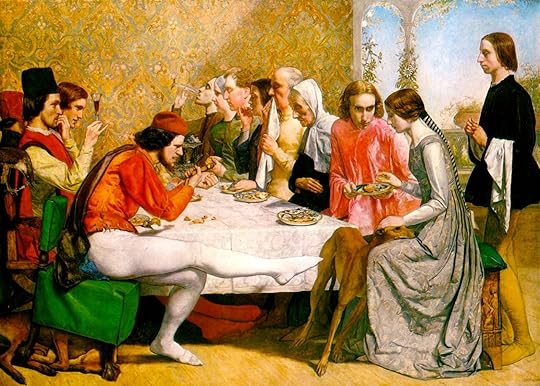
How to analyse a Millais painting
The subject is "Lorenzo and Isabella" (painted when Millais was 19)
The brother in the foreground is holding up a nutcracker in his right hand. While the cracking of a nut could well indicate his desire to emasculate poor Lorenzo, the shadow he himself casts is of a brooding sexuality directed at his own sister. The shadow of his forearm on the table looks like an erect penis, a mound of white ejaculate indicated by salt spilt on the cloth. The brother's foot points at his sister's lap.
The PRB were the first English bohemians. They broke various social taboos, they just couldn't care. The main thing they did was locate stunners on the London streets. They would go out as a group deliberately trawling for stunners (their word), and they would inveigle the girls to become models. The girls were shop assistants or prostitutes, because being an artist's model was the same as prostitution to the Victorians, no difference at all. Then the boys would get these working-class or even underclass girls to live with them, and – the ultimate shockingness – they occasionally married these girls, sometimes after paying for them to get trained up in the middle-class niceties of fashion and manners first. Then they would have affairs with each others' models and/or wives. And it was a whirligig ride for the girls. (For those interested, it turned out that Annie Miller was the Yoko Ono.)
Sometimes it turned out well – Millais got off with Effie – and sometimes it ended badly – Rossetti got off with Lizzie Siddall, shop assistant turned IT girl; he became besotted; promised to marry her; ten years later was still promising; by which time she was a junkie (laudanum) with mental health problems; then finally he did marry her, then he copped off with another woman; then she committed suicide, aged 29. Oh yes, and in his extravagant grief, as a grand gesture Rossetti cast a manuscript book of his own poetry into the coffin , and some months later regretted this rashness and got a special license to get the coffin exhumed to retrieve his bloody poetry, which he now wished to publish and dedicate to his new girlfriend, which, you know, was in poor taste, because she was another man's wife. And you have to laugh because there was a wormhole through his favourite poem. Literally. A hole made by a worm.
As for Ruskin, he survived the wagging tongues and in a truly gothic E A Poe-ish way he started to repeat the same Effie story again with another young girl, this one being ten when he met her aged 39. That wretched car crash takes up most of the last quarter of this book.
The PRB was a living museum of psychosexual morbidity which they then laid bare in their beautiful art. All that yearning, all that death, all that prettiness. All those flowers and fabrics and little mice and foliage and eyes like saucers and undraped flesh and knights and goats and doom.
And finally
Rossetti liked to keep inappropriately exotic pets in his garden. They all died of neglect. His favourite was a wombat.
The wombat did not last long in the Rossetti household. Anecdotally, its demise was as a result of eating a box of cigars.
* One theory about JR was that he had been so conditioned by his immersion in classical art that he was struck with repulsed horror at the sight of his new wife's pubic hair. (Could this happen to a young man of today, I wonder? I think it might, but it wouldn't have been classical art he had been immersed in.)
This book is about what the subtitle says: the private lives of the Pre-Raphaelite Group and their champion.
So, we get to know their social and family origins, how they knew each other, how they got together, how they searched for the “stunners” (were these women or the embodiment of their fantasies?), and how they swapped them amongst themselves.
The book is border line between social history and a gossip magazine, with may be more of the latter than the former. There is very little analysis of their work, but it remains Ruskinian in its honesty. It does not pretend to be what it isn’t and stays true to its nature.
Anyway, it was highly entertaining, and it raises once again the question of whether knowing about the life of an artist or writer adds, or detracts, anything from an appreciation of that person’s work. This is a tough question and I shall not propose an answer. Sometimes I welcome knowing more, sometimes I do not.
To this group I would give the following Prizes:
The greatest painter: Millais The most irritating character: Rossetti The most Oxfordy: Burne-Jones The best decorator: Morris The most complex character: Ruskin The most interesting character: Hunt The most forgettable: Madox Brown
Some hold two prizes.
The most kitschy painter: Hunt The most inspiring: Ruskin The most socially significant: Morris
With the women, I ended up very confused, since they all move around from one member of the brotherhood to another. Most of them cut a similar Pygmalonian pattern, had (or were depicted as having) frizzy hair, long neck and melancholic eyes. Alas, in my mind they have all become one.
I will give more attention to their art when I visit the Tate’s exhibit next month. I will also then start with Ruskin’s writings on art in preparation to reading someone who was deeply inspired by him: Proust.
I just realized this, but I have the audiobook called “Effie”, which is about John Ruskin’s wife and their extremely unhappy marriage(that could totally be a monstrous understatement); this book, which deals with the pre Raphaelites (which deals with Ruskin, Effie, Lizzie Siddell et Al,) and a historical fiction about Lizzie, which I have not yet read. Then there is also Ruskin’s studies of the stones of Venice and the master painters. So I should feel well studied, but noooo. I blame Ruskin. My lord is he a miserable man. Ok Ruskin is one fantastically walking nightmare. Everything he touches hits a fan. Whatever size fan is fine, it’ll hit it all the same. When I attempted to read the stones of Venice, I made it through two volumes until I finally threw in the towel on the last two. I’ve not picked up the painters yet. BUT I have listened to Effie about three times (I want to say that’s on audible plus right now and if so I’m buying it once it’s dropped). And everytime I listen to it I absorb a little bit more of that tragic tale. How I found this book I have no idea. I must have done a search on my iPad and this popped up with other items. I’ve really enjoyed it. To be able to read all three of these books gives the mind such a brilliant inside story. Rossetti needs some of my bipolar meds he’s so manic I’m surprised his spirit hasn’t jumped out of the pages and tried to paint me. Walking common disaster. I recommend if you get this book, try to at least get Effie as well. I’m not very far at all with Lizzy to know how it fits in. Just remember I warned you about Ruskin.
Desperate Romantics: The Private Lives of the Pre-Raphaelites is a decent introductory text on the lives of those individuals involved in the Pre-Raphaelite art movement. Franny Moyle's text is well-written and engaging, often informative.
I don't doubt that Desperate Romantics – or perhaps, more specifically, the subsequent, identically-titled BBC dramatisation – has drawn new attention the Pre-Raphaelites, introducing them to an audience that perhaps isn't so interested in art to begin with. It's my story, more or less – I watched the TV series and wanted to know about the real people behind the drama. Or how Dante Gabriel Rossetti was even real...
However, I found too many disappointments in the book to see it as more than a jumping off point for further research.
Moyle's writing is firstly let down by her at times confusing structure. Chapter 9 begins by discussing the inquest into the death of Lizzie Siddall, seemingly skipping over the tail-end of her courtship with Rossetti, their eventual marriage and the stillbirth to get to her sudden death. Of course, Moyle doesn't really skip over these subjects – she goes over these things until mid-chapter 12 where she gets to discussing the circumstances of Siddall's death. Perhaps Moyle felt that the 'drama' of Siddall's death would liven up a narrative.
Similarly, the epilogue is poorly structured. The epilogue provides a brief summary of what happened to the main figures discussed in the book after the "end" of the Pre-Raphaelite movement. Logic would perhaps dictate setting events out in order in which they occurred – this doesn't happen. Chronologically, the epilogue is all over the place. It would also logical for Moyle to structure the epilogue to end by focusing on the most significant figures in her narrative – again, this doesn't happen. The last person to have her fate discussed is Fanny Cornworth – who is hardly a star of this narrative.
The second thing that disappoints is Moyle's frequent use of Freudian psychoanalysis to provide insight into the minds of these historical personages. My understanding is that Freud's methods and theories are no longer relevant, most of them now considered "mindboggingly, catastrophically wrong". Yes, Ruskin's dream of a "slender snake" that "became a fat thing" has enough phallic imagery to be a Freudian's wet dream and it's hard not to associate such obvious imagery with Ruskin's issues surrounding sex. But come on, obvious phallic imagery is obvious.
Furthermore, examining real-life, non-sexual events to show discuss how this obviously relates to their views on sex? Just seems a poor decision for the sake of creating a more shocking story.
Despite being a book essentially about the Pre-Raphaelites' private lives, Moyle's main focus seems to explore the scandals associated with various associates of the Pre-Raphaelite Brotherhood. Millais, for example, enters early on, is a chief figure in the art movement, and his role in the Ruskins' divorce is discussed – but the moment he marries Effie, the former Mrs Ruskin, he exits the book. In fact, the only two characters that remain front and centre across the book are Rossetti and Ruskin – both of whom could be easily described as scandalous and mentally unbalanced.
As an aside, Moyle's descriptions of a young Rossetti make me think he might have been suffering from bipolar disorder prior to the formation of the Pre-Raphaelite Brotherhood (of course, there are immense difficulties, if not impossibilities, with diagnosing the long-dead and I'm far from a mental health expert, so please don't take my word for it) – but Moyle prefers to think of him paying for his unconventional life and wrong-doing with his sanity.
I also found myself uncomfortable with Moyle's bald, misogynistic flavoured statements, often directed at prostitutes, such as "Hunt eventually got over his penchant for slutty girls and finally married one of the respectable kind" (page 255). This was Victorian times so of course such attitudes existed and were seen as natural and normal. But there's no reason for Moyle, writing in 2009, to support and contribute to such attitudes.
Somewhere, I have also got the impression that Moyle's presentation of events is flawed – that is, her history is not "up to scratch" and the information is not 100% reliable. This meant that I didn't feel I could wholly trust her narrative, thus putting even more a dampener on my enjoyment of the text.
All up, Desperate Romantics is a good primer for further research, providing the basic details of the Pre-Raphaelites. It was, however, a disappointing and frustrating read for me in many ways. I look forward to reading more about the Pre-Raphaelites, but I doubt I'll feel the need to keep Moyle's book to hand.
This is an immensely readable book. For anyone with a liking for Pre-Raphaelite art, it should be unputdownable, if that is a word. I already was familiar with a lot of this material and I still felt suspense. All appreciation of art is enhanced immeasurably by knowledge of the artist, their time, and the individual story of the work itself, of course, and most especially so with this bunch. Truth is certainly stranger than fiction.
Oh, how I love this book! It's the perfect balance of scandal, historical detail, and art criticism. If you're a Pre-Raphaelite scholar this will be hopelessly lightweight, but if (like me) you just want a great story with fascinating characters and art details, pick this up. It's enthralling.
Šī grāmata ir tikai viens posms notikumu ķēdītē. Neesmu neko diža mākslas pazinēja un gardēde, bet, pirmo reizi ieraugot prerafaelītu darbus, zināju, ka esmu uzķērusies. Mani savaldzināja šis pārsmalkais, romantiskais un vienā acumirklī atpazīstamais stils. Tad jau kaut kur izlasīju, ka prerafaelītiem bijusi sava brālība, iegaumēju pāris uzvārdu, noskatījos filmu "Efija Greja". Jau plānojot janvāra beigu īso izbraucienu ar draudzenēm uz Londonu, pamanīju, ka Nacionālajā portretu galerijā ir izstāde "Prerafaelītu māsas". Vēl šaubījos, jo Londonā, ko skatīt, paši zināt, cik daudz. Turklāt biļete arī bija diezgan sālīta. Tomēr fakts, ka izstāde notika pēdējo dienu, kaut kā pamudināja izmantot iespēju.
Lūk, rezultāts: esmu mēreni pārņemta. Pēc izstādes apmeklējuma noteikti gribēju izlasīt ko vairāk gan par prerafaelītu brāļiem, gan māsām. Manuprāt, trāpīju desmitniekā. Foilas grāmata ir lieliska tieši tādiem iesācējiem kā man. Par gluži akadēmisku pētījumu to nenosaukt, bet populārzinātnisks šis vēstījums, kas koncentrējas galvenokārt uz prerafaelītu vētrainajām attiecībām ar sievietēm, kuras pašas vairumā gadījumu neatkarīgi no savas izcelmes (kas bija tieši tik dažāda, cik Viktorijas laikmetā iespējams) arī bija spilgtas personības, gleznoja, rakstīja dzeju, izšuva un ko tik vēl ne. Koncentrēšanās uz skandāliem un mīlas trīs- un četrsstūriem varētu būt arī galvenais pārmetums grāmatas autorei (Raskina-Efijas Grejas-Milē skandāls vien ir ko vērts), bet jāatzīstas, ka tāda ielūrēšana pa durvju šķirbu 150 gadu senos notikumos sagādāja milzu baudījumu. Turklāt iedeva fonu un izpratni pašu mākslas darbu tapšanas vēsturei un laikmeta izpratnei. Bez šaubām tiek piedāvāts arī ieskats brālības darbā, sākotnējā publikas neizpratnē un izsmieklā un samērā straujajā atzinībā. Tāpat raksturoti galvenie prerafaelītu darbi un nostāja, kādai jābūt modernai mākslai. Bagātīgi citētas vēstules.
Uzzināju arī šādus tādus triviālus, bet interesantus faktus: Piemēram, par to, kā jau 19. gs. vidū džentlmeņi burkšķēja par Kristāla pils būvniecību Haidparkā, jo tās dēļ nācās nocirst senus kokus. Vai, piemēram, ka pie tās pašas Kristāla pils, kad tā jau bija pārvietota ārpus centra, tika izvietotas dinozauru skulptūras sabiedrības izklaidēšanai un izglītošanai. Nekā jauna šai pasaulē :)
Jūs jau sapratāt - paviegls, bet ļoti aizraujošs pētījums par ļoti interesantiem un neordināriem cilvēkiem. Domāju, ka būs labs pamats, lai citkārt pieķertos kam gruntīgākam par šo tēmu.
Piecas zvaigznes nelieku, jo mazliet traucēja, manuprāt, nepieslīpētā grāmatas struktūra un maķenīt nekonsekventā mētāšanās no viena personāža pie otra.
Well, this was a fascinating book. Being a tie-in to a TV dramatisation, I wasn't expecting much at all, but this was an annotated, scholarly work. Perhaps tending towards oversimplification in parts, but not dumbed down to the point of non-enjoyability.
It concentrates mostly on the love affairs, marriages and romantic entanglements of the core members of the PreRaphaelite brotherhood, plus John Ruskin. It touches on their art or politics only really in connection with the women around them, glossing over a lot of it. It shows how the women, usually picked to be models for their specific appearance, were characters, artists and poets in their own right. It also shows just how entangled with each other the whole lot of them were by the end.
This book taught me a lot of facts I didn't know about this group of artists and certainly has made me look at a lot of their art in a fresh light, knowing the personalities behind the women thus painted.
"Desperate Romantics" is an intriguing essay about the Pre-Raphaelites. Poets, painters and artists: who were they beyond their achievements? Loads of private letters, pages of diaries and news in the paper tell us a story of these men and women: artists to the heart, dealing with a world that was uncapable to accept them. Their humanity, their dreams, their devotion to love and beauty were values the Victorians were not able to understand, nor tolerate. Most of them lived difficult lives, unable to settle and conform to society's expectations. It makes me wonder. Is this the fate for artists, no matter where or when they live? To be misjudged and uncomprehended? It is sad, to realize that there's no space for dreams and love and beauty in this world of ours.
While at times given to some conjecture that was perhaps gone a little far when considering the lives of real, actual people, this book did a marvelous job of navigating the messy, complicated lives of the PRB. Balancing out their idiosyncrasies with their genius...and their severe shortcomings, the author gave a full picture, though did focus on the messier members of the clique (i.e. Rossetti and Ruskin); when Hunt and Millais actually found some success and settling, the book veered away from their stories. Overall, a fantastic read!
While not in the same league of PRB detailed research as Jan Marsh (from whom this author benefited), this overview of the intricacies of the lives of the Pre-Raphaelite Brotherhood artists and models is tightly summarized in this account by Franny Moyle. If someone is completely unaware of the PRB this book is a great one for diving in. With that said if a person comes to this book after having seen only the PBS series by the same name, they would do well to forget every detail of the series which took large dramatic license with the know histories.
Even so it is true that the history of the PRB interactions does assume an element of a Victorian soap opera. Eminent art critic and historian John Ruskin's marriage was annulled and his former wife Effie did marry PRB artist John Everett Millais. Founding PRB member William Holman Hunt was highly religious but also had Annie Miller, a prostitute as his model, mistress, and it is believed, for a time his betrothed. These instances are perhaps shocking enough for the uptight Victorian society, but it was the liaisons of the other founding PRB member Dante Gabriel Rossetti that has become such legend to interest each successive generation since his glory days.
Rossetti had enjoyed a professional and personal entanglement with Annie, sometimes when Holman Hunt was far away, but also when he was in London. Rossetti also became enmeshed in a long time, on and off again relationship with his early model who also appeared in one of Millais' best known paintings 'Ophelia'. Her name was Elizabeth 'Lizzie' Siddal and the circumstances of her life and death have kept historians and casual art lovers intrigued for more than a century. Although connected with Rossetti for over ten years, their brief marriage at the end of her life gives her a unique place in the PRB lore. And also because Rossetti's professional partnerships with models such as (presumed prostitute) Fanny Cornforth and Jane (wife of PRB designer William) Morris, also included a physical relationship, he is regarded as the enigmatic bad boy of the PRB. Rossetti was also a poet as well as painter,
This book is not the best on what made the Pre-Raphaelite Artists so controversial to the art world of their time for that had much more to do with their canvases than their personal pecadillos, but this book does illustrate how the three best known PRB artists Holman-Hunt, Millais and Rosseti gained their fame, both artistically and otherwise.
Having a deep love and respect for the Pre-Raphaelites and having sat through the truly dreadful BBC TV series which is based on this biography, I was initially put off reading this book. I was pleased to find, however, that the book really isn't that bad. Not marvelous by any means - Moyle's writing style is ok but I felt she was rather disconnected from her subjects in comparison to excellent biographers such as Antonia Fraser who can truly draw you in. The personalities are rather flat and unlikeable. It didn't contain any new revelations or startling viewpoints to mull over but I enjoyed reading it on the train. This book is hardly the rompathon in the style of "The Tudors" presented by the BBC. The most shocking thing about it is the wonder of how the Brotherhood managed to paint anything at all as they were clearly busy with other things. The intelligence and romanticism which the PRB were reknowned for in their densely symbolic work is almost completely disregarded by the TV series to the point of being disrespectful. The book is, however, a light but decent read which finds a balance of relationships and the impact upon their work.
Focusing on the beginning of the Pre-Raphaelite movement and the artists who formed it, this book takes an in-depth look at the lives of Rossetti, Malias and Ruskin whose lives became entwined. These were men from the upper socioeconomic rungs, they chose models from the lower economic scale, whom they called "Stunners." Lizzie Siddal, Annie Miller, Jane Burden and Fanny Corforth all represented the sulky, beautiful women who indeed forever transcended the criticism of both the art movement and the definition of beauty..
Recommended for those who appreciate the works of the Pre-Raphaelite artists.
This is a detailed and enjoyable look at the artists of Pre-Raphaelite Brotherhood and the women who modelled for them, slept with them or married them. It is about the personalities as much as the art and some of the personalities are very colourful and unconventional to the point of being shocking, as was the art. I couldn't help wondering how Dante Gabriel Rossetti found the time to paint his pictures, in between having affairs with his models and his friends' wives and girlfriends.
A fun read, however it's not as scholarly a work as Pre-Raphaelites in Love by Daly. She virtually ignores Holman-Hunt after Annie Miller. I'd skip it and read the aforementioned or a work by Jan Marsh
This is a rollicking good read, but, there were times when I thought "Hang on a minute, Franny Moyle - aren't you jumping a bit much to conclusions there?!!" There is much to commend this book though, so who cares about a bit of 'poetic licence' ?
I discovered the existence of this book after watching my DVD again. I've always been fascinated with the Pre-Raphaelite artists and even saw a few of the paintings in the Tate Museum when I visited there a few years ago. I was looking for a more in-depth look at their lives, and the book fulfilled that wish. I enjoyed reading the book, but it is a very slow process. Being a work of non-fiction, it has no dialogue, only advanced-level prose and letter excerpts. I would not try to attempt it again, I think. Nevertheless, I found the private lives of these artists quite fascinating, and having seen the DVD, I could picture them in my mind (at least as the actors portrayed them). The book covered in-depth the lives of Dante Gabriel Rossetti, William Holman Hunt, John Everett Millais, William Morris, Edward Burne-Jones, the art critic, John Ruskin, and many of the women they were involved with. They were a strange group of men, some bordering on madness in their genius, but definitely artistic geniuses. I wouldn't recommend reading this book to anyone but a serious fan of their art.
This book was soooo good. I very almost gave it a 5. I recently went to see the rosetti exhibition at the tate and I wish I had read this first. I wish Franny Moyle would teach me about everything. This book was engaging.
Marrying the paintings with the time line of the pre-raphelite brother hood was such an engaging experience.
I can not believe I ever in my head romantacised the idea of Rosetti and Siddal.🤮
This entire review has been hidden because of spoilers.
I picked up this book knowing nothing about art and very little about Victorian England and came with an amazing amount of knowledge about both. The lives of the Pre-Raphaelite Brotherhood and their Muses came to life for me through Franny Moyle's pen. I came away with a great amount of admiration for those young men who dared to break the rules. Some came out winners and other, not so much so, but all of them produced some amazing artwork that set changes in motion that last till today. I would give it more stars if that was an option.
This book came into my hands as a direct link to the Poldark series. I was looking at youtube and found this BBC drama from 2009 via Aidan Turner (Ross in Poldark). It is about the Pre-Raphaelite Brotherhood, their lives and deeds in 19th century England. I had never heard about this group, but as is usual, once you hear about something it pops up everywhere. I downloaded the book and found a fantastic, real life story of passion, love, fanatism and a quest for the perfect painting.
The group consisted of seven English painters, poets and critics who formed the initial "brotherhood", and the aim was to reform the art. They did not agree with the teachings of academic art at the time, and wanted to go back to older ways of painting, where much more detail was shown, the colours were more intense and more complex compositions from the Quattrocento Italian art.
This biography follows them all, but are mostly concentrated on the three, very talented founders William Holman Hunt, John Everett Millais and Dante Gabriel Rossetti. They were joined by William Michael Rossetti, James Collinson, Frederic George Stephens and Thomas Woolner.
Franny Moyle starts her story when all of them are struggling to be acknowledged, although painting in a different way from the norm. They often used the same models, and the models themselves became famous and integrated parts of their lives, for good and for worse. Their motto seemed to have been 'this day is the last'. As they get older and establish themselves, their interests are developing in different ways, and they split. Rossetti, who seemed the most diabolic of them, starts a second group with new upcoming artists. They are all like a big family, and relationships start and end, at regular intervals. Apart from Millais who settles down when he marries Effie Grey and live a family life, the others are restless souls, who never seem to find their peace.
One of the most famous critics at the time is John Ruskin. He is a very important part of the group's lives, in more ways then one. He is a very peculiar person, highly intelligent and a patron of the arts. He takes the Pre-Raphaelite painters under his wings. We follow his troubled marriage to Effie Gray, who finally divorces him and marries John Everett Millais.
There are a lot of fantastic characters in this book, and they all come from real life. Franny Moyle has managed to vitalise them into, what I can imagine they were, highly passionate, dedicated painters. It seems that the painting was what kept them alive, sometimes on behalf of personal relations. It was, as if they could not separate their paintings from their lives. A highly interesting book about a set of characters that made a stir and a scandal in Victorian England.
Cannot wait to see the BBC drama. In a future post I will tell you more about my visit to Tate Britain to see some of their paintings, and other literary references to this fascinating group.
Desperate Romantics is a collective biography of the Pre-Raphaelite Brotherhood, a fraternity of artists centered around Dante Gabriel Rossetti. While Rossetti wasn't the only founding member of the Brotherhood, nor the most talented, he was the most consistent member of it and continued to embody the early ideals of the group from start to finish all throughout his life. The other primary character in this biography is John Ruskin, an art critic whose reviews and association with the Brotherhood are largely credited with their eventual mainstream acceptance. On it's own, this isn't necessarily the type of book that I would gravitate toward, as I know next to nothing about the art world, but the combination of my love for Franny Moyle's biography of Constance Wilde and my interest in the women associated with Rossetti and Ruskin led me to buy this book on my Kindle.
The Pre-Raphaelite Brotherhood was started by Rossetti and two of his associates, John Millais and William Holman Hunt. It was a mix of a secret society, an artistic movement, and a fraternity that preached the value of finding beauty in things that weren't beautiful and in art for the sake of art. Their philosophy was nice, but in reality they were a group of self-important young men who took it upon themselves to harass women on the street in order to convince them to model for whatever painting the boys were working on. The first of these women was Lizzie Siddal, who left behind an honest job as a milliner in order to model (something akin to prostitution in the Victorian era), and became the ill-used life partner of Dante Gabriel Rossetti. Behind her came a procession of equally attractive women who were used by the Brotherhood and discarded, shamed for their modeling just as the men were praised for the art.
While every person in the book had something of note worth discussing in this review, for the sake of brevity I will just focus on the two that stood out the most; Rossetti and Ruskin.
Rossetti was a terrible person. Honestly, he treated Lizzie terribly to the point that she committed suicide, then after dramatically throwing his poetry into her grave, he had her body legally exhumed so that he could reclaim his love poems and rededicate them to one of his mistresses, a mistress who was married to his friend. There is a lot of evidence that he was mentally ill, especially as his later years were filled with paranoia and enforced isolation by his family members, so obviously I have to cut him some slack with that regard, but man he would have been terrible to be around back then.
The other character, Ruskin, is equally as odious. He married Effie Grey and then refused to consummate the marriage, spending years of her life insulting her and telling her how ugly she was, what a bad parent she would be, all sorts of things to justify the fact that his mommy issues made him impotent. Then, when the marriage to Effie was finally annulled, he became obsessed with a nine year old and essentially groomed her into falling in love with him, until she eventually was driven mad and died an early death. He was disgusting.
As you might notice, there is a ton of interesting material in this book. So what's with the low rating? Well, once more, Franny Moyle's writing has left something to be desired.
(1) She is constantly making reference to Freud's theories and placing symbolism into the dreams of the people she is discussing that hypersexualize everything. Sure, there was some sexual disfunction going on in Ruskin's case, and his dreams may have had a psychosexual element to them, but putting all of this sexual significance to Rossetti's dreams or actions, and to every little thing that Ruskin does is tiresome, especially since Freud's theories said more about Freud than about the human psyche.
(2) Her own biases slip into the book too often. It is clear that she has some issues with sex workers and promiscuous women, as she uses terms like "slut" when referring to the girls that the Brotherhood paid to model for them.
(3) She has some crackpot idea that Rossetti's illness where he started to lose his sight was a psychosomatic result of feeling bad for being a liar. Then she later says something about an issue he had with his scrotum being a biblical comeuppance for being a cheating man whore. While I understand that Rossetti was a liar and a "slut", I have issue with the idea that physical illness is ever related to morality.
(4) The book tackles many, many people as the Brotherhood had new members coming in and out as well as a large variety of associated romantic partners and models. Moyle struggles to juggle all of the people that she is trying to write about and it leaves the book feeling a little chaotic. Perhaps a failing of my own is the fact that sometimes I would forget who people were if they hadn't appeared in the book for a while, or else I would forget about an interaction that held significance much later because I'd read it so long ago (i.e. Lizzie hating Hunt because he joked that they were married once, basically making fun of the idea that she was good enough to be married to him, and then being confused by her hating him so much later on because I'd forgotten about the joke.)
All in all, I enjoyed learning about a group of people that I would have otherwise never learned about, but I think that Franny Moyle's skills as a biographer may not have been entirely up to the task of telling such a broad story. It may have benefitted from being a story specifically focused on Rossetti, or Ruskin, or just the pair of them rather than trying to tell the story of the whole Brotherhood.
I enjoyed reading about the lives of these trend-setting Bohemian artists and their muses, women from various strata of society who posed for them and fired up their imaginations. The author uses literary license although deriving her material from letters and historical data, to flesh out the lives of these fascinating human beings. As a result the story becomes exciting and interesting rather than dull and academic as stories from art history often tend to be. I also enjoyed the two sections of pertinent colour photos of paintings, portrait studies and drawings of and by these artists including a self portrait by Lizzie Siddall.By the way, the paperback is 371 pages long.
I've loved the work of the Pre Raphaelites for many years and watched the BBC series based on this book, but it didn't prepare me for the emotional impact and sheer excitement of this glimpse into the time period. I felt as if I was there with the painters, sharing their triumphs and disasters and gained much insight into the art through their lives. I suppose it could be described as sensationalist, but they were.
Use of diaries, letters, poems and newspaper articles from the time and accounts of those in or around the circles and the skill of the writer combine to make this a wonderful book. I was genuinely sad when I got to the end.
This book was really well written. It reads more like a novel than a literary biography, but the scholarship appears to be there. I would suggest reading it with a book of the PRB paintings handy because you will be flipping back and forth to the pictures included if you don't have another source. The book kept me up late after I was dead tired and sure that more than three pages would have me turning out the light. It is interesting that sometimes Moyle appears sympathetic to Rossetti and at others she appears to loathe him. It is clear that she feels for the poor women who became entangled with the BRB.
these people are horrible and screwed up and so much misfortune stems from patriarchal bullshit and male privilege but it was so fascinating!
I felt like the epilogue ended rather abruptly, and at times the book was hard to follow---understandable given the number of players but the overlap of years is difficult. I had to re-read certain passages to discern the year and keep the time line straight.
Hmmm, a good read but I agree with one of the other reviewers that the editing left a little to be desired. Fascinating story though, I've always been interested in the pre-raphaelites and their relationships with the various muses, will try and watch out for the TV drama but will doubtless miss it!
Having been unable to watch the TV programme I wondered whether I would enjoy this book. I more than enjoyed it and found it interesting and fast moving, with all the various characters and the twists and turns of their fates. The editing was poor, a shame as it cheapens the book, I feel. Despite that, I'd recommend it.
A very, very good place to start an education into the world of the Pre Raphaelites. From the original Brotherhood through to Burne-Jones and Morris; Moyle brings to life each artist and explains the influences and meaning behind each picture. The slightly unusual living arrangements of them all are presented with no judgement from the author. This is a very well written book.
This is an utterly fascinating account of the lives of the artists who made up the BPR - the Brotherhood of the Pre-Raphaelites. Modern soap operas nd movie plots could learn from the antics that made up the lives of this Victorian group of artists.