

What do you think?
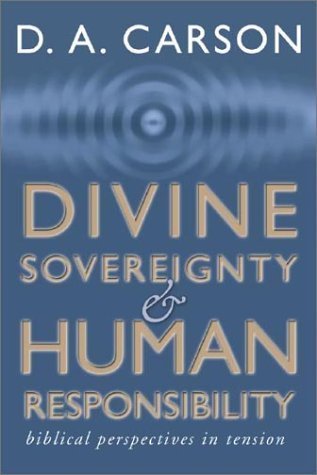
Divine Sovereignty and Human Responsibility: Biblical Perspective in Tension
Both theology and philosophy wrestle with the tension that exists between the sovereignty of God and human response. In Christianity, this tension is particularly acute as God is understood to be both omnipotent and benevolent. This tension underlies numerous other about the nature of God, the meaning of human freedom and choice, the concept of divine repentance, the reign of God and supremely, the significance of the incarnation. Dr. Carson brings clear, scholarly insights and finely-honed exegetical skills to this all-pervasive issue, seeing it not so much as a problem to be solved as a framework to be explored. He examines the sovereignty-responsibility themes in the Old Testament, intertestamental literature and in the theology of John's gospel and concludes with a reflection on the theological implications for ministry and mission today.
284 pages, Paperback
First published January 1, 1981
About the author
D.A. Carson
341 books766 followersDonald A. Carson is research professor of New Testament at Trinity Evangelical Divinity School in Deerfield, Illinois. He has been at Trinity since 1978. Carson came to Trinity from the faculty of Northwest Baptist Theological Seminary in Vancouver, British Columbia, where he also served for two years as academic dean. He has served as assistant pastor and pastor and has done itinerant ministry in Canada and the United Kingdom. Carson received the Bachelor of Science in chemistry from McGill University, the Master of Divinity from Central Baptist Seminary in Toronto, and the Doctor of Philosophy in New Testament from the University of Cambridge. Carson is an active guest lecturer in academic and church settings around the world. He has written or edited about sixty books. He is a founding member and currently president of The Gospel Coalition. Carson and his wife, Joy, reside in Libertyville, Illinois. They have two adult children.
Ratings & Reviews
Friends & Following
Create a free account to discover what your friends think of this book!
Community Reviews
Displaying 1 - 15 of 15 reviews

October 1, 2018
Full disclosure, I'm an ex-christian atheist who has debated on public platforms God's existence, the ways in which philosophy and science starkly contradict religion as an epistemology for truth, the insurmountable hurdle determinism pushes upon theology, and much more. I say this namely to exemplify to theists that atheists certainly can recognize good Christian literature when it surfaces, and to show atheists (at least the more respectable ones who engage in counter arguments to their fullest) that there is certainly Christian literature worth reading, if not in the least for the purposes of steel manning one's opponents, discovering otherwise unknown ammunition for your own arguments, and better equipping you to understand what exactly it is that you don't believe in.
Donald Carson, though this is only the first of his books I've familiarized myself with, has proven himself without a doubt to be a laudable writer. His use of language is refined in a way that renders his erudite content exceptionally clear to readers taking on subjects such as the interface between horizontal and vertical dualism (as opposed to their juxtaposition), end times eschatology vs realized eschatology, and merit theology vs other forms of soteriology (yes, SO many -ologies!!), is no facile task.
In the opening of the book, Carson certainly peaked my skepticism. He flatly states that there isn’t a conflict to be resolved, but rather a framework to be explored. This to me was an all but subtle admission to begging the question, indicating that he planned to dissect biblical passages based on a true belief that such a God was real and the tensions reconcilable based on such a premise. This starkly contrasts what I see as the honest scientific approach, namely that we should deduce based on certain premises, and we should compare the data observed (biblical findings) to expected results. However, I was perhaps too quick to discredit Carson's methodology.
While Carson was no doubt a believer long before his endeavor to research and write this book, he showed a level of intellectual integrity in his layout of the material that remains too often unseen from religious 'scholars'. Carson at no point seems disingenuous in his coverage of the material, and seems to have made a purposeful effort in providing a sound culmination of both sides of this 'tension' that undoubtedly exists within monotheistic (Abrahamic) belief systems.
In the final chapter (which is what I would recommend for those that would read without a bible in hand, or who want a brief overview of the conclusions), Carson lays out his views on 1) the boundaries of free will, 2) time and eternity, 3) the nature of divine 'ultimacy', 4) the 'will(s)' of God, 5) anthropomorphism/personality, and 6) experience and theory [of God]. Interestingly, he ends most all of his conclusions regarding these issues with statements like “we don’t know enough to say that this apparent contradiction is 'necessarily' a logical problem” or “this shows us how difficult God is to understand.” While I think such conclusions, for theists and atheists alike, are far from satisfying, they are indeed the best you can ascertain when attempting to address the apparent contradictory tension that is so pervasive throughout the bible. He sums it up nicely when he says "For us mortals there are no rational, logical solutions to the sovereignty-responsibility tension: it should be clear from the foregoing that neatly packaged harmonisations are impossible." I would only add a light caveat to this, that if you stop begging the question of God's existence, there certainly is a solution that does just this ;)
So, my general perspective on this issue of sovereignty/free will remains the same, but now with a plethora more of biblical references to back it up. The idea that the Christian bible, authored-or at the very least inspired by-the omnipotent and omniscient creator of the cosmos, has left us with such a knot of contradictory passages should at the very least instill doubt as to the origins (and nature of authorship) of these writings. Passage after passage, as highlighted exhaustively by Carson, need to be explained (or explained away depending which 'scholar you're working with'), just to come to the aforementioned conclusions (or in-conclusions, as Carson honestly alludes to).
The olympic-level mental gymnastics that so many theologians are forced to employ (though thankfully not Carson to much of an extent), is indicative that there are legitimate reasons to question a faith that relies so heavily on both divine sovereignty and human freedom/responsibility. As fun as these sorts of exegetical activities might be, as a part of a larger pseudo-intellectual sport, I think books like this, written thoroughly and honestly, provide great launching points for people to consider serious investigations into the justifications they have for their beliefs.
Carson, had he perhaps finished with a statement such as this, could have earned my vote to implore Goodreads Reviews to allow up to a 6-star rating. “In writing this book, and exploring the biblical tension between divine sovereignty and human responsibility, my faith has been shaken to its very core, as should have anyone's who has reached this point without blatant disagreement with my aforementioned claims (in which case, you would just be wrong for other reasons.”
:)
Donald Carson, though this is only the first of his books I've familiarized myself with, has proven himself without a doubt to be a laudable writer. His use of language is refined in a way that renders his erudite content exceptionally clear to readers taking on subjects such as the interface between horizontal and vertical dualism (as opposed to their juxtaposition), end times eschatology vs realized eschatology, and merit theology vs other forms of soteriology (yes, SO many -ologies!!), is no facile task.
In the opening of the book, Carson certainly peaked my skepticism. He flatly states that there isn’t a conflict to be resolved, but rather a framework to be explored. This to me was an all but subtle admission to begging the question, indicating that he planned to dissect biblical passages based on a true belief that such a God was real and the tensions reconcilable based on such a premise. This starkly contrasts what I see as the honest scientific approach, namely that we should deduce based on certain premises, and we should compare the data observed (biblical findings) to expected results. However, I was perhaps too quick to discredit Carson's methodology.
While Carson was no doubt a believer long before his endeavor to research and write this book, he showed a level of intellectual integrity in his layout of the material that remains too often unseen from religious 'scholars'. Carson at no point seems disingenuous in his coverage of the material, and seems to have made a purposeful effort in providing a sound culmination of both sides of this 'tension' that undoubtedly exists within monotheistic (Abrahamic) belief systems.
In the final chapter (which is what I would recommend for those that would read without a bible in hand, or who want a brief overview of the conclusions), Carson lays out his views on 1) the boundaries of free will, 2) time and eternity, 3) the nature of divine 'ultimacy', 4) the 'will(s)' of God, 5) anthropomorphism/personality, and 6) experience and theory [of God]. Interestingly, he ends most all of his conclusions regarding these issues with statements like “we don’t know enough to say that this apparent contradiction is 'necessarily' a logical problem” or “this shows us how difficult God is to understand.” While I think such conclusions, for theists and atheists alike, are far from satisfying, they are indeed the best you can ascertain when attempting to address the apparent contradictory tension that is so pervasive throughout the bible. He sums it up nicely when he says "For us mortals there are no rational, logical solutions to the sovereignty-responsibility tension: it should be clear from the foregoing that neatly packaged harmonisations are impossible." I would only add a light caveat to this, that if you stop begging the question of God's existence, there certainly is a solution that does just this ;)
So, my general perspective on this issue of sovereignty/free will remains the same, but now with a plethora more of biblical references to back it up. The idea that the Christian bible, authored-or at the very least inspired by-the omnipotent and omniscient creator of the cosmos, has left us with such a knot of contradictory passages should at the very least instill doubt as to the origins (and nature of authorship) of these writings. Passage after passage, as highlighted exhaustively by Carson, need to be explained (or explained away depending which 'scholar you're working with'), just to come to the aforementioned conclusions (or in-conclusions, as Carson honestly alludes to).
The olympic-level mental gymnastics that so many theologians are forced to employ (though thankfully not Carson to much of an extent), is indicative that there are legitimate reasons to question a faith that relies so heavily on both divine sovereignty and human freedom/responsibility. As fun as these sorts of exegetical activities might be, as a part of a larger pseudo-intellectual sport, I think books like this, written thoroughly and honestly, provide great launching points for people to consider serious investigations into the justifications they have for their beliefs.
Carson, had he perhaps finished with a statement such as this, could have earned my vote to implore Goodreads Reviews to allow up to a 6-star rating. “In writing this book, and exploring the biblical tension between divine sovereignty and human responsibility, my faith has been shaken to its very core, as should have anyone's who has reached this point without blatant disagreement with my aforementioned claims (in which case, you would just be wrong for other reasons.”
:)

January 9, 2017
This is not a complete review because I read only the introduction and the last two chapters: "The Soteriology of John" and "The Formulation of the Tension." Maybe when I get some more time, I'll come back for the rest (although I may have already gleaned most of the profit).
With that caveat, I found the portions of this book that I did read incredibly helpful! I found Carson saying many of the same things I have been taught much more clearly than I have ever heard them said before. The chapter on John would have been extremely difficult or impossible for me to follow had I not preached through John and read most of Carson's commentary on it first. But having done those things, it was a big help.
Carson's underlying commitment is to biblical theology (over and above systematic theology), and that commitment guides his entire approach. Most of the book consists of exegesis. Even though Carson devotes seven chapters to intertestamental Jewish literature, I understand from the introduction that he does so primarily to set up the background of John.
Given his commitment to biblical theology and based on his study of the Biblical data, Carson approaches the theological questions with an important presupposition: the tension between divine sovereignty and human responsibility cannot be solved by finite human beings. Carson says, "To recognise this is already a major advance, for it rejects those easy 'solutions' which impose alien philosophical constructions upon the biblical data, or which dismiss those elements of the biblical data not conducive to the investigator's system" (2). In the concluding chapter, Carson states his commitment to this premise in even stronger language. He says, "If a person disagrees with this conclusion and seeks final solutions to the problem, we will enjoy little common ground in this debate" (220). Thus the title of the book.
That said, Carson adamantly rejects the claim that the tension itself is illogical. He offers the following illustration: "The whole tension remains restless in our hands; but it is the restlessness of having a few randomly-selected pieces of a jigsaw puzzle when thousands more are needed to complete the design" (218).
In addition, Carson does not leave the reader without any direction. Rather, to state the tension more biblically and to expose unbiblical statements of it.
So what does the Bible say about this topic, and what doesn't it say? The following points come from Carson's concluding chapter, in which he applies logic to the fruits of his exegesis.
Necessity of the Tension
Carson says, "It is axiomatic that any truly monotheistic religion is going to experience somewhere the tension between divine sovereignty and human responsibility..." (205). He is right, but I had never thought about that before. This tension is a difficulty not only for Christianity, but for anyone who claims monotheism.
Free Will
Carson argues strongly that the Bible never presents free will as what he calls "absolute power to the contrary." In other words, no one can resist God's will. However, he also argues that it is both exegetically and philosophically vital to affirm some form of free will. He cites A.A. Hodge (a good Calvinist). "This matter of free-will underlies everything. If you bring it to question, it is infinitely more than Calvinism.... Everything is gone if free-will is gone; the moral system is gone if free-will is gone; you cannot escape, except by materialism on the one hand or pantheism on the other" (207). Carson ultimately opts with Hodge for what Hodge calls "free agency" (209), which I understand to be free will apart from power to resist God. Carson argues that absolute power to the contrary cannot possibly be the essence of free will, or else God himself would not be free, since he cannot sin (207)! Also, if free will consists of the ability to resist God, then we will be slaves for all eternity, since there will be no sin in heaven (208).
Necessary Distinctions in the Statement of God's Sovereignty
Carson argues that while God is completely sovereign over both good and evil, it is vital to maintain a distinction between his sovereignty over good and his sovereignty over evil, the latter being much more mysterious. He also says that the concept of second causes (which partly disassociates God from evil by asserting that he is never its direct cause) is important to maintain (210-212). For what it's worth, this was the section of what I read that was the most difficult for me to understand.
God's Sovereignty and Time
Carson argues that although it is true, the fact that God exists outside of time is not the final answer to the sovereignty-responsibility tension and notes, "The biblical data are unashamedly presented in terms of sequence" (210).
The Complexity of God's Will
Carson maintains that there is a complexity to the will of God that we as finite mortals cannot understand. He is not a big fan of any of the popular ways of stating this tension, but he seems to be least dissatisfied with the system that separates between God's moral and sovereign will (211-214).
Anthropopathisms
Carson is not a big fan of these. He says, "The doctrine of impassibility nevertheless depends on the dogmatic assertion that all contrary biblical evidence (e.g. Jer. 31:20; Hos. 11:8) is nothing but anthropopathism" (215). He says, "God takes both a rational and an emotional part in his relationship with his creatures" (215).
The Tension in the Experience of the Biblical Characters
Carson points out that the sovereignty-responsibility tension does not seem to bother any of the biblical character until they are thrust into a situation in which it is difficult to believe that God can be both sovereign and good. He refers to Job as a particularly helpful example, and he points out that Job's conclusion is that he has been guilty of over-simplifying God. In fact, the last part of the book of Job (minus the short conclusion) consists of God calling into question Job's ability to grasp the situation and calling Job to repent and trust him. Hence, "Whatever other answers to the problem of theodicy the biblical writers proffer it is clear that the transcendence of God figures most prominently as the 'solution' par-excellence" (217). This observation "attacks man's arrogance, defies the limits of his knowledge, and makes the only 'solution' one of faith" (218).
Purpose of the Tension
Carson argues that it is important to study not only what the biblical writers said, by why they said those things. When it comes to what John says about God's sovereignty on the one hand and human responsibility on the other, Carson argues that John's purpose is to exalt God. If a person believes in Jesus, it is because God chose and drew Him, and God gets the credit. If a person rejects Christ, it is because he chose to do so, and he (not God) is to blame. Thus, the maintenance of this tension turns out to be very important theologically!
Carson laments that some of the debate that has gone on in regards to this biblical tension has amounted to little more than "ignorant name-calling" (219). That is why we must study what the Bible and the various theologians actually say! Carson recommends reading on both sides of the issue, including biographies of Whitefield and Arminius. He also warns against jumping to the conclusion a certain theological position will be taken to an unbiblical length (221). He also expresses an appreciation for devout Christians on both sides of the issue (222). However, he recognizes that the conclusions of an individual or organization in regards to this tension will have an enormous effect on his ministry.
Once again, this was a great book. I would love to see at least the last chapter of it it added to the required reading list for many seminaries.
With that caveat, I found the portions of this book that I did read incredibly helpful! I found Carson saying many of the same things I have been taught much more clearly than I have ever heard them said before. The chapter on John would have been extremely difficult or impossible for me to follow had I not preached through John and read most of Carson's commentary on it first. But having done those things, it was a big help.
Carson's underlying commitment is to biblical theology (over and above systematic theology), and that commitment guides his entire approach. Most of the book consists of exegesis. Even though Carson devotes seven chapters to intertestamental Jewish literature, I understand from the introduction that he does so primarily to set up the background of John.
Given his commitment to biblical theology and based on his study of the Biblical data, Carson approaches the theological questions with an important presupposition: the tension between divine sovereignty and human responsibility cannot be solved by finite human beings. Carson says, "To recognise this is already a major advance, for it rejects those easy 'solutions' which impose alien philosophical constructions upon the biblical data, or which dismiss those elements of the biblical data not conducive to the investigator's system" (2). In the concluding chapter, Carson states his commitment to this premise in even stronger language. He says, "If a person disagrees with this conclusion and seeks final solutions to the problem, we will enjoy little common ground in this debate" (220). Thus the title of the book.
That said, Carson adamantly rejects the claim that the tension itself is illogical. He offers the following illustration: "The whole tension remains restless in our hands; but it is the restlessness of having a few randomly-selected pieces of a jigsaw puzzle when thousands more are needed to complete the design" (218).
In addition, Carson does not leave the reader without any direction. Rather, to state the tension more biblically and to expose unbiblical statements of it.
So what does the Bible say about this topic, and what doesn't it say? The following points come from Carson's concluding chapter, in which he applies logic to the fruits of his exegesis.
Necessity of the Tension
Carson says, "It is axiomatic that any truly monotheistic religion is going to experience somewhere the tension between divine sovereignty and human responsibility..." (205). He is right, but I had never thought about that before. This tension is a difficulty not only for Christianity, but for anyone who claims monotheism.
Free Will
Carson argues strongly that the Bible never presents free will as what he calls "absolute power to the contrary." In other words, no one can resist God's will. However, he also argues that it is both exegetically and philosophically vital to affirm some form of free will. He cites A.A. Hodge (a good Calvinist). "This matter of free-will underlies everything. If you bring it to question, it is infinitely more than Calvinism.... Everything is gone if free-will is gone; the moral system is gone if free-will is gone; you cannot escape, except by materialism on the one hand or pantheism on the other" (207). Carson ultimately opts with Hodge for what Hodge calls "free agency" (209), which I understand to be free will apart from power to resist God. Carson argues that absolute power to the contrary cannot possibly be the essence of free will, or else God himself would not be free, since he cannot sin (207)! Also, if free will consists of the ability to resist God, then we will be slaves for all eternity, since there will be no sin in heaven (208).
Necessary Distinctions in the Statement of God's Sovereignty
Carson argues that while God is completely sovereign over both good and evil, it is vital to maintain a distinction between his sovereignty over good and his sovereignty over evil, the latter being much more mysterious. He also says that the concept of second causes (which partly disassociates God from evil by asserting that he is never its direct cause) is important to maintain (210-212). For what it's worth, this was the section of what I read that was the most difficult for me to understand.
God's Sovereignty and Time
Carson argues that although it is true, the fact that God exists outside of time is not the final answer to the sovereignty-responsibility tension and notes, "The biblical data are unashamedly presented in terms of sequence" (210).
The Complexity of God's Will
Carson maintains that there is a complexity to the will of God that we as finite mortals cannot understand. He is not a big fan of any of the popular ways of stating this tension, but he seems to be least dissatisfied with the system that separates between God's moral and sovereign will (211-214).
Anthropopathisms
Carson is not a big fan of these. He says, "The doctrine of impassibility nevertheless depends on the dogmatic assertion that all contrary biblical evidence (e.g. Jer. 31:20; Hos. 11:8) is nothing but anthropopathism" (215). He says, "God takes both a rational and an emotional part in his relationship with his creatures" (215).
The Tension in the Experience of the Biblical Characters
Carson points out that the sovereignty-responsibility tension does not seem to bother any of the biblical character until they are thrust into a situation in which it is difficult to believe that God can be both sovereign and good. He refers to Job as a particularly helpful example, and he points out that Job's conclusion is that he has been guilty of over-simplifying God. In fact, the last part of the book of Job (minus the short conclusion) consists of God calling into question Job's ability to grasp the situation and calling Job to repent and trust him. Hence, "Whatever other answers to the problem of theodicy the biblical writers proffer it is clear that the transcendence of God figures most prominently as the 'solution' par-excellence" (217). This observation "attacks man's arrogance, defies the limits of his knowledge, and makes the only 'solution' one of faith" (218).
Purpose of the Tension
Carson argues that it is important to study not only what the biblical writers said, by why they said those things. When it comes to what John says about God's sovereignty on the one hand and human responsibility on the other, Carson argues that John's purpose is to exalt God. If a person believes in Jesus, it is because God chose and drew Him, and God gets the credit. If a person rejects Christ, it is because he chose to do so, and he (not God) is to blame. Thus, the maintenance of this tension turns out to be very important theologically!
Carson laments that some of the debate that has gone on in regards to this biblical tension has amounted to little more than "ignorant name-calling" (219). That is why we must study what the Bible and the various theologians actually say! Carson recommends reading on both sides of the issue, including biographies of Whitefield and Arminius. He also warns against jumping to the conclusion a certain theological position will be taken to an unbiblical length (221). He also expresses an appreciation for devout Christians on both sides of the issue (222). However, he recognizes that the conclusions of an individual or organization in regards to this tension will have an enormous effect on his ministry.
Once again, this was a great book. I would love to see at least the last chapter of it it added to the required reading list for many seminaries.

April 22, 2024
This is not so much an edited form of Carson's PhD as his PhD with an arm and a leg cut off. With apologies for sections he thinks should be a hundred pages long but which only run to several. Cursed be the stunted mind of the modern reader.
It is mainly a reader about historical thinking on the subject, rather than a consideration of it as such. So if you want an introduction to 3,000+ years of thinking in this area, this is a book for you. If you want an introduction to how the apocrypha and traditional Jewish literature flubbed the topic entirely, and how the Jews historically had a merit-based notion of sovereignty that contradicts the very notion of the word...well, this is for you, too.
And if you don't mind large sections of text being rendered essentially unreadable due to the sheer tonnage of cross-references, have at it.
It's all, technically speaking, academically, good stuff. But I prefer to see books like this priced £200 and called monographs. So I can tug a forelock at it and move on to books written for numbskulls who don't want to turn to 100 pages of size 7 text notes because the author writes that to include it in the main text would make the book too long. (What did he think - the notes section was being published separately?)
My favourite part is the 20-page executive summary at the end, where he mocks - maybe even gently eviscerates, if that's possible - those who pick one of the two concepts over the other. And warns against that painfully common concept of people who lean so far one way that they have an early-warning defence system against the tiniest radar blip of the contrary. (Shoutout to those of you who, like me, have been 'corrected' when leading a seminar in which you mention the need to persevere in the faith...)
I'm glad I read it, and I'll use it for reference in the future. But it's an academic primer, not a pithy homily. Be warned and prosper.
It is mainly a reader about historical thinking on the subject, rather than a consideration of it as such. So if you want an introduction to 3,000+ years of thinking in this area, this is a book for you. If you want an introduction to how the apocrypha and traditional Jewish literature flubbed the topic entirely, and how the Jews historically had a merit-based notion of sovereignty that contradicts the very notion of the word...well, this is for you, too.
And if you don't mind large sections of text being rendered essentially unreadable due to the sheer tonnage of cross-references, have at it.
It's all, technically speaking, academically, good stuff. But I prefer to see books like this priced £200 and called monographs. So I can tug a forelock at it and move on to books written for numbskulls who don't want to turn to 100 pages of size 7 text notes because the author writes that to include it in the main text would make the book too long. (What did he think - the notes section was being published separately?)
My favourite part is the 20-page executive summary at the end, where he mocks - maybe even gently eviscerates, if that's possible - those who pick one of the two concepts over the other. And warns against that painfully common concept of people who lean so far one way that they have an early-warning defence system against the tiniest radar blip of the contrary. (Shoutout to those of you who, like me, have been 'corrected' when leading a seminar in which you mention the need to persevere in the faith...)
I'm glad I read it, and I'll use it for reference in the future. But it's an academic primer, not a pithy homily. Be warned and prosper.

April 6, 2020
For what it is, an historical and literary overview of the "foreknowledge" debate, I haven't read anything else like it. He covers Psuedopigrapha, Dead Sea Scrolls, Targums, Apocalyptic literature, Old Testament, and the Gospel of John to put together a comprehensive overview on viewpoints. This all comes down to what the title holds, that divine sovereignty and human responsibility are in tension throughout scripture and especially in the New Testament. While God does call, give salvation freely, and much more, mankind must respond and has the free ability to do so.
This so far sounds like Carson's book isnt worth reading, after all, a summed it up in a few sentences. However, if you think you have the whole thing sorted in your own mind, take a look into this book and realize there is much more to be considered.
I highly recommend, but only to those who can deal with highly technical language.
This so far sounds like Carson's book isnt worth reading, after all, a summed it up in a few sentences. However, if you think you have the whole thing sorted in your own mind, take a look into this book and realize there is much more to be considered.
I highly recommend, but only to those who can deal with highly technical language.
May 30, 2026
Great resource, challenging read in some respects, but certainly well worth it, especially considering how few understand or even acknowledge the tensions that are in Scripture.

July 4, 2010
This is Carson's doctoral dissertation and as such it is a dense read, but very rewarding. I have to admit that I skipped all of the intertestamental portions of the book, but thoroughly enjoyed the OT and NT portions.
I think to start off it is important to understand the following:
"The sovereignty-responsibility tension is not a problem to be solved; rather, it is a framework to be explored." There are no easy solutions to this tension, but we must not deny what the bible says. "To admit we do not possess enough pieces of the puzzle to complete the picture is a far cry from saying that the pieces belong to quite different puzzles and therefore could not be related to each other even if we were given the rest of them."
Carson goes through the OT and NT (specifically John) to more fully explore and expound on this tension/compatibility. I found the book very helpful. It is not a easy read for everyone, but if you are willing to put in the work it is rewarding.
I think to start off it is important to understand the following:
"The sovereignty-responsibility tension is not a problem to be solved; rather, it is a framework to be explored." There are no easy solutions to this tension, but we must not deny what the bible says. "To admit we do not possess enough pieces of the puzzle to complete the picture is a far cry from saying that the pieces belong to quite different puzzles and therefore could not be related to each other even if we were given the rest of them."
Carson goes through the OT and NT (specifically John) to more fully explore and expound on this tension/compatibility. I found the book very helpful. It is not a easy read for everyone, but if you are willing to put in the work it is rewarding.

February 18, 2016
D.A. Carson is an author that just does not disappoint. He tackles the issues without heavy handed polemics. He takes care to not be reductionistic and warns the readers to avoid that trap. His overview of the historical context surrounding this debated topic is helpfully more broad than most other evangelical books in the topic. While this book isn’t exactly easy reading for any audience, it certainly is accessible and with careful reading it can be helpful to any audience. This is an excellent book.

March 14, 2025
This book says helpful things to get oriented in the theological conversation at large, but I’m not sure it offers anything groundbreaking. Perhaps it did at the time of publication? The conclusion is “both,” though much of Carson’s conservative world of thinkers continues to simply lean strongly toward divine sovereignty with Calvinist predestination and struggle to explain how human responsibility is possible … while somehow remaining successful at guilt-tripping (that’s not what Carson’s doing here, though). Carson’s thick language made this a challenging read, and his explanations didn’t make me feel I understood human responsibility within his paradigm any better. Onward to reading varied views of “divine sovereignty.”

December 5, 2021
Meticulous

July 8, 2014
Carson's work was insightful, but because of its scope and berevity, served mostly to whet one's appetite for the sovereignty/responsibility tension found within Scripture. Carson's treatment of the intertestemental literature is proficient and helpful, but his greatest contribution comes from his discussion of the tension as seen in the Gospel of John. Carson maintains a humble attitude towards the mysteries of Scripture that many on both sides of the debate, including myself, could learn from.
November 20, 2008
Excellent explanation of the theme: compatibilism.

April 29, 2015
Heavy wading, but well worth the effort.

July 20, 2015
A good book and a good survey and interaction, but a little bit technical sometimes.
March 20, 2019
A stand- in for the J.I. Packer essay of the same name. So I guess antinomies are a contradiction where the facts of reality indicate that both sides of the issue are simultaneously true; whereas a paradox is merely a contradiction in terms and more a product of wordplay. But whether it’s an antinomy or a paradox, contradictions invite us to expand our thinking; and it’s just not expanding our thinking- at least to anyone’s benefit- to guilt people into contentment with the unresolved.
Displaying 1 - 15 of 15 reviews