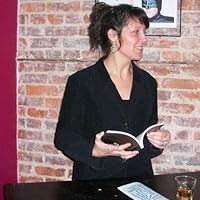
Mary Jo Bang is an American poet. In her most recent collection, The Bride of E, she uses a distinctive mix of humor, directness, and indirection, to sound the deepest sort of anguish: the existential condition. Bang fashions her examination of the lived life into an abecedarius—the title of the first poem, "ABC Plus E: Cosmic Aloneness Is the Bride of Existence," posits the collection's central problem, and a symposium of figures from every register of our culture (from Plato to Pee-wee Herman, Mickey Mouse to Sartre) is assembled to help confront it.
Bang is the author of five previous books of poetry: Apology for Want, Louise in Love, The Downstream Extremity of the Isle of Swans, The Eye Like a Strange Balloon and Elegy, which won the 2007 National Book Critics Circle Award in Poetry and was named a 2008 New York Times Notable Book. She’s been the recipient of a Guggenheim Fellowship and a Hodder Fellowship from Princeton University. She has an M.F.A. from Columbia University, an M.A. and B.A. in Sociology from Northwestern University, and a B.A. in Photography from the Polytechnic of Central London. From 1995-2005 she was the poetry co-editor at Boston Review. She lives in St. Louis, Missouri, where she is a Professor of English and teaches in the Creative Writing Program at Washington University.
In Elegy, Mary Jo Bang paces around that gaping, cavernous hole left by grief that Edna St. Vincent Millay wrote about: “Where you used to be, there is a hole in the world, which I find myself constantly walking around in the daytime, and falling in at night.” Bang describes the changed structure of even the most mundane aspects of life in the aftermath of her son’s death, the five stages in rhythmic alliteration, ruing, regretting, trapped in the endless eddies of her grief-induced guilt: “I see you as a grief heat hallucination telling me I could have saved you if I’d been better.” When she exits that cloud of torment and seems to reach acceptance, her words burst forth in a crescendo of love, like the explosion from a dying star, as she describes it in "She Said": "It was as if life were being lived / In the afterglow of a starburst." But this emotional outpouring is no better illustrated than in her magnum opus, “You Were You Are Elegy”: “This is how I measure The year. Everything Was My Fault Has been the theme of the song I've been singing, Even when you've told me to quiet. I haven't been quiet. I've been crying. I think you Have forgiven me. You keep Putting your hand on my shoulder When I'm crying. Thank you for that. And For the ineffable sense Of continuance. You were. You are The brightest thing in the shop window And the most beautiful seldom I ever saw.”
Bang captures the shell shock of finding oneself in an entirely new and foreign world where simultaneously everything, everything, still reminds you of the dearly departed. There is that wandering sense that they are not truly gone from this place, just misplaced, hidden, somewhere behind a veil you can’t penetrate. Her words bargain with themselves as she tries to reconcile this ultimately irreconcilable absence: "It begins to sink in. Dead / Is dead, not just not / Here."
This collection summoned the devastation I felt in the days and weeks and months after my mother's death to the point where I could feel the physical sensation of that same dread — the heavy heart, like an anvil on or inside my chest — in Bang's vivid words like muscle memory. Yet I also took so much comfort in being able to relate to her pain and her attempts at reconciliation and self-forgiveness. Most of all, though, I was comforted by her acknowledgement that this wound can never be healed, only accepted: "You are reduced / To the after-sorrow / That will last my lifetime." Memory alone will have to sustain us.
Mary Jo Bang picked up the electric guitar, or blue guitar, or maybe Apollo's lyre, and she rocked this book. Is that observation crude, or insensitive to register the emotional tone of the poems? Well, I apologize. I read it at the beginning of Hurricane Ike, and I have enough distance from that read to lodge my enthusiasm in no uncertain terms. From the very raw and suffering poems at the beginning, to the very large return to her aesthetic in the end, a return informed by her experience, and intelligence, this book has a lot to admire.
Mary Jo Bang wrote this collection, Elegy, while dealing with the grief and trauma of her son's death by suicide. I read this book while dealing with the deepest trauma of my life so far. I cannot go into it, but it was a deeply, deeply painful event for a lot of people.
As I have with recent books of poetry, I wrote some poems as a response/review.
"When Even Good News Comes as Bad News" by Philip Habecker
Moments of grief . bring moments of grief Recollections of past sadness . long forgotten . trials and traumas . overcome or not
Remembrances neighbors apologetically bring.
In moments of grief, turn to . moments of hope . moments of levity . moments of grief
The Brain -Philip Habecker
Talk about it Talk about it Talk about it Talk about it Talk about it Talk about it Talk about it Talk about it Talk about it Talk about it Talk about it There's nothing left to say
Seems to me that someone would have to have a very cold heart not to respect the bravery of this book -- its author's search for a tone that could control her grief. It's a difficult and painful book to read, but an important one nonetheless. Here's a thing I wrote a while back:
There are at least a couple of ways of reading a book of poetry. You can jump around in it, looking for individual gems that move your fancy—or you can read the whole thing from beginning to end, including even the blurbs, the dedications, and the acknowledgements. Mary Jo Bang’s Elegy asks for the latter.
Bang’s title tells us to expect a formal lament for the dead, and the first blurb lets us know that this is about the “loss of a child . . . an only child who is in the prime of life.” The dedication gives us the name, Michael Donner Van Hook, and his dates, as they might appear on a gravestone, “January 17, 1967–June 21, 2004.”
This is all necessary information before we actually begin reading the poems, because Bang has chosen a very formal, often deceptively calm presentation to control the grief that would otherwise overwhelm her. “After great pain, a formal feeling comes,” Emily Dickinson wrote, rather famously, and Mary Jo Bang has learned that lesson well. The poems in Elegy are placed chronologically in the year following the death of her son from an accidental overdose of prescription pills. An early poem, “Ode to History,” shows the poet’s search for the language to contain her grief:
Had she not lain on that bed with a boy
All those years ago, where would they be, she wondered.
She and the child that wouldn’t have been but was now
No more. She would know nothing
Of mothering. She would know nothing
Of death. She would know nothing
Of love. The three things she’d been given
To remember. Wake me up, please, she said,
When this life is over. Look at her—It’s as if
The windows of night have been sewn to her eyes.
This poetry offers no easy cure, either in its making or in the reading. An older and wiser man once told me that if poetry cannot cure, it almost certainly provides consolation. Near the end of Elegy, almost a year after the death of her child, Mary Jo Bang writes:
And now in spite of sorrow unending, the sky is more
Beautiful than it’s ever been.
Blue and night-blue above a string of pale April yellow
Which stands in for incandescent clarity,
Which is heard as if only.
And the beauty becomes real even in the face of that sorrow. It feels like an honor to read these poems.
Some poetry collections, when read, defy the written word; instead they paint a world of their own, using images as a paintbrush on the canvas, the reader’s mind. Elegy: Poems by Mary Jo Bang did just that for this reader. Bang chronicles the year following her son’s death in this new collection of poems. Though Bang’s poetry is new for me, she has published four poetry collections and is a Professor of English and the Director of the Creative Writing Program at Washington University.
This volume of poetry is rich with vivid imagery. If the reader is looking for a nice, feel-good read, then do not choose this book. But if the reader is in search of a poignant journey that gives them something to think on for days, this is exactly the read that should be chosen. This collection is rich in emotional truth that anyone who has suffered a loss can relate to.
When I reached the poem, "History," I saw the grief in a raw form:
Had she not laid on that bed with a boy All those years ago, where would they be, she wondered.
The ‘what ifs’ and the ‘should haves’ consume the mourner. These two lines sum up the whole collection for me. I was deeply touched. The reader is immersed into the pit of darkness this death has brought, but also sees the light. Bang's light shines in the poems "Let’s Go Back" and "One Thing."
"Visiting" is the last poem in this journey and reminds me that moving forward is a choice, but the loss is ever present, adjusted, walked around, but always present in the corners of the mind.
After I wake from a dream of walking Shoeless in snow. Cold is that cold. Look at all the meaningless gestures.
People keep Making: flowers in a vase and overheard Overblown terms like seldom
And massive and missive and all The words except I miss you. For me meaning is pared
Thank you, Mary Jo Bang for a glimpse into your honesty. You have touched this reader. Mary Jo says it all in the last two lines of this volume:
Book-length collections that revolve around a single theme tend to work less well than those that range all over the map. There are any number of reasons for this, but the main one is that most poets just don't produce enough material over a protracted period of time about the same thing to make it work. This is why, when a book does get it right, it's such a brilliant reminder of how good such things can be (the obvious example, to my mind, is Donald Hall's Without, which traverses much the same ground Elegy does). When a book fails to do so, on the other hand, that doesn't mean in any way that it's as bad as the successes are good; much of the time it just means that the quality of the poems varies a bit more than one would like to see in a single-author poetry collection. Elegy is one of those books, with poems ranging from the blindingly brilliant to the quotidian. There's nothing here that's bad, some pieces just suffer in relation to others.
“A caboose climbing an emerald hill. Daily we tend the garden. Daily we wave
Our lashes like little flags In a cordial wind. I? Who isn't Ever I in a circular now.” (“We Are Only Human”)
Compare and contrast to:
“How could I have failed you like this? The narrator asks
The object. The object is a box Of ashes. How could I not have saved you,
A boy made of bone and blood.” (“Landscape with the Fall of Icarus”)
It all works, some just works better than the rest. Give it a look if you see it at the store. ***
While perhaps not a household name, Bang won this year’s National Book Critics’ Circle Award for ELEGY, the chronicle of a year following the apparent suicide of her son. The collection is characterized by short, honed sentences and syntax that acts like knife-thrusts to the reader’s heart, avoiding any sentimentality.
Bang also allows her story to pool into a larger context — per- haps the largest context — of being and nothingness, time and its sudden stilling. “The snake of time,” she writes of the funeral, “was spending itself / Like an arrow in motion, aimed at a bale of hay, / Each bale a bad day.” Meaning, perhaps, one day closer to death, to that nothingness where days are no standard of measure.
(originally published in *The Tennessean*, 20 April 2008)
Bang opens the door to a mother's grief and speaks the unspeakable. Although her son is no longer with her physically, her love for him continues and shines through her pain. It takes a great deal of courage to reveal oneself as she has.
Much less playful / less interesting language than previous books. Lyric poetry about her dead son. May be of more interest for those who've recently lost someone they loved.
What is elegy but the attempt To rebreathe life Into what the gone one once was Before he grew into enormity.
(from "The Role of Elegy" p.63)
I'm going to sound like a heartless bitch, but I found Elegy to be lacklustre. Yeah, it's sad that Mary Jo Bang lost her adult son, and it's bittersweet that she wrote and dedicated an entire book of poetry to him as a way of dealing with her grief—even putting one of his paintings on the cover—but I still didn't like the book.
The subject matter became very repetitive: death, the box of her son's ashes, memory, morgues, time, clocks, calendars, dreams, motherhood, pills, overdoses, and a general numb and bleak tone. The style is also quite boring, with simple words, simple sentences, rhetorical questions (my poetic pet peeve), and awkward enjambment:
"How much does matter matter? Very." (from "Heartbreaking" p. 48)
"What is today? Where am I?/What cruel nature wires a brain like this?/ To give it pleasure//And then let pleasure make itself a pain?/To say you loved a person/To say that person no longer exists." (from "No Exit" p. 32-33)
"She would know nothing/Of mother. She would know nothing/Of death. She would know nothing/Of love. The three things she'd been given/To remember. Wake me up, please, she said/When this life is over." (from "Ode to History" p. 17)
"Now, she said, do you know/How I feel? No, he said//I know nothing. I'm only, as you've described me//Ash in a box. No, she said/That's not what I meant" (from "Now" p. 60)
The author obviously went through an immense amount of grief, and writing about it was probably therapeutic...however, if I were her, I would've kept the writing private. The poems are too sentimental, too mournful, and—if I'm completely honest—too mediocre for a public audience.
This book of poetry was alluded to by Tish Harrison Warren in her July 16, 2023 article in the NY Times, "We keep writing and reading poetry because ‘we are ourselves poems’". Because I appreciate Warren's writing, I count her opinions about authors as being worthy. Further, I have had several opportunities to write elegies in prose, and I wanted to see such thoughts expressed in poetry.
I remember discussing poetry in high school English classes. We would read a poem aloud, and then the teacher would ask what the poem or a line in the poem meant. Rather than making an effort to provide a thoughtful response, many students would cop out by saying, "Only the poet can answer that question." In this book by Mary Jo Bang, we are given important information that bears on the meaning of her poems. They were written in the aftermath of the death of her only child: Michael Donner Van Hook who lived from 1/17/1967 to 6/21/2004.
While many will want to avoid reading this collection because of its subject matter, those who have faced the death of loved ones will find some identity with the author. In addition, students of poetry will appreciate aspects of her style. It won the 2007 National Book Critics Circle Award in Poetry.
I need to keep this book to read again in the future for a fuller appreciation.
I truly don't know how Mary Jo had the presence of mind and enough strength to put her thoughts together in regards to such a tragedy into lyrics so mournful yet so eloquently. I wrote a poem of this magnitude once and it completed drained the life out of me. In my humble opinion, her self-expression of the one situation that most of us fear more than anything in this lifetime was pretty remarkable. As for certain reviewers that nitpicked at this collection......I know we're all entitled to our own opinions and I'm absolutely not advocating censorship but sometimes the simplicity of just being humane should be able to sincerely recognize and appreciate that kind of suffering and still be able to deliver that much artistry. Damn.
The book's dedication is for Michael Donner Van Hook (1/17/1967 - 6/21/2004). Here's a stunning example of how a real incident in an writer's life can inform her poem-making without it being/seeming autobiographical or memoir-esque. Deep-imagery at its best! I loved these last two lines in the poem on page 55 ("Untitled"), "Some glass is for looking through, some is for seeing back. / Every outline is a cage one way or another." Brava, Bang.
overall i liked this collection better than the bride of e (making me feel normie)--structurally I found this more cohesive & the questions it raised more interesting, but I recorded less individual poems than I did for the other book... so i guess i appreciate this as an unfolding but each individual poem glimmers a little less except for a few
«Y entonces no como una cortina corrida sino un cada vez más oscurecerse la tarde hasta que una mano ya no es una mano y el amarillo se va volviendo verde, estrechándose hasta la nada. El ritmo lo es todo. El lento borrarse
de la ventana desde la que ella está mirando y el espejo tan lejano ahora como una estrella y ambos ausentes. Uno del otro y del mito que fuimos».
The style and poems didn’t clicked to me, although there were many haunting lines, and banger pieces. I couldn’t get past the fragments to fully enjoy this collection. There are better works I’ve read before pertaining to the topic of elegy.
Nonetheless, here are my favourite poems:
- Landscape with the Fall of Icarus - April is Ending - You Were You Are Elegy
Must have been unbelievably hard to write this book. I felt like learned a lot about enjambment, but generally there were not many individual poems that I will revisit for my own writing purposes. I would highly recommend though.
I came across one of these poems excerpted in a different, multi-author anthology and decided to seek out the complete book. Her poems grapple with the grief of losing her (adult) son. I read them with my own friend who lost her adult son present in my heart.
Haunting and lyrical poetry. Bang explores the darkest and most difficult grief that a person can experience and she does so while manipulating her lines wonderfully.
Well deserving of the award nominations it's received--and the win in the National Book Critics Circle.
Bang chronicles movement through grief--nothing so neat as Kubler-Ross's stages, though there's definitely anger and denial and bargaining in some poems. Instead, the focus is on particular images that can represent the loss or distract from the loss. The poems move associatively from image to image, and the play with language at times connotes ee cummings. While there isn't a strict progression, the poems do seem to take place consecutively.
And although there is a sense of the confessional about them (the dedication to her son leads us there), the poems are more allusive than declarative. The lack of directness is one Bang has employed in previous work, but the details seem more coherent here than in "The Eye Like a Strange Balloon," and the indirectness/reticence itself works, because it seems to echo a mind in grief. There is less of a demand for every detail to be "clear" and understandable.
A few poems could have been cut, perhaps, but the questioning of elegy throughout is masterful. In "The Role of Elegy," a sort of an ars poetica for this particular collection that questions the problems with re-creating the dead in poems, the speaker notes that
"The role of elegy is To put a death mask on tragedy, A drape on the mirror. To bow to the cultural
Debate over the aesthetization of sorrow, ...
What is elegy but the attempt To rebreathe life Into what the gone one once was Before he grew to enormity."
Stop Smiling: Tell me about the first poem you wrote. Did that experience reflect why and how you write now?
Mary Jo Bang: I wrote it in high school, after JFK was assassinated, and after reading a lot of Ayn Rand. It was probably no more than six lines. I remember the last line was: “The man who stands alone,” which now sounds like it should be followed by a few bars of melodramatic music.
SS: Is there still a Kennedyesque Randian in there somewhere, directing the poems?
MJB: Teen angst morphed into the usual broader cosmic anguish, which flickers here and there behind my poems. Sometimes more, sometimes less. I try to keep it out of the foreground. Or, like a good Modernist, to deflect it through irony.
I'm interested now in the foundations of art — that includes all sorts of issues I wasn't aware of back then. Issues of point of view. Of craft. Of artifice. The provisional aspects of the characters who inhabit poems and act as speakers.
Mary Jo Bang explores the process of grieving, and how a mother can go on when her son is dead. This book is difficult in both language and content, but exquisitely written. Mary Jo Bang uses punctuation liberally, so that a thought or a sentence seems to end, and then must go on. The choppyness definitely supports access to the writer's state of mind. Portions were incredibly abstract, while others are completely literal and physical. She becomes direct about her subject matter late in the book, so that until that point she is writing these dense poems that only halfway made sense to me until I'd read the other part of the book. This volume is best read with a lot of attention, and possibly several times in a row, which is not a bad thing to say about poetry. It's like she's hiding what she needs to say, even from herself, so her admissions of grief and guilt have to be teased out slowly.