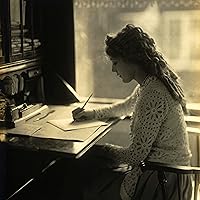
This collection reveals the full range of Charlotte Mew's work, showcasing the urgency and passion that compelled her to reinvent forms and prosodies to explore her complex pains and loves. With themes at the heart of feminist concerns, these poems illustrate her standing as an experimental modernist and a poet of formal precision.
Charlotte Mary Mew was a modernist British poet. Mew's father, architect Frederick Mew, died in 1898 without making adequate provision for his family; two of her siblings suffered from mental illness, and were committed to institutions, and three others died in early childhood leaving Charlotte, her mother and her sister, Anne. Charlotte and Anne made a pact never to marry for fear of passing on insanity to their children.
In 1894, Mew succeeded in getting a short story into The Yellow Book, but wrote very little poetry at this time. Her first collection of poetry, The Farmer's Bride, was published in 1916. Mew gained the patronage of several literary figures, notably Thomas Hardy, who called her the best woman poet of her day, Virginia Woolf, who said she was "very good and quite unlike anyone else," and Siegfried Sassoon. She obtained a small Civil List pension with the aid of Cockerell, Hardy, John Masefield and Walter de la Mare. This helped ease her financial difficulties.
After the death of her sister, she descended into a deep depression, and was admitted to a nursing home where she eventually committed suicide by drinking Lysol. Mew is buried in Hampstead Cemetery.
I don’t read enough poetry, so every now and then I try to make amends. I’ve been reading a good deal from the late nineteenth century up to the 1930s recently. Charlotte Mew is a much neglected poet who spans the late Victorian and Modernist periods who attracted praise from people such as Woolf, Hardy and Sassoon. I intend to read Penelope Fitzgerald’s autobiography of her in the near future and her life is rather sad. The poems reflect many of her struggles; her struggles with faith and religion, with mental health, alienation, those outcast from society and especially with death. There was a history of mental illness in Mew’s family and two of her siblings (a brother and a sister) were schizophrenic; an illness known at the time as dementia praecox. Mew and her sister Alice decided not to marry because of the history of mental illness in the family. They lived together until Alice’s death of cancer in 1927. Following her death Mew sank into depression and took her own life the next year. Mew had always been concerned that her own mental health may be fragile as she illustrates in this stanza where the speaker in the poem answer the doorbell only to find no one there; Tonight I heard a bell again – Outside it was the same mist of fine rain, The lamps just lighted down the long, dim street, No one for me – I think it is myself I go to meet.
The poem On the Asylum Road follows the theme from a different angle and also shows Mew’s claim to be a nature poet in the tradition of Clare;
Theirs is the house whose windows—every pane— Are made of darkly stained or clouded glass: Sometimes you come upon them in the lane, The saddest crowd that you will ever pass.
But still we merry town or village folk Throw to their scattered stare a kindly grin, And think no shame to stop and crack a joke With the incarnate wages of man’s sin.
None but ourselves in our long gallery we meet, The moor-hen stepping from her reeds with dainty feet, The hare-bell bowing on his stem, Dance not with us; their pulses beat To fainter music; nor do we to them Make their life sweet.
The gayest crowd that they will ever pass Are we to brother-shadows in the lane: Our windows, too, are clouded glass To them, yes, every pane!
Mew is something of an enigma; she was first published in the 1890s when she had a short story published in the first yellow book; her poems came along twenty years later. She fell in love over the years with two women, Ella D’Arcy and May Sinclair, with no reciprocation. There is evidence of inner turmoil on many issues and Mew expresses her feelings brilliantly in her poetry. She often takes on a male voice as she does In Nunhead Cemetery, where she also ponders death and madness, considering the processes of a split mind;
It is the clay what makes the earth stick to his spade; He fills in holes like this year after year; The others have gone; they were tired, and half afraid But I would rather be standing here;
There is nowhere else to go. I have seen this place From the windows of the train that's going past Against the sky. This is rain on my face - It was raining here when I saw it last.
There is something horrible about a flower; This, broken in my hand, is one of those He threw it in just now; it will not live another hour; There are thousands more; you do not miss a rose.
One of the children hanging about Pointed at the whole dreadful heap and smiled This morning after THAT was carried out; There is something terrible about a child.
We were like children last week, in the Strand; That was the day you laughed at me Because I tried to make you understand The cheap, stale chap I used to be Before I saw the things you made me see.
This is not a real place; perhaps by-and-by I shall wake - I am getting drenched with all this rain: To-morrow I will tell you about the eyes of the Chrystal Palace train Looking down on us, and you will laugh and I shall see what you see again.
Not here, not now. We said "Not yet Across our low stone parapet Will the quick shadows of the sparrows fall.
But still it was a lovely thing Through the grey months to wait for Spring With the birds that go a-gypsying In the parks till the blue seas call. And next to these, you used to care For the Lions in Trafalgar Square, Who'll stand and speak for London when her bell of Judgement tolls - And the gulls at Westminster that were The old sea-captains souls. To-day again the brown tide splashes step by step, the river stair,
And the gulls are there!
By a month we have missed our Day: The children would have hung about Round the carriage and over the way As you and I came out.
We should have stood on the gulls' black cliffs and heard the sea And seen the moon's white track, I would have called, you would have come to me And kissed me back.
You have never done that: I do not know Why I stood staring at your bed And heard you, though you spoke so low, But could not reach your hands, your little head; There was nothing we could not do, you said, And you went, and I let you go!
Now I will burn you back, I will burn you through, Though I am damned for it we two will lie And burn, here where the starlings fly To these white stones from the wet sky - ; Dear, you will say this is not I - It would not be you, it would not be you!
If for only a little while You will think of it you will understand, If you will touch my sleeve and smile As you did that morning in the Strand I can wait quietly with you Or go away if you want me to - God! What is God? but your face has gone and your hand! Let me stay here too.
When I was quite a little lad At Christmas time we went half mad For joy of all the toys we had, And then we used to sing about the sheep The shepherds watched by night; We used to pray to Christ to keep Our small souls safe till morning light - ; I am scared, I am staying with you to-night - Put me to sleep.
I shall stay here: here you can see the sky; The houses in the street are much too high; There is no one left to speak to there; Here they are everywhere, And just above them fields and fields of roses lie - If he would dig it all up again they would not die.
The poetry is striking and Mew herself is intriguing; she dressed as a dandy in male clothing and was most likely a lesbian, but her inner turmoil is writ large in her writings. The prose in this collection has a gothic edge, a story of two sisters living together during the Napoleonic Wars and a short play about the tensions between a mother-in-law and daughter-in-law with a sharp twist at the end which is most surprising. Charlotte Mew doesn’t deserve to be neglected; give her a try
Charlotte Mew is now one of my very favorite poets! Her writing is darling, mellifluous, delicately colorful. Reading her work is to be lit from the inside. I will go back to it again and again, I'm sure of it. :)
The best of the poems—especially the dramatic monologues—are very good indeed and occasionally call early Eliot to mind (but did Mew write first?). The prose is likewise strong.
Not for that city of the level sun, Its golden streets and glittering gates ablaze-- The shadeless, sleepless city of white days, White nights, or nights and days that are as one-- We weary, when all is said, all thought, all done. We strain our eyes beyond this dusk to see What, from the threshold of eternity We shall step into. No, I think we shun The splendour of that everlasting glare, The clamour of that never-ending song. And if for anything we greatly long, It is for some remote and quiet stair Which winds to silence and a space of sleep Too sound for waking and for dreams too deep. -"Not For That City"
I shall stay here: here you can see the sky; The houses in the streets are much too high; There is no one left to speak to there; Here they are everywhere, And just above them fields and fields of roses lies-- If he would dig it all up again they would not die. -from "In Nunhead Cemetery"
Oh! He will take us stripped and done, Driven into His heart. So we are won: Then safe, safe are we? in the shelter of His everlasting wings-- I do not envy Him His victories. His arms are full of broken things. -from "Madeleine in Church"