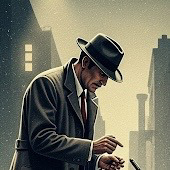
This powerful novel, on which Orson Welles based his famous 1958 film, is a sleek, dark indictment of the American justice system--an original American masterpiece. "Masterson looks at corruption in society and shows how it taints all of us".--Atlanta Journal-Constitution.
Whit Masterson is a pen name of authors, Robert Allison “Bob” Wade (1920-present) and H. Bill Miller (1920–61). The two also wrote under several other pseudonyms, including Wade Miller and Will Daemer.
"Guns must be answered with guns, bullets with bullets."
'Badge of Evil' lives up to its name in Masterson's iconic noir. For the badge is enough to shield accusations and falsify documents to bring forth a conviction, the local law have half a job to do - convince the DA of their suspects and the suspects of their guilt. Mitch Holt, a young intelligent, good old fashioned American male, is brought into the spotlight and cast in a manner to which he's not accustomed. Following success on a recently closed case, Holt is the proverbial pin-up boy of the law, that is, until his smarts get in the way of police corruption. Caught in between a rock and a hard place, Hot chooses the hard place and sets out on a mission to prove the innocence of Tara Linneker and Delmont Shayon of the alleged murder of Tara's farther, a wealthy town resident. Enlisting unlikely sources and questioning even more unlikely acquaintances, Holt's diligence for the truth may very well cost him his life.
On the low end of the page count, 'Badge of Evil' read like a much longer and deeper novel. McCoy, the retired cop is well defined, his reputation fully fledged and actions prominent throughout the investigation. The same can be said for his partner, albeit on a smaller scale. However its the actions and relenting desire for justice by the protagonist that leads this novel. From start to finish, Holt is the centre of proceedings - and he couldn't have been better written.
This isn't a typical crime/noir/police procedural, 'Badge of Evil' is multi dimensional, comprising the usual thriller aspects associated with crime but also a distinctly human element and a softer edge through Holt's domestic life. I liked the way Masterson slowly converges crime on the home front - there was a feeling that no one was untouchable which heightened the corruption plot and kept the story fresh and stimulating. This is a good book and one well worth re-reading. 4 stars.
Bob Wade and Bill Miller, writing as a team, offer us a classic crime noir in a dark, dreary world. They tell us the story from the point of view of Mitch Holt, a 35-year-old married deputy district attorney who ends up being the lone Mr. Smth tilting at windmills.
The story opens with a wealthy industrialist Linneker, waiting for his daughter at his lonely beach cabana, and suddenly getting blown to smithereens by a bundle of dynamite thrown inside. The prime suspects, according to experienced detectives, are the daughter Tara Linneker, set to inherit two million dollars, and her fiance , show salesman Delmony Shayon. The theory is that the lovebirds wanted to marry and dear papa disapproved. To top it off, their alibi stinks. They claim to have been driving aimlessly for hours with no one to vouch for them. And their cynical attitude stinks. They assume Holt and everyone in the Justice machine is out to get them and they’ll never get a chance at justice.
Convinced by his Mexican heiress wife, who married a poor by comparison government lawyer even with her father’s disapproval, Holt is a lone voice in the wilderness, arguing for further investigation and willing to believe two honorable homicide detectives planted something to close a case that had all too obvious a conclusion.
Holt risks his career, his marriage, and even his life to fight for the truth. No one has his back, not even his boss. For those who think the Government is a big bad monolith, Holt stands as the exception, the Socratic questioner who is really to fight for truth, justice, and the American way no matter what it costs.
This would probably make an amazing motion picture and in fact it did.
A solid thriller about an assistant DA who, when he tries to investigate a corrupt cop, finds the entire system turned against him. Plot is everything here; prose and characterization are tailored to carry the story forward efficiently and quickly, creating a successful page-turner that is a satisfying quick read, but not particularly outstanding.
The film Viewing Orson Welles’ Touch of Evil again immediately after reading the novel, I became aware of plot threads from the book which were used or adapted in the film, but which I missed in past viewings amid the razzle-dazzle and hurly-burly of the film. The film’s sordid beauty and many memorable scenes (that opening shot!) put it artistically miles ahead of the novel, but in the end Welles created a technically brilliant film which suffers from a muddled narrative and is thematically inconsistent. I suspect Welles realized this and walked away from the final editing so that the studio in whose hands he left the unfinished film would get blamed for the muddle while he would get credit only for the brilliance.
Here’s a set of questions relating to the film of the sort provided in publishers’ “reader’s guides” to act as points for discussion or contemplation. • What does Tana’s (Marlene Dietrich) comment about Hank Quinlan (Orson Welles), “He was some kind of a man,” mean? From what evidence from the film do you base this understanding? • Who planted the dynamite shown at the beginning of the film? This is stated in a line of dialogue at the end, but I wouldn’t be surprised if many viewers miss it. If “telling” instead of “showing” is a flaw in writing, it is much more so in filmmaking. Do you think the solution offered is believable? If so, how does it affect your understanding of the story in retrospect? • What was the purpose of the abduction and mistreatment of Vargas’ wife (Janet Leigh) for Joe Grandi (Akim Tamiroff)? For Hank Quinlan? What was the role of Vargas’ gun in this plan?
Good chewy pulp. This story was used as a launch point for Orson Welles's classic "Touch of Evil", one of the last of the Noir films. Personally, I'm glad they changed the name. It's less of a spoiler that way. Our hero is a virtuous man (You can practically hear his square jaw) in a crooked world where no good deed goes unpunished. He breaks the rules to preserve justice, as one is expected to do. He starts off painfully (almost unbelievably) naive, but he does recover. It's no Hammet, or Chandler, but it was an exciting and enjoyable read.
This is the book that the Orson Welles movie, Touch of Evil, was based on. Like the movie, it fits smack-dab into the noir genre. The story’s hook is its protagonist’s, Mitch Holt’s, discovery that famed police investigators Loren McCoy and Hank Quinlan have been planting evidence to pad their cases against targets they have decided must be guilty of crimes under investigation.
The story starts with Holt innocently enough being assigned to a high-profile murder case, the death of lumber millionaire, Rudy Linneker . Someone snuck onto Linneker’s property while he was relaxing on his patio and tossed a bundle of dynamite close enough to obliterate him.
The obvious suspects are Linneker’s own daughter, Tara, and her fiance, Delmont Shayon. Linneker had disapproved of the marriage, and of Shayon in general. McCoy and Quinlan are convinced they did the job.
Holt is assigned to the case from the prosecutor’s office to satisfy political pressures to treat the case as a high priority.
But Holt does some investigating of his own, and becomes not only convinced that Shayon and Tara did not commit the murder but extracts a confession from the true murderer, a former employee of Lineker’s named Farnum. Farnum had a festering grudge against Linneker.
In the meantime, McCoy and Quinlan have “discovered” additional sticks of the same brand of dynamite in a storage closet at Shayon’s apartment, apparently sealing the case against him. They have to backtrack quickly when Farnum’s confession makes it clear that Shayon is not the guilty party.
Farnum maintains that he did not himself plant the dynamite at Shayon’s apartment to frame him. So who did?
The answer is obvious, and Holt follows up on it, looking into the records of past investigations by McCoy and Quinlan to see if there is a pattern of planting evidence. He finds dirt, lots of it.
Now we’ve got a mess. McCoy and Quinlan have been exposed by Holt, but their reputations and ties to the police and the District Attorney’s office are so solid, and the political and legal repercussions of what Holt is claiming to have discovered are so dire, that no one will throw support behind Holt’s claims.
Holt is left on an island, eventually suspended from his job. And McCoy and Quinlan are out to squelch his story once Holt takes it to the press.
Meanwhile, Holt’s wife, Connie, and daughter, Nancy, are vulnerable. He’s sent them to Mexico, to her father’s ranch, but Connie grows increasingly concerned for Holt’s safety and returns. That’s not such a good idea.
If you’ve seen Touch of Evil, you have some idea of what happens to Connie. It’s a spectacular, unnerving scene, and, although the scene isn’t quite so graphic in the book, it’ll stay with you.
It certainly motivates Holt. And it pushes the story to its resolution. You know that there’s going to be a confrontation involving Holt, McCoy, and Quinlan.
It’s a great story, and I can see why Welles wanted to adapt it to film. To be honest, this is a rare case where I think the movie outdoes the original story.
What I found a little lacking in the story was that there was a kind of easy, at times frictionless flow to the plot. Some things that shouldn’t go easy and that offer the opportunity for interesting internal conflicts slide right by. Connie’s support for Holt’s dangerous stand against McCoy and Quinlan — that could have been a stressful tug of war between protecting her family and supporting a courageous but very likely futile stand against injustice. Holt’s decision to pursue the investigation of McCoy and Quinlan itself — it’s pure and admirable, sure, but, a likely career-killer and danger to himself and everyone who supports him. Farnum’s confession — it just rolls out smooth and easy. And one last one I can’t describe because it would be a spoiler, but, again, it rolls too smoothly and is necessary to resolving the plot.
But, like I said, it’s a great story, and I may be overly critical given how good a film Welles made of it, adding to the tensions and drama with graphic visuals and camera work, as well as some major changes to the roles, setting, and to the plot itself.
“What’s your favorite movie of all time?” My answer often defaults to Touch of Evil. In truth, this might change from day to day, but Orson Welles’s 1958 noir classic is certainly high on my list. I’ve seen it more times than I can count, and love every frame, from the famous long single-shot opening to the over-the-top acting of Charlton Heston and Welles himself, to the pulsing soundtrack and ‘50s social bugaboos (JDs and reefer!). I’ve often heard that the pulp crime novel that the film was based upon was no great shakes, and has certainly been hard to track down over the years. I finally found a copy, though, and zipped through it in due course. It’s not a bad read, to be honest. Mind you, what Welles did with the material is transcendent. Although long past his “boy wonder” RKO days, he still took a rough lump of clay and created great art. Absent from these pages are the aforementioned juvenile delinquents, likewise Marlene Dietrich’s world weary Tanya (“He was some kind of a man …”). We do have smaller than life stand-ins for Uncle Joe Grande and Schwartz, as well as Hank Quinlan with his game leg (although with less “screen time” here and represented in a starkly different manner), but that’s really all we need; it’s enough. Let’s be honest, something tells me that you probably won’t want to read this. Intuition, I call it. This ain’t bad, but how often do we have a chance to read a book, shrug, and say, “The movie was better.”?
This is very different from the 1958 film directed by Orson Welles. The Charlton Heston character is not Mexican, but a Southern California prosecutor who is drawn into a high-profile case that leads him down a rathole of official corruption. The personalities of the Orson Welles character and the Joseph Calleia character are reversed. In the book, Welles' Quinlan is not the evil kingpin, but an unwitting accomplice. (Is that a spoiler? I think not). This book has a strong Chinatown vibe, without the "my sister, my mother, my sister, my mother" bit. As long as you understand that you're not getting a very different story, I think you'll enjoy this book. It started a little slow, but the second half really took off--I read the back half of the book in one sitting.
Entertaining and smartly written police story of an assistant district attorney set to personally uncover the truth and restore justice and honesty in a police department that had been wronged by a crooked veteran cop. It was the inspiration of the movie Touch of Evil directed by Orson Wells, where he also played the role of the evil Captain McCoy.
Great pulp fiction. A definite thrilling page turner in the grand tradition. Too bad they don’t write them like this anymore. Fortunately there were enough written to fill a library— if you can get your hands on them. Somebody should republish the great pulps.
This was the basis for the legendary 1958 Orson Welles, Charlton Heston, Janet Leigh, Dennis Weaver, Marlene Deitrich, Mercedes McCambridge, Zsa Zsa Gabor film noir “Touch of Evil.” Other than the name of the villain, and some basic plot elements, this is not the same story. This is terrible.
Good story, a little dated as I expected but fun nonetheless. I didn’t care for the writing style but that’s a personal preference. Recommended for people that enjoy pulps.
The best of the old pulp noir mystery and detective novels have an immediacy that really grabs you. They don't feel dated at all, even sixty or more years after publication. Almost all of Fredric Brown's work has that quality. So does Catcher in the Rye, although of course that's not a mystery or noir.
Touch of Evil (originally titled Badge of Evil, but renamed after the release of the Orson Welles movie that was loosely based on the book) has that timeless quality, too. It's short, particularly compared to modern novels, but the story is gripping and carries the reader along. It's a tale of corruption as old as the institution of law itself.
The plot moves swiftly, with no slow patches at all. If anything, it seems to draw to a close a little too quickly, and be a little too sparse; I'd have liked to read a bit more detail about the lives of the Holt family. But all in all it's a very enjoyable book, and re-reads well. I strongly recommend it, and will be searching out other books by the authors ("Whit Masterson" being the pseudonym of two co-authors).
A fast-moving, if somewhat dated, thriller. Idealistic prosecutor Mitch Holt is investigating the bomb-murder of the town's wealthiest citizen when he stumbles upon a trail of police corruption. Following that trail will endanger the lives of Mitch and his wife Connie.
Badge of Evil differs substantially from Orson Welles' famous film adaptation Touch of Evil. The novel seems bland when compared to the film (Most notably, Welles added the bordertown racial elements that make Touch crackle with tension), but taken on its own it's an enjoyable read.
Re-read this after about 15 years. I'd forgotten much of the book detail other than the reversal of the Quinlan and McCoy (Menzies in the movie) characters for the film.
It's an engaging and suspenseful book.
It's interesting to revisit this and note how elements were adapted into "Touch of Evil." The plot's all there though the film builds an even greater sense of tension and immediacy with the shift to a border town.
This entire review has been hidden because of spoilers.
This is one of my favorite books by Whit Masterson, one of many pen names used by Robert Wade and his late writing partner, H. Billy Miller (see Wade Miller). This is one of the first crime novels to explore the abuse of power by law enforcement officials. It was the basis of Orson Wells's film noir classic "Touch of Evil."
Decent enough stuff that unfortunately hasn't aged very well. But still immensely cool to read it if you like Touch of Evil. Totally incredible how Wells managed to turn this unquestionably original, but somehow mediocre novel into a timeless mastepriece.
Rarely do I find a movie being better than the source material,but this is that exception. Nothing against the book, it was a good story, but the movie in Welles' hand was far more evolved and suspenseful. That being said, I still enjoyed the book and found it far better than much of what is being put out currently.
Good plot, starts low-key and kicks into high gear half-way through. Lawyer vs. public corruption. Characters, aside from the protagonist and villian, are stock. Plot pulls you through. Highly recommended.
1950s pulp fiction. I read it because I liked the cover. Not having read much of this style, I can see why they were so popular. Intrigue! Crime! Mystery! Stereotypical yet somehow comforting character types!
I really enjoyed this book. Holt was an engaging main character, if a bit of a boyscout. Wasn't really a mystery so much as a thriller. Overall a fun and engrossing read.
A bit dated, but a good story overall. In truth, I may have actually preferred the movie "Touch of Evil" a tad more, but the book and film are so loosely related, that might not be a fair statement.