

What do you think?
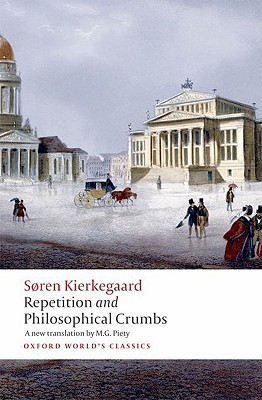
Repetition and Philosophical Crumbs
"The love of repetition is in truth the only happy love." So says Constantine Constantius on the first page of Kierkegaard's Repetition. Life itself, according to Kierkegaard's pseudonymous narrator, is a repetition, and in the course of this witty, playful work Constantius explores the nature of love and happiness, the passing of time and the importance of moving forward (and backward). The ironically entitled Philosophical Crumbs pursues the investigation of faith and love and their tense relationship with reason. Written only a year apart, these two short works are a perfect introduction to Kierkegaard's philosophy: playful and profound, they explore notions of love and time, selfhood and Christianity, and pave the way for his later major works. These are the first English translations to convey both the philosophical precision of the originals and their literary quality. Edward F. Mooney's Introduction deftly guides the reader through Kierkegaard's key arguments and concepts, while helpful notes identify references and allusions and clarify difficulties in the texts.
187 pages, Paperback
First published January 1, 2009
About the author
Søren Kierkegaard
1,161 books6,790 followersSøren Aabye Kierkegaard was a prolific 19th century Danish philosopher and theologian. Kierkegaard strongly criticised both the Hegelianism of his time and what he saw as the empty formalities of the Church of Denmark. Much of his work deals with religious themes such as faith in God, the institution of the Christian Church, Christian ethics and theology, and the emotions and feelings of individuals when faced with life choices. His early work was written under various pseudonyms who present their own distinctive viewpoints in a complex dialogue.
Kierkegaard left the task of discovering the meaning of his works to the reader, because "the task must be made difficult, for only the difficult inspires the noble-hearted". Scholars have interpreted Kierkegaard variously as an existentialist, neo-orthodoxist, postmodernist, humanist, and individualist.
Crossing the boundaries of philosophy, theology, psychology, and literature, he is an influential figure in contemporary thought.
Kierkegaard left the task of discovering the meaning of his works to the reader, because "the task must be made difficult, for only the difficult inspires the noble-hearted". Scholars have interpreted Kierkegaard variously as an existentialist, neo-orthodoxist, postmodernist, humanist, and individualist.
Crossing the boundaries of philosophy, theology, psychology, and literature, he is an influential figure in contemporary thought.
Ratings & Reviews
Friends & Following
Create a free account to discover what your friends think of this book!
Community Reviews
Displaying 1 - 30 of 40 reviews

March 2, 2018
Introduction & Acknowledgements, by Edward F. Mooney
Note on the Translation
Select Bibliography
A Chronology of Søren Kierkegaard
--Repetition
--Philosophical Crumbs, or A Crumb of Philosophy
Explanatory Notes
Note on the Translation
Select Bibliography
A Chronology of Søren Kierkegaard
--Repetition
--Philosophical Crumbs, or A Crumb of Philosophy
Explanatory Notes

November 15, 2019
Søren Kierkegaard is probably my favourite writer. He's a brilliant thinker, and some of his books are profoundly beautiful, particularly Fear and Trembling, Works of Love and some parts of Either/Or. The two in this collection make a strange bundle. Repetition, although very engaging and beautifully written, seemed to me rather slight for a Kierkegaard text. It is also, perhaps, the closest that he ever came to writing a novel. Of course, The Seducer's Diary fits the bill of a novel quite well and Repetition is unsurprisingly very similar to it. The two of them are probably Kierkegaard at his most literary (in the conventional sense). The big difference between them is that The Seducer's Diary, although often published seperately these days, is a part of a larger work, and its rather slighter-than-usual ideas fit in well with the essays around it, and are just one small part of a wider discussion and its themes are expounded upon after the fact. In the case of Repetition, the hoped-for expounding never appears.
And Philosophical Crumbs has almost the opposite problem. There is in it, I'm sure, a truly great work trying to get out. Kierkegaard is often verbose - it's a part of his style - but in Philosophical Crumbs he is at once verbose and terribly brief. What I mean by this is that he tries to cover an enormous amount of ground, spreading across several fields of knowledge, without really granting many of his ideas the time that they really need. Kierkegaard's verbosity isn't usually a problem, because ordinarily he is very thorough in ensuring that his ideas are fully understood, but here he seems intent to sort of race through things. In Philosophical Crumbs, I fear, there is a great four hundred page book trying to break free from the confines of an unduly challenging eighty page book. And I don't think I'm the only person to think this. Given that Kierkegaard followed it up a few years later with a six hundred page 'postscript', I imagine that he himself felt that the ideas needed to be expanded.
All in all, if you're new to Kierkegaard, this is not the place to start. These works are fascinating, and important, but they are not Kierkegaard at his best.
And Philosophical Crumbs has almost the opposite problem. There is in it, I'm sure, a truly great work trying to get out. Kierkegaard is often verbose - it's a part of his style - but in Philosophical Crumbs he is at once verbose and terribly brief. What I mean by this is that he tries to cover an enormous amount of ground, spreading across several fields of knowledge, without really granting many of his ideas the time that they really need. Kierkegaard's verbosity isn't usually a problem, because ordinarily he is very thorough in ensuring that his ideas are fully understood, but here he seems intent to sort of race through things. In Philosophical Crumbs, I fear, there is a great four hundred page book trying to break free from the confines of an unduly challenging eighty page book. And I don't think I'm the only person to think this. Given that Kierkegaard followed it up a few years later with a six hundred page 'postscript', I imagine that he himself felt that the ideas needed to be expanded.
All in all, if you're new to Kierkegaard, this is not the place to start. These works are fascinating, and important, but they are not Kierkegaard at his best.

April 18, 2014
"And now the moment. Such a moment is unique. It is, of course,
brief and temporal, as moments are, ephemeral, as moments are,
passed, as moments are, in the next moment, and yet it is decisive,
and yet it is filled with eternity. Such a moment must have a special
name. Let us call it: the fullness of time."
brief and temporal, as moments are, ephemeral, as moments are,
passed, as moments are, in the next moment, and yet it is decisive,
and yet it is filled with eternity. Such a moment must have a special
name. Let us call it: the fullness of time."

July 25, 2024
Grūti te vispār kādu vērtējumu likt. Kirkegora doma un filosofija ir gan laicīga, gan pārlaicīga, nezaudējot aktualitāti. Tāpēc jebkurā brīdī pie viņa “sējumiem” ir vērts atgriezties.
Te varēja sastap labi zināmo salīdzinājumu ar atcerēšanos un atkārtošanos. Kirkegors uzsver, ka patiess atkārtojums nekādi nav iespējams, jo cilvēks ir mainīgs. Tāpat arī viņš uzdod jautājumu, vai esam lemti izdzīvot atmiņas vai tomēr kaut kas jauns ir piedāvājumā.
Izslavētais “leap of faith” parādās un dzimst šeit. Kirkegors pievēršas arī kristietības paradoksam, kur Dievs kļūst par cilvēku.
Kirkegors necieta Hēgeli, tāpēc nepaskopojas arī pāris vietās iebilst Hēgeļa filosofijai.
Te varēja sastap labi zināmo salīdzinājumu ar atcerēšanos un atkārtošanos. Kirkegors uzsver, ka patiess atkārtojums nekādi nav iespējams, jo cilvēks ir mainīgs. Tāpat arī viņš uzdod jautājumu, vai esam lemti izdzīvot atmiņas vai tomēr kaut kas jauns ir piedāvājumā.
Izslavētais “leap of faith” parādās un dzimst šeit. Kirkegors pievēršas arī kristietības paradoksam, kur Dievs kļūst par cilvēku.
Kirkegors necieta Hēgeli, tāpēc nepaskopojas arī pāris vietās iebilst Hēgeļa filosofijai.

September 9, 2018
Repetition is a psychological novella in style, though its purpose is to introduce Kierkegaard’s idea of repetition—a lifestyle and a guiding principle for maintaining happiness (in love). Kierkegaard starts from the Socratic concept of recollection, as presented by Plato in Phaedrus (amongst other works). It says that person can recall divine knowledge (possessed by all humans) when appropriately guided by a teacher like Socrates. In other words, we can find happiness in being taught philosophy and eventually in becoming philosophers ourselves.
Kierkegaard’s repetition is far harder to grasp. In my interpretation it can be thought of as finding peace and happiness in an essentially repeating scenario which slightly improves with each iteration. Intriguingly, this balances the need for novelty (the scenario has ups and downs and little positive variations) with a predilection for romantic melancholy (it’s the familiar scenario). It’s a helix with a shallow angle.
The matters of a repeating cycle’s duration and its “slight improvement” aren’t quite clear. A foundational component of the treatise is the Biblical story of Job—the man who was subjected to the worst possible pains and ignominies by Satan (with God’s permission) and yet accepted everything as God’s will. For his perseverance and unwavering faith, Job was then blessed with renewed prosperity: he got everything he’d had initially and more. This, according to Kierkegaard, is a model of repetition.
Philosophical Crumbs veers heavily into philosophical theology, the more so as the text progresses, and though it is broken up by insightful and imaginative flourishes (The King and the Maiden, Paradox of the sorites, an interlude on becoming), the density of the discourse and the topics covered cater best to a specialist reader.
I would recommend Repetition as one possible introduction to Kierkegaard, the literary stylist and philosopher, though I'd caution against Philosophical Crumbs being anyone's first contact with philosophy.
This Oxford World’s Classic contains a helpful thirty-page introduction that will aid the general reader.
Kierkegaard’s repetition is far harder to grasp. In my interpretation it can be thought of as finding peace and happiness in an essentially repeating scenario which slightly improves with each iteration. Intriguingly, this balances the need for novelty (the scenario has ups and downs and little positive variations) with a predilection for romantic melancholy (it’s the familiar scenario). It’s a helix with a shallow angle.
The matters of a repeating cycle’s duration and its “slight improvement” aren’t quite clear. A foundational component of the treatise is the Biblical story of Job—the man who was subjected to the worst possible pains and ignominies by Satan (with God’s permission) and yet accepted everything as God’s will. For his perseverance and unwavering faith, Job was then blessed with renewed prosperity: he got everything he’d had initially and more. This, according to Kierkegaard, is a model of repetition.
Philosophical Crumbs veers heavily into philosophical theology, the more so as the text progresses, and though it is broken up by insightful and imaginative flourishes (The King and the Maiden, Paradox of the sorites, an interlude on becoming), the density of the discourse and the topics covered cater best to a specialist reader.
I would recommend Repetition as one possible introduction to Kierkegaard, the literary stylist and philosopher, though I'd caution against Philosophical Crumbs being anyone's first contact with philosophy.
This Oxford World’s Classic contains a helpful thirty-page introduction that will aid the general reader.

March 2, 2020
I picked this up because I decided to use Piety's translation of Crumbs for my Kierkegaard course this semester. It doesn't replace Hong&Hong's edition that comes with copious notes and SK's relevant journal entries. But without those cumbersome and often interruptive notes this edition makes for a much more enjoyable read. I benefited from Mooney's Introduction to Repetition: that work has always been a bit of a stumbling block for me, and he helped me crack open some seals.
I have read the English translations of Philosophical Crumbs (formerly "Fragments," but Evans and Piety have made a convincing case that "crumbs" is better) by Swenson, Hong & Hong, and Piety now. All three seem good (I didn't make a detailed comparison, just noticed minor differences here and there), but it's quite interesting how I notice different things with each translation. If one sentence jumps out in Swenson, that same sentence can sound transitional or unimportant in Piety.
I have read the English translations of Philosophical Crumbs (formerly "Fragments," but Evans and Piety have made a convincing case that "crumbs" is better) by Swenson, Hong & Hong, and Piety now. All three seem good (I didn't make a detailed comparison, just noticed minor differences here and there), but it's quite interesting how I notice different things with each translation. If one sentence jumps out in Swenson, that same sentence can sound transitional or unimportant in Piety.
August 12, 2026
I’ve finished Repetition and will come back and read Philosophical Crumbs later. I can’t fully explain it, but this book was extremely relevant to me in a particular situation in my life and for that reason I am indebted to Kierkegaard. This is the second time something his has written was a salve to a wound at the perfect time.
Also, a crucial section of this book serves as an extremely insightful commentary on the book of Job.
“Have you read Job? Read it. Read it again and again” (63).
Also, a crucial section of this book serves as an extremely insightful commentary on the book of Job.
“Have you read Job? Read it. Read it again and again” (63).

July 15, 2024
5/5 for repetition 4.35/5 for the crumbs :)

February 5, 2011
This is a very clear, excellent new translation of two beautiful texts: Kierkegaard's Repetition (written under Constantine Constantius) and Philosophical Crumbs (written under Climacus, otherwise known as 'Philosophical Fragments' in the previous Hong translation). Not only is it a very good translation, but the pairing of these two texts next to each other in some ways makes much more sense than pairing Repetition with Fear and Trembling.

January 13, 2020
A tough read, I’m not gonna lie, but to boil it down: 1) Recollection and repetition are the same movement in opposite directions; 2) Wait, what? 3) He has a lot of terrible relationship advice; 4) the best seats at the Königstädter Theatre in Berlin are box 5 or 6 to the left. There’s other stuff, but that’s the basic gist. (BTW I really liked it.)
August 13, 2011
I would've done better to take a day off and read this all at once. Small sections here and there don't work, as each sentence is incredibly rich and reading a page is as exhausting as reading ten pages. The last five pages of Philosophical Crumbs were exhilarating.

March 17, 2013
Repetition: wonderful. Crumbs: arduous.

November 12, 2024
“ 𝙒𝙚 𝙖𝙧𝙚 𝙞𝙣 𝙀𝙧𝙧𝙤𝙧 (𝙤𝙧 𝙨𝙞𝙣). 𝙉𝙚𝙫𝙚𝙧𝙩𝙝𝙚𝙡𝙚𝙨𝙨, 𝙬𝙚 𝙮𝙚𝙖𝙧𝙣 𝙛𝙤𝙧 𝙩𝙝𝙚 𝙞𝙣𝙛𝙞𝙣𝙞𝙩𝙚. ”
"𝘏𝘰𝘸 𝘪𝘴 𝘪𝘵 𝘵𝘩𝘢𝘵 𝘯𝘰 𝘰𝘯𝘦 𝘩𝘢𝘴 𝘳𝘦𝘵𝘶𝘳𝘯𝘦𝘥 𝘧𝘳𝘰𝘮 𝘵𝘩𝘦 𝘥𝘦𝘢𝘥? 𝘉𝘦𝘤𝘢𝘶𝘴𝘦 𝘭𝘪𝘧𝘦 𝘥𝘰𝘦𝘴 𝘯𝘰𝘵 𝘬𝘯𝘰𝘸 𝘩𝘰𝘸 𝘵𝘰 𝘤𝘢𝘱𝘵𝘪𝘷𝘢𝘵𝘦 𝘪𝘯 𝘵𝘩𝘦 𝘸𝘢𝘺 𝘥𝘦𝘢𝘵𝘩 𝘥𝘰𝘦𝘴, 𝘣𝘦𝘤𝘢𝘶𝘴𝘦 𝘭𝘪𝘧𝘦 𝘪𝘴 𝘯𝘰𝘵 𝘴𝘰 𝘱𝘦𝘳𝘴𝘶𝘢𝘴𝘪𝘷𝘦 𝘢𝘴 𝘥𝘦𝘢𝘵𝘩. 𝘠𝘦𝘴, 𝘥𝘦𝘢𝘵𝘩 𝘪𝘴 𝘣𝘳𝘪𝘭𝘭𝘪𝘢𝘯𝘵𝘭𝘺 𝘱𝘦𝘳𝘴𝘶𝘢𝘴𝘪𝘷𝘦, 𝘪𝘧 𝘰𝘯𝘭𝘺 𝘰𝘯𝘦 𝘸𝘪𝘭𝘭 𝘯𝘰𝘵 𝘢𝘳𝘨𝘶𝘦 𝘸𝘪𝘵𝘩 𝘪𝘵, 𝘣𝘶𝘵 𝘫𝘶𝘴𝘵 𝘭𝘦𝘵 𝘪𝘵 𝘴𝘱𝘦𝘢𝘬. "
1. 𝐑𝐞𝐩𝐞𝐭𝐢𝐭𝐢𝐨𝐧 :
The book starts with Kierkegaard discussing The Socratic idea of 'recollection'. Kierkegaard however himself believes in 'repetition'. Kierkegaard compares the two ideas and admires the idea of repetition.Kierkegaard then narrates a story of a young man falling in love and through the story he tries to capture the idea of repetition.
Some quotes:
・"Repetition and recollection are the same movement, just in
opposite directions, because what is recollected has already been and
is thus repeated backwards, whereas genuine repetition is recollected
forwards"
・"It requires
youthfulness to hope and youthfulness to recollect, but it requires
courage to will repetition. "
・"He who will only hope is cowardly. He
who wants only to recollect is a voluptuary. But he who wills repetition, he is a man, and the more emphatically he has endeavoured to
understand what this means, the deeper he is as a human being"
・"Repetition is actuality and the earnestness of existence."
・"a love-struck young person is such a beautiful sight that one
cannot help but rejoice in it and thus forget to observe."
・"Who
could sleep! Who could sleep so easily that sleep does not become a
heavier burden than the burdens of the day!
・" Or is it not the case that the
older one becomes, the more life reveals itself to be deceptive; the smarter one becomes, the more ways one learns to help oneself; the
worse off one is, the more one suffers? "
・"The older one gets, the better one understands life and the more
one comes to care for and appreciate comfort. In short, the more
competent one becomes, the less one is contented"
・" Every
mood resonated melodically in my soul. Every thought, from the
most foolish to the most profound, offered itself, and offered itself
with the same blissful festiveness. Every impression was anticipated
before it came, and thus awoke from within me. It was as if all of
existence were in love with me."
・"You are the only one who really knows
what you want, because what you want is to flow, to lose yourself
in the ocean that is never filled! Play on, life’s drama, which no one
calls a comedy, no one a tragedy, because no one knows how it ends!
Play on, you existential drama, where life, like loans, is never repaid"
2. 𝐏𝐡𝐢𝐥𝐨𝐬𝐨𝐩𝐡𝐢𝐜𝐚𝐥 𝐜𝐫𝐮𝐦𝐛𝐬:
Let's be honest this was very difficult, i couldn't understand half of the stuff he was saying. It's very dense. I will be re-reading for sure.In this book Kierkegaard again discusses the Socratic idea of recollection and how we achieve truth. According to Kierkegaard humans are in error (sin) and because of this the truth remains hidden from us, however we can access the truth through a teacher, but what's important here is that to access this truth we must possess the ability to understand it. And God has given us this ability. And then Kierkegaard involves ig idea of Christianity to further explain this idea. Nevertheless i found it extremely difficult.
Quotes:
・" This change is not in essence, but in being. It is a change from not being to being. "
・"it is easy to see that belief is not a type of
knowledge, but a free act, an expression of will. It believes becoming
and has thus in itself cancelled the uncertainty that corresponds to
the nothingness of non-being."
・"Belief is a sense for becoming and doubt is a protest against
any conclusion that goes beyond immediate sensation and immediate cognition"
・"Socrates did not have faith that there was a God. What he knew
about God he achieved through recollection, and God’s existence was, for him, in no way historical"
"𝘏𝘰𝘸 𝘪𝘴 𝘪𝘵 𝘵𝘩𝘢𝘵 𝘯𝘰 𝘰𝘯𝘦 𝘩𝘢𝘴 𝘳𝘦𝘵𝘶𝘳𝘯𝘦𝘥 𝘧𝘳𝘰𝘮 𝘵𝘩𝘦 𝘥𝘦𝘢𝘥? 𝘉𝘦𝘤𝘢𝘶𝘴𝘦 𝘭𝘪𝘧𝘦 𝘥𝘰𝘦𝘴 𝘯𝘰𝘵 𝘬𝘯𝘰𝘸 𝘩𝘰𝘸 𝘵𝘰 𝘤𝘢𝘱𝘵𝘪𝘷𝘢𝘵𝘦 𝘪𝘯 𝘵𝘩𝘦 𝘸𝘢𝘺 𝘥𝘦𝘢𝘵𝘩 𝘥𝘰𝘦𝘴, 𝘣𝘦𝘤𝘢𝘶𝘴𝘦 𝘭𝘪𝘧𝘦 𝘪𝘴 𝘯𝘰𝘵 𝘴𝘰 𝘱𝘦𝘳𝘴𝘶𝘢𝘴𝘪𝘷𝘦 𝘢𝘴 𝘥𝘦𝘢𝘵𝘩. 𝘠𝘦𝘴, 𝘥𝘦𝘢𝘵𝘩 𝘪𝘴 𝘣𝘳𝘪𝘭𝘭𝘪𝘢𝘯𝘵𝘭𝘺 𝘱𝘦𝘳𝘴𝘶𝘢𝘴𝘪𝘷𝘦, 𝘪𝘧 𝘰𝘯𝘭𝘺 𝘰𝘯𝘦 𝘸𝘪𝘭𝘭 𝘯𝘰𝘵 𝘢𝘳𝘨𝘶𝘦 𝘸𝘪𝘵𝘩 𝘪𝘵, 𝘣𝘶𝘵 𝘫𝘶𝘴𝘵 𝘭𝘦𝘵 𝘪𝘵 𝘴𝘱𝘦𝘢𝘬. "
1. 𝐑𝐞𝐩𝐞𝐭𝐢𝐭𝐢𝐨𝐧 :
The book starts with Kierkegaard discussing The Socratic idea of 'recollection'. Kierkegaard however himself believes in 'repetition'. Kierkegaard compares the two ideas and admires the idea of repetition.Kierkegaard then narrates a story of a young man falling in love and through the story he tries to capture the idea of repetition.
Some quotes:
・"Repetition and recollection are the same movement, just in
opposite directions, because what is recollected has already been and
is thus repeated backwards, whereas genuine repetition is recollected
forwards"
・"It requires
youthfulness to hope and youthfulness to recollect, but it requires
courage to will repetition. "
・"He who will only hope is cowardly. He
who wants only to recollect is a voluptuary. But he who wills repetition, he is a man, and the more emphatically he has endeavoured to
understand what this means, the deeper he is as a human being"
・"Repetition is actuality and the earnestness of existence."
・"a love-struck young person is such a beautiful sight that one
cannot help but rejoice in it and thus forget to observe."
・"Who
could sleep! Who could sleep so easily that sleep does not become a
heavier burden than the burdens of the day!
・" Or is it not the case that the
older one becomes, the more life reveals itself to be deceptive; the smarter one becomes, the more ways one learns to help oneself; the
worse off one is, the more one suffers? "
・"The older one gets, the better one understands life and the more
one comes to care for and appreciate comfort. In short, the more
competent one becomes, the less one is contented"
・" Every
mood resonated melodically in my soul. Every thought, from the
most foolish to the most profound, offered itself, and offered itself
with the same blissful festiveness. Every impression was anticipated
before it came, and thus awoke from within me. It was as if all of
existence were in love with me."
・"You are the only one who really knows
what you want, because what you want is to flow, to lose yourself
in the ocean that is never filled! Play on, life’s drama, which no one
calls a comedy, no one a tragedy, because no one knows how it ends!
Play on, you existential drama, where life, like loans, is never repaid"
2. 𝐏𝐡𝐢𝐥𝐨𝐬𝐨𝐩𝐡𝐢𝐜𝐚𝐥 𝐜𝐫𝐮𝐦𝐛𝐬:
Let's be honest this was very difficult, i couldn't understand half of the stuff he was saying. It's very dense. I will be re-reading for sure.In this book Kierkegaard again discusses the Socratic idea of recollection and how we achieve truth. According to Kierkegaard humans are in error (sin) and because of this the truth remains hidden from us, however we can access the truth through a teacher, but what's important here is that to access this truth we must possess the ability to understand it. And God has given us this ability. And then Kierkegaard involves ig idea of Christianity to further explain this idea. Nevertheless i found it extremely difficult.
Quotes:
・" This change is not in essence, but in being. It is a change from not being to being. "
・"it is easy to see that belief is not a type of
knowledge, but a free act, an expression of will. It believes becoming
and has thus in itself cancelled the uncertainty that corresponds to
the nothingness of non-being."
・"Belief is a sense for becoming and doubt is a protest against
any conclusion that goes beyond immediate sensation and immediate cognition"
・"Socrates did not have faith that there was a God. What he knew
about God he achieved through recollection, and God’s existence was, for him, in no way historical"
August 15, 2021
To be honest, most of what was brought up in this book went way over my head. Although individual topics could be, with much effort, understood, the larger underlying themes were something I found incredibly difficult to grasp. I would probably rate the first part, repetition, way higher, if only just for its literary merit, although I'm not sure I even came close to grasping the concept (which was the entire reason I read the book). Anyways, here are some nice quotes.
Comfort, security, is that not the foundation upon which our society rests? Sacrifice your life, your hopes and dreams, and in return we promise you security and comfort. We tend to forget the fleeting nature of this sacrifice however, as if it wasn't less than a hundred years ago since the last world war. The only thing we truly know is the transitory nature of life, and yet it is the one thing we refuse to accept. This denial robs us of a fulfilling life. We chase perfection, contentedness, as if it exists somewhere else, apart from where we are, not realizing that accepting, being content with, the moment we are in is perfection precisely because it is actual. The thing that grows with age is expectations, which is precisely what hinders contentedness.
”The older one gets, the better one understands life and the more one comes to care for and appreciate comfort. In short, the more competent one becomes, the less one is contented."
Comfort, security, is that not the foundation upon which our society rests? Sacrifice your life, your hopes and dreams, and in return we promise you security and comfort. We tend to forget the fleeting nature of this sacrifice however, as if it wasn't less than a hundred years ago since the last world war. The only thing we truly know is the transitory nature of life, and yet it is the one thing we refuse to accept. This denial robs us of a fulfilling life. We chase perfection, contentedness, as if it exists somewhere else, apart from where we are, not realizing that accepting, being content with, the moment we are in is perfection precisely because it is actual. The thing that grows with age is expectations, which is precisely what hinders contentedness.
Kierkegaard quoting Diogenes Laertius (Book IX §107): ”The end to be realized [The Skeptics] hold to be suspension of judgement, which brings with it tranquility like a shadow.”
”The great advantage of recollection is that it begins with loss. This is its security – it has nothing to lose.”
”The dialectic of repetition is easy, because that which is repeated has been, otherwise it could not be repeated; but precisely this, that it has been, makes repetition something new. When the Greeks said that all knowing was recollecting, they were also thus saying that all of existence, everything that is, has been. When one says that life is repetition, one also says that that which has existed now comes to be again. When one lacks the categories of recollection and repetition, all of life is dissolved into an empty, meaningless noise.”
September 30, 2025
Philosophical Crumbs is deceptively short yet dense. Kierkegaard challenges the Socratic idea that truth is already within us, waiting to be recollected, by proposing instead the radical “Moment” in which truth enters existence from outside, given by the divine. It is a sharp meditation on Christianity’s paradox: that eternal truth became historical in the figure of Christ. For Kierkegaard, this “absolute paradox” defies reason and forces the individual into either offense or faith.Repetition, by contrast, takes on a more personal, almost literary form. It tells the story of a young man struggling with love and despair, interwoven with Kierkegaard’s reflections on whether true repetition is possible in life. While the narrative is fragmented and even playful, it complements Crumbs by dramatizing the tension between philosophy and lived existence. The idea of repetition becomes a metaphor for faith: not a nostalgic return, but a forward leap that renews life through commitment. Taken together, these works highlight Kierkegaard’s brilliance and difficulty. They resist easy summaries, because Kierkegaard is not offering a system, but shaking the reader awake—forcing us to confront paradox, anxiety, and the limits of human autonomy. His style can be challenging—witty, ironic, and deliberately evasive—but that’s part of the experience.
Verdict:
Philosophical Crumbs and Repetition is not an easy read, but it is a rewarding one. For readers interested in existentialism, theology, or the philosophy of faith, these texts are foundational. They mark Kierkegaard’s shift from abstract speculation to the deeply personal, where philosophy is not just theory but a way of living.
Verdict:
Philosophical Crumbs and Repetition is not an easy read, but it is a rewarding one. For readers interested in existentialism, theology, or the philosophy of faith, these texts are foundational. They mark Kierkegaard’s shift from abstract speculation to the deeply personal, where philosophy is not just theory but a way of living.

October 21, 2024
Passionate and wilful, the philosophy of subjectivism spelled out through some frantic opinions on love and small but important clarifications of perspective inside of rational thought
Most compelling I found his manic reaction to love, he can go from questioning it all to knowing everything. It’s a fun read but quick and sharp. Confusing if you let slip for a moment but full of romantic energy.
It is certainly a work of literature although at points feels like a philosophical investigation. His mind works quick and you can see it in the writing. He can conclude a scene perfectly and move on within sentences.
Light and easy to miss philosophies inside of his ‘repetition’.
I must say the exact meaning of repetition eludes me but it’s this manic elusiveness that I find so compelling.
However, unless you feel like your mind may feel similarly manic I wouldn’t read it.
Most compelling I found his manic reaction to love, he can go from questioning it all to knowing everything. It’s a fun read but quick and sharp. Confusing if you let slip for a moment but full of romantic energy.
It is certainly a work of literature although at points feels like a philosophical investigation. His mind works quick and you can see it in the writing. He can conclude a scene perfectly and move on within sentences.
Light and easy to miss philosophies inside of his ‘repetition’.
I must say the exact meaning of repetition eludes me but it’s this manic elusiveness that I find so compelling.
However, unless you feel like your mind may feel similarly manic I wouldn’t read it.

February 18, 2021
Two pamphlets published as a book, but very different works.
Repetition read a lot like the 1st half of Either/Or and in a similar style. If you’ve already read Either/Or there isn’t much to gleam from it, but if you haven’t it would serve as an effective summary of it.
Crumbs is the superior of the two works, similar in style to ‘Fear and Trembling’, it builds an analysis of whether second hand faith is more or less than contemporaneous faith. There are constant illusions to Christianity, and is a worthwhile read for those considering the idea of following the teachings of one 2000 years prior idiosyncratic, whether that be a faith you hold or not.
Repetition read a lot like the 1st half of Either/Or and in a similar style. If you’ve already read Either/Or there isn’t much to gleam from it, but if you haven’t it would serve as an effective summary of it.
Crumbs is the superior of the two works, similar in style to ‘Fear and Trembling’, it builds an analysis of whether second hand faith is more or less than contemporaneous faith. There are constant illusions to Christianity, and is a worthwhile read for those considering the idea of following the teachings of one 2000 years prior idiosyncratic, whether that be a faith you hold or not.

July 2, 2025
Absolutely bonkers, though I've come to expect nothing less from Kierkegaard. I loved it.
A quote from our at-once seemingly love-struck (though perhaps not really), eternally, internally struggling poet:
"Long live thought's flight, long live mortal danger in the service of the idea, long live the misery of battle, long live the festive shouts of victory, long live dancing in the eddy of the infinite, long live the wave that drives me down into the abyss, long live the wave that slings me up again over the stars."
A quote from our at-once seemingly love-struck (though perhaps not really), eternally, internally struggling poet:
"Long live thought's flight, long live mortal danger in the service of the idea, long live the misery of battle, long live the festive shouts of victory, long live dancing in the eddy of the infinite, long live the wave that drives me down into the abyss, long live the wave that slings me up again over the stars."

May 29, 2018
Parts of this text I really liked - repetition and recollection as categories of human experience, his comments on the Greek's conceptions of motion, and particularly his reflections on Job at the end. When it came to memory lane, though, my eyes became heavy. I'll be honest, I've just never been able to get into Kierkegaard. Maybe later.

December 29, 2024
It's in repetition, rather than recollection we move forward. Profound, and one that needs reading many times to properly understand. Not sure I've fully got my head round it yet. The wonderful thing about Kierkegaard is one can read and read again, always coming with an array of thought provoking wonder.

January 21, 2023
I found this pretty accessible & also thought the content & conversations were quite interesting, I just am not a fan of Kierkegaard and the westernization of Greek philosophy around the idea of faith grinds my gears

December 14, 2018
Difficult to review because much of the book was difficult for me to understand.
Still, Kierkegaard is amazing and I will continue to try to solve his amazing philosophical puzzles.
Still, Kierkegaard is amazing and I will continue to try to solve his amazing philosophical puzzles.

January 3, 2019
Important

February 16, 2019
Strugglesome read.

January 31, 2020
Did these writings, perhaps, influence Schopenhauer ?

December 8, 2020
Did not expect this to be K writing through a breakup

January 25, 2021
I first read Repetition in college, then re-read it (a repetition!) before doing an episode on the Work of Repetition for What's Left?
https://www.patreon.com/posts/p47-wor... (paywall!)
https://www.patreon.com/posts/p47-wor... (paywall!)

April 14, 2023
I only read Philosophical Crumbs for the reading group I’m in, but it was my favorite Kierkegaard reading so far by some distance

Did Not Finish
August 29, 2024Repetition deserves another read, crumbs can wait until I’m ready.

Displaying 1 - 30 of 40 reviews