

What do you think?
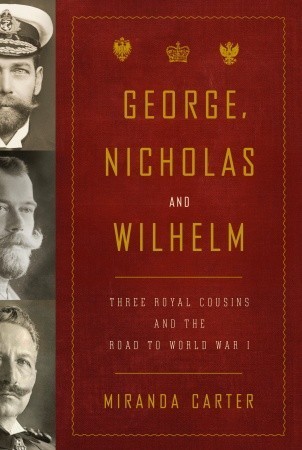
George, Nicholas and Wilhelm: Three Royal Cousins and the Road to World War I
In the years before the First World War, the great European powers were ruled by three first cousins: King George V of Britain, Kaiser Wilhelm II of Germany and Tsar Nicholas II of Russia. Together, they presided over the last years of dynastic Europe and the outbreak of the most destructive war the world had ever seen, a war that set twentieth-century Europe on course to be the most violent continent in the history of the world.
Miranda Carter uses the cousins' correspondence and a host of historical sources to tell the tragicomic story of a tiny, glittering, solipsistic world that was often preposterously out of kilter with its times, struggling to stay in command of politics and world events as history overtook it. George, Nicholas and Wilhelm is a brilliant and sometimes darkly hilarious portrait of these men--damaged, egotistical Wilhelm; quiet, stubborn Nicholas; and anxious, dutiful George--and their lives, foibles and obsessions, from tantrums to uniforms to stamp collecting. It is also alive with fresh, subtle portraits of other familiar figures: Queen Victoria--grandmother to two of them, grandmother-in-law to the third--whose conservatism and bullying obsession with family left a dangerous legacy; and Edward VII, the playboy "arch-vulgarian" who turned out to have a remarkable gift for international relations and the theatrics of mass politics. At the same time, Carter weaves through their stories a riveting account of the events that led to World War I, showing how the personal and the political interacted, sometimes to devastating effect.
For all three men the war would be a disaster that destroyed forever the illusion of their close family relationships, with any sense of peace and harmony shattered in a final coda of murder, betrayal and abdication.
Miranda Carter uses the cousins' correspondence and a host of historical sources to tell the tragicomic story of a tiny, glittering, solipsistic world that was often preposterously out of kilter with its times, struggling to stay in command of politics and world events as history overtook it. George, Nicholas and Wilhelm is a brilliant and sometimes darkly hilarious portrait of these men--damaged, egotistical Wilhelm; quiet, stubborn Nicholas; and anxious, dutiful George--and their lives, foibles and obsessions, from tantrums to uniforms to stamp collecting. It is also alive with fresh, subtle portraits of other familiar figures: Queen Victoria--grandmother to two of them, grandmother-in-law to the third--whose conservatism and bullying obsession with family left a dangerous legacy; and Edward VII, the playboy "arch-vulgarian" who turned out to have a remarkable gift for international relations and the theatrics of mass politics. At the same time, Carter weaves through their stories a riveting account of the events that led to World War I, showing how the personal and the political interacted, sometimes to devastating effect.
For all three men the war would be a disaster that destroyed forever the illusion of their close family relationships, with any sense of peace and harmony shattered in a final coda of murder, betrayal and abdication.
528 pages, Hardcover
First published September 3, 2009
About the author
Miranda Carter
11 books46 followersBiographer/historian/thriller writer. Also goes under M.J. Carter.
Ratings & Reviews
Friends & Following
Create a free account to discover what your friends think of this book!
Community Reviews
Displaying 1 - 30 of 416 reviews

July 16, 2013
I have a joke for you: hereditary monarchies.
That’s it. That's the joke.
Of all the ways that man has devised for cornering power, none is as breathtaking as the hereditary monarchy. For centuries, kings and queens have ruled vast nations based solely on the notion that their blood is somehow “royal.” It’s utter wash, of course, as countless failed leaders have proven. There is nothing special about royal blood. It is the same blood as runs through our veins. Except for the hemophilia. The royals have a lot more hemophilia.
The absurdity of the crown runs like a black joke throughout Miranda Carter’s triple biography, George, Nicholas and Wilhelm: Three Royal Cousins and the Road to World War I. King George V of Great Britain, Kaiser Wilhelm II of Germany, and Tsar Nicholas II of Russia were not great men. They were not even average men. Quite to the contrary, they were eminently unsuited to lead a PTA meeting, much less globe-spanning empires. They are Exhibits A through C as to why the coincidental meeting of sperm and egg should not decide any country’s transfer of power.
Of course, by the time World War I rolled around, that had become apparent to most thinking people. Accordingly, King George V was a figurehead, Kaiser Wilhelm was constrained by Reichstag, and only Nicholas II came close to a true autocrat – in fact, a true autocrat right to the end, which spelled doom for him, his wife, and his children.
This reality - the occasional impotence of these leaders - defines the contours of Carter’s book. The subtitle, Three Royal Cousins and the Road to World War I, hints that the intertwining lives of these three ridiculous men had something to do with the collision in the Balkans and the resulting catastrophe in Europe. That’s not the case. Leaving aside the infamous Willy-Nicky telegrams, these three men played diminished roles of varying importance leading up to 1914, and were well-seated bystanders during the July Crisis.
To Carter’s credit, she doesn’t try to prove otherwise. There is no overarching theory that the blood-relationships and diplomatic relationships between these three men caused or could have averted World War I. This is not an academic history. It is not concerned with political movements or geopolitical posturing or Balkan history or entangling alliances.
Instead, it is the story of three average to below average men who were all way over their heads. The punch line being that none of them realized how far over their heads they were.
Taken that way, George, Nicholas and Wilhelm is well-researched, ably presented, and easily read. It is also quite entertaining. Carter mostly ignores the political science angle and focuses instead on the human dimension. This is the perfect route to take, because George, Nicholas, and Wilhelm were excruciatingly human. There was never any hint that God or the gods smiles upon these men.
George is the least interesting, partially because he had no power in an England dominated by Parliament, and partially because he was a big dull dud. George, in fact, perfectly embodies the modern British crown. He was a fop, obsessed with clothes; he had an intellect that was “of no more use than a pistol packed at the bottom of a trunk if one was attacked in the robber-infested Apennines”; and he had intense dislike for “everything complex.” His great passions in life were stamp collecting and shooting. He was very good at shooting.
George’s obsession with aristocratic hunting – beaters to flush the game, servants to carry his guns and lunch – was shared with Tsar Nicholas (with whom George also shared an uncanny resemblance). Indeed, in 1893, Nicholas recorded “667 dead creatures for 1596 shots fired.” Oh, also, that was for one day.
Nicholas is a man difficult to hate. It is, after all, hard to despise a person who was murdered in a grimy little basement along with his entire family. By all accounts, he was a good husband and a caring father, who doted unceasingly on his hemophilic son Alexis. He was remarkably stolid after his abdication, spending his captivity chopping firewood. On the other hand, Nicholas’s historical reputation has benefited greatly from sympathetic biographers such as Robert Massey. He may have loved his family, but he gave two farts for the people he ruled. And when you push some people long enough, some people push back.
By far the most fascinating – and horrifyingly so – leader was Kaiser Wilhelm. It is rare to see so many pathologies bundled into a single person. Wilhelm is the easiest of the three crowned heads to despise. With his posturing, his mustache, his bellicosity, he was a caricaturist's dream. His actions towards Great Britain – I love you! I hate you! Do you like my admiral's uniform? – are more fitting for grade school romances than a head of state. His stubborn insistence on forging a great Navy, despite being a mostly landlocked country, triggered an arms race with Great Britain that finally resolved itself at Jutland. Yet Wilhelm also engendered more of my sympathy than the other two. He was, it seems, marked from the beginning to fail:
Wilhelm’s deformity, his crummy upbringing, teach a great lesson: Emperors, it seems, were children once. Even at his belligerent worse, I think it’s possible to see the damaged child behind Willy’s upturned mustache.
Carter’s combined biography mostly concludes with the outbreak of World War I. She does devote a single chapter to the three monarchs during the war; however, this is obviously not adequate to maintain the level of detail previously provided. This authorial decision was a bit disappointing. After reading these vivid portraits, I wanted to follow these well-intentioned unworthies through the ups and downs of war. It’s an especial shame when it comes to Nicholas’s abdication, arrest, and murder. Due to the compression of the entire war into one chapter, Carter doesn’t have the proper space to devote to Nicholas’s plight, specifically with regards to his two cousins’ failure to save him.
Having read this during the summer of Kate Middleton’s pregnancy, I took a special lesson from George, Nicholas, and Wilhelm: monarchies are preposterous. Great Britain literally pays these people to create spectacles to entertain the masses. (Americans can – and do – enjoy for free; maybe more than most Brits). Marriages and pregnancies, affairs and divorces, topless photos and sudden death. None of it is relevant to running a country. None of it is relevant to the ordinary, day to day lives of anyone.
This is why history is instructive. The past can help clarify the present. Put down that Us Weekly! Turn off E! Entertainment News! Ignore the royal bump. These are just folks, folks. Fact: strip away the future crown and Prince William is an okay-looking fellow with male pattern baldness and the tendency towards a weak chin.
Democracy is often a train wreck. It’s often a train wreck combined with a plane crash crossed with a traffic accident. Elections often come down to corporate money, demagoguery, ad hominem attacks, and popularity contests. But at least no one pretends they were chosen by the heavens to rule on this earth.
That’s it. That's the joke.
Of all the ways that man has devised for cornering power, none is as breathtaking as the hereditary monarchy. For centuries, kings and queens have ruled vast nations based solely on the notion that their blood is somehow “royal.” It’s utter wash, of course, as countless failed leaders have proven. There is nothing special about royal blood. It is the same blood as runs through our veins. Except for the hemophilia. The royals have a lot more hemophilia.
The absurdity of the crown runs like a black joke throughout Miranda Carter’s triple biography, George, Nicholas and Wilhelm: Three Royal Cousins and the Road to World War I. King George V of Great Britain, Kaiser Wilhelm II of Germany, and Tsar Nicholas II of Russia were not great men. They were not even average men. Quite to the contrary, they were eminently unsuited to lead a PTA meeting, much less globe-spanning empires. They are Exhibits A through C as to why the coincidental meeting of sperm and egg should not decide any country’s transfer of power.
Of course, by the time World War I rolled around, that had become apparent to most thinking people. Accordingly, King George V was a figurehead, Kaiser Wilhelm was constrained by Reichstag, and only Nicholas II came close to a true autocrat – in fact, a true autocrat right to the end, which spelled doom for him, his wife, and his children.
This reality - the occasional impotence of these leaders - defines the contours of Carter’s book. The subtitle, Three Royal Cousins and the Road to World War I, hints that the intertwining lives of these three ridiculous men had something to do with the collision in the Balkans and the resulting catastrophe in Europe. That’s not the case. Leaving aside the infamous Willy-Nicky telegrams, these three men played diminished roles of varying importance leading up to 1914, and were well-seated bystanders during the July Crisis.
To Carter’s credit, she doesn’t try to prove otherwise. There is no overarching theory that the blood-relationships and diplomatic relationships between these three men caused or could have averted World War I. This is not an academic history. It is not concerned with political movements or geopolitical posturing or Balkan history or entangling alliances.
Instead, it is the story of three average to below average men who were all way over their heads. The punch line being that none of them realized how far over their heads they were.
Taken that way, George, Nicholas and Wilhelm is well-researched, ably presented, and easily read. It is also quite entertaining. Carter mostly ignores the political science angle and focuses instead on the human dimension. This is the perfect route to take, because George, Nicholas, and Wilhelm were excruciatingly human. There was never any hint that God or the gods smiles upon these men.
George is the least interesting, partially because he had no power in an England dominated by Parliament, and partially because he was a big dull dud. George, in fact, perfectly embodies the modern British crown. He was a fop, obsessed with clothes; he had an intellect that was “of no more use than a pistol packed at the bottom of a trunk if one was attacked in the robber-infested Apennines”; and he had intense dislike for “everything complex.” His great passions in life were stamp collecting and shooting. He was very good at shooting.
George’s obsession with aristocratic hunting – beaters to flush the game, servants to carry his guns and lunch – was shared with Tsar Nicholas (with whom George also shared an uncanny resemblance). Indeed, in 1893, Nicholas recorded “667 dead creatures for 1596 shots fired.” Oh, also, that was for one day.
Nicholas is a man difficult to hate. It is, after all, hard to despise a person who was murdered in a grimy little basement along with his entire family. By all accounts, he was a good husband and a caring father, who doted unceasingly on his hemophilic son Alexis. He was remarkably stolid after his abdication, spending his captivity chopping firewood. On the other hand, Nicholas’s historical reputation has benefited greatly from sympathetic biographers such as Robert Massey. He may have loved his family, but he gave two farts for the people he ruled. And when you push some people long enough, some people push back.
Nicholas compensated for his anxious feelings of inadequacy and lack of preparedness by holding tenaciously to his belief in divine right. The moment the crown had touched his head, he had become a vehicle for God’s purpose and had magically absorbed a kind of spiritual superiority which made him, whatever his inadequacies, better equipped than any minister to know what Russia needed. It was a mystical idea far more literal even than the pronouncements about his relationship with God which had brought Wilhelm such derision in Europe, and in Nicholas it encouraged a kind of fatalism which would make him oddly passive in a crisis. It also made him extremely possessive of his authority, and sensitive to anything that could be interpreted as interference. While Nicholas the family man was gentle and charming, Nicholas the emperor was often touchy, mistrustful and stubborn
By far the most fascinating – and horrifyingly so – leader was Kaiser Wilhelm. It is rare to see so many pathologies bundled into a single person. Wilhelm is the easiest of the three crowned heads to despise. With his posturing, his mustache, his bellicosity, he was a caricaturist's dream. His actions towards Great Britain – I love you! I hate you! Do you like my admiral's uniform? – are more fitting for grade school romances than a head of state. His stubborn insistence on forging a great Navy, despite being a mostly landlocked country, triggered an arms race with Great Britain that finally resolved itself at Jutland. Yet Wilhelm also engendered more of my sympathy than the other two. He was, it seems, marked from the beginning to fail:
At the moment of his birth, two, or arguably three, factors, immediately had a defining effect on the life and character of [Kaiser Wilhelm II]… Firstly, the baby’s left arm was damaged in the delivery – a fact which, in the relief and excitement following his birth, wasn’t noticed for three days. It seems likely that in the obstetrician’s urgency to get the baby out before he suffocated, he wrenched and irretrievably crushed the network of nerves in Willy’s arm, rendering it useless and unable to grow. Secondly, and unprovably, it’s possible that those first few minutes without oxygen may have caused brain damage. Willy grew up to be hyperactive and emotionally unstable; brain damage sustained at birth was a possible cause. Thirdly, an almost impossible burden of conflicting demands and expectations came to rest upon Willy at the moment of his birth.
Wilhelm’s deformity, his crummy upbringing, teach a great lesson: Emperors, it seems, were children once. Even at his belligerent worse, I think it’s possible to see the damaged child behind Willy’s upturned mustache.
Carter’s combined biography mostly concludes with the outbreak of World War I. She does devote a single chapter to the three monarchs during the war; however, this is obviously not adequate to maintain the level of detail previously provided. This authorial decision was a bit disappointing. After reading these vivid portraits, I wanted to follow these well-intentioned unworthies through the ups and downs of war. It’s an especial shame when it comes to Nicholas’s abdication, arrest, and murder. Due to the compression of the entire war into one chapter, Carter doesn’t have the proper space to devote to Nicholas’s plight, specifically with regards to his two cousins’ failure to save him.
Having read this during the summer of Kate Middleton’s pregnancy, I took a special lesson from George, Nicholas, and Wilhelm: monarchies are preposterous. Great Britain literally pays these people to create spectacles to entertain the masses. (Americans can – and do – enjoy for free; maybe more than most Brits). Marriages and pregnancies, affairs and divorces, topless photos and sudden death. None of it is relevant to running a country. None of it is relevant to the ordinary, day to day lives of anyone.
This is why history is instructive. The past can help clarify the present. Put down that Us Weekly! Turn off E! Entertainment News! Ignore the royal bump. These are just folks, folks. Fact: strip away the future crown and Prince William is an okay-looking fellow with male pattern baldness and the tendency towards a weak chin.
Democracy is often a train wreck. It’s often a train wreck combined with a plane crash crossed with a traffic accident. Elections often come down to corporate money, demagoguery, ad hominem attacks, and popularity contests. But at least no one pretends they were chosen by the heavens to rule on this earth.

May 6, 2020
I have always been fascinated with royalty, particularly how they fit into a larger world history. I have an equal interest in monarchical lineage and was enthralled to learn about how Queen Victoria left her impact with so many of her offspring playing key roles in the later 19th and early 20th centuries. Miranda Carter taps into both of these aforementioned interests with this book, which seeks to highlight the lives and choices of three grandsons of the former queen: Nicholas of Russia (eventual Tsar Nicholas II), Wilhelm of Germany (Kaiser Wilhelm II), and George of the United Kingdom (George V). These three men proved to be completely different in their leadership style, but also held strong affinities for one another during the lives. Offering biographical pieces of each throughout the tome, Carter starts by exploring the early years of these boys, noting that they all lived in their respective countries and did not see one another with any regularity. When they could, it was surely great fun and the three countries were amicable throughout. On one end of the spectrum was Wilhelm, the oldest, who soon became enthralled with the politics of Germany, a powerful military country in Europe. He was shaped by this strong sentiment towards defence and did, on occasion, puff out his chest and use the iron fist he was given to keep other countries in line. Carter depicts him as the most ‘international’ of the three, with his focus almost exclusively outside the borders of his own country, permitting the government to handle domestic issues. The second grandson (and the youngest of the three), Nicholas, also lived in a country of much military might and political maneuvering. Russia sought to exert its place on the world scene, becoming a powerful force in the European and Asian theatres, exacting its own control with a strong military, though always leery of other countries trying to flex their muscle too ostentatiously. Unlike Wilhelm, Nicholas had also to deal with domestic issues and a rise in socialism within the country, which directly challenged his role as monarch. Such a vast territory would need constant attention and the tsar handled things as best he could on the domestic front to quell internal squabbles whenever possible. George, by contrast, was so separated from the goings-on in the international political arena, that he took more interest in steering clear of any major decisions or even the attempted lessons his father tried to instil for his eventual ascension to the British Throne. Carter argues that George V spent much of his time as a true constitutional monarch and overseeing the domestic situation of Great Britain, with Ireland pushing for its own independence and India beginning to ask for its own voice, as well as other local matters in which the British governments were always embroiled. Truly a contrast between these three men from their respective powerful countries.
As Carter explores in the latter portion of the book, the start of the 20th century was one in which these three men were forced to come into their own and show much of their aforementioned leadership. Wilhelm sought to confirm alliances with others, including his Russian cousin, sure that they would be needed if ever Britain or France sought to push their might. It is highly interesting to see some of the thoughts of these leaders during this time, particularly knowing their a common bloodline existed. By the time George became king in 1910, his cousins had a firm grip on power in their respective countries and Germany was solidifying alliances that would prove interesting when all the political dominoes came tumbling down in 1914. Carter explores the give and take between the three, with amicable telegrams, positioned themselves for an inevitable war without turning on one another personally. Three men, all tied together by a common grandmother, had such diverse and politically different lives, which is truly fascinating to the attentive reader. That they remained cordial and respectful of one another throughout was even more intriguing. Carter lays down some strong arguments about how these three men acted in their own ways and the decisions attributed to them paved the way to World War I. Great reading for those passionate about somewhat modern European political history, as well as those who love to trace royal lineage throughout the numerous countries with monarchs.
I am not sure why I chose to let this book collect virtual dust for so long, as I was captivated by the premise and became even more enthralled when I started it. Miranda Carter collects information on these three figures and presents it with ease. She is keen to draw some parallels between the men, while also contrasting their choices under similar historical goings-on. The reader familiar with these men will surely find new and exciting narratives on which they can learn more, while the layperson with a keen interest will be flooded with wonderful information to begin their own personal exploration of the time period. The book is effectively divided into four parts, denoting time periods, with chapters that focuses the attention on each of the men as they handled their respective domestic and international issues. Carter fills each chapter with needed information but does not appear to inundate the reader, scaling back where it suits the tome. Extensive research has surely gone into this piece, depicting the multi-perspective surrounding Europe as a powder keg in the years leading to the Great War. Fabulous in its presentation and content, I can only hope to find more by Miranda Carter to explore additional topics that intrigued her.
Kudos, Madam Carter, for this formidable piece. I love history and this was right up my alley. I hope others will find it as helpful or interesting.
Love/hate the review? An ever-growing collection of others appears at:
http://pecheyponderings.wordpress.com/
A Book for All Seasons, a different sort of Book Challenge: https://www.goodreads.com/group/show/...
As Carter explores in the latter portion of the book, the start of the 20th century was one in which these three men were forced to come into their own and show much of their aforementioned leadership. Wilhelm sought to confirm alliances with others, including his Russian cousin, sure that they would be needed if ever Britain or France sought to push their might. It is highly interesting to see some of the thoughts of these leaders during this time, particularly knowing their a common bloodline existed. By the time George became king in 1910, his cousins had a firm grip on power in their respective countries and Germany was solidifying alliances that would prove interesting when all the political dominoes came tumbling down in 1914. Carter explores the give and take between the three, with amicable telegrams, positioned themselves for an inevitable war without turning on one another personally. Three men, all tied together by a common grandmother, had such diverse and politically different lives, which is truly fascinating to the attentive reader. That they remained cordial and respectful of one another throughout was even more intriguing. Carter lays down some strong arguments about how these three men acted in their own ways and the decisions attributed to them paved the way to World War I. Great reading for those passionate about somewhat modern European political history, as well as those who love to trace royal lineage throughout the numerous countries with monarchs.
I am not sure why I chose to let this book collect virtual dust for so long, as I was captivated by the premise and became even more enthralled when I started it. Miranda Carter collects information on these three figures and presents it with ease. She is keen to draw some parallels between the men, while also contrasting their choices under similar historical goings-on. The reader familiar with these men will surely find new and exciting narratives on which they can learn more, while the layperson with a keen interest will be flooded with wonderful information to begin their own personal exploration of the time period. The book is effectively divided into four parts, denoting time periods, with chapters that focuses the attention on each of the men as they handled their respective domestic and international issues. Carter fills each chapter with needed information but does not appear to inundate the reader, scaling back where it suits the tome. Extensive research has surely gone into this piece, depicting the multi-perspective surrounding Europe as a powder keg in the years leading to the Great War. Fabulous in its presentation and content, I can only hope to find more by Miranda Carter to explore additional topics that intrigued her.
Kudos, Madam Carter, for this formidable piece. I love history and this was right up my alley. I hope others will find it as helpful or interesting.
Love/hate the review? An ever-growing collection of others appears at:
http://pecheyponderings.wordpress.com/
A Book for All Seasons, a different sort of Book Challenge: https://www.goodreads.com/group/show/...

Want to Read
March 24, 2010OK, I haven't read this book -- I will, maybe -- but I was pissed after reading a review. Here's part of a review that demonstrates why I often hate reviews in the NY Times Book Review. Last two paragraphs:
“George, Nicholas and Wilhelm” is an impressive book. Ms. Carter has clearly not bitten off more than she can chew for she — as John Updike once wrote about Günter Grass — “chews it enthusiastically before our eyes.”
You turn this book’s pages with interest, however, but rarely with eagerness. It’s a volume that never quite warms in your hands, packed perhaps too airlessly with what Ms. Carter describes at one point as “backstabbing, intrigue and muddle.” That phrase would have made a good alternative title."
First paragraph says it's impressive. Fine. And then goes on to make another compliment (after some silly, gratuitous name-dropping) that the author "chews it enthusiastically." Not one of Updike's more felicitous metaphors.
OK, I'm interested, sounds positive, right? But then, WTF, comes the seemingly negative, "but rarely with interest." Because the book "never quite warms in your hands...packed too airlessly," Huh? Filled with "backstabbing, intrigue and muddle," which makes it sound interesting again.
Obviously the writer of this review is staring in the mirror, preening with self-satisfaction at having sounded sufficiently erudite and opaque so we haven't a clue what to think.
edited to include "maybe". :)
“George, Nicholas and Wilhelm” is an impressive book. Ms. Carter has clearly not bitten off more than she can chew for she — as John Updike once wrote about Günter Grass — “chews it enthusiastically before our eyes.”
You turn this book’s pages with interest, however, but rarely with eagerness. It’s a volume that never quite warms in your hands, packed perhaps too airlessly with what Ms. Carter describes at one point as “backstabbing, intrigue and muddle.” That phrase would have made a good alternative title."
First paragraph says it's impressive. Fine. And then goes on to make another compliment (after some silly, gratuitous name-dropping) that the author "chews it enthusiastically." Not one of Updike's more felicitous metaphors.
OK, I'm interested, sounds positive, right? But then, WTF, comes the seemingly negative, "but rarely with interest." Because the book "never quite warms in your hands...packed too airlessly," Huh? Filled with "backstabbing, intrigue and muddle," which makes it sound interesting again.
Obviously the writer of this review is staring in the mirror, preening with self-satisfaction at having sounded sufficiently erudite and opaque so we haven't a clue what to think.
edited to include "maybe". :)

Read
July 17, 2023Very good indeed. A history of the runn up to WW1 themed around the monarchs of Britain, Russia and Germany, culminating in the cousin King, Tsar, and Kaiser who presided over the mess. This is the opposite of a Great Men of History book: it's more a demolition of the concept of monarchy by demonstrating how these untalented, unimaginative, self-centred charisma voids didn't even make the best of their limited capacities.
Wilhelm is probably the worst, being not entirely sane, uttterly unreliable, ego-crazed, profoundly damaged by terrible parenting, and an absolute shocker at administration. Nicholas would probably have been harmless if he hadn't been born into a position to do an incredible amount of harm by a combination of insane self regard and horrendous inaction. George comes out relatively sympathetic if only because he did occasionally get over himself long enough to try to do a decent job.
It's terrifically written with deadpan humour and some actual laugh out loud moments, and it conveys the complex family structures and wildly shifting politics extremely well. Highly recommended.
Wilhelm is probably the worst, being not entirely sane, uttterly unreliable, ego-crazed, profoundly damaged by terrible parenting, and an absolute shocker at administration. Nicholas would probably have been harmless if he hadn't been born into a position to do an incredible amount of harm by a combination of insane self regard and horrendous inaction. George comes out relatively sympathetic if only because he did occasionally get over himself long enough to try to do a decent job.
It's terrifically written with deadpan humour and some actual laugh out loud moments, and it conveys the complex family structures and wildly shifting politics extremely well. Highly recommended.

July 3, 2023
Family Connections
George, Nicholas and Wilhelm centres around the extended family and their relationships of the Emperors who ruled three of the major powers as they plunged into the First World War. These are Kaiser Wilhelm II of Germany, Tsar Nicholas II of Russia and King George V of the United Kingdom. Carter’s aim or thesis is to show Prince Albert and Queen Victoria’s vision of a Europe connected by family ties would make diplomacy easier, the content stable and a long lasting peace endured. This of course failed, as this did not take into account the unsuitability of some personalities in positions of power and the roles of politicians, military men and bureaucrats. Carter also sets out to show that Wilhelm and Nicholas didn’t hold as much power or influence as they believed, which further undermined the idea that one could wire a telegraph to the other and appeal to their inner self in order to change the course of history.
These are fair points and no one could argue that for example, Nicholas was completely unsuited to the role of autocrat in a Russia that was desperate for strong rule or reform. However their are huge problems with this book. First and foremost, although easy to read, it is written at the level of a newspaper article and not a scholarly piece of work. There is a sense of arrogance in the writer’s tone, as though she is the authority of the subjects and had long made her mind up about them before even her research began. She dislikes her subject matters, in fact almost everyone in this book she despises. Carter is writing through a huge looking glass of hindsight and acts as though everyone’s actions as they were at the time with the information they had at the time was ludicrous, stupid and unacceptable. This is madness to write this way. I genuinely believe Carter knows actually every little about what she is talking about. There is no context whatsoever. She seems to coax over the fact that the events described happened over 100 years before she began her research. This was a different world, with different standards, viewpoints, social ideas and activities. Nicholas, Wilhelm and George were part of this world, and therefore decisions and actions which might seem deplorable now were acceptable then.
The detest and blame of them in each and every step becomes farcical. She almost blames Wilhelm for having a disabled arm! She makes a huge point of showing Wilhelm didn’t wield the power he claimed to have and then blames him when he cannot get things done, due to the military machine or politicians holding information back. She lambasts George for being dull and of low intelligence, but equally issues a polemic when he completes some of his political ingenuities, such as changing the royal name to Windsor or removing German relatives from British roles of honour. This man was astute enough to ask Ramsey MacDonald to form a first labour government in 1924, but again somehow Carter is able to take this away from George. The most ridiculous thing I read was how Carter managed to link the catastrophe of the Battle of the Somme to being George’s fault as he supported Sir Douglas Haig. What nonsense this is and again shows Carter’s absolute lack of understanding of the wider subject she is talking about. Haig was the only real choice and unfortunately there wasn’t much in the way of options when attacking the Germans. Politically the bite and hold method of Sir Henry Rawlinson was too slow for the French. Furthermore, when David Lloyd George gained power in 1916, he launched Passchendaele anyway, with the same devastating consequences. It’s always funny to me that George is described as ‘dull’ and his interest in collecting stamps has a held against him, as Carter likes to point out, almost straight away. However, this was a common hobby of the time and no one has ever called Franklin D Roosevelt, who was a near contemporary dull for the same pastime.
For me, George, Nicholas and Wilhelm is already out of date. Other better authors have already kiboshed these old myths. Christopher Clark, Dominic Lieven and Jane Ridley all provide fairer, more balanced, better argues and more throughly researched assessments of Wilhelm, Nicholas and George. None were heroes or what we would consider ‘great men’, but they certainly were not the deplorable characters described here. Robert K Massie does such a better job in his Dreadnaught, which describes the connections of these characters had to each other and to their wider families in the lead up to WWI. This is not your answer, this is not it. This is not the authority on this subject. A poor misfire.
George, Nicholas and Wilhelm centres around the extended family and their relationships of the Emperors who ruled three of the major powers as they plunged into the First World War. These are Kaiser Wilhelm II of Germany, Tsar Nicholas II of Russia and King George V of the United Kingdom. Carter’s aim or thesis is to show Prince Albert and Queen Victoria’s vision of a Europe connected by family ties would make diplomacy easier, the content stable and a long lasting peace endured. This of course failed, as this did not take into account the unsuitability of some personalities in positions of power and the roles of politicians, military men and bureaucrats. Carter also sets out to show that Wilhelm and Nicholas didn’t hold as much power or influence as they believed, which further undermined the idea that one could wire a telegraph to the other and appeal to their inner self in order to change the course of history.
These are fair points and no one could argue that for example, Nicholas was completely unsuited to the role of autocrat in a Russia that was desperate for strong rule or reform. However their are huge problems with this book. First and foremost, although easy to read, it is written at the level of a newspaper article and not a scholarly piece of work. There is a sense of arrogance in the writer’s tone, as though she is the authority of the subjects and had long made her mind up about them before even her research began. She dislikes her subject matters, in fact almost everyone in this book she despises. Carter is writing through a huge looking glass of hindsight and acts as though everyone’s actions as they were at the time with the information they had at the time was ludicrous, stupid and unacceptable. This is madness to write this way. I genuinely believe Carter knows actually every little about what she is talking about. There is no context whatsoever. She seems to coax over the fact that the events described happened over 100 years before she began her research. This was a different world, with different standards, viewpoints, social ideas and activities. Nicholas, Wilhelm and George were part of this world, and therefore decisions and actions which might seem deplorable now were acceptable then.
The detest and blame of them in each and every step becomes farcical. She almost blames Wilhelm for having a disabled arm! She makes a huge point of showing Wilhelm didn’t wield the power he claimed to have and then blames him when he cannot get things done, due to the military machine or politicians holding information back. She lambasts George for being dull and of low intelligence, but equally issues a polemic when he completes some of his political ingenuities, such as changing the royal name to Windsor or removing German relatives from British roles of honour. This man was astute enough to ask Ramsey MacDonald to form a first labour government in 1924, but again somehow Carter is able to take this away from George. The most ridiculous thing I read was how Carter managed to link the catastrophe of the Battle of the Somme to being George’s fault as he supported Sir Douglas Haig. What nonsense this is and again shows Carter’s absolute lack of understanding of the wider subject she is talking about. Haig was the only real choice and unfortunately there wasn’t much in the way of options when attacking the Germans. Politically the bite and hold method of Sir Henry Rawlinson was too slow for the French. Furthermore, when David Lloyd George gained power in 1916, he launched Passchendaele anyway, with the same devastating consequences. It’s always funny to me that George is described as ‘dull’ and his interest in collecting stamps has a held against him, as Carter likes to point out, almost straight away. However, this was a common hobby of the time and no one has ever called Franklin D Roosevelt, who was a near contemporary dull for the same pastime.
For me, George, Nicholas and Wilhelm is already out of date. Other better authors have already kiboshed these old myths. Christopher Clark, Dominic Lieven and Jane Ridley all provide fairer, more balanced, better argues and more throughly researched assessments of Wilhelm, Nicholas and George. None were heroes or what we would consider ‘great men’, but they certainly were not the deplorable characters described here. Robert K Massie does such a better job in his Dreadnaught, which describes the connections of these characters had to each other and to their wider families in the lead up to WWI. This is not your answer, this is not it. This is not the authority on this subject. A poor misfire.

December 9, 2013
I highly recommend this book. What it does in an exemplary fashion is show the reader who George, Nicholas and Wilhelm were. You learn not only of their actions, but also of there varying temperaments. This is a biography, not a dry history book. It is well researched, and will be fascinating to those of you who want to look at the personalities of these three cousins. At the same time you will come to understand why WW1 occurred; why in fact it was practically inevitable. Political disputes and family disputes are intertwined. I loved learning about Queen Victoria, the three cousins' grandmother. This book whets the readers' interest in numerous other historical figures too, such as Queen Victoria, Bismarck and Vicky, Wilhelm's mother. If you have not read about the Archduke Franz Ferdinand you will need to read other books that focus on him! (I liked The Assassination of the Archduke: Sarajevo 1914 and the Romance that Changed the World. You simply cannot find just one book about all of the people and events leading to WW1!)
The book is well researched. It is filled with many, many quotes that reveal the idiosyncrasies of each character. They are not cardboard figures. The beginning of the book starts with three chapters, each respectively about the childhood of the three cousins. As adults their interactions and others' roles are detailed. The political climate is carefully depicted. What was happening in not only the Balkans but also Africa, Japan and China. Of course, Great Britain under Queen Victoria and her offspring, Russia under Alexander II and III and Germany - all of this is covered. The historical facts are interwoven with family celebrations, marriages, birthdays, shared summers together and deaths. As in any family there are disputes and happy memories. Jealousies, competition and family quirks.This is a book about political and familial tensions. The book covers the time-period from the middle of the 1800s through the war and after the war until each of the cousins' deaths. What happened to Kaiser Wilhelm after the war? It is all here. Of course the Russian Revolution too, Nicholas' abdication and his family's death, Rasputin and Alexi's hemophilia.
I didn't love the book as much in the end as I did in the beginning. Why? I am not quite sure. Maybe it is because I listened to it rather than read it? Let me explain. The narrator, Rosalyn Landor, used one theatrical voice, a gruff "British" male voice, for all the different men. For me, I associated this voice with Wilhelm, but in fact she used exactly the same intonation for all of the quotes voiced by men. I became confused and unsure who was speaking. Is this George or Wilhelm or Nicholas, or in fact somebody else? WHO is talking now? I would have to rewind. (And why did I always assume that it was Wilhelm speaking; he is German!) Usually, I try and rate the written book, but here the narration caused me confusion and affected my appreciation of that written. For this reason it has influenced my rating. The confusion doesn't happen in the beginning of the book; the reader knows exactly who the author is speaking of. I wish Landor had just read the book without adding a theatrical presentation. If she wanted to dramatize the voices she should have used different intonations for the three cousins.
*******************************
I have only read two chapters, but am impressed and totally captivated. The first was on Wilhelm's youth, the second on George's and now comes Nicholas'. You really feel like you get to know the families of these three cousins. I love learning about Queen Victoria, their grandmother. The author makes their lives interesting and fills the book with interesting facts. There is a lot to learn here. I am even tempted to start over again to hammer into my head more of the details. I do believe that one's personality is largely influenced by childhood experiences. How did these three leaders, (King, Czar and Kaiser) come to be shaped? This author presents the facts in such a manner that the reader wants to know more and more and more and is interested in what is presented; in other words the text is not dry even though it is chock-full with facts.
The book is well researched. It is filled with many, many quotes that reveal the idiosyncrasies of each character. They are not cardboard figures. The beginning of the book starts with three chapters, each respectively about the childhood of the three cousins. As adults their interactions and others' roles are detailed. The political climate is carefully depicted. What was happening in not only the Balkans but also Africa, Japan and China. Of course, Great Britain under Queen Victoria and her offspring, Russia under Alexander II and III and Germany - all of this is covered. The historical facts are interwoven with family celebrations, marriages, birthdays, shared summers together and deaths. As in any family there are disputes and happy memories. Jealousies, competition and family quirks.This is a book about political and familial tensions. The book covers the time-period from the middle of the 1800s through the war and after the war until each of the cousins' deaths. What happened to Kaiser Wilhelm after the war? It is all here. Of course the Russian Revolution too, Nicholas' abdication and his family's death, Rasputin and Alexi's hemophilia.
I didn't love the book as much in the end as I did in the beginning. Why? I am not quite sure. Maybe it is because I listened to it rather than read it? Let me explain. The narrator, Rosalyn Landor, used one theatrical voice, a gruff "British" male voice, for all the different men. For me, I associated this voice with Wilhelm, but in fact she used exactly the same intonation for all of the quotes voiced by men. I became confused and unsure who was speaking. Is this George or Wilhelm or Nicholas, or in fact somebody else? WHO is talking now? I would have to rewind. (And why did I always assume that it was Wilhelm speaking; he is German!) Usually, I try and rate the written book, but here the narration caused me confusion and affected my appreciation of that written. For this reason it has influenced my rating. The confusion doesn't happen in the beginning of the book; the reader knows exactly who the author is speaking of. I wish Landor had just read the book without adding a theatrical presentation. If she wanted to dramatize the voices she should have used different intonations for the three cousins.
*******************************
I have only read two chapters, but am impressed and totally captivated. The first was on Wilhelm's youth, the second on George's and now comes Nicholas'. You really feel like you get to know the families of these three cousins. I love learning about Queen Victoria, their grandmother. The author makes their lives interesting and fills the book with interesting facts. There is a lot to learn here. I am even tempted to start over again to hammer into my head more of the details. I do believe that one's personality is largely influenced by childhood experiences. How did these three leaders, (King, Czar and Kaiser) come to be shaped? This author presents the facts in such a manner that the reader wants to know more and more and more and is interested in what is presented; in other words the text is not dry even though it is chock-full with facts.

September 14, 2019
As I previously read in Queen Victoria's Matchmaking it was Albert’s (and later) Victoria’s dream to create a network of European monarchies, where conflicts between the various European empires could be solved during a Christmas dinner.
Instead, a King, a Kaiser and a Czar - which happened to be each others cousins, happily went to war.
It was perhaps Albert’s greatest mistake to assume that Kings, in the modern world of the early 20th century, still would be able to shape modern politics. In fact the three monarchs were ill-equipped by education and personality to deal with the modern world, and (with the exception of George) were not able to prevent the outbreak of World War I.
In this book Miranda Carter realties a personal history of the three monarchs. But at the same time she shows how this history also shows how Europe moved from an age of empire to an age of democracy , self-determination and greater brutality.
We have the often colourless and stamp collecting George who, within the British constitution played a necessary but entirely formal and ceremonial role. As a matter of fact, it didn’t matter who was King, as long as he was sober and followed the rules. How different for Wilhelm II, who in the evenings designs fancy new uniforms, while his government is trying to keep his faux pas to a minimum. And finally there is Nicholas, who - as a self proclaimed reclusive is his palace - is unaware of the revolutions in his country and in the end is forced to abdicate and murdered by the Bolsheviks.
Only for George the story doesn’t end with a tragedy. He alone managed to hang on to his throne until eldest son David, aka Edward VIII, gave it away in 1936.
”The world is full of Kings and Queens, Who blind your eyes and steal your dreams.”
Instead, a King, a Kaiser and a Czar - which happened to be each others cousins, happily went to war.
It was perhaps Albert’s greatest mistake to assume that Kings, in the modern world of the early 20th century, still would be able to shape modern politics. In fact the three monarchs were ill-equipped by education and personality to deal with the modern world, and (with the exception of George) were not able to prevent the outbreak of World War I.
In this book Miranda Carter realties a personal history of the three monarchs. But at the same time she shows how this history also shows how Europe moved from an age of empire to an age of democracy , self-determination and greater brutality.
We have the often colourless and stamp collecting George who, within the British constitution played a necessary but entirely formal and ceremonial role. As a matter of fact, it didn’t matter who was King, as long as he was sober and followed the rules. How different for Wilhelm II, who in the evenings designs fancy new uniforms, while his government is trying to keep his faux pas to a minimum. And finally there is Nicholas, who - as a self proclaimed reclusive is his palace - is unaware of the revolutions in his country and in the end is forced to abdicate and murdered by the Bolsheviks.
Only for George the story doesn’t end with a tragedy. He alone managed to hang on to his throne until eldest son David, aka Edward VIII, gave it away in 1936.
”The world is full of Kings and Queens, Who blind your eyes and steal your dreams.”

July 25, 2011
I have managed to write a review that is longer than the actual book but I found the subject matter so interesting that it was hard not to talk about it. If you are interested in the monarchs that ruled pre-WWI Europe and how these royal cousins ushered in the war than this is a must read for you. The beginning of the book focuses on Queen Victoria - probably the last effective monarch in England. At the time of Victoria, the English Monarchs still had sway and a veto. In Germany and Russia, the Kaiser and Tsar still ruled supreme. The royals believed that blood ties between countries were the best way to preserve peace. Therefore, Victoria’s grand children, through a series of arranged marriages, wound up as monarchs in about a dozen countries across Europe. Wilhelm and George were both grandchildren of Victoria and Czar Nicholas's wife Alexandria was Victoria's favorite grandchild. At the turn of the century however, running a country was becoming too complex for a Monarch whose qualification to rule was merely birth right. The Czar was completely sheltered and raised in opulent wealth. His first language was English and he had more German blood than Russian. The Kaiser took on an active role in all matters. He was even an Admiral in the British Navy! He took this honorary title way too seriously and was considered a bit of a royal horse’s ass by all. George liked to hunt birds…sometimes with his cousin Nicky. They would take 1100 game birds in a single day!
Meanwhile, Wilhelm’s saber rattling, Navel build-up, and general competition with England put in motion what Wilhelm could not stop. Tsar Nicholas knew this war had the potential to lead to disaster. Just a few years prior, in 1905 the Tsar was talked into a conflict with Japan by his advisers. This had led to a lopsided defeat and plunged Russia’s economy into a tailspin. The Russian people, the general public, and the German army wanted war. At the last minute, the three cousins tried to stop the conflict but it could not be stopped.
During the war, George changed the family name from Saxe-Coburg’s to the Windsor’s. The Kaiser helped initiate the Bolshevik revolution in order to take his cousin out of the war. George could have given asylum to his cousins but he inexplicably refused. The Czar and Czarina and their family helped to usher in a new era by becoming the first victims of a new type of government that was good at only one thing – Killing off their own citizens. When the war ended the reign of the Hohenzollern’s and the Romanov’s was over. The Saxe-Coburg’s/Windsor’s lost even more influence.
Meanwhile, Wilhelm’s saber rattling, Navel build-up, and general competition with England put in motion what Wilhelm could not stop. Tsar Nicholas knew this war had the potential to lead to disaster. Just a few years prior, in 1905 the Tsar was talked into a conflict with Japan by his advisers. This had led to a lopsided defeat and plunged Russia’s economy into a tailspin. The Russian people, the general public, and the German army wanted war. At the last minute, the three cousins tried to stop the conflict but it could not be stopped.
During the war, George changed the family name from Saxe-Coburg’s to the Windsor’s. The Kaiser helped initiate the Bolshevik revolution in order to take his cousin out of the war. George could have given asylum to his cousins but he inexplicably refused. The Czar and Czarina and their family helped to usher in a new era by becoming the first victims of a new type of government that was good at only one thing – Killing off their own citizens. When the war ended the reign of the Hohenzollern’s and the Romanov’s was over. The Saxe-Coburg’s/Windsor’s lost even more influence.

September 4, 2012
This was brilliant. For anyone interested in the road to WWI this is a wonderful synopsis from the perspective of the exhaustion and decline of autocracy, monarchy and empire. Using the familial relationships among Victoria, Edward, George, Wilhelm and Nicholas Carter pulls the reader into the conflicting pulls on the leading monarchs of their day amid the challenges of nationalism, republicanism, socialism and the last gasps of aristocratic and colonial entitlement. Along the way we are provided poignant and stark portraits of the characters under the crowns. Victoria's selfishness, Wilhelm's maniacal madness, Bertie's appetites, George's stodginess, Nicholas's mystical fatalism, Alexandra's fearfulness and the many diplomats, courtiers, hangers on and politicians who had to wrestle with their monarchs and a world plunging inexorably to war. Ultimately, this is the story of global expansion and coexistence and clarifies the legacy we live with today. A must read for any student of history.

May 17, 2010
First-class analysis, and really well-written.

August 3, 2018
This book was long, dense, and detailed. From the endorsements on the cover I expected something a little more rollicking, but historical detail is often a trade-off with readability, and it's quite a fair trade.
This book is a look at the lives of Tsar Nicholas II, King George V, and Kaiser Wilhelm II in the years from their birth to World War II, with additional focus on Queen Victoria and Edward VII. Carter is absolutely unsparing of each man's foibles. Although when war actually came, Wilhelm tried to prevent it, his years of hysterical and unstable rule, his worship of the hyper-masculinised German army machine and his refusal to allow the Reichstag any control of it meant that when war did come, Germany quickly and quietly transformed into a military dictatorship. Although Nicholas II was a quiet, gentle, and doting family man, he firmly believed that despite his own manifest incompetence to rule - his utter ignorance of life beyond the gates of his own palaces, the inability of any one man to personally administer the government of millions - he nevertheless was magically gifted to rule purely by virtue of the fact that he was the tsar. Thousands of Russians peacefully begging for liberty and representative government were murdered following his orders and when he was finally forced to allow them a representative assembly (the Duma) he did everything he could to obstruct it. George V, the only man who seems to have learned anything at all from his experiences, was simply a painfully dull, ignorant, incurious, and tactless man of whom it was once said that "For seventeen years, he did nothing at all but kill animals and stick in stamps."
George is, however, the only gleam of grace in this book. Like his grandmother Queen Victoria, he found the knack of presenting himself to his people not as a symbol of the divine right of an autocrat to rule, but that of the people to govern themselves: Harold Laski is quoted as saying "The Monarchy, to put it bluntly, has been sold to the democracy as the symbol of itself." Ever since Victoria there has been something decidedly bourgeois about the English monarchy, and it was George V who made the conscious decision to institutionalise this. Nicholas and Wilhelm had lived lives totally detached from those of the people they governed, to the extent that Nicholas had no idea of the worth of money. George wanted to present the English crown (in the words of his secretary, Stamfordham)
as a living power for good, with receptive faculties welcoming information affecting the interests and social well-being of all classes, and ready, not only to sympathise with those questions, but anxious to further their solution...if opportunities are seized, during His Majesty's visits to industrial centres, in conversation with the workmen, to show his interest in such problems as employers and employed will have to solve, these men will recognise in the Crown those characteristics - may I say "virtues"? - which I have ventured to enumerate above. In other words, as disinterested by engaged with the people, especially the working classes.
This is without a doubt the secret for the perpetuation of the English monarchy to the present day. Wilhelm and Nicholas were determined to be autocrats, ruling supreme and for their own benefit. The English crown, however, traded power for survival and saw their role as being the servants of those they govern. Americans often scoff at the Royal family for being "welfare queens" but today, the House of Windsor annually contributes millions of pounds' worth of revenues from crown property and thousands of millions of pounds' worth of tourist revenue to the UK, as well as working hard to present a personal, engaged, and gracious face of British government to the people.
THE THREE EMPERORS is a fascinating look at the last gasps of royal autocracy in Europe. As history marches on, autocratic power whether in the church, the state, or the family becomes more and more untenable, and people who were once content to live subject to the whims of the divinely-appointed become more demanding of freedom (it can be no mistake that in China and Russia, the two largest Communist nations, Communism replaced an imperial regime that was actually possibly more repressive and demeaning than even Communism itself). Eventually, there must be repentance or judgement. This book was detailed and not a particularly fast read, but it was utterly illuminating.
This book is a look at the lives of Tsar Nicholas II, King George V, and Kaiser Wilhelm II in the years from their birth to World War II, with additional focus on Queen Victoria and Edward VII. Carter is absolutely unsparing of each man's foibles. Although when war actually came, Wilhelm tried to prevent it, his years of hysterical and unstable rule, his worship of the hyper-masculinised German army machine and his refusal to allow the Reichstag any control of it meant that when war did come, Germany quickly and quietly transformed into a military dictatorship. Although Nicholas II was a quiet, gentle, and doting family man, he firmly believed that despite his own manifest incompetence to rule - his utter ignorance of life beyond the gates of his own palaces, the inability of any one man to personally administer the government of millions - he nevertheless was magically gifted to rule purely by virtue of the fact that he was the tsar. Thousands of Russians peacefully begging for liberty and representative government were murdered following his orders and when he was finally forced to allow them a representative assembly (the Duma) he did everything he could to obstruct it. George V, the only man who seems to have learned anything at all from his experiences, was simply a painfully dull, ignorant, incurious, and tactless man of whom it was once said that "For seventeen years, he did nothing at all but kill animals and stick in stamps."
George is, however, the only gleam of grace in this book. Like his grandmother Queen Victoria, he found the knack of presenting himself to his people not as a symbol of the divine right of an autocrat to rule, but that of the people to govern themselves: Harold Laski is quoted as saying "The Monarchy, to put it bluntly, has been sold to the democracy as the symbol of itself." Ever since Victoria there has been something decidedly bourgeois about the English monarchy, and it was George V who made the conscious decision to institutionalise this. Nicholas and Wilhelm had lived lives totally detached from those of the people they governed, to the extent that Nicholas had no idea of the worth of money. George wanted to present the English crown (in the words of his secretary, Stamfordham)
as a living power for good, with receptive faculties welcoming information affecting the interests and social well-being of all classes, and ready, not only to sympathise with those questions, but anxious to further their solution...if opportunities are seized, during His Majesty's visits to industrial centres, in conversation with the workmen, to show his interest in such problems as employers and employed will have to solve, these men will recognise in the Crown those characteristics - may I say "virtues"? - which I have ventured to enumerate above. In other words, as disinterested by engaged with the people, especially the working classes.
This is without a doubt the secret for the perpetuation of the English monarchy to the present day. Wilhelm and Nicholas were determined to be autocrats, ruling supreme and for their own benefit. The English crown, however, traded power for survival and saw their role as being the servants of those they govern. Americans often scoff at the Royal family for being "welfare queens" but today, the House of Windsor annually contributes millions of pounds' worth of revenues from crown property and thousands of millions of pounds' worth of tourist revenue to the UK, as well as working hard to present a personal, engaged, and gracious face of British government to the people.
THE THREE EMPERORS is a fascinating look at the last gasps of royal autocracy in Europe. As history marches on, autocratic power whether in the church, the state, or the family becomes more and more untenable, and people who were once content to live subject to the whims of the divinely-appointed become more demanding of freedom (it can be no mistake that in China and Russia, the two largest Communist nations, Communism replaced an imperial regime that was actually possibly more repressive and demeaning than even Communism itself). Eventually, there must be repentance or judgement. This book was detailed and not a particularly fast read, but it was utterly illuminating.

June 26, 2011
The Impact of Queen Victoria on History
Queen Victoria of England not only had one of the longest reigns in royal history (her reign of 63 years and 7 months, which is longer than that of any other British monarch and the longest of any female monarch in history) but her progeny produced leaders in disparate countries that focused on three names in the pre-world War I period - King George V of Great Britain (an India), Tsar Nicholas II of Russia, and Emperor Wilhelm II of Germany. In a manner of relating history more as a fascinating novel than as a history book author Miranda Carter manages to explore the personalities of these three men and more importantly the dissimilarities in these three cousins. She slowly but surely allows us to see how thoroughly apolitical King George and Tsar Nicholas were and how the paranoid Emperor Wilhelm used the relationships to foster the growing embitterment between Germany and England. In fact, Carter creates the atmosphere of the times to document how inept and out of touch with not only their duties of governance but also with the situation of the world as it developed in this curious time.
The fact that the interaction (or lack thereof) among these three descendants of Queen Victoria brought to an end the concept of Monarchy in Europe makes Carter's beautifully documented book well worth the read. There is so much history and recreation of the milieu of the times in this book that reading it more closely resembles a terrific film or stage play than a book. For those who enjoy exploration of personalities as they influence world events, then this book is bound to please. Few writers have been as consistently readable as Carter in that strange gap in our history - 1914 - 1918 - that changed the globe forever.
Grady Harp
Queen Victoria of England not only had one of the longest reigns in royal history (her reign of 63 years and 7 months, which is longer than that of any other British monarch and the longest of any female monarch in history) but her progeny produced leaders in disparate countries that focused on three names in the pre-world War I period - King George V of Great Britain (an India), Tsar Nicholas II of Russia, and Emperor Wilhelm II of Germany. In a manner of relating history more as a fascinating novel than as a history book author Miranda Carter manages to explore the personalities of these three men and more importantly the dissimilarities in these three cousins. She slowly but surely allows us to see how thoroughly apolitical King George and Tsar Nicholas were and how the paranoid Emperor Wilhelm used the relationships to foster the growing embitterment between Germany and England. In fact, Carter creates the atmosphere of the times to document how inept and out of touch with not only their duties of governance but also with the situation of the world as it developed in this curious time.
The fact that the interaction (or lack thereof) among these three descendants of Queen Victoria brought to an end the concept of Monarchy in Europe makes Carter's beautifully documented book well worth the read. There is so much history and recreation of the milieu of the times in this book that reading it more closely resembles a terrific film or stage play than a book. For those who enjoy exploration of personalities as they influence world events, then this book is bound to please. Few writers have been as consistently readable as Carter in that strange gap in our history - 1914 - 1918 - that changed the globe forever.
Grady Harp

August 12, 2019
I thoroughly enjoyed this!!!!!!! I really found this easy to read. I listened to this on audiobook and didn't realize at first that the author was using quotes and I was upset at the language used. Once I understood that the author was making a point of including how racist these monarchs were I enjoyed it.
The references to the 'yellow race' and 'natives' 'savages' etc is jarring but important.
This war will drag in the colonies and involve all kinds of innocent parties.
I had not understood how the 'scramble for africa' contributed to underlying tensions that also contribute to the hostilities of war.
Fascinating.
This book also includes the knowledge that the countries involved in WWI were well aware that a conflict like this could result in a devastating war like WWI.
They knew and did it anyway.
The references to the 'yellow race' and 'natives' 'savages' etc is jarring but important.
This war will drag in the colonies and involve all kinds of innocent parties.
I had not understood how the 'scramble for africa' contributed to underlying tensions that also contribute to the hostilities of war.
Fascinating.
This book also includes the knowledge that the countries involved in WWI were well aware that a conflict like this could result in a devastating war like WWI.
They knew and did it anyway.
May 15, 2025
Perfectly adequate, but what you get is three mini-biographies of three men who are only interesting because of the titles they held. In many ways the inclusion of George V is misleading because unlike his two first cousins, Wilhelm and Nicholas, he had absolutely no political role to play. He could fuss over court dress, uniforms, which way men pressed their trousers, collect stamps and be a god-awful bore and boring but it mattered not a wit (except to form the template of the house Windsor that exists today. Wilhelm and Nicholas were equally infantile in their interest, knowledge and actions but they were in jobs where their inadequacies mattered.
This is an OK book, the linking together of these three through their 'cousinage' is no more than a marketing device. How often do any of us see our siblings let alone first cousins or think highly of them? Look at how many cousins these three monarchs had - there must have been someone assigned to keep track and remind them to send cards/presents.
If you know nothing about these three silly men this not a bad place to start but if you do then a read a proper biography or even better some real history.
This is an OK book, the linking together of these three through their 'cousinage' is no more than a marketing device. How often do any of us see our siblings let alone first cousins or think highly of them? Look at how many cousins these three monarchs had - there must have been someone assigned to keep track and remind them to send cards/presents.
If you know nothing about these three silly men this not a bad place to start but if you do then a read a proper biography or even better some real history.

January 13, 2013
Other reviews have noted that there is little new here, but the point of this book is not to bring out new information; It is to explore the origins of World War I from a different point of view. In examining the character of these three cousins, their upbringing and education, their role in the structure of their respective governments and the issues and attitudes of their counties, Miranda Carter shows how they did and didn't influence the course of events that led to The Great War.
The cousins of this book are contemporaries born into an era where the historical role of the monarch was no longer functional. Governing had become too complex to be handled by one man. Governing needed more input from those affected by its policies, but gathering input was a skill totally lacking in Wilhelm and not considered appropriate by Nicholas. Over the years, England had structurally sidelined the monarch. An example of how this erosion happened is shown on p. 43, where Queen Victoria surrenders prerogatives in order to have the title "Empress" (of India). This illustrates (monarchial) priorities of pomp over practicallity.
Just a look at the book's photos shows the royals' unquestioned sense of entitlement. Carter describes the pageantry of the 17 day funeral of Alexander III, the dunbars of India and even "simple" family gatherings that were expensive, banal and contributed nothing to the well being of the monarch's respective countries. The royals profess their love and loyalty to each other, the "value" of which is demonstrated by George V and his abandonment of his Romanov cousin and his family.
Carter shows how the education and upbringing of these 3 royals gave them little practical knowledge and spawned a host of self esteem issues. The most destructive result of this process was the childhood of Wilhelm (even more fully described in "Victoria's Daughters" by Packard). Wilhelm's actions, mostly a result of his stunted emotional self, nicely summarized on pp. 374-5, are a major cause of World War I. Wilhelm, like Nicholas, had no idea of the potential consequences of his actions.
This book, with it's focus on individuals, provides an excellent addition to the literature on this era and will hold the reader's attention throughout.
The cousins of this book are contemporaries born into an era where the historical role of the monarch was no longer functional. Governing had become too complex to be handled by one man. Governing needed more input from those affected by its policies, but gathering input was a skill totally lacking in Wilhelm and not considered appropriate by Nicholas. Over the years, England had structurally sidelined the monarch. An example of how this erosion happened is shown on p. 43, where Queen Victoria surrenders prerogatives in order to have the title "Empress" (of India). This illustrates (monarchial) priorities of pomp over practicallity.
Just a look at the book's photos shows the royals' unquestioned sense of entitlement. Carter describes the pageantry of the 17 day funeral of Alexander III, the dunbars of India and even "simple" family gatherings that were expensive, banal and contributed nothing to the well being of the monarch's respective countries. The royals profess their love and loyalty to each other, the "value" of which is demonstrated by George V and his abandonment of his Romanov cousin and his family.
Carter shows how the education and upbringing of these 3 royals gave them little practical knowledge and spawned a host of self esteem issues. The most destructive result of this process was the childhood of Wilhelm (even more fully described in "Victoria's Daughters" by Packard). Wilhelm's actions, mostly a result of his stunted emotional self, nicely summarized on pp. 374-5, are a major cause of World War I. Wilhelm, like Nicholas, had no idea of the potential consequences of his actions.
This book, with it's focus on individuals, provides an excellent addition to the literature on this era and will hold the reader's attention throughout.

November 17, 2011
“Тримата императори” на Миранда Картър – как анахроничният монархизъм и виещите медии предизвикаха Световната война
http://www.knigolandia.info/2011/07/b...
Многоликата история винаги може да представи нови и нови гледни точки към себе си. От всяка една от тях нещата изглеждат различни, понякога дори изключващи се взаимно, но при всички случаи сборът от които води до последствия, които в наши дни изглеждат неизбежни, но всъщност никога не са били такива. Всичко е било предотвратимо при наличието на здрав разум и осъзнаване на отговорността. Никое от тези неща не е налице при поредицата от събития, които довеждат света до Световната война, която се оказва и катализаторът на своята “наследничка” – двете зловещи събития, белязали XX век.
http://www.knigolandia.info/2011/07/b...
Многоликата история винаги може да представи нови и нови гледни точки към себе си. От всяка една от тях нещата изглеждат различни, понякога дори изключващи се взаимно, но при всички случаи сборът от които води до последствия, които в наши дни изглеждат неизбежни, но всъщност никога не са били такива. Всичко е било предотвратимо при наличието на здрав разум и осъзнаване на отговорността. Никое от тези неща не е налице при поредицата от събития, които довеждат света до Световната война, която се оказва и катализаторът на своята “наследничка” – двете зловещи събития, белязали XX век.

January 4, 2016
I enjoyed the book for the most part. It has a simple thesis: The more your leader is out of touch and coddled the more severe the results inflicted on the followers. Spoiled children without reality are not the ones to run the country: think of Mr. Trump!

June 30, 2023
A book about England, Russia, and Germany before World War I. They were the great powers, even before America. They were ruled by three cousins. George in England, Nicholas in Russia, and Wilhelm II in Germany. They fell because the three cousins clashed with each other. A house divided cannot stand. in this book, we learn of their wartime interventions and the endless repercussions, including the collapse of their empires and their emperors.

December 29, 2019
A revealing, intelligent, and very readable history of George, Wilhelm, and Nicholas and their role in the origins and lead-up of the war.
Carter’s portrait follows the traditional model of the dull, relatively powerless George focused on day-to-day matters; the insecure narcissist Wilhelm, a caricature of himself who everyone tried to ignore and verged on certifiable; and the detached Nicholas devoted to routine minutiae. Carter looks at how these men lacked a formal education and how their tutors mostly focused on routine matters like protocol and ceremony.
Carter does a remarkable job making these men interesting, given how dull they could be. The narrative is clear, engaging and insightful. It can, however, jump around a bit, and Carter’s alternation between people’s nicknames is a little annoying. Also, there is less on the lead-up to the war than you might expect. Sometimes it almost feels like Carter just tries to regurgitate everything she has read on her subjects.
Also, at one point Theobald von Bethmann-Hollweg is called “Theodore.” She also writes that the Serbs’ July 28 response to the Austiran ultimatum was “breathtakingly humble and acquiescent; it acceded to everything the Austrians could reasonably have asked and swung international opinion back Serbia’s way.” The Serbs’ reply was actually equivocal, written ambiguously, and granted only partial agreement to some of Austria’s conditions.
A lively, well-written, well-researched work.
Carter’s portrait follows the traditional model of the dull, relatively powerless George focused on day-to-day matters; the insecure narcissist Wilhelm, a caricature of himself who everyone tried to ignore and verged on certifiable; and the detached Nicholas devoted to routine minutiae. Carter looks at how these men lacked a formal education and how their tutors mostly focused on routine matters like protocol and ceremony.
Carter does a remarkable job making these men interesting, given how dull they could be. The narrative is clear, engaging and insightful. It can, however, jump around a bit, and Carter’s alternation between people’s nicknames is a little annoying. Also, there is less on the lead-up to the war than you might expect. Sometimes it almost feels like Carter just tries to regurgitate everything she has read on her subjects.
Also, at one point Theobald von Bethmann-Hollweg is called “Theodore.” She also writes that the Serbs’ July 28 response to the Austiran ultimatum was “breathtakingly humble and acquiescent; it acceded to everything the Austrians could reasonably have asked and swung international opinion back Serbia’s way.” The Serbs’ reply was actually equivocal, written ambiguously, and granted only partial agreement to some of Austria’s conditions.
A lively, well-written, well-researched work.

August 22, 2013
Oh, families. If you think your family is crazy, you haven't met the Saxe-Coburg-Gotha-Romanovs. This academic-style text is a discussion of the familo-political interactions from about 1860 that lead to World War I. I left this book thinking that perhaps we could "blame" WWI, not on the Germans, but instead on Queen Victoria. Why? She was the grandmother from hell. She insisted that all of her children were raised in an extremely severe style favored by her husband, Prince Albert; some of her children raised in this system took it as a starting point for even more severity with their own children (Vicky, Wilhelm's mother) while others were so traumatized they let their children run wild with the barest of educations (Edward, George's father). By the time they were adults all of her grandchild seemed to suffer some form of personality disorder, and even then Grandmamma didn't stop interfering, arranging marriages, spreading gossip, lying, playing one person off another for her own gain, etc. One can discover all of this in the first half of this book. After that, the book seems an endless list of petty grievances and back-biting. Even though it is true and of supreme importance to the people involved (and world history), it becomes too much to read.

May 8, 2010
This entire review has been hidden because of spoilers.

April 23, 2015
This book deserves 5 stars. I took one out because of all the editing the book needs. Pronouns, in particular, confused me as to who was talking to whom, for example, repetitions of appositives and typos.
That little annoyance aside, it was a wonderful read and though it's a history book, I noticed that it had a structure quite similar to a novel with a climax and an ending that, to me, came as a surprise.
I loved reading it because it showed how much those three emperors were in denial and willfully distant from the social changes happening in their respective empires. Had they not been involved in a disastrous war, the reading of this book would have flown smoothly, but there were times when this reader secretly believed that the war might be averted if one of those three (particularly the German and the Russian) would have acted in a more modern way (but they were not raised to listen or to think, and the book makes this clear).
I also loved reading about the entourage of those emperors, and how perceptive and smart some were: it's easy for a reader to make correct judgment about people when facts are laid out and historical events are now known, but to be able to draw foreshadowing conclusions. or to be able to pin a person for what this person truly is, this is quite remarkable, and it made reading the book even more pleasant to me.
I'm touching on this point, because some of the generals or ministers or ambassadors who were directly or indirectly involved in that war, didn't really commit evil deeds (for the most of them) as much as they committed errors in judgment, in particular, towards those figures they served. In this panorama of key figures, seen through the eyes of the Kaiser, the King and the Tsar, I experienced the page-turning effect I normally have in fiction.
That little annoyance aside, it was a wonderful read and though it's a history book, I noticed that it had a structure quite similar to a novel with a climax and an ending that, to me, came as a surprise.
I loved reading it because it showed how much those three emperors were in denial and willfully distant from the social changes happening in their respective empires. Had they not been involved in a disastrous war, the reading of this book would have flown smoothly, but there were times when this reader secretly believed that the war might be averted if one of those three (particularly the German and the Russian) would have acted in a more modern way (but they were not raised to listen or to think, and the book makes this clear).
I also loved reading about the entourage of those emperors, and how perceptive and smart some were: it's easy for a reader to make correct judgment about people when facts are laid out and historical events are now known, but to be able to draw foreshadowing conclusions. or to be able to pin a person for what this person truly is, this is quite remarkable, and it made reading the book even more pleasant to me.
I'm touching on this point, because some of the generals or ministers or ambassadors who were directly or indirectly involved in that war, didn't really commit evil deeds (for the most of them) as much as they committed errors in judgment, in particular, towards those figures they served. In this panorama of key figures, seen through the eyes of the Kaiser, the King and the Tsar, I experienced the page-turning effect I normally have in fiction.

September 19, 2011
King George V, Tsar Nicholas, and Kaiser Wilhelm were cousins (talk about dysfunctional families). Of course thanks to Queen Victoria everybody was related to each other through blood or marriage. But these three men held the future of Europe in their hands. Fortunately for George, his duties in a constitutional monarchy involved being the figurehead--something he could handle. He and Nicolas were first cousins as their mothers (Danish royalty)were sisters. They looked uncannily alike and people often mistook them. That's where the similarity ends. Nicholas wanted to stay home with Alexandra and his children...he didn't want to hear about those serfs, the starvation, the politics. We know where this is going. Kaiser Wilhelm wanted to simply run everything--he would lie to one ruler about another and simply lie outright about what was going on. He was Victoria's first grandchild and he assumed her favorite (he assumed he was everyone's favorite). His love/hate affair with Britain shaped history.
This is a fascinating look at the beginning of World War I and the formation of 20th century Europe. That one person can have so much influence is frightening--especially when he is incompetent. When he has inherited the position, there's nothing short of revolution.
This is a fascinating look at the beginning of World War I and the formation of 20th century Europe. That one person can have so much influence is frightening--especially when he is incompetent. When he has inherited the position, there's nothing short of revolution.

January 24, 2019
This was very good. It was perhaps a bit too long, although I cannot identify any substantial part that could have been cut. What I found most striking and alarming was how frequently a sentence about Wilhelm, Kaiser of Germany, would have made perfect sense if you substituted the name trump in the place of Wilhelm. Wilhelm was a thorough narcissist, and you can certainly see how the actions he took resemble trump's actions. Another similarity was the way neither could accept blame and responsibility for any actions. To the end of his life, Wilhelm blamed everyone but himself for actions that directly caused World War I. Even actions the author acknowledged the ministry and army took without his agreement, could be traced back to actions he would have approved of.
There is a strong suggestion that none of the three did anything useful to save themselves and their families. George did change after the War and made the royal family the bland nice charity oriented group they are today. He recognized that he needed to make the family safe and that the easiest way was to relinquish more power and become essentially decorative. What kept the family that became the Windsors on the throne during the war was due more to the stability of Britain than to any actions George took. Certainly both Wilhelm and Nicholas did many things that led directly to their downfall. Neither really were aware of or cared about the plight of the common person. At least George was somewhat aware of the fact they existed and were a force to be acknowledged! All of them were really nonentities that were completely unprepared for the job of ruling in the 20th century. All three looked back on the 19th century as a rather utopian time, which I suppose it was for royalty. I should qualify a prior sentence: Edward VII did have a desk put alongside his so George did get some exposure to what a king's job consisted of. The other two didn't even get that much preparation.
This was well worth reading, if only to get a better understanding of the narcissist currently president of the United States.
There is a strong suggestion that none of the three did anything useful to save themselves and their families. George did change after the War and made the royal family the bland nice charity oriented group they are today. He recognized that he needed to make the family safe and that the easiest way was to relinquish more power and become essentially decorative. What kept the family that became the Windsors on the throne during the war was due more to the stability of Britain than to any actions George took. Certainly both Wilhelm and Nicholas did many things that led directly to their downfall. Neither really were aware of or cared about the plight of the common person. At least George was somewhat aware of the fact they existed and were a force to be acknowledged! All of them were really nonentities that were completely unprepared for the job of ruling in the 20th century. All three looked back on the 19th century as a rather utopian time, which I suppose it was for royalty. I should qualify a prior sentence: Edward VII did have a desk put alongside his so George did get some exposure to what a king's job consisted of. The other two didn't even get that much preparation.
This was well worth reading, if only to get a better understanding of the narcissist currently president of the United States.

November 8, 2017
"King George found the post war world a foreign chilly place."
This book was quite excellent! I learned so much and consider this book my favorite non-fiction book of 2017.
What is so lovely about my experience with this book is that I happened to stumble upon it in my library's collection when I was browsing the biography section.
This is one of my favorite periods in history so I have read a lot about it through the years yet I learned quite a bit from this very well researched book.
There are so many aspects of WWI to study and I discovered that though I did know some about these royal cousins, there was much I didn't know and what I learned fascinated me!
The book begins with the births of the eventual monarchs and takes the reader all the way through to each of their deaths.
I had always surmised that the Kaiser was most at fault for WWI and this book confirmed that. When you have someone in power who rules by mood and emotions and everyone merely appeases him, you will get burned. King George said of his cousin in his diary: "The Kaiser is the world's greatest criminal for plunging the world into war and ruining Germany." Did the Kaiser ever feel remorse or the weight of what the war actually meant? The evidence suggests not. What is really astounding is that the Kaiser always wanted to play up his role as Queen Victoria's oldest Grandson-- he actually privately wanted to be English and was jealous of/ hated the English and antagonized his Uncle Edward during his reign as King of England.
The friendship between Nicky and Georgy was lifelong and I thought it was beautiful that King George was going to try to rescue the Tsar and his family all by himself when England refused to grant the Tsar sanctuary. Unfortunately it was too late and George never again had faith in humanity after his beloved cousin Nicholas and family were so brutally executed.
Excellent excellent book!
This book was quite excellent! I learned so much and consider this book my favorite non-fiction book of 2017.
What is so lovely about my experience with this book is that I happened to stumble upon it in my library's collection when I was browsing the biography section.
This is one of my favorite periods in history so I have read a lot about it through the years yet I learned quite a bit from this very well researched book.
There are so many aspects of WWI to study and I discovered that though I did know some about these royal cousins, there was much I didn't know and what I learned fascinated me!
The book begins with the births of the eventual monarchs and takes the reader all the way through to each of their deaths.
I had always surmised that the Kaiser was most at fault for WWI and this book confirmed that. When you have someone in power who rules by mood and emotions and everyone merely appeases him, you will get burned. King George said of his cousin in his diary: "The Kaiser is the world's greatest criminal for plunging the world into war and ruining Germany." Did the Kaiser ever feel remorse or the weight of what the war actually meant? The evidence suggests not. What is really astounding is that the Kaiser always wanted to play up his role as Queen Victoria's oldest Grandson-- he actually privately wanted to be English and was jealous of/ hated the English and antagonized his Uncle Edward during his reign as King of England.
The friendship between Nicky and Georgy was lifelong and I thought it was beautiful that King George was going to try to rescue the Tsar and his family all by himself when England refused to grant the Tsar sanctuary. Unfortunately it was too late and George never again had faith in humanity after his beloved cousin Nicholas and family were so brutally executed.
Excellent excellent book!

November 16, 2019
An amazing account of the twilight of European monarchies in the decades leading up to WWI. Carter shows how isolated these kings and emperors had become from the changing world and how that led to the horrors of the Great War.
It is fascinating to read about how Queen Victoria's children and grandchildren essentially took over Europe, with something like 90% of the crowned heads of Europe being related to her by blood or marriage. The three titular cousins, who came to rule England, Germany, and Russia, are followed from their earliest days through to Armistice Day, November 11th, 1918.
This is really a rather sad book. None of the three men are really prepared to lead their nations, all three can't understand and resist the massive social changes going on around them, and in the end, the only one to keep his throne was the one had already been stripped of all his powers.
I really recommend this book to any student of modern European history. By weaving the lives of these three cousins together, Carter paints a vivid picture of their sheltered lives and gradual loss of power.
It is fascinating to read about how Queen Victoria's children and grandchildren essentially took over Europe, with something like 90% of the crowned heads of Europe being related to her by blood or marriage. The three titular cousins, who came to rule England, Germany, and Russia, are followed from their earliest days through to Armistice Day, November 11th, 1918.
This is really a rather sad book. None of the three men are really prepared to lead their nations, all three can't understand and resist the massive social changes going on around them, and in the end, the only one to keep his throne was the one had already been stripped of all his powers.
I really recommend this book to any student of modern European history. By weaving the lives of these three cousins together, Carter paints a vivid picture of their sheltered lives and gradual loss of power.

November 29, 2018
I find it fascinating that these three monarchs of major powers before and during WWI were related and had personal relationships. This was not by accident; it was the plan of Albert (Victoria's husband) to spread the family blood to ensure peace and prosperity. Yes, that worked out great, didn't it? Not only did it not work, but it spread hemophilia through the royal houses.
I enjoyed this book very much and recommend it. I would have liked it to contain more maps, but it did contain very useful family trees. One criticism: Although the author is a very good writer, she sometimes gave in to an impulse to show off her vocabulary (I had to look up "antipodean", which is a reference to Australia and New Zealand) or to be cute or clever, as when she described how people acted "Tiggerishly" and "Eeyore-ishly". I will give her a pass on the vocabulary, but the Winnie the Pooh references should have been left out of a history book.
I enjoyed this book very much and recommend it. I would have liked it to contain more maps, but it did contain very useful family trees. One criticism: Although the author is a very good writer, she sometimes gave in to an impulse to show off her vocabulary (I had to look up "antipodean", which is a reference to Australia and New Zealand) or to be cute or clever, as when she described how people acted "Tiggerishly" and "Eeyore-ishly". I will give her a pass on the vocabulary, but the Winnie the Pooh references should have been left out of a history book.

June 18, 2026
One of my favorite settings and time periods to read about in all of history. This book is a biography of the three Royal cousins, Wilhelm, Nicholas, and George. This book also shows a great deal of Queen Victoria and her son, (George’s dad) Edward.
This book really shows how throughout Europe, the sway and influence of “royalty” was on the decline. Britain had already moved away from the monarchy having direct power/influence, but seeing Wilhelm and Nicholas make such poor decisions which ultimately lead to their own demise is wild.
Overall really enjoyed this book and think many people would find it interesting. Anyone looking to know more about the rise to WW1 and the downfall of two major monarchies, this one is for you.
4.15/5
This book really shows how throughout Europe, the sway and influence of “royalty” was on the decline. Britain had already moved away from the monarchy having direct power/influence, but seeing Wilhelm and Nicholas make such poor decisions which ultimately lead to their own demise is wild.
Overall really enjoyed this book and think many people would find it interesting. Anyone looking to know more about the rise to WW1 and the downfall of two major monarchies, this one is for you.
4.15/5

August 11, 2018
Fascinating account of the three maladjusted royal cousins who ruled Germany, England and Russia in the years leading up to the First World War. Highly recommended!

December 15, 2025
A very interesting look at the late 19th to early 20th century through the lens of the major monarch of the period
Displaying 1 - 30 of 416 reviews