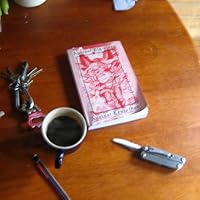
An acidic, satiric novel in the form of a travelogue of the American northwest, complete with annotations by an outraged local.
"I gazed out my window on the sea of dark clouds as my shaking seat jiggled the image into double vision; and I pictured the flat, geometrically divided western landscapes below, wondering why anyone still bothered to travel in this cookie-cutter country. What was the use of visiting identical reproductions of the same Wal-Mart or adding new encounters of equally streamlined mentality to the roster? As far as I was concerned, everything had been shorn from the same cloth, woven for years in the drab bungalows of suburban North America."—from Pacific Agony.
Depressed, cynical, and subversive, East Coaster Reginald Fortiphton has been brought to Seattle by a West Coast publishing company that wants him to write a guide to the American Northwest. His job is to travel, on their dime, from Eugene, Oregon, to Vancouver, shining an admiring light on the region—which the publishers feel has been neglected by the New York publishing monopoly. Pacific Agony is his ironic attempt to fufill his assignment. To ensure that the project goes as planned, the very respectable Narcissa Whitman Applegate—notable member of the Willamette-Columbia Historical Legion and the Daughters of the Oregon Trail Historical Committee (and named after a nineteenth century missionary who was famously killed by Oregon's Nez Percé Indians)—is asked to annotate the manuscript. Her notes at the bottom of the page become progressively more outraged as the alienated Reginald's mock travel narrative skewers the region with merciless political observations—while he spirals into a depressive mania.This acidic, satirical novel hilariously eviscerates contemporary American culture at the same time that it exposes some of the darker motivations of American middle-class liberalism.
"authentic habitation, rapidly being extinguished by suburban raids into urban terrain that bring with them their glum insistence upon child-friendly streets, piped-in TV entertainment and ugly structures meant to house their SUV's." (p28)
"However, the city I liked to imagine existed even before this notoriety. Bizarrely, it had been built along boardwalks on First Avenue, all of them balanced on stilts, barely holding human life out of the lapping sea's reach as it roiled constantly around ankles, threatening the permanence of the place." (p29)
"quagmire, logs, gold, greed, theft, shit, fire. Such, it seems, were at the foundation of the city's civic pride." (p30)
“but the youthful inhabitants of this city seemed caught in a perpetual conflict between urban life and some Wordsworthian delight of the countryside. Which must have been why the young man seemed to be in an altered stat. The bliss of nature for these inhabitants was a kind of drug abuse, which they were compelled to repeat over and over again, returning from it in their altered state that left them impervious to temperature. And I began to wonder how many addicts this had claimed among the local young.” (P57)
“Cars are encapsulated, moving prisons. They became indispensable, of course, after World War II, with the growth of suburban life, as families fled the chaotic interactions imposed by the city. Little did they realize that cars were transporting them to “camps,” secure enclosures that would implant them within a single tyranny bound by blood. Now cars exist only to prolong the cohesion of that nuclear unit, that perverse receptacle of Freudian family romance that has come to dominate every aspect of our culture, political life and geography. They transport mom, dad and kids from one regimented atmosphere to another, isolating them from chance encounters, prolonging and maintaining the enclosed microcosm of their resentful existence, offering only the possibility of a fatal accident as a way out of the script.” (P69)
“Their minds must have been empty of everything, I surmised, except the programmed goals they’d inherited almost as surely as their genes. They were rushing past me with no real reason for speed, gaining a minute of extra time only to lose it again, accomplishing nothing but a dangerous state of competitive chaos that might transform this geometric system into something mangled and bloody: blank-faced housewives headed back form Home Depot with shrewd, determined eyes, their back seat loaded with fitted storage bins; spreading businessmen with pursed mouths, grimly expecting a predictable evening at home; pasty teenage boys in a desperate bid for an autonomous experience, hoping that their fake i.d. would get them into a porn shop on the strip mall; electricians and other small contractors in vans, enveloped in the gloom of unpaid bills and too many children.” (P71)
“Nevertheless, this imperfect molecule – the nuclear family – was still being touted as the building block of our society, by the Right and Left alike; and because it’s atoms are so secretly volatile and the space in which they circulate so curtailed and uniform, we were moving through life like a blindfolded person balancing a grenade, wrapping our claustrophobia and anxiety in the cotton batting of wholesomeness and civic concern, sublimating them into petty worries involving helmets for tricycle riders, low-fat menus and no smoking signs (as our SUV’s belched smog into each other’s lungs), until they would explode in large scale in the context of international conflict. Only then did our rage burst fully forth, played out with provincial contempt for other civilizations in scenarios of war and torture, until the infantilism of our position was revealed to all nations.” (P73)
“watching the endless parade of severed tree trunks, thinking of the millions of years of culture that had woven a matrix between us and Nature, offering art and religion as poor compensations for our unsatisfied desire, imposing a “cultural ordering of the wild.” Then suddenly, the procession of amputated tree limbs was gone, and black empty space encased the headlights.” (P91)
“It wasn’t the originality or even the vivacity of either world that fascinated me – no, not by any means – it was the interface between the two. That line of demarcation that separated the genteel if bruised world of the hotel from the sordid, libidinal world of Stark Street was the magic dotted line from which all cities had once been generated. Magic, because the crossing of the line, or the pulsating energy nudging it from either side, created most of the narratives of urban life. Each camp was defined by its contrast to and interaction with the other. Charity and violence, commerce and crime, entertainment and exploitation all owed something to it.” (P109)
“Again and again in the fine mist of sea and rain, huge stretches of forest or water would hypnotize me into a state of awed surrender, whether I saw the gloomy, totalitarian majesty of a stand of old Douglas firs or waves slashing a desolate, pebbly shore. Then all this would be interrupted suddenly by the baldness of a clear-cut hill or the sinister, smoke-spewing stack of the juggernaut of a power plant. Unlike the East, where, in many places, such sights had long ago tamed and supplanted nature, here the struggle aggressively raged in all its blatant and elemental vulgarity.” (P150)
“Could this terrible cleavage between man and the natural world be nothing more than an ideological cleavage in me? Were nature and man on opposite ends of a dichotomy, or merely different aspects of an endlessly transforming single process? (P172)
“Here I saw the ballet of amputated tree trunks – enormous logs that had been swept to sea by current or storm, smashing against each other in helpless agony.” “I thought about the dog-eared manuscript lying inside the cabin, the cocky urban irony and the contempt of its first several chapters, and how insignificant such observations and opinions seemed juxtaposed against this crashing panorama. Here there was no need for sly irony, which shriveled in the face of blatant, delirious conflict. The inconsequentiality of the irony, then, was proof of the inconsequentiality of the individual. How much did only one shrieking, protesting bird matter? Woven together like twistings of Friday’s tarpaulin, however, they formed great, sweeping gestures of fatality.” (P176)
This entire review has been hidden because of spoilers.
First off, Benderson's eviscerations of the Northwest's dull middle-class culture are vicious and spot-on. Right on! And yet, he doesn't come off as just some terrible New York snob. Rather, he just reveals that maybe, today, the emperor might not be wearing any clothes.
And-- and I say this as a Northwesterner-- his enumerations of what is actually interesting about the region are just as accurate. I'm so glad this was written by an actual outsider-- a pleasant contrast to the obnoxious, self-fellating local writers.
What I liked so much about it was also that it was very much a narrative with a narrator who had a personality-- in an age of impersonal, realist American fiction, this was a blast of fresh air.
i had a really difficult time putting this book down, or deciding whether i even liked the narrator, a cynical drug addled drunk recently incarcerated for pederasty and intoxicating a minor. usually i find rape/assault narratives as plot devices somewhat antiquated/infuriating, especially when it's used as a rouse to illicit some sort of "oh, this person is 'quirky' or 'edgy' and pushing against the norms of society" bullshit. i'm not sure my feelings about this resolved by the end, but i did finish the novel.
sometimes the narrators sour demeanor and descriptions of events read like try-hard attempts to develop a caricaturization of the region and its people, especially entwined with the layout of the book (the back and forth between the editor that constantly breaks up the text), but sometimes they were so dead on and funny that i couldn't help but continue reading.
this was an interesting follow up to "emerald city: an environmental history of seattle," as much of this book reads like real history of the region brought to cartoonish life.
and then there are gems like this:
"...I had the impression that I was finally understanding this region for the very first time. It was neither an Edenic natural paradise nor a smug, opportunist hub of commerce, but actually an accidental, brilliantly grotesque collision between the two. Again and again in the fine mist of sea and rain, huge stretches of forest or water would hypnotize me into a state of awed surrender, whether I saw the gloomy, totalitarian majesty of a stand of old Douglas firs or waves slashing a desolate, pebbly shore. Then all this would be interrupted suddenly by the baldness of a clear cut hill or the sinister, smoke-spewing stacks of the juggernaut of a power plant. Unlike the East, where, in many places, such sights had long ago tamed and supplanted nature, here the struggle aggressively raged in all its blatant and elemental vulgarity."
and
"This was a place--I finally had to admit--of violence and struggle, a thrillingly ugly battle between the land and humans that produced a rich, stupefying sensory experience. Here there would never be a chance for genuine order; only the snarl of nature echoed by the discontent of the human condition--and all of it hiding under a featureless mask of progressivism because the people here were well aware that their struggle could never be completely expressed in words."
in some ways the last pieces of the book remind me of a part of "emerald city" in which the author gives overwhelming agency to nature to rectify the intrusion of civilization on the west coast by liquefying the artificial mud blankets created by the regrades on the tideflats; this would be easily done during the looming earthquakes characteristic of the geology of the region and completely destroy downtown seattle. as a reader (i think) you are meant to realize that the perceived, tacit sterilization of the area is actually heavily shaped by the chaotic ecosystems that will not be, long term, contained by humans for commerce. this is all reinforced through repeated appearances by john zerzan's writings as well as the indigenous cyclical myths contemplated throughout.
second most interesting to me, i suppose, was that the author never makes excuses for himself or his history, but so vehemently loathes the ability of those in the pacific northwest middle and upper classes to tidy up their latent racism/classism/sexism/desire to dominate nature that he spends most of the story high out of his mind. as he further investigates the other methods of living deployed by those destroyed by industry and capitalism's clashes with nature, the region begins to cast a spell on him that ends ambiguously, as, according to the repeated themes of the book, it must.
Completely nihilistic and hilarious!! A hack writer takes a job writing a travel piece on the northwest and Puget Sound, under false pretenses, and recounts his adventures here, his bitter sarcastic sense of humor at the ready.
Exactly what I wanted and expected from a Semiotext(e) novel. For some reason copies have been showing up at my local bookstores in Portland, decided to pick one up before a trip up to the Olympic Peninsula. From the start, this book had me laughing, the travelogue with intervening footnotes structure had a great comedic effect. Among the paranoid and crude ramblings of the unsympathetic/unreliable narrator I found plenty of observations I agreed with re: the PNW. As a fellow transplant, but from Florida not the NE, I sympathize with searching for the radical undercurrents (Astoria Finnish socialists, Wobblies, eco-anarchists and anarcho-primitivists, WTO black blocs of the battle for Seattle) of the past bubbling up into the present. I’ll be buying a drink at the labor hall in the Astoria next time I visit. 4/5
Fun play with voice. A read that felt a bit like getting stuck talking to a drunk distant relative: a little tedious, but still entertaining, with a few rare moments of insane clarity that you'll parrot to your friends the next day.
The narrative and structure of *Pacific Agony* are quite appealing: cynical and seditious east coast author is commissioned to write a guide to the Pacific Northwest, overseen by a regionally patriotic and rather uptight daughter of the Oregon Trail (whose voice is only found in the footnotes to the author’s manuscript). This premise seems to promise a humorous clash of cultures, and *Pacific Agony* does provide that, however, this conflict is played out to such an extreme degree that the text, throughout, feels forced and heavy handed. This is particularly true in relationship between Fortiphton (east coaster) and Applegate (northwesterner), as Benderson, in an effort to continually up the ante in the counterpoint between these two characters, allows the both of them to grow more and more extreme, often to the point of caricature.
That said, *Pacific Agony* was engaging enough to keep me reading (2.5 stars seems more fitting), mostly because, however forced, many of Fortiphton’s observations about the Pacific Northwest—which can often be extended to America, as a whole—are spot-on, or, at the very least, thought provoking:
"This was a place—I finally had to admit—of violence and struggle, a thrillingly ugly battle between the land and humans that produced a rich, stupefying sensory experience. Here there would never be a chance for genuine order; only the snarl of nature echoed by the discontent of the human condition—and all of it hiding under a featureless mask of progressivism because the people here were well aware that their struggle could never be completely expressed in words."
This book was soooooo lame. The premise sounded awesome. About a travel book written by someone who didn't want to really write it, full of increasingly-furious protestations in the form of an editor's footnotes. But I sort of want some of these hours of my life back. It's not written like a travel book. It's not even really written like a travelogue. It's just so ham-fisted in everything it does, and the writing is boring. This book does a lot of telling and not a lot of showing, and it's not funny, and the only thing that could have saved it would have been if the narrator got hit by a train and sliced up by it's sharp train wheels. I am never reading any fiction published by MIT ever again. Don't read this book.
Machu Stapler = best. name. evar. (Machu as in Machu Picchu. Mr. Stapler is the protagonist's distant publisher.)
- Benderson delights in handling the taboo. - There's a distracting war between the unsympathetic and barely reliable narrator and the PNW annotator whose righteously indignant footnotes make you wonder who's nuttier. - I didn't really like this book. But I liked how I didn't like it.
This is my second time reading the novel, and oh, what a pleasure. Having been to Victoria last summer, it brought back great memories of my adventures there, whether queer or in general. Benderson is a living treasure.
Note 1: I just read this for a third time for an upcoming conference presentation. It's now one of my favorite contemporary novels.
After The Romanian, it's amazing this book was written, given this author-man's demons. Weltschmerz is chief among them, for this well-oiled utilitarian svidrigailov-type narrator. The monster killer in here is reduced to a bed wetter his house is gone.
I didn't enjoy this novel as much as expected but I read at a complex time in my life so I need to give it another chance. At this point I would only give it three stars and until I look at it again I will always worry that might be generous.
In the midst of my own pacific agony, I enjoyed reading this book for its sardonic treatment of northwestern cities. But otherwise... not all that interesting.