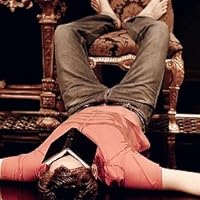
A deeply romantic evocation of gay life, this stunning first novel by celebrated British gay writer Neil Bartlett gives a tender, erotic, brutally explicit portrayal of love between men. In a dark corner of the best bar in the city, two lovers fall into each other's arms. The bar has been called many names, but it is now known simply as The Bar. Its proprietor is the aging, still glamourous Madame. Its clientele is gay. The two who fall in love are Boy, a beautiful nineteen-year-old, and the handsome, forty-something "Older Man" referred to as "O" by the regulars of The Bar. This is the story of Boy's and O's courtship and marriage, of Madame's role in the affair, and of the man called "Father," who threatens to come between them. Searingly honest in its deception of gay culture and ritual, this gripping novel is at once a moving celebratiion of love and a stark picture of life for gay men today.
Born in 1958, Neil Bartlett has spent twenty-five years at the cutting edge of British gay culture. His ground-breaking study of Oscar Wilde, Who Was That Man? paved the way for a queer re-imagining of history ; his first novel, Ready To Catch Him Should He Fall, was voted Capital Gay Book of The Year; his second, Mr Clive and Mr Page, was nominated for the Whitbread Prize. Both have since been translated into five European languages. Listing him as one of the country's fifty most significant gay cultural figures, the Independent said "Brilliant,beautiful, mischievous; few men can match Bartlett for the breadth of his exploration of gay sensibility".
He also works as a director, and in 2000 was awarded an OBE for services to the theatre. He founded his first theatre company in 1982 and is now an "independent theatre-maker and freelance director", continuing to write novels and work as an activist for gay rights.
this often fearfully stark novel seeks to boil down the clichés and stand-bys of queer fiction into a mini-universe composed solely of archetypes and living metaphors. the problem with this is obvious: a cliché is a cliché is a cliché. nonetheless, the writing is strong and the late entrance of the oddly dithering, disturbingly ambiguous, potentially catalytic character "Father" manages to force genuine, human emotion into what at times appears to be something of a gay-brecht-for-beginners.
overall, more intriguing to contemplate than to actually experience.
I needed to sit with this book a bit before attempting to write a review. I'm still not sure I can articulate how I feel about it. It is beautiful and hard and sad and joyful and devastating and affirming, and absolutely worth sighing and sobbing over.
Since I normally read and review romance on here, I should first stress that this is NOT a romance. It is a love story (really, multiple love stories), but does not aspire or adhere to romance conventions and expectations. The story and the MCs' relationship is in some ways brutal, obscure, and painful, but it is also loving, overwhelming, and visceral. There is a happy ending, in the sense that the central relationship is loving, strong, and endures (though it is not sexually exclusive). But framing it as an HEA in the romance sense is trying to make it something it's not.
So what is it?
This book is a love story between two men, yes. It is about two men learning - one for the first time, one anew - how to love, how to be together, how to be. But it is equally about how this love affair affects/ animates/ inspires/ is gossiped about in the broader community in which it plays out. With the effect that the love story between O and Boy is both central and oddly peripheral.
More than a love story between two men, then, it is a love story about a specific community in a specific place and time (not that long ago): a community that is surviving, loving, and living in the shadow of AIDS and in a society that, when it's not actively rejecting, punishing, and abusing them, just wants them invisible and grateful for being allowed to exist. Bartlett in the preface refers to "the fierce tenderness with which all characters in the novel habitually - and without question - care for each other" -- and to me, THAT'S the main love story in this book: the fierceness, tenderness, care, acceptance, burden-sharing, and togetherness that bind this group of people, when all they have is each other.
It is a time capsule: a book published 32 years ago that in some ways feels utterly foreign, but in other ways feels timeless and utterly recognizable.
I don't usually like to center my identity as a cishet white woman in my reviews, because fuck knows that cishet white women are centered enough in this world. But it's relevant here because it's inescapably central to how I read and experienced this book. Obviously this book is not about people like me. And in some sense it's not for me. I felt very much a visitor in this space, sometimes in an uncomfortably voyeuristic way. But while it is a specific story, it's also a generous one. It says: "You, who are not in us or of us. You, who want to know what it was like, how we lived and loved. You, who wish to share this journey a while. Welcome."
And while this is in part a function of intangible things like feel or tone, it is primarily a function of the way Barnett uses POV and language.
Because this is a love story narrated by an unnamed quasi-omniscient third party, a man who frequents The Bar, which is the focal point for the community and the stage in/upon which O and Boy's romance starts, develops, and deepens. And this means that our access to Boy and, especially, O is highly mediated and circumscribed. The first quarter of the book is all about Boy's arrival to The Bar and the shockwaves his beauty, naivete, and thirst for experience and connection creates for The Bar's denizens. O doesn't even arrive on page until around the 25 percent mark, and though he has long been a regular at The Bar, he is an opaque, mysterious presence - and remains so for much of the book. We learn much more about Mother, the owner of The Bar and a fierce protector/ den mother/ fixer who essentially orchestrates O and Boy's romance, than we do about O. And this means that our experience of O and Boy's romance is essentially the shared experience of outsiders: we are observing and reacting to their romance as if we were gossiping about it at The Bar, at least as much as we are experiencing and, for lack of a better word, living in it as one does in 3rd person single or dual (much less 1st person) POV. Where we are getting access or insight to things the narrator couldn't possibly know, this is often (though not always) framed as speculative - the narrator taking a step back to divine what might have happened, how it might have felt, what the motivations might have been. And this, of course, is why this story is as much about the community around O and Boy as it is about O and Boy - because the experience of the love story is mediated through and inextricable from the way it is perceived and understood and interpreted by others, and what it means to them:
It would not have surprised me to have seen them at that time walk naked and hand in hand down the street, so proud they were of each other; or at least bare-chested and barefoot and sweeping the pavements with some extraordinary gowns, like saints, that was the way they walked when they were out together. They were so very much in love; I used to just stand and watch them. I had not seen so many men be that way, and I still could not quite believe that it could be that way. In fact these days I still cannot quite believe it, I cannot believe that an affair like that is either legal or possible.
You just can't believe these things happen.
The language use is also incredible here. And there are definitely commonalities with Skin Lane, which is a very different book (I reviewed it here). In my review of Skin Lane, I noted that the narrator is constantly bringing the reader in, sharing observations ("you will not be surprised to hear") and asking questions ("have you noticed that?") in a way that (to me) makes us complicit in our own manipulation. In RTCHSHF, the same technique is used, but to opposite ends: it is an act of generosity, of sharing, of drawing the reader in to this little gossipy group, of helping us understand what it was like in that time and that place and with these people. It is making the reader an "us" to frame and support and laugh at and admire and be jealous of and love O and Boy. And the language itself is sharp, concise, precise, but also wry and empathetic, always seeking to explain and comfort and, in some cases, justify. Importantly, though, it very purposefully maintains the distinction between people in and of the community, and those of us invited in as guests. There is no erasure of the difference between queer and non-queer, and there is no pretense that this distinction doesn't matter. And while people like me are invited in, it is made very clear - in a way that is gutsy AF for a book written in the late 1980s - that the lives and loves of O and Boy and Mother and the other denizens of The Bar are in no way conditional on outsiders' acceptance:
What else can I tell you about our nights there? Yes, you could have sex there, in the toilets, but only according to certain rules. I should say, really, that you could live just how you wanted there, according to certain rules. But the point was, they were our own rules.
This book is not perfect. There are some things I loved and some things I really didn't. The section on Father was really hard to read, although it showed us new sides of Boy and O and their relationship dynamics, particularly O as caregiver for Boy (while Boy devotes himself obsessively to Father). But even in the parts I didn't like, there was always some beautiful observation or incisive insight that kept me engaged, pulled me along. And fuck. What a ride.
A note about context. AIDS is the inescapable backdrop, not on page but also on every page. There is a lot of love and joy in this book, but it is also suffused with loss, grief, and absence:
What I remember is seeing a grown man lean against a wall and cry. As I remember it the wall was in the hallway of O and Boy's new flat and the man was one of the guests at the wedding, a big handsome man of about sixty, and he went pale and put his hand up to his face as he started to cry and then quite unselfconsciously leant up against the wall, because he had to hold himself up. And he said, over and over again, as he was crying, Oh I miss him, oh I wish he was here, oh I miss him, oh, I wish he was here.
Also, for those sensitive to such things, the relationship dynamics between O and Boy can be characterized as BDSM. This is not just about the sex (which is not especially graphically described), but about how they relate to each other in general (informed also by a significant age and experience gap). This is particularly in play in the chapter called "Robing the Bride", which recounts what can almost be described as an initiation or hazing period that O puts Boy through before the wedding.
There are some serious CWs here. Chapters are bookended with short, non-graphic but chilling descriptions of homophobic violent assaults happening at the time (not against named characters). Generalized homophobic attitudes and actions described throughout. Attempted homophobic assault against the MCs. Ambigious relationship with mysterious Father figure with overtones/ suspicion of childhood abuse. Racist scene involving blackface/ body paint and some racist language. Please read with care.
I end on this list of advice from Mother to Boy soon after his arrival on the scene. It can hardly be bettered.
1. Accept all the advice you can get, courteously. After all, they've been doing this longer than you have. 2. REMEMBER, YOU HAVE LEFT HOME NOW. 3. Never make love badly. 4. Remember who you were this time last year. 5. Protect your body. 6. 'Money is everything, right?' 7. The moment after he's come, just after, that's when you really see his face how it is. Whip out your instamatic and take his picture and keep that in your wallet. 8. Mother speaking of a great gown: 'If you can't afford it, steal it; if you can't steal it, copy it; if you can't copy it, buy a postcard of it and dream about it; if you can't afford the postcard then get your fucking act together.' 9. Mother says: If someone does something, it is probably because she wants to. 10. Mother says: People only lose because they're not strong enough, not because they don't want to fight or aren't good at fighting.
I'm thinking of petitioning Goodread to bring in a 0-star category. If they do, I'd downgrade this one. I read this many years ago but it sticks in my mind as one of the worst books I've ever read. Boring doesn't even describe this horrible mess. I think it's symptomatic of "gay" related books and movies. I recently went through a list on IMDb of "best" gay movies and got hold of them. Dear God. Why should gay writing and gay film making not be held to account the same as any mainstream entertainment? Seriously, watching them was about as pleasant as dragging my fingernail down a blackboard whilst being anally probed by Anjem Choudrey. Bone-wearyingly long establishing shots of some nameless, badly-shaved guy walking somewhere or other. Dialogue that makes you want to invent a virus that prevents the human race speaking--ever. Ahhh. And then there are books like this. And people defend it saying it's a product of its times and can't be judged against modern gay novels. Really? That's like saying Wilkie Collins The Woman in White (brilliant thriller) can't be judged against Harry Quebert (my hand still shakes from repressed fury at wasting money on that total pile of garbage). I wonder if it could be a defence in a court if found downloading books illegally to say the crime would be actually having to pay for them? If that defence ever gets accepted, this book would qualify.
The first time I read this book in college I couldn't get into it, but I loved it the second time around. I think what threw me the first time was the intensity and even violence in O and Boy's relationship, which I think shocked me back in college and soured me on the book. But on a second read I feel like I understand what Neil Bartlett was going for, and his portrayal of the relationship between the two characters feels very full, rich and powerful. Bartlett does a great job of making the world of the book--the bar, the apartment, the city-- feel vibrant and alive. The characters, the dishy narrator, the book's sense of mission, and the occasional elements of magical realism all drew me in and made me fall in love with the book.
I found it a struggle to finish this book, although the plot did gain interest in the final 50 pages or so. It's an improbable tale of mutual sexual obsession between an older man, identified only as O and a youth of about 20, identified only as Boy. Most of the action takes place in and around a London gay bar, and the tale is narrated by another regular bar patron, who remains anonymous. We learn nothing about the narrator, or his own feelings, but can surmise from his tone that he is an older, gossipy queen living vicariously through the Boy-O affair. A vague hint of danger runs through the novel as the narrator mentions every chapter or two that another gay-bashing has occurred in the bar's vicinity. The bar is portrayed as its own, highly insulated subculture, where customers more or less worship Madame, the old drag queen who runs the business and nightly performs her signature tune, "All of me, why not take all of me?" The book may have some value for evoking the atmosphere of closeted gay bars in the pre-AIDS decades. But by the end of the novel, I was thinking of another old standard, that of Peggy Lee: "Is that all there is?"
I am very glad I read Bartlett's Skin Lane first. That book is one of my favourites. Unfortunately it led me then to this one.
This book seemed to have everything going for it, nameless characters, as in Skin Lane, referred to here as O and Boy. Bartlett's poetic writing style is as always on display. A plot that sounds interesting.
What you find as you get in to the book is that the plot described on the back cover is the entire plot. Two men meet and fall in love at a local pub. Nothing else much really happens.
Bartlett's flowing narrative is on overdrive. It seems in this, his first book, he hadn't yet learned how to reign it in, and there are many times when it just becomes a rambling incoherent mess. These numerous jaunts take away from the already thin plot to the point that several times I found myself falling asleep trying to read the book.
I like the author's strong pro-gay tone, being openly gay and direct about it is never an issue. I totally agree though with another reviewer who said that this book is better to contemplate than to actually read.
There were times I wanted to throw this book against the wall. You will probably hate it. I finished it because I fell in love with the main characters, Boy and O, and I didn't want to let them go.
Back in high school, one of our favorite games was “Division by Zero.” Because division by zero is “undefined,” we got a kick out of (mis)using it to achieve any desired mathematical result. There’s an equivalent in modern fiction: the first-person omniscient narrator. In the best cases, the story collapses upon (or into) the narrator: the choice of those things to tell the reader that no narrator of merely human powers would know does ultimately define the narrator, not the story’s characters. This is almost impossibly difficult to pull off if the only things we know about the narrator are the things he tells about others, not himself; *A Dance to the Music of Time* is probably the most successful example I know of, and that mostly because of its epic breadth, or at least bulk – and because the author seems to deliberately tease the reader with how little will be revealed about the narrator.
But things are much worse in those cases in which the narrator, for no discernible reason, shuts off the omniscience from time to time. Neil Bartlett’s first novel is a particularly annoying example. The only thing we know about the narrator is that he more or less lives in a London gay bar (probably in the early- to mid-1980s, as the proprietress is depicted as forward-looking for handing out condoms), and has made peace – sort of – with the fact that he isn’t as handsome as the one main character, called O, and will never again be young, and probably never was beautiful, like the other main character, called Boy. On the one hand, he’s omniscient enough to conjure up details and even an entire scene (the absurd, grotesque “engagement” scene) out of nothing, and even relates things Madame says to herself when alone and – most astonishingly – the thoughts inside the semi-senile mind of the character who may or may not be Boy’s father; on the other, he chooses to know nothing about Boy’s past or, for that matter, the identity of the father (or “father”) in question. Now I would welcome with open arms such switching on and off of the omniscience if it served some discernible purpose beyond really crude plot manipulation, but . . . no, there ain’t none.
O (oh) Boy (boy)! The novel promises initially to be something from the Gordon Merrick School of Poolside Reading, with two impossibly gorgeous protagonists finding each other and living happily ever after. And yes, it’s almost that bad, but not quite. O – as in Older, not as in Story Of, although in fact there’s more than a little bit of Sir Stephen in him – may be nearing the end of his visibility days in a gay bar: he’s graying at the temples, but still all impossibly handsome and studly. And yes, we know virtually nothing of his past, too, except for the things he tells while really, or more likely pretending to be, asleep. Then there’s the impossibly beautiful Boy – that’s the only thing anyone calls him, who, as noted earlier, is entirely without a past, except for that niggling father/“father” bit. Now at this point one may object: So much of gay life back in the Bad Old Days (which, unfortunately, and of course, are far from over) involves the creation of new identities to compensate for, or replace entirely, the identities one grew up with, which were more often than not characterized by misery and even abuse. This is perhaps no more apparent than in the case of those who find their identities in adopting the gender characteristics typically associated with the other of the two major sexes. (No shortage of transvestites and/or transsexuals – we're never given to be sure which – in this bar, by the way.) No problem with this. The problem becomes apparent when these new identities are expected to carry a story line that demands a certain degree of psychological depth, and the characters in question lack either such depth or sufficient motivation to make their actions appear plausible. Thus O, the “man” of the couple (and if you think it insulting to describe the couple in such terms, do please reflect upon the number of times Boy is required to do drag, and willingly complies, whereas O never does or has to), whose dominance over Boy includes a certain degree of physical violence that might be not just erotic play, and who of course is the “top” in bed, becomes Boy’s docile helpmeet when the latter unilaterally adds Father/“Father” to the household. And never even asks Boy who the hell the guy is – but then, I guess the narrator -- and Bartlett -- don’t want him to ask that.
For all that, the novel begins well enough – those eight words are perhaps my entire review in a nutshell – because despite the hackneyed premise Bartlett does have a way with words, and his depiction of life in a gay bar does have the ring of truth, especially to gays of a certain age. (Don’t ask me how I know.) But our protagonists’ progress toward “engagement” and “marriage,” all masterminded by proprietress Madame (who later renames herself Mother, although since there’s no question of biology she’s spared the irony quotes), grows ever more ludicrous, as if a series of role-playing games and humiliations were necessary milestones on the way to achievement of marital bliss and successful avoidance of gay bashings (which knowledge should certainly be imparted to all gays, not just the impossibly beautiful ones being directed toward Togetherness?); and the novel’s last and mercifully shortest third, obsessively prepped by the author, in which Father/“Father” joins the household, is arbitrary and just plain sloppy in conception.
Edmund White loved this book. Figures. Oh well, the novel begins well enough. Three – generous – stars.
I wish I knew where to start! This novel is so carefully crafted that, though interspersed with omissions, it seems to lack nothing. It’s filled with opposites; silence is met with giving oneself fully, loneliness is countered by a community and a sense of belonging. Often times what is told is so raw and intimate that reading the scenes almost seems to be intrusive. I could go on for pages but I’ll leave it at a wholehearted recommendation to read it.
Spring break has finally allowed me to finish this, and I'm very grateful for the break.
I continue to be stunned by Neil Bartlett. There's a hypnotic, erotic, and dream-like element to his books that has convinced me that they are some of the best gay male novels available to readers. Bartlett's books consistently map the intersections between violence, desire, and abjection in the lives of gay men, while they are also finely attuned to the works of earlier gay writers. The tributes to _The Picture of Dorian Gray_ that one finds here are beautiful, while the mysterious figures of "Father" and "Mother" that become central to the narrative deserve their own novels. Bartlett's readers will experience stupefaction from his work's strangeness, anticipation around his characters' sexual exploits, fear impending violence against vulnerable gay men, and admiration for the lyricism of a frankly aestheticist passage. As I was reading _Ready_, I was repeatedly uncertain about why I was reading, but I knew that I had to keep going, almost as if unraveling the story meant unraveling something about myself.
I could keep gushing, but really, the point of a good review on goodreads is to get you to read the book. In this case, if you're interested in fiction about sexuality or in gay novels, this is a must-read. I'm not sure I'll have many more concrete things to say until I've read this again or, alternatively, recovered from its spell.
This is a very conflicting book for me. For the most part, if you read the blurb, that's all you get, two men are introduced to each other and fall in love and end un together, nothing else happens. Plus a few overly descriptive paragraphs about settings and quite frankly nonsensical actions from every character. At one point I swear the author describes the same room twice in different chapters with very similar words. It made it very hard enjoy reading.
Moving on to the hardest part for me, I don't agree with justifying this book as a "product of its time". The book point blank tries to romanticise physical, sexual and psychological abuse to a 19 year old Boy, by not only his boyfriend but his "Mother figure" and this "Stella" Character. Whether it was consensual or not, it's not clear. To me the book makes it seem like he didn't know better and confuses this abuse with love. Again, it was difficult to read and feel enamoured by this couple when 2/3 of their relationship was just abuse.
The only redeemable for me are the final chapters after the arrival of the "Father" figure. The writing becomes a bit more efficient and the romanticised abuse is no longer there. However, it's still unclear how Boy knew the Father figure, and I wish we got that, because the rest of the book seems like filler descriptions that do not bring anything to the plot.
I would not recommend this to anyone
This entire review has been hidden because of spoilers.
The problem is that I read this novel not when it was published in 1990 or any time in the 1990s but in 2018 and for me any positive emotional response that I might have had to the novel was no longer possible. The world had changed in 28 years, I had changed in 28 years and none of the changes inclined me to have patience for this overwritten, self-indulgent, mastubatory, wish fulfilment of a novel. I had read an excerpt, 'Three Wedding Ceremonies' in Edmund White's 1991 anthology 'The Faber Book of Gay Short Stories' and it was my least favorite piece in the anthology. Indeed I hated it with a passion because it seemed to be the verbal equivalent of the gross simpering pre-Raphaeltie sentimental homo-erotic scribbling of Simeon Solomon.
I do not like it but then I don't care for Neil Barlett's writing. Even being loved by Edmund White, an author I do revere, doesn't make me question my opinion.
This is a boring book. It is trying so hard to be something, using literary techniques like directly labelling the chracters instead of using names and making various homages to previous (good) gay literature. It is, however, boring. I quit half way through, and then decided to complete it while on a holiday. It's just a boring re-enactment of some stylized and sterotypical 1980s gay life. Nothing is to be learned in this book. I usually don't bother with writing reviews, but I would want to dissuade anyone from trying to plough through it. In some ways the writing is very good, but that doesn't make up for a vacuous and uninteresting story.
I found this one really difficult to get into, but I kept pushing through it because there were some very good reviews. I thought the one dimensional characters based on gay stereotypes would eventually become more complex, but that was not the case.
The messy, drawn out writing style didn't help, I'm sure. I thought this would be a page turner, but I found myself wanting to skip some pages to get to some substance. In the end, though, it was really the stark contrast between the queer scene I've grown to love so much and the "manly man love for men that only men understand" that made this difficult to relate to or root for.
Un libro strano, con una scrittura a tratti di difficile comprensione. Da un lato una storia d’amore intensa e violenta. Dall’altro la descrizione del periodo storico in cui andare in un locale gay era pericoloso. Nel testo sono tanti i cliché usati. Forse un segno del tempo. Ma per certi versi diventano quasi eccessivi e rendono il testo a tratti grottesco. Proverò a rileggerlo in futuro.
In the depths of the night, in a little place simply called "the Bar", two men meet and start a passionate affair under the watchful eye of the Bar's patron, the mysterious and enigmatic "Madame".
This book was, to be honest, somewhat underwhelming.
It has some truly powerful turns of phrase, some parts that are breathtaking in their beauty, but most of the book feels like a lot of filler for these smaller bits. And, as another reviewer pointed out, the summary you read on the back of the book pretty much gives you the entire plot.
Seriously, that's it.
Additionally, as some of the other reviewers here also point out, "Ready to Catch Him Should He Fall" is rife with clichés.
And I get that this is done on purpose. The clichés are there to make a point. But still, when you fill a book with clichés, no matter how badly you want to use them to underline your message, the book is still going to end up being ... well, quite frankly, a little boring. Perhaps particularly for readers like myself who for the most part prefer character-driven plots.
I think this is why it took me so long to read this. A 300-page book normally wouldn't take me more than a week to read, this took two. It was simply very difficult to get into, because the often painfully stylized nature of the descriptions, particularly of the characters, made them nearly impossible to relate to, made the situations nearly impossible to relate to.
And yes, okay. I'm not a gay man living in London in the 80s, so there are naturally parts of this book that it will be difficult for me to connect with on a personal level, still, a well developed character can almost always make the reader feel a bond with him/her, even if that character's situation is nowhere close to the reader's own. This bond is never created here.
So what did I like?
Well, the atmosphere of the Bar is interesting, and though, as mentioned, the characters in the story are overly stylized and, let's face it, charicatured, an obsessive focus on physical beauty often overshadowing actual character development, this does have an effect in certain parts of the book. When developments in these characters' lives are put next to descriptions of attacks against the community, one understands the need for flamboyance, for overtness, for pride. These parts of the book are powerful.
Madame/Mother is a fascinating character who plays a pivotal role in getting O and Boy together. Her motivations for this are vague, though they seem to orbit the near-worshipful appreciation of beauty that permeates much of what happens in the Bar. She, too, falls prey to the author's need to stylize everything, but through her actions she is permitted more of a personality than any of her patrons.
The narrator is also interesting. The reader is never made privy to his identity, but he is known to be another patron of the Bar. He speaks of his motivations for relating this tale in flowing terms that also seem to revolve around the theme of beauty, but because we don't know anything about him, and because we know he is clearly a very partial storyteller, he becomes a fascinatingly unreliable narrator. He even admits this himself, often imagining situations and scenes he hasn't actually witnessed, though presenting them in such a way that we are, I think, supposed to believe they happened as he imagines they did.
In other words, there are, as mentioned, parts of this story that are interesting, and I think the novel might have been as well, had the characters and their motivations been more developed and subject to less cliché.
In addition, had the book been 150 pages shorter, I think it might actually have been a very powerful, beautiful image of a minority culture in the midst of a socially and physically traumatic time. As it is, the book is too long for its very limited plot, and this, sadly, makes for slow, often dull reading.
Looking at some of the less than flattering reviews, it's clear that some readers are searching for realism in a work that is not only idealistic, but tells a fairy tale of mythical proportions.
It seems futile to scour the pages for "truth" in a work that quotes Herman Melville's reflection on the verity of writing, "I never used to believe what I read, but only thought it very strange, and a good deal too strange to be altogether true; though I never thought the man who wrote the book meant to tell lies". It also seems exhausting to cling to a world built around the periphery of one's own "truth". Sadly, the fact that some readers engage in these activities means that they end up overlooking the meaty substance buried within Bartlett's prose.
Through its restless need to provoke, seduce, baffle and embolden, Bartlett's strong writing gives hope to the oppressed. This includes both the gay men within the story, who fear the symbolism of the knife poised to slash their faces open in the night, and those moving about the "real" world, filled with similar acts of loathing and violence.
In this respect, the novel possesses a remarkably positive tone, taking on the resonance of a near-deafening battle cry. This is incredibly rare for books that fall in the "gay literature" category. To be able to transcend the margins of the victim narrative, Bartlett employs numerous tropes. These serve to achieve a few things at once: thicken the structure of the central fairy tale, appeal to a collective consciousness and communicate with those, who are familiar with the inner-workings of the discussed scene. In doing so, these symbols manage not to stray far from the "real" gay world, which is often reduced to a realm of walking clichés by those, who aim to undercut its unique struggles and attributes.
Bartlett's work operates as a myth, and this key quality might make it a somewhat challenging read for those, who are used to the logic that rules novelisations, for example. This is also the crucial difference between fiction and literature. Those used to the subversive tools of the latter appreciate writing for its artistic value, and can spot the devices used to carve lyrical landscapes. It's along these planes that readers' perceptions are challenged.
The novel toys with our understanding of what is real and what must remain indefinite. It takes pleasure in storing its morals beneath images, hiding thick emotions between grappling hands and tear-stained cheeks. For all its surreal plot points and political endeavours, the story is incredibly tender and relatable, as evidenced by the characters' struggle to articulate the depths of their love.
Overall, "Ready to Catch Him Should He Fall" is a stupendous, thought-provoking novel that celebrates not only the elasticity of the mind, but the beauty of transitory feelings.
O ouro do livro parece estar num lugar diferente daquele que o autor acredita, mas quando ele se permite enxergá-lo, o livro se torna mágico. Um retrato bonito e duro sobre o amor ideal entre o Garoto e o Homem Mais Velho, narrado do ponto de vista de uma bicha velha que viveu este amor apenas como espectadora. Na metade do livro, depois de parecer derrapar nas descrições detalhadas da fauna e flora do Bar onde todas essas bichas londrinas se encontro, me pego cada vez mais afeiçoado a esse narrador, talvez por medo ou por projeção, por me reconhecer bicha velha memorialista e por acreditar na posição do viver-de-segunda-mão (ver trecho memorável, algo da voz exclusiva do narrador, sua experiência em primeira mão). O romance entre Garoto e Homem Mais Velho parece bastante tradicional de um tipo de descrição de sonho gay (o equilíbrio de belezas e emudecimentos, dois opostos que se encontram na dor), com todas as tintas de "Giovanni" do Baldwin, entremeado por diversos relatos de ataques homofóbicos violentos que reforçam a sensação de bolha deste romance. E então o livro muda radicalmente, e o surgimento do "Pai" do Garoto traz um fio narrativo que nunca vi tão bem representado: a velhice gay, os últimos dias de uma geração, cuidada, amada e odiada pela geração a quem coube cuidá-los. O terço final de "Ready to Catch Him Should He Fall" beira a obra-prima (e, pena, se estende um pouco além do necessário): "bem, diga à Mãe que nós fomos perfeitos".
Um trecho memorável:
"Escuta, dá licença, eu sei, eu realmente tento não ser amargo, como todo mundo que conheço. Você passa um tempão sentindo que está gradualmente saindo, saindo de casa, gradualmente se distanciando, criando uma distância. Uma distância a partir da qual você consegue enxergar a vista propriamente. Um ponto a partir do qual você consegue escrever uma carta pra casa, ligar pra casa, mandá-los uma fotografia de como você é agora, contá-los o tanto sobre a sua vida que você queira contar (...) E então chega o momento, anos depois, quando você se dá conta que finalmente vive outro tipo de vida e que está, finalmente, vivendo em outra cidade completamente, um lugar muito diferente daquele em que nasceu. Que você, finalmente, saiu de casa. Ainda assim, mesmo que tenha te tomado tanto tempo, você ainda sente como se tivesse fugido à noite com apenas aquilo que precisava, apenas o que conseguia carregar numa pequena mala. E agora você sabe que aquela pequena mala é tudo o que você tem consigo, e agora ali está você numa manhã fria na estação de trem, uma rodoviária talvez, e você percebe que todas as suas habilidades e suas memórias e seus números de telefone estão todos naquela pequena mala, e claro que há aquele endereço, e aquela única fotografia sua, com eles, sempre lá no fundo da mala; essas são as únicas coisas que você têm, de certa forma, sua mala e seu casaco que você usa em todo lugar, e seus sapatos que você usa em todo lugar. E às vezes você quer chorar, chorar, chorar, você deseja que eles te aceitassem de volta, você deseja que houvesse um lugar para o qual voltar, ou algum lar para o qual voltar, uma forma de voltar ou, mais precisamente, uma forma na qual você nunca tivesse saído... mas às vezes, bem, você pega sua mala, você pega aquela pequena mala sorrindo para si mesmo e você toma aquele trem."
(Serpent's Trail/2017, p. 233-235, tradução minha)
This was a real disappointment. I couldn't help thinking that this is the noir version of Gordon Merrick. Here these godly beautiful men are inarticulate and abusive instead of rich and fabulous. The story is almost non-existent and the episodes are painfully drawn-out. The three principal characters are enigmatic (to be kind) or just plain boring (to be honest). Whatever their motivations are is totally unclear and why we should care about them becomes increasingly difficult to understand. Some of the minor characters, although only quoted occasioanally, are actually more interesting (e.g. Gary the dj at the bar where most of the "action" takes place and the black drag queens). The old man who enters at the end of the book is better rounded than either of the three main characters. We can see him and begin to have a reader relationship to him, whereas Boy, O, and Madame were cartoon figures at best.
Tim Hughes in his "The Naked Tuck Shop" describes the Colony Room Club in London presided over by a domineering older woman, Muriel Belcher. I am wondering if Bartlett had this woman in mind when he created Madame/Mother who is the commanding matriarch of his unnamed Bar. If so, he was writing for a coterie of men who would pick up on this connection and maybe this increased their pleasure in the book.
A comment on the narrative technique: the story is told in the first person by someone we never learn anything about although he assures us that he has had sexual liaisons with both O and Boy and is a frequent patron of the bar where they all meet. Just one more "dreamlike" confusion in this obsessive novel. Finished with great relief.
“You, of course, living in a rather different time or in different countries, will find all this hard to credit now, everything they went through[…]”
One of the most remarkable, important books I’ve ever read. I urge every queer person to pick it up and read it - it’s a true time capsule of the queer experience in 80s-90s Britain. Reading it as a young gay person in 2025 was an incredibly emotional experience. Several moments had me truly lost for words. It’s a story told through omissions. Like the experience it’s trying to reflect, it’s at times puzzling, uncomfortable and surreal. It’s uncanny and dreamlike. It often feels like the mourning of a lost memory, or rather the mourning for a future which generations of men before me will never get to experience. It’s unlike anything I’ve ever read before.
The Melville quote Bartlett finishes the book with summarises it all perfectly:
“Somehow, when I read… I never used to really believe what I read, but only thought it very strange, and a good deal too strange to be altogether true; though I never thought the man who wrote the book meant to tell lies.”
Bartlett’s work is one of the most honest and raw pieces of fiction you are likely to find.
"Ready to Catch Him Should He Fall" by Neil Bartlett left me with mixed feelings. On the one side, this novel is a beautifully written, lyrical witness of a chapter of queer history that too often gets swept under the carpet. And the scene of is simply awesome. On the other hand, the characters are nothing more than walking, talking stereotypes, and the alleged "deeply romantic evocation of gay life" is actually the romanticised portrayal of an abusive relationship that made me cringe more often than not and also made me want to: 1) call the police on O, and 2) refer Boy to a shelter for domestic abuse victims. What really baffled me is that all the other characters know perfectly well about the violent element in Boy and O's relationship, but for some reason, they do absolutely nothing about it: they excuse away and even idealize the bruises that O leaves on Boy, and this complicity is in a way even more disturbing than the actual abuse is. To top it all off, the scene where Boy tries to is downright creepy.
I've been reading Neil Bartlett's plays (originals, translations, and adaptations) since encountering his Hollywood adaptation of Moliere's The Misanthrope, penned in witty rhyming couplets, in the late '80s. I've had this novel on the shelf for a long time and finally picked it up. What a fascinating, fable-like plunge into gay London culture, circa early '60s, before homosexuality was legalized! I'm not gay but but can appreciate the loneliness and danger the unnamed narrator feels. His unnamed but labeled central characters -- Mother, Old, Boy, Father -- come vividly to life in a harrowing story about making a life despite society's obstacles and how they leave everyone damaged. I'm looking forward to finding more of Bartlett's novels as well as his plays.
While I really appreciated the beginning of Bartlett’s novel, particularly its promise of being an examination of layers of voyeurism and performance within a gay space, this slowly started to fall in on itself for me. I had a similar problem with In Youth is Pleasure; at a certain point, the book becomes its premise, meaning that it doesn’t offer much insight beyond pointing out the ways frequenters of The Bar mythologize Boy and O, Boy and O’s imitation of straight relationships as an expression of tenderness, etc. I think I would have loved this book in my freshman year of college but I need more aesthetic musculature now. Still, not terrible. DNFed at 250 so I won’t count it toward my goal (unfortunately).
More 4.67 stars really, what a remarkable novel. Haunting and beautiful in at times a brutal also but in a rather mythical fashion as although everything is grounded in the unnamed city which is mid 1980s London,the remove of characters just being 'O' and 'Boy' and drinking at 'The Bar' with the nameless narrator keeps everything as something of a legendary story. The ending is suitably ambiguous too.
Also although AIDS is never mentioned by name, being a gay novel set in the 1980s, it's clearly present throughout through mentions of leaflets, condoms, the homophobic attacks and climate the panic of it inspired and the mysterious 'Father' too.
A vividly imagined narrative in the style of Fellini, Jean Genet, Derek Jarman, and others of that ilk. What I found most interesting, and somewhat troubling for a portrayal of a so-called ‘alternative’ lifestyle, was the heteronormative model of courtship, engagement, marriage, domestic life, etc., together with the inclusion of a Mother and Father figure. And the slow drip drip of violent homophobic acts throughout for no obvious reason but to state them felt odd. Nevertheless, an incredibly well written imagining of a place, time, and segment of gay life.
“Sometimes I think we're all parentless, and that The Bar is just one big orphans' home anyway.”
Ready to Catch Him Should He Fall is a great case study of a typical though sometimes idyllic gay community in mid 20th century Britain focused mostly on the watering hole in the center of it, referred to simply as “The Bar.”
If you’re looking for an amazing plot with highs and lows, this might not be the novel for you. This is more of a feel-good story centered around some of the more typical archetypes we come to expect finding in a gay space at this time.
There were some very beautiful, tender and thought provoking bits but too much fluff (sometimes good fluff, but too much fluff). I would have liked more dialogue, many of the relationships seemed to have a depth I didn't understand as there was very little talking between characters. This may have been fostered through being part of a marginalised group in the 60's but nevertheless, I would have loved the main characters to talk openly and to understand them a little better.
I'm glad I read it as there were loads of wonderful parts, it was just a bit of a slog.
Can’t quite get my head around what this book is trying to do, and I found the exploitation of one characters love and need to be desired kinda harrowing. It is a love story and like there are lots of emotional moments throughout tbh, but it’s toeing the line between fantasy and reality so much that it’s in part hard to follow. Mother is an interesting character and I’m not sure her intentions are fully realised, and it’s almost in a way that exceeds the aloof, mysterious trope and kinda leaves a lot of unanswered questions.