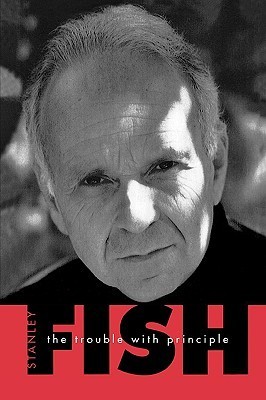
Stanley Fish is an equal opportunity antagonist. A theorist who has taken on theorists, an academician who has riled the academy, a legal scholar and political pundit who has ruffled feathers left and right, Fish here turns with customary gusto to the trouble with principle. Specifically, Fish has a quarrel with neutral principles. The trouble? They operate by sacrificing everything people care about to their own purity. And they are deployed with equal highmindedness and equally absurd results by liberals and conservatives alike.
In this bracing book, Fish argues that there is no realm of higher order impartiality--no neutral or fair territory on which to stake a claim--and that those who invoke one are always making a rhetorical and political gesture. In the end, it is history and context, the very substance against which a purportedly abstract principle defines itself, that determines a principle's content and power. In the course of making this argument, Fish takes up questions about academic freedom and hate speech, affirmative action and multiculturalism, the boundaries between church and state, and much more. Sparing no one, he shows how our notions of intellectual and religious liberty--cherished by those at both ends of the political spectrum--are artifacts of the very partisan politics they supposedly transcend. The Trouble with Principle offers a provocative challenge to the debates of our day that no intellectually honest citizen can afford to ignore.
Stanley Eugene Fish is an American literary theorist and legal scholar. He was born and raised in Providence, Rhode Island. He is often associated with postmodernism, at times to his irritation, as he describes himself as an anti-foundationalist.
He is the Davidson-Kahn Distinguished University Professor of Humanities and a Professor of Law at Florida International University, in Miami, as well as Dean Emeritus of the College of Liberal Arts and Sciences at the University of Illinois at Chicago, and the author of 10 books. Professor Fish has also taught at the University of California, Berkeley, Johns Hopkins University, Columbia University, and Duke University.
Stanley Fish, let's face it, is a jerk. He kind of reminds me of that guy you knew in college who would argue fiercely about Heidegger and get super-wasted and still sleep with all the really sexy art-major girls, and you got along with him because he was cool, and in college that seemed to be the transcendental signifier.
But the thing is, Fish's logic is devastating. His ideas about the incommesurability and totality of worldviews, while sometimes simplistic, are generally correct. If nothing else, he forces me to wriggle around a bit and reassess my thought, and that's probably a good thing.
The trouble with principles is that they are appealed to as absolutes but are really just ad hoc rhetorical strategies to advance personal agendas. (Fish is right, I think, if God doesn’t exist.)
Fish argues that the trouble with Principle is that it is an empty concept—that we fill talk of principle with whatever commitments we already bring to the table. In a way, he’s simply stating what Alvin Plantinga says in Warrented Christian Belief re: presuppositions, bases, etc. Fish is a coherentist, but his broader point is that the form your Epistemological or other philosophical commitments take is immaterial; we will always act on the basis of unchallenged assumptions that may or may not have much relation to the form we pick when we start talking about them. He makes an exception for religion—indeed, he seems to disbelieve in the possibility of a religion that is not exclusive and demanding, one that does not reject big-L Liberalism (because to accept Liberalism is to accept ideas of tolerance and fairness as more basic than religious beliefs). In the end, though, the main thrust of the book is political—the language of theory is being usurped by the Right, and we need to get it back if we really believe that certain things are good, etc. That’s fine, because according to Fish everything is political/rhetorical. I should note that Fish wrote this book over a decade ago, and much of the political landscape has changed—though how much would be hard for me to say. Eight years of Bush and the growing power of the Religious Right, the fight over gay marriage, etc. certainly have a bearing on Fish’s argument, but I’m not equipped right now to trace exactly what that bearing might be.
Almost as much as Derrida, Fish sort of lives to needle people, and at times his style can be a bit, well, arch. Still, this is an amazing and brilliant piece of work, perfectly dovetailing into both relativism and neopragmatism while leaving intact Fish's own idiosyncratic views on principle and morality.
Wow! This book is insane. I'm not a philosophy major (and I'm not very acquainted with logic or the social sciences for that matter), but after getting used to the first few chapters, this book pushes you to think about ideologies in a new way. Even after reading, I thought about the book a lot and about how Fish's POV's relate to society. Worth the struggle to read! ;)
'Boutique multiculturalism' is my favorite argument of his so far, and let me tell you, people who think themselves enlightened and liberal HATE hearing it.