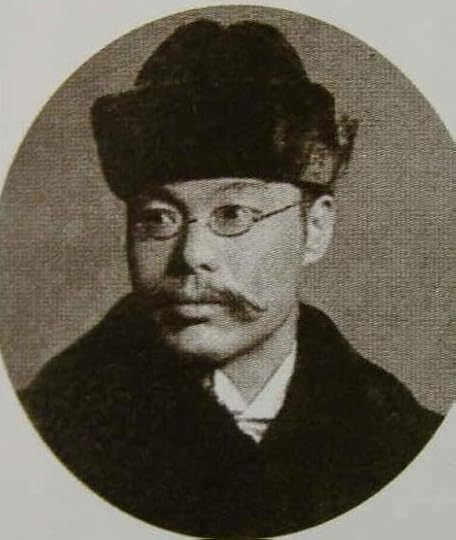
Futabatei Shimei (二葉亭 四迷) was a Japanese author, translator, and literary critic. Born Hasegawa Tatsunosuke (長谷川 辰之助) in Edo (now Tokyo), Futabatei's works are in the realist style popular in the mid- to late-19th century. His work Ukigumo (Floating Clouds, 1887) is widely hailed as Japan's first modern novel.
Hasegawa Tatsunosuke (1864-1909)* Nota bene: The reviews of two related books have been combined into one and posted for both books. If you've read the one review, you've read the other. I apologize in advance for the length, but there is much in Hasegawa's life and work that interests me.
The 1880's were a time of great change in Japan and witnessed the birth of the modern novel in Japanese. Throughout the Tokugawa era (1603-1868) the novel was an officially despised form of popular entertainment or a barely tolerated form of moral instruction; the brilliant examples of Lady Murasaki's Genji monogatari and a few other early texts had been forgotten, or at least set aside. But with the Restoration of the Meiji Emperor and the opening of Japan to the outside world after two and one-half centuries of enforced isolation both the nature and the social standing of the Japanese novel began to change significantly. Spurred by Tsubouchi Shōyō's tract, Shōsetsu Shinzui (The Essence of the Novel, 1885/86), many authors - including Tsubouchi himself - made valiant efforts to reconstitute the novel, and the experts seem to agree that the laurels belong to Hasegawa Tatsunosuke.
Hasegawa's Ukigumo (Floating Clouds, 1887/88/89) is regarded as Japan's first modern novel for a few worthy reasons, though, unfortunately, those of us who must read it in translation miss out on one of the primary reasons. Prior to Ukigumo serious prose in Japan was written in an antiquarian literary language with roots in the Heian era (794-1185) that was proving itself to be inadequate for the task of dealing with the turbulent period of transition that was the Meiji era (1868-1912).(*) Ukigumo is viewed by specialists as the first important contribution to the development of a more flexible written language modeled on contemporary speech, a development to which other authors such as Mori Ogai added important elements later. According to Glenn W. Shaw, the translator of Hasegawa's third and final novel, Heibon (1907), Hasegawa spent years trying to find the right tone and mix of diction for Ukigumo; the genesis is described in some detail by Marleigh Ryan (see below).
Hasegawa was strongly influenced by his love of the Russian language and literature, particularly of Turgenev's works (though initially he learned the language in order to be of service to Japan against its Russian competitor and soon to be foe).(**) He translated texts by Turgenev and other Russian realists into his native language(***) and used them as models for his own novels, including taking over the tradition of impotent, uncertain protagonists that dates back to Pushkin. So Ukigumo is also a "modern" novel because its focus is not on plot and colorful adventure but on character. The complex, often improbable plots and the numerous, one-dimensional characters of the gesaku literature have been replaced by the simplest of plots and a thoroughgoing examination of a few characters in Ukigumo.
After their initial, somewhat ironic introductions the four main characters in Ukigumo - with the intelligent, sensitive and generous, but tentative, vacillating and ultimately self-deceived Utsumi Bunzo the primary - are revealed through their interactions (not by authorial description) and are well-rounded and consistent, i.e. believable according to Western novelistic tradition. The impoverished Bunzo was brought up in his aunt's house and fell in love with her daughter, Osei. He has managed to land a clerk's job with the government and with it his aunt's grudging respect and possible acceptance as a son-in-law. But he loses his job and the drama begins, heightened by the entry of his assertive and successful former colleague, Noboru, who has become interested in Osei and has even been promoted: A simple plot rife with dramatic possibilities that Hasegawa skillfully plays with while letting the characters emerge naturally, though he couldn't be compared with Henry James or Virginia Woolf. None of this would have been particularly remarkable in the Western tradition of the novel in the late 19th century, but for Japan it was a revelation. As the contemporary Japanese critic, Tokutomi Soho, wrote, "Ukigumo is a study of the human mind, its author is a master of analyzing human emotions."
The four main characters are finely nuanced, each with admirable qualities and significant failings, except possibly the immature Osei who stands in for Japan in her initial love for the traditionalist Bunzo and her subsequent enthusiasm for all things Western that culminates in her love for Noboru, ultimately cruelly disappointed because his eyes are actually on the boss' young sister-in-law. Though Hasegawa occasionally pulls back to give an entertaining and sarcastic picture of a crowd scene, the reader spends most of his time with the main characters, above all in Bunzo's mind, where Hasegawa reveals slowly that the sympathetic and gentle Bunzo is incapable of empathy for others and constantly misunderstands them and his own situation. Hasegawa's subtlety of treatment of a character that shared many of his own traits suggests that he may actually have had a very clear understanding of his own circumstances but was unable to find a suitable resolution even in the face of Bunzo's warning example...
But Ukigumo is also a critical examination of important aspects of Meiji society. All four major characters are members of the lowest levels of the former samurai class, which has been cast down from the apex of society and has lost its economic basis through the Meiji reforms. Worse, the Confucian-influenced way of life of the samurai is completely unsuited for the new society. Bunzo is doomed to failure because he holds onto the Confucian/samurai system of values, while Noboru doesn't give a fig for the received moral system and is only interested in pleasure and money. He is in every respect the antithesis of the Confucian gentleman. The aunt, too, is shrewd and aggressive and calculates only material gain; Bunzo's intellectual accomplishments are of no value to her unless they generate money. All of this is more than familiar to Westerners both then and now, but in 1880's Japan the shock of such behavior left the traditionalists breathless and outraged. Bunzo's interior monologue analyzes Meiji society from the perspective of the earlier Japanese values and finds it repulsive and distressing. Hasegawa's realistic portrait of this particular moment of change in Japanese society as it was occurring is another "first" to add to his laurels. And his experience with Russian literature's obsession with the evils of bureaucracy enables his indirect attack on the emerging modern bureaucracy to be very telling.
I read Ukigumo in Japan's First Modern Novel: Ukigumo of Futabatei Shimei (1967) in which Marleigh Grayer Ryan provides not only an English translation of the novel but also a very interesting, two hundred page examination of Hasegawa's life, work and times. Hasegawa was graced with many gifts, but he was too intense, introverted, morose and neurotic for his own good (and for his friend Tsubouchi's) and made his life miserable with a rigid idealism. Sometimes one can be one's own worst enemy.
Due to the vagaries of interlibrary loan I read Heibon (Mediocrity) in a translation and edition dating from 1927 before I read Ukigumo; the pages in the second half of the book were still uncut.(!) I disagree with that silent condemnation. Strongly autobiographical, Heibon is a look at an ineffective addict of literature, but this time the primary character has very little to recommend him as a human being. However, the finely gauged portrayal of that character and the rhythmic changing of the prose's mood between wry humor, disgust, and straightforward, open sentiment have much to recommend the book as literature.
The first person narrator considers himself at the age of 39 to be old, useless and of no worth to anyone except his little family, which needs him solely for the little bit of money he earns as a minor bureaucrat. He gives the reader the story of how he got there, from a lengthy look at his childhood in a provincial city through his attempts to make his way as a writer in Tokyo. He is passive and pusillanimous, pushed about by circumstances and willing to submit to stronger wills. He attains a certain success but it means little to him.
The text is full of disgust both for the principal character and for itself, often presented in such a way that I laughed aloud. They say that of late the fashionable thing is a way of writing called naturalism or something, in which the writer sets down all his experiences, no matter how ridiculous, without the least application of art, just as they happened, drop by drop like the drivel of a cow. A good thing has become fashionable. I, too, shall fall in line.
Then the title shall be "Mediocrity" and the manner cow drivel.
Experts report that the literature of Japanese naturalism is exceedingly solemn and deadly sincere. Not this book! The text suddenly cuts off in media res, and one finds this afterword: By Futabatei. This manuscript story I got while amusing myself looking over a night stall, and the conclusion had been torn off and lost. It is much like being cut off when talking over a phone, but it cannot be helped.
Dissatisfied with literature and life as a bureaucrat, Hasegawa got himself sent to St. Petersburg as a foreign correspondent for the Asahi Shimbun, suffered a nervous breakdown and died on the way back to Japan. Though he believed himself to be a total failure, he is now regarded as one of the most important writers of the Meiji era behind Natsume Soseki and Mori Ogai (I personally would also put him behind Nagai Kafu and Higuchi Ichiyo). His work is most definitely more than just an historical curiosity.
* Futabatei Shimei was Hasegawa's pseudonym, based upon the expletive Kutabatte shimae!, which means something like "Die and be done with you!" or, more idiomatically, "Go to Hell!"
(*) That was the situation in "serious" fiction, but as I explain in my review of Shikitei Sanba's Ukiyoburo - https://www.goodreads.com/review/show... - in the popular gesaku literature of the 18th and 19th centuries the language of the literary elite was jettisoned for another, playful, colloquial language. Some of those books were read and appreciated by the Meiji era authors who were trying to revitalize "serious" literature and surely had some degree of influence I cannot judge.
(**) For all of his life Hasegawa dreamed of performing some striking act of patriotism that would go down in history, but in three consecutive years he failed the physical exam for entry into the Imperial military academy and found his later attempts at realizing his dream equally futile. Because he thought he was not of the caliber of his Russian models, he abandoned literature after an initial success, returned to it and then left it again.
(***) In translating these texts from the Russian Hasegawa reportedly stretched Japanese in ways that permanently enriched the language. Some of these translations are still read and considered to be among the most important literary works of the Meiji era.
Ukigumo is, indeed, a much more modern Japanese novel than the era of Japanese work that I usually find myself engrossed in, with the exception of a few works by Natsume Soseki and Fumiko Enchi (both of which I recommend strongly). As such, I am pretty amazed at how similar this work manages to feel in tone, yet how different and modern it is as well.
Essentially, the plot follows a young man named Bunzo and a girl named Osei, who are in love with each other but are actually vastly different people with different outlooks on life. Half of the time they interact, it leads to frustration, anger, and confusion. As a reader, this is frustrating for me, knowing that what Bunzo really has to say to Osei is so simple, yet he misses every single opportunity to do so. What's even more frustrating is that the author does not even reveal the result of him finally gathering up the courage to do so! Of course, this may have to do with the novel being incomplete, but wow, what a place to leave the novel unfinished. It's almost too appropriate a place to leave it.
Overall, I thought Ukigumo was a decent novel. Was it anything special? Not particularly. It is well-written, interesting in its modernism and contains a plot worth following, but I would only recommend this to someone who's been reading Japanese literature for a while and needs another novel to go to that's not super old or Soseki.
the epitome of she’s just a girl!! very interesting to read after Kokoro, with two rather nerve-prone men agonizing over women who no longer have interest in them! again, we see the influence of western thought, fashion, culture in Japanese youth during the Meiji era vs/ the older generation. last sentence was a hit!!!
Me ha parecido una novela con algunos personajes tremendamente modernos para su época, con una estructura que debió resultar rompedora. Leída ahora, la trama podría resultar sencilla, reduciéndose a un simple triángulo amoroso. Pero los diálogos, las conversaciones, las reflexiones del protagonista y los comentarios que el autor hace como voz en off, la dotan de una gran profundidad. Situada en un Japón donde están ocurriendo grandes cambios, se nos presentan las complejidades de los jóvenes del momento y su incapacidad de, por un lado, aceptar ciertas tradiciones y de, por otro, liberarse de cierto sentido del honor. Durante la lectura, lo japonés está lleno de salpicaduras de occidentalización, y esto, me parece, permite empatizar con todos los personajes mejor. Además, quizá porque es el comienzo de la era Meiji, estas pinceladas occidentales no desgarran a los personajes tanto como en libros de Soseki o Mori. Aún así, dentro de esta inocencia, ya aparece el individualismo frente a la obligación colectiva o filial; matrimonio por amor; o la educación de la mujer. Bunzó, el protagonista, pierde su trabajo, y esto pone su mundo y sus planes patas arriba. Su espacio como hombre en disposición de convertirse en cabeza de familia, desaparece. Y le vamos acompañando mientras intenta recolocar las piezas de su nueva vida. Una de estas piezas será Osei, la chica, quien se nos presenta como quizá la nueva mujer Meiji: se define liberal por estar en contra del matrimonio y valorar la educación de la mujer; es descrita como una chica que no es dócil y no hace lo que le dicen, y que se revela ante su madre. También está el personaje de Noboru, antiguo compañero de Bunzó, más tradicional en sus formas y pensamientos. Según el libro va avanzando, vamos leyendo las comeduras de coco de un Bunzó que cada vez está más descolocado, y que, sin embargo, nos van resultando de lo más lógicas. Los comentarios del narrador a sus reflexiones son geniales. El final, me encantó. Para mí no podría haber habido otro mejor.
I enjoyed this one much more than I thought I would. It's the very first Japanese novel written not in classical, but in modern Japanese. I haven't read the afterword yet, but I heard that the language was greatly influenced by rakugo author Sanyutei Encho; also it's quite obvious that Futabatei Shimei learned some stuff from Russian literature. It's a story of a young guy named Utsumi Bunzo, who is living in Tokyo with his aunt O Masa and his beautiful cousin O Sei. Bunzo and O Sei are sort of betrothed, and he is very much in love, but O Sei likes novelty, luxury, and to have fun, and Bunzo is very socially awkward. When the novel starts, Bunzo has been sacked because he was unwilling to curry favor with his boss. When his aunt, who is a greedy, vulgar, hypocritical woman, hears about this, she is furious at Bunzo and decides she won't let O Sei marry him. And surely enough, there comes Bunzo's colleague, Honda Noboru, a slimy but funny guy, and... yeah you know what happens... sort of, because the novel is actually unfinished. The book's theme is serious and sad, but its tone is light (here's probably the rakugo touch); it is also a bit didactic, as the names indicate, and condemns materialism and, surprise surprise, Western influences (the first part was written in 1887). Needless to say, I enjoyed Noboru and O Masa's characters (especially given Noboru's beginnings... poor guy) much more than Bunzo's. But the Japanese literature is full of guys like him... O.o The depictions of everyday life - clothes, food, streets, gardens - are great.
"He was certain that when he talked to her she would agree with him and encourage him in his plans. He had no reason to feel this way. He felt this way because he wanted to."
Poor old Bunzo! So terrible at being alive and not making a bit of a mess of things.
Futabatei Shimei (real name: Hasegawa Tatsunosuke; 1864-1909) was born in Tokyo and studied Russian at what is now the Tokyo University of Foreign Studies. He became known as a distinguished translator of Russian literature, especially his Turgenev translations were excellent - his translations of several stories from Sketches from a Hunter's Album would help the development of nature writing in Japan and greatly influenced Kunikida Doppo, Shimazaki Toson and Tayama Katai.
Futabatei was a social critic who was constantly dissatisfied with his own work, and steadfastly refused to write for money. He saw literature as a sacred linguistic art for revealing the truth. As Ukigumo was written in a sort of vacuum - no one else was trying to do the same, the book was far in advance of its time - Futabatei fell silent for twenty years. After Ukigumo, Futabatei wrote only two more novels (at the time of the rediscovery of Ukigumo by the Japanese Naturalists), Sono omokage (In His Image aka An Adopted Husband) in 1906, and Heibon (Mediocrity) in 1907, but these were less successful. Shimei initially was a disciple of Tsubouchi Shoyo and Ukigumo was therefore first published under the name of his master. Ukigumo is part of the canon of modern novels in Japan.
Ukigumo has been called "the first modern Japanese novel" on the basis of its style and psychological realism, introducing a new spirit into Japanese literature. Futabatei believed that a novelist had the duty to uncover the truths unique to his time. In his case, this meant writing a realistic novel about the society he saw collapsing around him in materialism and lack of morals. This is also reflected in the title: Futabatei saw the Japanese of his time as "drifting clouds," buffeted by new technology and new ideas from the West, which had cut them loose from the moorings of their own civilization. To him, Japanese society in the 1880s had lost its moral center.
This is demonstrated through the story of Bunzo, a serious and introspective young man from the provinces, who stands outside the mainstream of modern life but rigidly adheres to traditional values of honesty, sincerity and restraint as a sort of a "superfluous man" of the Meiji period. His unwillingness to compromise and toady to his superiors costs him his government job, which is perceived in a bad light by his aunt, with whom he lodges, and his aunt's daughter Osei (the first "Westernesque" femme fatale), with whom he is in love.
Osei falls under the spell of the shrewd and aggressive Noboru (lit. "Rising"), Bunzo's friend, who is a glib talker on a fast track to advancement in the bureaucracy (he represents the spirit of Meiji). With his half-baked enthusiasm for democracy and admiration for the West, he is portrayed as a model of vulgar success. But Noboru has his sights set higher than Osei...
The characters have a life of their own and are developed naturally. Futabatei's primary model and inspiration was Russian realism (especially Turgenev), of which he had made an extensive study. Except in the first chapters where he was still trying to find his way, Futabatei uses the vernacular, undoubtedly helped by his experience as a translator of Russian fiction. Futabatei's landmark novel was enthusiastically praised by his contemporaries for its innovative subject matter and style, and later re-discovered by the Japanese Naturalists.We should however note that it remained an exception, and had no direct influence on other Japanese writers of the late 19th century, who, instead of trying to write a Russian-type novel, were more interested in a dialogue with the Japanese tradition.
The first Japanese modern novel. Ukigimo is a full-japanese text book that I read. Have no clue about it's pronounciation except few of its word like "manabu" which means study.
This was my first try to master Japanese language and quite challenging to actually read the book. This book is unfinished because the author thought he won't pursue writing but eventually sparks the Japanese novelist revolution. Crowned as Japanese first modern novel, this will be my first ever Japanese novel to read.
The exuberant narrative asides are a little annoying—although certainly understandable in a first novel, they tend to come off as “juvenile self-regard.” But I find it hard to believe that he really didn’t complete the novel, and imagine he just refused to re-write the “happy ending” demanded by his editors. Since An Adopted Husband (その面影) is so similar, you have to wonder why Futabatei (when he started writing his own novels again) didn’t just re-publish the completed work.
First, I guess, since the ending (if he wrote it) wasn’t published, it would only have existed in manuscript; and since Futabatei wasn’t all that enamored with the idea of being a novelist, he probably didn’t keep the manuscript. Second, even if Futabatei wrote and kept an ending for the novel, I imagine that he didn’t hold the copyright to what had been published, or publishers may have been reluctant to reprint the novel (how popular was Futabatei in 1906?). I don’t know much about Russian literature, but it would be interesting to compare 浮雲 and その面影 to see how Futabatei was being influenced (other than with realism) by the novels he was translating.
the commentary is outdated, but it's good enough for a first-time intro to futabatei. the translation really doesn't do justice to the nuances of his prose (especially the humor!), but i guess it's also accurate enough.