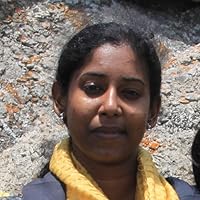
Once again after long years of search I came into contact with the power of honest poetry when I was reading Meena Kandasamy's anthology of verse. She wove a fabric rare and strange, faintly smudged with the Indianness of her thought that saw even the monsoons come leisurely strolling like decorated temple elephants. The unseen lover weaves his way into every poem she cries but she must write about him forgetting the shame and the embarrassment it would cause for somehow it seems better than not writing anything at all. An infidel s emptiness, a void closing over voids... Dying and then resurrecting herself again and again in a country that refuses to forget the unkind myths of caste and perhaps of religion, Meena carries as her twin self, her shadow the dark cynicism of youth that must help her to survive. Happiness is a hollow world for fools to inhabit cries Meena at a moment of revelation. Revelations come to her frequently and prophecies linger at her lips. Older by nearly half a century, I acknowledge the superiority of her poetic vision and wish her access to the magical brew of bliss and tears each true poet is forced to partake of, day after day, month after month, year after year...
Dr Meena Kandasamy FRSL is a poet and provocateur who has spent two decades triggering the far right. She’s been translated into over 20 languages.
Her previous novel, When I Hit You, was shortlisted for the Women’s Prize, Jhalak Prize and Hindu Literary Prize. It was also Book of the Year in the Financial Times, Observer, Daily Telegraph and Irish Times. Her poetry collection, Ms Militancy, went viral across South Asia. In 2022, PEN Germany awarded her a medal for being ‘a fearless fighter for human rights.’
Meena has two sons. Her new novel, Fieldwork as a Sex Object, is out now.
Step 1: Take a beautiful Shudra girl. Step 2: Make her marry a Brahmin. Step 3: Let her give birth to his female child. Step 4: Let this child marry a Brahmin. Step 5: Repeat steps 3-4 six times. Step 6: Display the end product. It is a Brahmin.
End.
Algorithm advocated by Father of the Nation at Tirupur. Documented by Periyar on 20-09-1947.
Algorithm for converting a pariah into a Brahmin.
Awaiting another Father of the Nation to produce this algorithm.
Inconvenience caused due to inadvertent delay is sincerely regretted.
Meena is a great Indian poet, very young, writes and fights for Dalits. She is a Dalit but is very well educated in the English language, and writes in English. Many Dalits view education in the English language as part of the route out of caste oppression and poverty. High valuation of English and fluency in English is widespread in India.
Lucidity of Language is something I have come to associate with Kandasamy's writing. She is a linguist foremost and a poet later. Touch is a collection of 84 poems divided into irregular sections exploring the duality of desire which can shape shift into oppression as it filters through caste identities.
The craft of her language is her beautification of brutality. My never published review of When I Hit You also has similar observations about her words. This is also my second read of Touch as first read was bit lost on me.
Since I constantly deal with Dalit literature, Meena's writing stands out from her predecessors for whom the writing was an act of rebellion itself. Her poems are rebelling and reclaiming the place in literature as both a woman and as a Dalit woman. She calls out the hypocrisy of intercaste marriage where the Dalit Girl is upgraded to Brahmin Standards. The Poems revisit the the constant abuse and rape by upper caste men that Dalit Women had to endure and questions when is it okay to be untouchable to a Brahmin? How can he penetrate an untouchable when it is the very act of a touch?
Layer by layer, she peels the misogyny that exists in name of love, lust and marriage. From personal anecdotes to community experience as a woman, violence is a constant companion through history. The book had some interesting design choices with its typography, without them certain poems would fall apart like deck of cards.
Despite a language to die for with versatile display of poems, the collection does become tiring. It is seamlessly following from one poem to another but no poem peaked in their emotions. Everything is measured and rearranged here to be a coherent whole; a book of poetry needs intonation and a pinch of whimsical.
A bold and true from heart collection of verse. Meena carries the fire that was burning in every heart of those who were marginalized by the stealthy designs of some of our own species. Her poem exudes a lot of heat but no smoke. But 50 years from now, may be a hundred, she could be coopted to the clan of 'bhakta kavis', for she has visualized Lingam (Shiva) in a rocket!
A must read for all who love poetry. Imagine the poetic output when all like Meena gets the language to vent the fire inside them.
Yet another mighty collection of poems by Meena Kandasamy. Her poems are like a lioness. A lioness which stares at you, judges you, laughs within before eating you alive. She attacks patriarchy, not to reform this man's world, but to destroy it. She stone pelts Brahminism to death with her words of poetry.
A must read, if you live in India, then a must read!
Monólogo revelador y explícito sobre el descenso a los infiernos de una mujer en su relación de pareja, desde la degradación moral hasta la violación física pasando por la inutilización laboral. Un descenso a los infiernos de la pareja, donde los sueños iniciales derivan en maltrato psicológico y físico. Turbador y real como la vida misma.