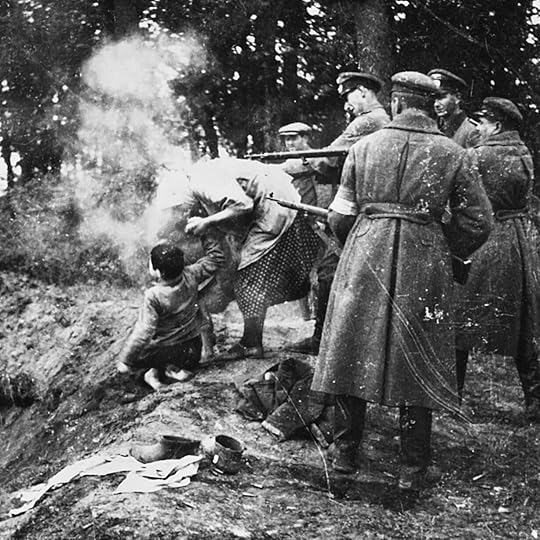
A book about a terrible photograph from the Holocaust – an exceptionally rare image documenting the horrific final moment of the murder of a family in Ukraine,
'This book is an act of restitution' David Aaronovitch, Book of the Week, The Times A strikingly original book about a terrible photograph – an exceptionally rare image documenting the horrific final moments of a Jewish family in Ukraine.
The terrible mass shootings in Poland and the Ukraine are often neglected in studies of the Holocaust, because the perpetrators were meticulously careful to avoid leaving any evidence of their actions. Wendy Lower stumbled across one such piece of evidence – a photograph documenting the shooting of a mother and her children and the men who killed them – and has crafted a forensically brilliant and moving study that brings the larger horror of the genocide into focus.
One of the most compelling themes to emerge from her investigations in Ukraine, Slovakia, Germany and the USA is the identity and the surprising role of the photographer who recorded the killings. He must, she assumed, have been part of the Nazi organization of genocide. The truth was different...
WENDY LOWER, Ph.D. is the John K. Roth Chair of History at Claremont McKenna College and research associate of the Ludwig Maximillians Universität in Munich, Germany. A historical consultant for the U.S. Holocaust Memorial Museum, she has conducted archival research and field work on the Holocaust for twenty years. She lives with her family in Los Angeles, CA, and Munich, Germany.
A single photograph—an exceptionally rare “action shot” documenting the horrific final moment of the murder of a family—drives a riveting process of discovery for a gifted Holocaust scholar
I remember quite clearly seeing images in History Books when I was in secondary school and being horrified that such an atrocity had taken place only 40 years previously. I remember I had so many questions on this chapter from our History book, but the following day the teacher had moved on but I hadn't. That chapter stayed with me until I developed an interest in reading and devoured library's and bookshops trying to understand through reading how such an atrocity could have happened.
The Photograph from the Ravine is heartbreaking and what the author has done from this one photograph is present history on a different level. The author has been given a photograph of a family. A young mother holding the hand of a little boy, He is standing barefoot on the edge of a ravine about to be slaughtered. Bending forward she appears to be holding another child. In the daunting work of tracing the photograph the author reveals the history in astonishing layers of detail concerning the open air massacres in Ukraine. The identities of mother and children, of the killers and, remarkably, of the Slovakian photographer who openly took the image, as a secret act of resistance are dramatically uncovered.
This is a very short book but its so well researched and written. I went through so many emotions as I turned the pages. A single photograph and yet the painstaking lengths that the author goes to to identify the family and the murderers in the image.
While doing research at the United States Holocaust Memorial Museum, author Wendy Lower was shown an “action shot” of the murder of a Jewish family in Ukraine in 1943.
She was immediately drawn to the photo because it included small children. At that moment Ms. Lower decided to investigate the circumstances of the incident with the intent of identifying the victims and perpetrators who appeared in the photograph.
Wendy Lower’s dogged pursuit of information is detailed in this emotional, moving, heartbreaking, and revealing book. As a person who is not Jewish, I learned so much from reading this account. Ms. Lower’s statement at the end of the book is so true - “Atrocity images, especially the rare ones that attest to acts of genocide, the crime of all crimes, offend and shame us. When we turn away from them, we promote ignorance….. And when we stop researching them, we cease to care about historical justice, the threat of genocide, and the murdered missing.”
Wendy Lower’s book adds to the many documents, recordings, and books which help prevent the many unnamed victims from being forgotten.
I received a free publisher's advance review copy, via Netgalley.
I previously read Wendy Lower’s Hitler's Furies: German Women in the Nazi Killing Fields, an impressive study of how hundreds of thousands of German became willing accomplices in the bureaucracy of genocide. Now Lower turns to a painstaking study of a single photograph of a murderous incident in Ukraine, in the early, Holocaust-by-gun phase of the war.
The Nazi government and military authorities forbade photographing of their murderous attacks on civilians. They knew that these could outrage the general population. Still, cameras had become available and affordable for large swathes of the population, including soldiers, and many brought cameras to the front with them. One of them, a man in the Nazi-affiliated Slovak forces, took a some photographs of Ukrainians, under the supervision of Germans, killing women and children.
Lower manages to identify several of the perpetrators. She learns how they came to volunteer to become murderers and what happened to them after the war. This massacre was not supervised or carried out by the SS, the Gestapo or even Germany army combatants. The shooters were Ukrainian neighbors of the victims, organized into a Nazi-friendly militia and supervised by volunteers from a non-combat unit of the German military.
Obviously, this is not a heartening story, but once again Lower fills in the background details that aid in our knowledge of how large numbers of people can come to see their neighbors as no longer individuals but as part of an enemy body needing to be exterminated. Secondarily, it shows how valuable pictorial evidence is in revealing the truth.
I’ve been interested in the history of World War II and the Holocaust for a long time. I never thought that it would become as relevant to contemporary life as it is now. Maybe all books like Lower’s should be subtitled “A Warning.”
A short, readable history that is well worth your time, along with Lower’s earlier Hitler’s Furies.
This was all the more heart-wrenching to get through given current events and the fact that history is repeating itself. A disturbing but important and enlightening read.
Ennek a kötetnek fontossága nem elsősorban abban áll, amit elmond. Hanem abban, hogy világosan megfogalmazza, miért kell elmondani. Van egy fotó, Ukrajnában készült, a második világháború idején. Két német egyenruhás van rajta, pár helyi segédszolgálatos, és az áldozatok, anya és gyermeke. A kép azt a pillanatot rögzíti, amikor a lövés eldördül - dokumentál tehát egy gyilkosságot. Egy gyilkosságot a másfél millióból, amit Kelet-Európában a nácik és csicskáik elkövettek. Másfél millió! Felfoghatatlan szám - tulajdonképpen nem is érzékeltethető másképp, mint a statisztika eszközein keresztül. A fénykép viszont a felfoghatatlan számok halmazából kiemel egyet, arcokat rendel hozzá, személyes történetté teszi.
És itt jön be az egyenletbe a történész.
Mert a klasszikus objektív tudományosság szemüvegén keresztül mi is egy ilyen fénykép? Dokumentum, amit be kell illeszteni egy nagyobb elbeszélésbe. Lower szerint viszont maga az elbeszélés, amit le kell tisztogatni és fel kell mutatni. Nála a történészi munka igenis morális kötelességekkel jár. Ki kell mondania: kérem, ez egy emberölés, itt elkövetők vannak, akiket -amennyiben lehetséges - meg kell találni. De ami ennél is fontosabb: ki kell mondania, hogy itt áldozatok vannak, akikre emlékezni kell.
Mert térjünk vissza a képre. A pillanatra, amikor egy anyától és gyermekétől elrabolják az életet. Ezen a képen nem pusztán az anya- és gyermekgyilkosság ténye a brutális. Hanem hogy egy szülő úgy kell meghaljon, hogy pontosan tudja: nem lesz, aki megsirassa. Az, akiben tovább kéne élnie a természet törvényei szerint, vele együtt hal meg. Legjobb esetben is puszta számok lesznek - egy-kettő a másfél millióból, név nélküli halottak, semmibe vetett lelkek. Ez elviselhetetlen. Amikor a történész elősegíti, hogy történetük fennmaradjon, az nem egyszerűen szakmai kérdés - hanem erkölcsi igazságszolgáltatás. Ami döbbenetes felelősség. Ne is menjen holokauszt-kutatónak, aki nem bírja az ilyet. Bíbelődjön inkább a XV. század gazdaságtörténetével, a regáléjövedelmek evolúciójával, vagy mit tudom én.
Have I become fascinated with photographs of atrocities? After reading Nadine Fresco’s The Death of Jews and now Wendy Lower’s The Ravine, I certainly hope not, or at least not in an evil way. The first shows a ridge of sand dunes in Latvia in December 1941; the latter a forest ravine in the Ukraine two months earlier and a thousand kilometers to the southeast. The victims are similar – women and children – as are some of the perpetrators: Latvian and Ukrainian militiamen. The Latvian photos were probably taken surreptitiously by an SS man named Strott. The Ukrainian scene was shot be a Slovak, Lubomir Skrovina, supposedly a German ally but actually an anti-Nazi, who gave it to the Czech authorities after the war. It is carefully composed, reminding the viewer of Goya’s etchings The Disasters of War. The distinctive uniforms and weapons of the shooters are striking: Russian greatcoats and Moisin Nagant rifles for the militiamen, wearing dark and light brassards (probably blue and yellow – Ukrainian nationalist colors). Surprisingly, the Germans were not SS or Order Police, but border guards. Apparently, the Einsatzgruppen were eager to enlist any formation they could find, German or foreign, to commit atrocities, and seem not to have no difficulty finding recruits. Were they mostly thugs, sadists, or hard-core anti-Semites? As has been documented repeatedly by historians, there are no records of soldiers ever being punished for refusing to participate in the murder of civilians. But the disproportion between the uniformed men with rifles and the victims, the woman with a print dress and her children or the naked women standing in the freezing cold on the beach is so striking I could not bear but look at these images.
As the saying goes: “A picture is worth a thousand words”. So it is with the picture that started Wendy Lower on a journey to identify the people in the picture: the victims, the shooter(s), the lookers on and the photographer who is not seen in the picture.
As if the photograph by itself is not staggering enough it has been enlarged in sections and is as harrowing as anything you will ever see. It is not the kind of picture one has seen of mass graves and the horrors of concentration camps.
It is an intimate look at cold blooded, calculating, inhuman killing of innocent persons at the exact time of the act.
To have managed to identify any person or persons in this one photograph is astounding. And further to have located not only the photographer but also the very camera used to take the photograph is monumental.
There is only one word to describe the photograph and this book: Chilling.
Wendy Lower is een Amerikaanse historicus die wereldwijd scoort met haar boeken rond de tweede Wereldoorlog en de Holocaust. Voor haar werk rond dit thema kreeg ze al verschillende onderscheidingen. Het boek dat ik las van haar hand was Het Ravijn. Het verhaal Lower krijgt van twee journalisten een foto waarop een joods gezin doodgeschoten wordt in De Oekraïne tijdens de tweede Wereldoorlog. Door middel van het ontleden van de foto start Lower de zoektocht naar de plaats en namen van zij die op de foto te zien zijn. Maar ook zoekt ze een manier om de fotograaf van achter zijn toestel te halen en ook voor de lens te plaatsen. Mijn gedacht Hoewel het hier en daar wat saai omschreven is ben je toch vlot aan het einde van het verhaal. Wat mogelijks als storend opgevat kan worden is dat er doorheen het verhaal redelijk wat cijfertjes bij bepaalde zinnen staan die een extra uitleg krijgen op het einde van het boek. Daar moet je als lezer een keuze in maken om ze tussen het verhaal door te gaan lezen of allemaal achteraf. Lower toont in haar verhaal de kracht van fotografie. Het vastleggen van een moment kan in de toekomst veel meer vertellen dan wat de fotograaf wilde vastleggen met zijn beeld. Het verhaal gaat over de tweede Wereldoorlog maar toont ook een zeer goeie manier van het ontleden van een foto. Het kleinste detail kan Lower helpen om verder te raken in haar zoektocht. Een zoektocht die naarmate hij meer info naar boven haalt de lezer meer en meer laat meeleven met de slachtoffers op de foto. De foto op zich wekt al emotie op maar de enorme voorraad aan kleine details sluipen het hart van de lezer wel binnen. Conclusie Een goed verhaal dat Nazimisdaden bloot legt en vooral de kracht van fotografie uitlegt. Ondanks hier en daar wat saai over te komen leest het eigenlijk wel nog vlot. Elke lezer moet voor zichzelf uitmaken hoe en wanneer hij de extra uitleg in de noten achteraan het boek leest.
Thank you to the publisher and Netgalley for a DRC of this book!
I've read quite a bit of books about the Holocaust. But the basis of The Ravine immediately interested me. It seemed to be a more intimate exploration of a small portion of the atrocity- a single photograph of a single Jewish family at the moment of this murder. As Lower discusses in this book, we often discuss the Holocaust in large terms- six million dead, x number of shoes, y number of glasses, etc. We rarely take it to the more intimate level of tragedy when we discuss it- discussing it at a family level instead of a national or municipal level. This is the task that Lower takes on when she begins to investigate this photograph.
The photograph itself depicts a massacre in Ukraine in 1941, and shows a Jewish women and two children as well as their Nazi and Ukranian collaborator murderers. Lower goes on a quest to contextualize this photograph, give a voice to the family depicted and the photographer who took the photograph (it was a crime in Nazi Germany to take unsanctioned photographs of these massacres and, as such, few of these atrocity images exist). She also researches the Nazis in the photograph, naming them and thus making them face some sort of judgement for their crime.
It was, in all, an interesting book. It was also terribly quick (the version I read only had about 125 pages, excluding the notes, indexes, etc.). I wish, however, that Lower had spent less time discussing the aspects of photography (which is not my area of interest), and more on the historical context of the image and some more interesting parts of the investigation (such as the excavations done at the mass grave). Those who enjoy art and art history would really, really enjoy this book. Alas, I am not an art history buff. History-fiends will enjoy, but art history fiends will love.
Kiinnostava teos natsien Ukrainassa toteuttamista juutalaisten joukkomurhista, lähtökohtana yksi valokuva. Lower purkaa valokuvaa ja sen kautta tapahtumia laajemmin, päästen valokuvaajan, surmaajien ja mahdollisesti myös surmatun perheen henkilöllisyyksien jäljille.
Kirja tarjoaa kiintoisaa tietoa juutalaisten historiasta etenkin Ukrainassa ja laajemminkin holokaustista ja toisesta maailmansodasta. Väkivallan kuvaukset ovat yksityiskohtaisia ja puistattavia, mutta mitä sitä pahuutta silottelemaankaan. Lower kertoo kyllä myös vastarinnasta ja ihmisten satunnaisesta hyvyydestä toisiaan kohtaan, mutta ne hyvyyden hetket ovat tässä tarinassa vain ohimeneviä välähdyksiä. Ihmisen kyky suunnattomiin julmuuksiin ei ole mihinkään kadonnut, eikä tässä kirjassa kuvatusta rajattomasta kauheudesta ole kovinkaan kauan aikaa. Tuntuu ajankohtaiselta muistutukselta, nyt kun tilanne Euroopassakin on taas se mikä on.
This book is important to the canon of Holocaust accounts. The photograph that is the basis for the story brought tears to my eyes, but the book is so much more. The author thoughtfully considers how photography - both abstractly and in the case of this specific photo - played a role in documenting crimes of genocide in WWII. Lower also discusses how we can and should consider, study, and talk about these photos to respect and honor their subjects.
I have read over 300 books about the various aspects of the Holocaust. Why do I keep reading? Because it still is an incomprehensible crime. I hope against hope that someone can determine why a civilized society could do such a heinous thing. I doubt we will ever truly know, but my hope is that new books can move us in that direction.
That said, this is not such a book. There is nothing new here. No perspective or insight not found elsewhere. Still I believe these stories NEED to be told. For you, it may be your first exposure to the Einsatzgroupen, and so it will be novel. For those interested, I recommend the books by DuBois (Holocaust By Bullets) and Browning (Ordinary Men) that are really the source for what is written here.
No complaints. This book does what it sets out to do. The photographs and story are eye opening and mind boggling. I will leave it there.
1.5 Ukrainian Jews murdered and buried in 500 mass graves. It’s nearly impossible to comprehend the evils that took place during WWII. This author’s discovery of an “atrocity photograph” led her on a journey to discover families lost together, collaborators, forced labor, and murderers of multiple nationalities. (No rating given purposefully.)
“The Ravine”, by Wendy Lower, is not a book you read for the fun of it. Subtitled “A Family, a Picture, a Holocaust Massacre Revealed”, it is the story of a Holocaust picture of a Jewish family - a mother and 2 little children - at the moment of their being murdered in Nazi-occupied village in Ukraine in 1941. Lower, a professor and author, was shown the picture at US Holocaust Museum and decided to track down both the victims and the perpetrators. Of course, the victims were dead and most of the perpetrators long gone, too, but Wendy Lower wanted to give these mostly unidentified people an identity they lacked after the “Aktion” took place.
Not all killings of Jews, Roma, and others were done in the death camps of Eastern Europe. The “killing fields” were all over what is now Poland, Ukraine, the Baltics, and Belarus, among other countries. There are maps which give these locations, mostly outside of small towns and villages. The German occupiers would set up these executions after identifying who was to be killed and making the victims dig their own mass graves, but local talent often carried out the actual murders. Could you stand a few inches away from someone and shoot them at point blank range? The “ability” to do this is not explained by Wendy Lower, but I assume most people reading this review will have considered the question.
Lower spent a few years researching where this particular “killing field” was located, Miropol, Ukraine. By 2018, the Jews of Miropol were long gone but several old Ukrainians remembered the slaughter from 1941. Lower was able to make a probable identification of the three noted in the picture. She was also able to identify the Ukrainian photographer who sent the pictures he took to resistance sources and he also joined the resistance against the Germans.
Wendy Lower’s book is incredibly well written. She also has written a book about Nazi women called “Hitler’s Furies” that I haven’t read, but I think I’ll add it to my list.
A really interesting way to explore the horrors of world war 2. The book focuses on 1 photograph but still addresses many aspects of the war. From the perpetrators or genocide, victims, victims’ families and residents who became complicit in nazi massacres. Definitely worth a read.
Different perspective then learned about in course work. Would have liked the notes at the end to have been embedded more into text or footnotes for each page.
This book unveils the story behind a photograph which depicts the murder of a woman and her young son at the edge of a mass grave in the.Ukraine during World War II - in October of 1941. It is meticulously researched and surprisingly readable given the horrific subject matter. Lower takes apart the various aspects of the story piece by piece - the town of Miropol where it happened, the killers, the photographer, the murdered family, the history of the excavation of the gravesite, and finally what justice what reached.
One of the things that struck was that the murders of the Jewish people in the Holocaust had the goal of destroying entire families. "In 1920, the founders of the Nazi party unveiled their manifesto, the so-called Twenty-five points which called for the restoration of a Greater Germany, the removal of Jews as citizens of the German nation, and the promotion of a racial state. Point Twenty-One declared that the state must care for the nation's health through the protection of mother and child. [...] Images of Holocaust victims, like the Miropol photo of the Madonna like mother and child, reveal how a western aesthetic valuing maternal love and sacrifice can be simultaneously consecrated and desecrated. Nazi policy was two-pronged: family welfare and family destruction." (pg 107)
In light of the recent discovery of the remains of 215 children buried at the site of the former Kamloops Indian Residential School in Kamloops, BC, the thought above haunts me. The goal of the former Indian residential school system in Canada was to "take the Indian out of the child" - a genocide perpetrated by the government of Canada and aided by various churches. Taking the children from their families was an attempt at the destruction of Indigenous peoples' family culture.
***SPOILER ALERT*** In the epilogue of the book Lower goes back to the photograph and looks at a seemingly insignificant part of the the photo - a pair of men's boots sitting on the edge of the ravine that became the mass grave, presumably belonging to the husband of the woman being murdered in the photo, pointing out that as head of the family, he would have likely been murdered first. Lower includes a few stanzas of the poem by Yiddish poet Abraham Sutzkever, "A Load of Shoes"
One of my friends in the book club I belong to hates reading stories about the Holocaust, fiction or non-fiction. She says she's tired of reading about all that death and destruction. As someone who has anscestors with Jewish heritage it is always difficult for me to look away from these images and stories. In Lower's final chapter of the book she addresses need to keep looking at the photos of these atrocities and learning about the stories behind them. . "Atrocity images, especially the rare ones that attest to acts of genocide, the crime of all crimes, offend and shame us. When we turn away from them, we promote ignorance. When we display them in museums without captions and download them from the internet with no historical context, we denigrate the victims. And when we stop researching them, we cease care about historical justice, the threat of genocide, and the murdered missing."
Here's the entire poem described above: "A Load of Shoes" by Avraham Sutzkever, Vilna Ghetto, January 1, 1943
The cartwheels rush, quivering. What is their burden? Shoes, shivering.
The cart is like a great hall: the shoes crushed together as though at a ball.
A wedding? A party? Have I gone blind? Who have these shoes left behind?
The heels clatter with a fearsome din, transported from Vilna to Berlin.
I should be still, my tongue is like meat, but the truth, shoes, where are your feet?
The feet from these boots With buttons outside or these, with no body? or these, with no bride?
Where is the child who fit in these? Is the maiden barefoot who bought these?
Slippers and pumps, Look, there are my mother’s: her Sabbath pair in with the others.
The heels clatter with a fearsome din, transported from Vilna to Berlin.
This entire review has been hidden because of spoilers.
In 2009, historian Wendy Lower discovered a photograph at the United States Holocaust Memorial Museum, showing the harrowing final moments of a Jewish family in the Holocaust. Specifically, a family that became victim of Hitler's Einsatzgruppen, who were responsible for mass-killings in German-occupied Europe. This extraordinary book, The Ravine, serves to document her investigations and shed light on this family, and bring justice to their killers.
Lower embarks on a journey of discovery inspired by this photograph, searching in archives and hearing stories of witnesses and other victims worldwide. Through this, she weaves together the story of this family from Miropol in Ukraine, discovers the surprising story of its photographer, and goes on the hunt for the family’s killers. It turns out, she isn’t the only one who has tried to do this. The perpetrators of this act have already been traced and punished, however Lower still seeks to document their involvement, and their life after committing this murder and the murder of countless others. This makes for an extremely interesting, yet personal read, and brings to light the involvement of other nations in the killing of Jews and other minorities in the Holocaust throughout German-occupied Europe. It's not an easy read, but it is a very accessible book, and one which should be read widely. I would highly recommend.
This book is for readers with an interest in German and Holocaust history. Also for readers of East West Street by Philippe Sands. Many thanks to the publisher, Head of Zeus, for the review copy of this book.
Books about the Holocaust often tend to be about the same subject matter so I was interested with the premise of this nonfiction book. Historian Wendy Lower discovered a photograph during her research of a family that is in the midst of being murdered by Nazis in Ukraine in 1941. There is very little photographic evidence of Nazis actually committing their crimes - just a lot of proof after the horrible deeds had been done. Lower decided to dig into the massacre that had taken place on the same day as the photo (where victims were disposed of in a ravine) and tried to discover who the family might have been.
This book was painstakingly researched, which was both an asset and a detriment to the story at times. It was obvious how many long hours were spent trying to unravel the mystery of the photograph (especially since there are few records from the time and even fewer survivors now). This attention to detail and the recounting of the facts showed how thoughtful Lower was about her research. However, the data also made the book feel a little stiff and dry at times. I understand the tendency for writers to do this when talking about the Holocaust - it can be incredibly painful to recount the many horrors committed by the Nazis, so some distance is required to write about it in a subjective way. But the book did feel a little too much like reading a textbook at times.
Overall, I appreciated that the book was on the shorter side. It would have been harder to take in the information without feeling extremely drained otherwise. I did feel like this was a unique lens in which to look at the murders of millions of Jews, and Lower's passion for the project did ring true throughout the entire thing. I would probably only recommend this to people who are really interested in history books or in Holocaust research.
*Free ARC provided by Netgalley and publisher in exchange for an honest review*
What does one do upon discovering a photograph that documents a murder?
In 2009, Wendy Lower was shown a photograph taken in Ukraine during the Holocaust. It depicted a scene of a horrific murder—a woman, holding onto a young boy’s hand, being shot and pushed down into a ravine. Upon seeing this photo, Lower embarked on a journey to uncover the identity of the innocent victims in the photo, their murderers, and the onlookers.
This photo was so special because of its rarity. While the Nazis are known for taking detailed written records of their atrocities, photographic records were strictly forbidden. There are only about a dozen known photographs of Holocaust murders.
This book is about the potential of discovery that exists if we choose to delve in. It is also about the voids that exist in the history of genocide. Its perpetrators not only kill but also seek to eras the victims from written records, and even from memory.
Lower weaves important questions about memory, historical record, and respect for the dead while recounting her historical quest. Despite the necessity of respecting those who lost their lives and their descendants, Lower underlines the importance of bearing witness to the horrors of the Nazis’s actions, especially given Hitler’s insistence on preventing the existence of photographs such as this one.
I learned so much in the course of reading this novel. It always surprises me that no matter how much I read about the Holocaust, there are still new perspectives and new facts that I have not yet come across. Lower is an amazing writer and historian. I highly recommend this book to anyone interested in reading more about this era of history.
Thanks to the publisher and Netgalley for the free copy in exchange for an honest review.
In Western Europe, we tend to equate the Holocaust with gas chambers and Auschwitz. But as many as 1.3 million Jews were shot in mass killings in the forests outside their own towns and villages, mainly in Ukraine.
The numbers are so large, they are difficult to grasp and therefore the author of this important book uses a photograph, clearly depicting such a mass shooting, as a way to bring to life the tragedy of a single Jewish family.
Such pictures are rare, because perpetrators of such atrocities during the Second World War generally made sure not to leave any incriminating evidence behind.
The author of the book and Holocaust researcher Wendy Lower goes on a search for the story behind the image: who were the victims, who were the perpetrators, who is the photographer and why could he take this perfectly composed photograph? And what happened after, was some form of justice done? What follows is a terrible, fascinating but in no way uncommon account of one of the hundreds of mass killings that took place in the autumn of 1941.
If you like Philippe Sands you will probably appreciate this too.
In 2009, Wendy Lower (author of Hitler’s Furies , another worthy book to add to your TBR list) comes across a photo from Miropol, Ukraine: a woman, toddler in her arms, baby at her feet, being shot by a Ukrainian collaborator during operations in that country during WWII. The title refers to the ravine into which people fell after being executed for no reason other than they were not part of the so-called "master race".
What follows is an excellent, although horrifying read, of Lower's investigation into this photo. This entails records retrieved in various countries - the US, Ukraine, Germany, and Israel - talking with people and/or potential witnesses, and eventually spans ten years to finally identify the doomed family as well as the Slovakian photographer who was not supposed to be taking pictures of these operations.
If you're at all interested in the Holocaust or the European Theater of Operations during WWII, you'll likely be as engrossed in this book as I was, even given - or especially because of the book's subject, something no one should ever forget.
Five out of five stars.
Thanks to Houghton Mifflin Harcourt and NetGalley for the review copy.
This book (or, really, this very long essay -- much of it is footnotes and appendices) discusses the role of photography as evidence. It centers on a single photo of the murder of a mother and her children in the Ukraine in 1941. The author considers what we learn when we see the visual images of crimes against individuals (vs., in this case, piles of shoes or bodies, which suggest scope rather than specific stories of people). She also considers the way that photographs like the one in question can offer insight into culpability (in this case, some of the murderers are not German soldiers, but, rather, members of the community) and the way that they can be used as resistance by the photographers. I picked this up after reading about the way that film has transformed the way the white public is coming to understand police violence against African Americans, and I think it would be an interesting historical case to read as part of a discussion of those contemporary events.
Be aware that the violence in this book is very graphic -- both in the discussion of genocide and the images it features.
It's fascinating to watch the author follow clues from the original photo and tease out bits of information that were long gone from human memory. She does masterful job of reminding us of the humanity of each individual, including the many who have no one who came after and honored their lives. The overarching theme of "family" works well at forging connections in our minds and perspectives. You cannot read this book and think of these murder victims as a faceless mass. They were mothers, fathers, grandparents, children... and they all lived and loved before this tragedy.
A really detailed look into the story told by one photo of the genocide with guns perpetrated in Ukraine during WW2. The author goes into detail on her journey studying the photo and seeking out all the figures and facts within. It's a family story but she contextualizes it well in the grander genocide without losing the focus on the victims, perpetrators and photographer that are linked by that one picture.
I was surprised most that of the tens of thousands of photos we have of WW2 Germany there are so few photos actually depicting the violent acts of the Holocaust she could name them. She goes into detail about the challenges of photos as historical sources and the many obstacles that limited prosecution of these war criminals. Ultimately most perpetrators avoided punishment and even reprisal, it's only due to dedicated inquests that those who fled the third Reich faced trial.
"Atrocity images; especially the rare ones that attest to acts of genocide, a crime of all crimes, offend and shame us. When we turn away from them, we promote ignorance. When we display them in museums without captions and download them from the internet with no historical context, we denigrate the victims. And when we stop researching them, we cease to care about historical justice, the threat of genocide and the murdered missing."
This is one of the first non-fiction books I’ve ever read that I couldn’t put down. Her writing was poignant and introspective. Although the subject matter was difficult, she did a fantastic job of recognizing the atrocities victims faced while ensuring she presented the subjects as human beings who were peoples families.
Disappointing book on such a horrifying story of the enormous murders of innocent families in an Ukrainian town simply because they were Jewish. Horrifying but the author didn’t have enough research for one picture or enough focus for this book.
Still, near the end of the book, the author points out that Eisenhower ordered that the proof of the attack on Jews be documented for ‘truth and justice.’ It is a good reminder what is happening today as those who lived through the Holocaust are dying off and the rise of anti-sematic activities are increasing. Even a weak book highlighting the terrible massacre of Jewish people that was part of the Holocaust is better education than the absence of further education when society total broke down.
This book is another example of the horrors of the Holocaust. A well-written account of the author's attempts to locate the relatives of the the victims in the horrifying photographs.
Why have I never seen photos like this one? Hmmm part of me thinks that the fact that the photo even exists is so goddamn wrong and looking at it makes me feel rather yuk. Shame on human beings tbh