

What do you think?

Knowing What We Know: The Transmission of Knowledge: From Ancient Wisdom to Modern Magic
From the creation of the first encyclopedia to Wikipedia, from ancient museums to modern kindergarten classes—here is award-winning writer Simon Winchester’s brilliant and all-encompassing look at how humans acquire, retain, and pass on information and data, and how technology continues to change our lives and our minds.
With the advent of the internet, any topic we want to know about is instantly available with the touch of a smartphone button. With so much knowledge at our fingertips, what is there left for our brains to do? At a time when we seem to be stripping all value from the idea of knowing things—no need for math, no need for map reading, no need for memorisation—are we risking our ability to think? As we empty our minds, will we one day be incapable of thoughtfulness?
Addressing these questions, Simon Winchester explores how humans have attained, stored, and disseminated knowledge. Examining such disciplines as education, journalism, encyclopedia creation, museum curation, photography, and broadcasting, he looks at a whole range of knowledge diffusion—from the cuneiform writings of Babylon to the machine-made genius of artificial intelligence, by way of Gutenberg, Google, and Wikipedia to the huge Victorian assemblage of the Mundaneum, the collection of everything ever known, currently stored in a damp basement in northern Belgium.
Studded with strange and fascinating details, Knowing What We Know is a deep dive into learning and the human mind. Throughout this fascinating tour, Winchester forces us to ponder what rational humans are becoming. What good is all this knowledge if it leads to lack of thought? What is information without wisdom? Does René Descartes’ ‘Cogito, ergo sum’—'I think, therefore I am’, the foundation for human knowledge widely accepted since the Enlightenment—still hold?
And what will the world be like if no one in it is wise?
With the advent of the internet, any topic we want to know about is instantly available with the touch of a smartphone button. With so much knowledge at our fingertips, what is there left for our brains to do? At a time when we seem to be stripping all value from the idea of knowing things—no need for math, no need for map reading, no need for memorisation—are we risking our ability to think? As we empty our minds, will we one day be incapable of thoughtfulness?
Addressing these questions, Simon Winchester explores how humans have attained, stored, and disseminated knowledge. Examining such disciplines as education, journalism, encyclopedia creation, museum curation, photography, and broadcasting, he looks at a whole range of knowledge diffusion—from the cuneiform writings of Babylon to the machine-made genius of artificial intelligence, by way of Gutenberg, Google, and Wikipedia to the huge Victorian assemblage of the Mundaneum, the collection of everything ever known, currently stored in a damp basement in northern Belgium.
Studded with strange and fascinating details, Knowing What We Know is a deep dive into learning and the human mind. Throughout this fascinating tour, Winchester forces us to ponder what rational humans are becoming. What good is all this knowledge if it leads to lack of thought? What is information without wisdom? Does René Descartes’ ‘Cogito, ergo sum’—'I think, therefore I am’, the foundation for human knowledge widely accepted since the Enlightenment—still hold?
And what will the world be like if no one in it is wise?
400 pages, Paperback
First published April 23, 2023
About the author
Simon Winchester
96 books2,393 followersSimon Winchester, OBE, is a British writer, journalist and broadcaster who resides in the United States. Through his career at The Guardian, Winchester covered numerous significant events including Bloody Sunday and the Watergate Scandal. As an author, Simon Winchester has written or contributed to over a dozen nonfiction books and authored one novel, and his articles appear in several travel publications including Condé Nast Traveler, Smithsonian Magazine, and National Geographic.
In 1969, Winchester joined The Guardian, first as regional correspondent based in Newcastle upon Tyne, but was later assigned to be the Northern Ireland Correspondent. Winchester's time in Northern Ireland placed him around several events of The Troubles, including the events of Bloody Sunday and the Belfast Hour of Terror.
After leaving Northern Ireland in 1972, Winchester was briefly assigned to Calcutta before becoming The Guardian's American correspondent in Washington, D.C., where Winchester covered news ranging from the end of Richard Nixon's administration to the start of Jimmy Carter's presidency. In 1982, while working as the Chief Foreign Feature Writer for The Sunday Times, Winchester was on location for the invasion of the Falklands Islands by Argentine forces. Suspected of being a spy, Winchester was held as a prisoner in Tierra del Fuego for three months.
Winchester's first book, In Holy Terror, was published by Faber and Faber in 1975. The book drew heavily on his first-hand experiences during the turmoils in Ulster. In 1976, Winchester published his second book, American Heartbeat, which dealt with his personal travels through the American heartland. Winchester's third book, Prison Diary, was a recounting of his imprisonment at Tierra del Fuego during the Falklands War and, as noted by Dr Jules Smith, is responsible for his rise to prominence in the United Kingdom. Throughout the 1980s and most of the 1990s, Winchester produced several travel books, most of which dealt with Asian and Pacific locations including Korea, Hong Kong, and the Yangtze River.
Winchester's first truly successful book was The Professor and the Madman (1998), published by Penguin UK as The Surgeon of Crowthorne. Telling the story of the creation of the Oxford English Dictionary, the book was a New York Times Best Seller, and Mel Gibson optioned the rights to a film version, likely to be directed by John Boorman.
Though Winchester still writes travel books, he has repeated the narrative non-fiction form he used in The Professor and the Madman several times, many of which ended in books placed on best sellers lists. His 2001 book, The Map that Changed the World, focused on geologist William Smith and was Whichester's second New York Times best seller. The year 2003 saw Winchester release another book on the creation of the Oxford English Dictionary, The Meaning of Everything, as well as the best-selling Krakatoa: The Day the World Exploded. Winchester followed Krakatoa's volcano with San Francisco's 1906 earthquake in A Crack in the Edge of the World. The Man Who Loved China (2008) retells the life of eccentric Cambridge scholar Joseph Needham, who helped to expose China to the western world. Winchester's latest book, The Alice Behind Wonderland, was released March 11, 2011.
- source Wikipedia
In 1969, Winchester joined The Guardian, first as regional correspondent based in Newcastle upon Tyne, but was later assigned to be the Northern Ireland Correspondent. Winchester's time in Northern Ireland placed him around several events of The Troubles, including the events of Bloody Sunday and the Belfast Hour of Terror.
After leaving Northern Ireland in 1972, Winchester was briefly assigned to Calcutta before becoming The Guardian's American correspondent in Washington, D.C., where Winchester covered news ranging from the end of Richard Nixon's administration to the start of Jimmy Carter's presidency. In 1982, while working as the Chief Foreign Feature Writer for The Sunday Times, Winchester was on location for the invasion of the Falklands Islands by Argentine forces. Suspected of being a spy, Winchester was held as a prisoner in Tierra del Fuego for three months.
Winchester's first book, In Holy Terror, was published by Faber and Faber in 1975. The book drew heavily on his first-hand experiences during the turmoils in Ulster. In 1976, Winchester published his second book, American Heartbeat, which dealt with his personal travels through the American heartland. Winchester's third book, Prison Diary, was a recounting of his imprisonment at Tierra del Fuego during the Falklands War and, as noted by Dr Jules Smith, is responsible for his rise to prominence in the United Kingdom. Throughout the 1980s and most of the 1990s, Winchester produced several travel books, most of which dealt with Asian and Pacific locations including Korea, Hong Kong, and the Yangtze River.
Winchester's first truly successful book was The Professor and the Madman (1998), published by Penguin UK as The Surgeon of Crowthorne. Telling the story of the creation of the Oxford English Dictionary, the book was a New York Times Best Seller, and Mel Gibson optioned the rights to a film version, likely to be directed by John Boorman.
Though Winchester still writes travel books, he has repeated the narrative non-fiction form he used in The Professor and the Madman several times, many of which ended in books placed on best sellers lists. His 2001 book, The Map that Changed the World, focused on geologist William Smith and was Whichester's second New York Times best seller. The year 2003 saw Winchester release another book on the creation of the Oxford English Dictionary, The Meaning of Everything, as well as the best-selling Krakatoa: The Day the World Exploded. Winchester followed Krakatoa's volcano with San Francisco's 1906 earthquake in A Crack in the Edge of the World. The Man Who Loved China (2008) retells the life of eccentric Cambridge scholar Joseph Needham, who helped to expose China to the western world. Winchester's latest book, The Alice Behind Wonderland, was released March 11, 2011.
- source Wikipedia
Ratings & Reviews
Friends & Following
Create a free account to discover what your friends think of this book!
Community Reviews
Displaying 1 - 30 of 306 reviews

September 13, 2023
The arc of every human life is measured out by the ceaseless accumulation of knowledge. Requiring only awareness and yet always welcoming curiosity, the transmission of knowledge into the sentient mind is an uninterruptible process of ebbings and flowings. There are times—in infancy, or when at school in youth—during which the rate at which knowledge is gathered becomes intense and urgent, a welling tsunami of information ever ready for the mind to process. At other times, maybe later in life, the inbound knowledge drifts in more slowly, set to adhere and thicken like moss, or a patina.--------------------------------------
Digital amnesia, for example, is now widely agreed to be a phenomenon, a thing. It is a condition that posits that words looked up online are often forgotten almost as quickly as they are acquired. Information that we know can easily be Googled needs never be known, or if it is known, needs never to be retained. Telephone numbers, for example, once so often known and the more cherished ones remembered, need not even be known at all now. The name of the person to be called is all that is required. The name is hyperlinked to the phone’s dialing system and merely touching the name gets the distant phone to ring.Epistemology is one of those ten-dollar words that make my brain hurt, particularly as its meaning is not made obvious through common Latin roots. Speaking it aloud could certainly lead one astray. It is neither the study of urine, excessive alcohol consumption, nor anger, but the study of knowledge. Winchester spends some time trying to define just what knowledge is. If you think it is something consisting of 100% verified, tested, water-tight, bullet-proof factoids, you will be disappointed. Simon traces human thought on this back to the ancients and adopts, as the world has, the definition of knowledge as “justified true belief.” (JTB) So, not the same thing as facts, information, or truth. Squishier. But still fascinating. He tracks advances in the Theory of Knowledge (TOK), (sadly, nothing to do with the media platform) including the latest thinking.
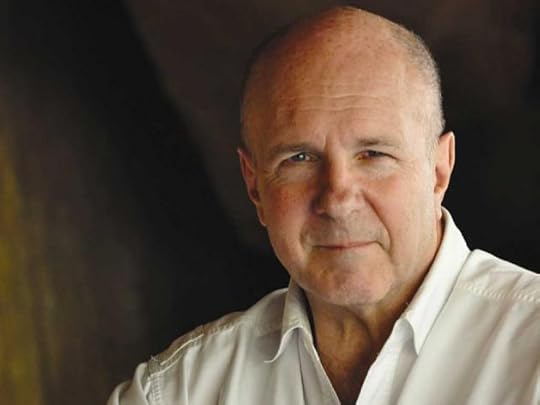
Simon Winchester - image from Kepler’s Literary Foundation
The sub-title of the book bears noting, The Transmission of Knowledge: From Ancient Wisdom to Modern Magic. Once having established what knowledge actually is, Winchester goes on to write about the means by which that knowledge was dispersed. He goes back to the development of the earliest known languages, marking the bridge where pictographic symbols were succeeded by letters representing sounds. It is fascinating to note that the use of written language arose more or less at the same time across the planet, across cultures that had had no contact with each other.
Once languages existed, schools would be needed, to sustain cultures and communities. The earliest known examples sprang up in Iraq and China. So, the means of transmission, beyond the family, was teachers. Some things never change. Winchester notes the considerable similarities between ancient and modern education. And some modern differences.
A Chinese school final exam is to the American SAT as Go is to Go Fish.He touches on the greatest hits of educational advancement. Gutenberg democratized, to a considerable degree, the acquisition of knowledge, or at least access to books, with his seminal press. A huge, big deal, as regular folks could now read materials that previously been reserved for the clergy and educated classes.
Another advancement earning considerable attention is the library, humanity’s storehouse of knowledge. Winchester goes into some detail on different sorts of libraries and how they spread. There are many fun bits of intel here, such as on the shift from scrolls to folded paper for books, and on an eccentric indexing system used in one notable private English library.
…knowledge has long been seen as far too precious to treat with casual disregard. It needs to not just be kept, but kept safe and secure. For almost as long as language, especially written language, has existed, we have sought ways of collecting, storing, and safeguarding this endlessly swelling body of what is known, of what has been learned, and of all that can then be taught, discussed, challenged, debated, and decided. The most widely recognized and most ancient means of storage is the institution that derives its English name from the Latin word for the inner bark of a tree, on which early works were said to have been written. The Latin word for this bark is liber; by way of centuries of etymological convolution, the English word, used since Chaucer’s time, is, of course, the library.Each revolution in how knowledge was transmitted was revolutionary well beyond the specific hardware upgrade. It was not just readily printable books that revolutionized the world. Printing presses were used to print newspapers as well, ushering in a world of regular information delivery to great numbers of people. Of course, newspapers have always been used as a source of propaganda and misinformation in addition to true reporting of actual events. So the capacity for mayhem grew with the capacity for a growth in awareness.
Why…did the transmission of knowledges that seem so potentially beneficial to us all get to be so drowned out by the noise of commerce and nationalism and war?Encyclopedias come in for a close look. They were seen as the informational bible for large numbers of people, as they sought to offer buyers all the information currently known. He covers several of the major such products, including those beyond the Encyclopedia Britannica. (I remember when I was a child in the 1950s Bronx, our local supermarket, an A&P, sold the Frunk and Wagnall’s encyclopedia volume by volume. Hardcover, very thin paper, occasional illustrations. I remember looking forward to the arrival of every single one of the twenty-five volumes. There would always be something of interest.) Such publications continued the work of Gutenberg, making potentially vast amounts of information available to regular people.
Further advances in info transmission were to come. The telegraph shrunk the world of the 19th century the way the internet has done today. Radio broadcasting had a great impact. We learn much about the early days of the BBC, and its Japanese counterpart, including the impact those institutions had on the education, and attitudes toward education, of their respective populations. This was particularly eye-opening.
The middle of the 20th century saw major advances. Computer chips revolutionized everything. Now we can access information on most things instantly, or close enough to it, using a hand-held device. And in place of bookshelf-filling volumes we can check with Wikipedia for information on almost anything.
But knowledge is a feeder to a larger question. Whither wisdom?
What can and may and will happen next to our mental development if and when we have no further need to know, perhaps no need to think? What if we are then unable to gain true knowledge, enlightenment, or insight—that most precious of human commodities, true wisdom? What then will become of us?This is not a new concern. Socrates was worried that the development of writing would impair people’s ability to understand things. He thought that if people could access written material, they would no longer have a need to memorize said material, by which means they supposedly incorporated it into their personal long-term storage, and had it available at the speed of thought. It is no big stretch to be concerned that the outsourcing of so much intellectual heavy lifting, which has been a product of the computer revolution, might leave our minds flabby and diminished.
Winchester offers a look at the greatest thinkers of all time, polymaths ancient and modern. In addition to the usual suspects, there are some names here that will be unfamiliar. Really? I never even heard of that guy. is a reaction I had more than once to some of the personages in his all-time, intellectual all-star roster.
If there is one thing that I found lacking in the book, well, lacking is not the right word, more like something I would have liked to have seen there. Is a look at how knowledge is lost or destroyed, whether by misfortune of evil intent. For just as knowledge can advance civilization, denial of access to it can help bring about a dark age.
Winchester’s aim here is to wonder how we will fare going forward when so much of our learning is housed outside our brains. Knowledge is a crucial element in the development of wisdom. Will our brains, uncluttered of vast amounts of information, be freed to contemplate deeper truths? Or will the neurons that gather information be too softened to address heavier thinking? Given what I have heard of so many younger people in the work force, I am leaning toward the dark side on this one. But I sure hope I am wrong. Encountering a passel of bright young minds in the last few years keeps alive hopes for better.
Simon Winchester is a national treasure. (probably for two countries, as he is an English-born American citizen) He repeatedly produces amazingly interesting books that open our eyes to parts of the world, contemporary and historical, that might otherwise remain unknown. Considering how much he has taught us through his writings, there is no question but that the world is a much richer place for how much knowledge and wisdom he has imparted to us all through his ongoing production of fascinating material. You may or may not become wise as a result of reading this book, but I guarantee you will become more knowledgeable.
How, in sum, do we value the knowledge that, thanks to the magic of electronics, is now cast before us in so vast and ceaseless and unstoppable a cascade? Amid the torrent and its fury, what is to become of thought—care and calm and quiet thoughtfulness? What of our own chance of ever gaining wisdom? Do we need it? Does anybody? How does a world function if no one within it is wise?
Review first posted - 9/15/23
Publication dates
----------Hardcover – 4/23/23
----------Trade paperback - 4/23/24
I received an ARE of Knowing What We Know from Harper in return for a fair review.


This review will soon be cross-posted on my site, Coot’s Reviews. Stop by and say Hi!
=============================EXTRA STUFF
Links to the Winchester’s personal, Twitter and FB pages
A nice overview of Winchester’s professional life can be found here
Interviews
-----The Michael Schermer Show - Are We Risking Our Ability to Think?
There is a wonderful story re material in the Encyclopedia Britannica about how a relied-upon source can foment truly awful errors.
-----Free Library of Philadelphia - Simon Winchester | Knowing What We Know: The Transmission of Knowledge
-----Live Talks Los Angeles - Simon Winchester in conversation with Ted Habte-Gabr at Live Talks Los Angeles
Reviews of other Simon Winchester books we have read:
-----2021 - Land: How the Hunger for Ownership Shaped the Modern World
-----2018 - The Perfectionists
-----2015 - Pacific
-----2010 - Atlantic
-----2008 - The Man Who Loved China
-----2005 - Krakatoa: The Day the World Exploded
-----2001 - The Map That Changed the World
-----1998 - The Professor and the Madman

August 27, 2023
Let’s Lighten Up
I don’t know what to make of this book. It seems to be a rambling journalistic account of something called ‘knowledge’ which it defines in a traditional way as “justified true belief.” Starting with Plato, it provides anecdotes and opinions from a vast array of philosophers, scientists, teachers and literary types about our state of knowledge without coming to any conclusion about either the efficacy of that state or it’s likely future. It therefore makes little if any contribution to either the perennial issues of epistemology or the more recent discussions of Artificial Intelligence. Perhaps the book’s primary function, intentional or not, is to provoke meditation. Here is mine:
Experience is mute. Knowledge has a voice. This voice sounds every time we speak about our experience, as well as in the archives, histories, manuscripts, diaries and algorithms that constitute our unique inheritance as Homo sapiens.
Knowledge is always in the form of language. It is consequently fundamentally communal. Even if some elements of knowledge are spoken, written, or merely thought by individuals, their linguistic character implies they have been shaped by a specific language and the culture in which that language is practiced.
Knowledge is, and always has been, infinite since the possibilities for the expression of experience are limitless. This is so even if our experiences themselves are limited by sensory abilities or technology. That knowledge is expanding at an increasing rate - from primitive signs, to language, to writing, to print, to electronic media - is a truism.
Experience is not knowledge. The connections between the world of experience and the world of knowledge have always been problematic, and have become obviously so as knowledge-technology itself becomes our dominant experience.
Nevertheless this dominance of knowledge over experience, long before the Internet or AI, has prevailed among the human species. Knowledge may not determine what we experience but it does most often set the bounds of what we can see. Knowledge has the advantage of the immense weight of a society to impose itself on individual experience.
Knowledge resists all attempts at verification through rational processes and calls experience which has not been captured/described/categorised in language as illusory. Conversely all experience that is so ‘encoded’ in language becomes part of recognised reality - most frequently with its own scientific, religious, superstitious, conspiratorial or other justification.
Knowledge only gives way to knowledge, and even then only when new knowledge is considered more useful in terms defined by/through/in the new knowledge. This usually occurs when adherents of the old knowledge die not because they accept the new knowledge as justified.
In short, knowledge is not something that we have or possess, either as individuals or as societies. If any thing, knowledge as the epitome of language possesses/controls/directs its participants. Education is, in the most general terms, the process of increasing knowledge, that is to say, one’s facility with language. But this means that education inevitably results in the mastery by language as much as the mastery of language.
Breaking the chains of knowledge may therefore be the challenge of knowledge itself. Knowledge is always misleading no matter how logical, sensible, or useful it may seem. Liberating knowledge, in other words, is doubt. Perhaps this is the authentic meaning of the myth of the tree in the garden of paradise - a kind of warning to not take anything too seriously.
I don’t know what to make of this book. It seems to be a rambling journalistic account of something called ‘knowledge’ which it defines in a traditional way as “justified true belief.” Starting with Plato, it provides anecdotes and opinions from a vast array of philosophers, scientists, teachers and literary types about our state of knowledge without coming to any conclusion about either the efficacy of that state or it’s likely future. It therefore makes little if any contribution to either the perennial issues of epistemology or the more recent discussions of Artificial Intelligence. Perhaps the book’s primary function, intentional or not, is to provoke meditation. Here is mine:
Experience is mute. Knowledge has a voice. This voice sounds every time we speak about our experience, as well as in the archives, histories, manuscripts, diaries and algorithms that constitute our unique inheritance as Homo sapiens.
Knowledge is always in the form of language. It is consequently fundamentally communal. Even if some elements of knowledge are spoken, written, or merely thought by individuals, their linguistic character implies they have been shaped by a specific language and the culture in which that language is practiced.
Knowledge is, and always has been, infinite since the possibilities for the expression of experience are limitless. This is so even if our experiences themselves are limited by sensory abilities or technology. That knowledge is expanding at an increasing rate - from primitive signs, to language, to writing, to print, to electronic media - is a truism.
Experience is not knowledge. The connections between the world of experience and the world of knowledge have always been problematic, and have become obviously so as knowledge-technology itself becomes our dominant experience.
Nevertheless this dominance of knowledge over experience, long before the Internet or AI, has prevailed among the human species. Knowledge may not determine what we experience but it does most often set the bounds of what we can see. Knowledge has the advantage of the immense weight of a society to impose itself on individual experience.
Knowledge resists all attempts at verification through rational processes and calls experience which has not been captured/described/categorised in language as illusory. Conversely all experience that is so ‘encoded’ in language becomes part of recognised reality - most frequently with its own scientific, religious, superstitious, conspiratorial or other justification.
Knowledge only gives way to knowledge, and even then only when new knowledge is considered more useful in terms defined by/through/in the new knowledge. This usually occurs when adherents of the old knowledge die not because they accept the new knowledge as justified.
In short, knowledge is not something that we have or possess, either as individuals or as societies. If any thing, knowledge as the epitome of language possesses/controls/directs its participants. Education is, in the most general terms, the process of increasing knowledge, that is to say, one’s facility with language. But this means that education inevitably results in the mastery by language as much as the mastery of language.
Breaking the chains of knowledge may therefore be the challenge of knowledge itself. Knowledge is always misleading no matter how logical, sensible, or useful it may seem. Liberating knowledge, in other words, is doubt. Perhaps this is the authentic meaning of the myth of the tree in the garden of paradise - a kind of warning to not take anything too seriously.

October 2, 2024
It is not easy to be a polymath - as the author says at one point in this, with so much information in the world today, the chance of us knowing everything there is to know, even in a small section of the wealth of human knowledge, is beyond the abilities of most of us. There was a time when there were polymaths. But that time is long past. And really, if this author could be anything at all, I’m nearly certain a polymath would be exactly what he would choose to be.
This is a book covering a wide range of topics - but particularly epistemology, but epistemology for the general public. It is clearly written and accessible, two things an aspiring polymath should definitely try to be if they possibly can. And this is a book about technology and how technology changes the ways in which we think and the ways in which we know. At one point in this he talks about navigation and how there was a time, a very recent time, when knowing where you were at any point on the earth’s surface meant you needed to know how to use a sextant and be able to apply trigonometry. Now, all of this is ancient history with global positioning able to tell you exactly where you are with virtually no prior knowledge at all. Does this diminish us? I remember in high school we were taught logarithms. We had bought a strange silver covered book with pages and pages of numbers. They weren’t all that hard to learn. But it was years later that I was finally told why we had learnt them. They were also important for navigation. In finding your location on the surface of the globe you needed to frequently multiply very large numbers together. But we are only human and humans tend to make mistakes when multiplying large numbers - did I carry the one? Someone realised that every number could be rewritten as a power of ten. This gave you a ten with a number as its index - the little number above the ten. If you had two large numbers, you could look up the indices of these two numbers and simply add them together - giving your the product of the two numbers. Since adding is much easier than multiplying, that is why log tables proved so useful. The teacher who told me this said that since we all have calculators now, the point of everyone learning logarithms was mostly down to mathematics teachers not bothering to keep up with the times. Perhaps an overstatement, but what would I know?
This is actually one of the big themes of this book - not logarithms as such, but how technology makes a lot of old knowledge pointless. The question then is, if today we carry with us a device that allows us to access the sum total of human knowledge in our back pockets, what is the point of holding knowledge in our heads any longer? This is not an easy question to answer.
He does the standard thing of differentiating between data, information, knowledge and wisdom. Just because you have access to lots of information doesn’t in the least mean that you are knowledgeable and certainly doesn’t mean you are wise. Which then begs the question of what it is to be wise. There is a lovely story of one of the physicists who was asked if he was a genius - he said he wasn’t, he was just really quite smart. He knew he wasn’t a genius because he had known lots of geniuses and they were quicker and smarter than he was. Which then also comes back to how philosophy got its name. When someone said to Pythagoras that he was a wise man, he said that he wasn’t wise, but a lover of wisdom - in Greek, a philosopher. Or Socrates when he was told he was the wisest man alive replied ‘all I know is that I know nothing’. Which, of course, is wisdom indeed.
I would love to be able to draw - but it has never been something I’ve ever been able to do. I love the simplicity of some people’s drawings, as much as the awe inspiring complexity of that of other artists. Picasso gets a bad rap now, but he had a sense of line that takes my breath away. To criticise him for what he did with his penis seems somewhat beside the point to me. I’m nearly certain I would not like him in the least. But I guess that might also be true of other of my heroes. I’m not sure I would like to spend a whole lot of time with Kafka or with Beethoven or with Marx. The more you learn about your heroes, the harder it is to keep thinking of them as heroes, well, other than in the sphere of achievement they excelled at. Try to write like Kafka and unless you are Ishiguro, you are probably going to make a total mess of it.
The kinds of people I find most interesting are those who can take a topic that is otherwise absurdly complicated and explain it in ways that are accessible to the rest of us poor mortals. When people fail at this - and I’ve read many books by physicists where this has been the case - it is a deep disappointment. I’m more interested in sociology than most other subjects now, but many of the sociologists specialise in overly complicated language. Even those I think really ought to know better. One is Bourdieu. He even wrote a fabulous book called Academic Discourse. I’m going to give a lecture on that next month. In it he talks of a survey his team did on French university students. Basically, what they did was to attend a series of lectures the students also attended. They took down the key words used by the professors at these lectures and then asked the students after the lectures to define these key words for them. Words like dialectic or epistemology or polymath, I guess. Unsurprisingly, the students couldn’t define these words. So they asked them why they hadn’t interrupted the lecturer and ask what they meant. The most general response was that they had understood the words in context, even if they now couldn’t define them. But then, a while later, they read over the essays these students wrote and found they had used all of these words they could not define in their essays. Bourdieu said that you aren’t really taught how to think at university, but rather you are provided a relationship to a culture - and in a sense you fake it until you make it. That is, you write in a way you don’t understand, but this positions you in a way that will, hopefully, lead you one day to knowing what you are talking about.
True story. In my undergraduate degree I had an experience very much like this. I had to write an essay on Foucault and I was incredibly proud of it - not least because I got a very good mark for the essay. About a year later I was clearing out my papers and spotted the essay. I thought I would have a quick read over it again to see just how brilliant I really was. The problem was that I could hardly understand two words I’d written together. It was so pretentious, and convoluted, and impenetrable. I could hardly believe I had written it. Rather than feeling a sense of pride, I felt crushed. I decided then to not give as much thought to getting good marks, but rather to try to write in as clear and simple a way as I possibly could. But if that is my story, I can’t say it is Bourdieu’s. He often writes in ways that are too difficult for me. This is particularly true of the first chapter of just about any book he ever wrote.
I think the point in life, in many ways, is something a machine struggles to do. And this is the idea of wanting to be a polymath, even when that is ultimately impossible. That is, not just to know lots of stuff, but to find ways to bring those different strands of knowledge together and to do so in a way that helps people understand something they didn’t know they didn’t know beforehand. We are social animals and to share knowledge - to share anything - is the most human of exchanges.
I’m not sure I enjoyed this book as much as I hoped I would. I’ve enjoyed other of his books more - but I like reading his books. He brings joy to the writing of them and he holds my hand as he explains things - even things I already know - and that is a lovely and deeply human thing to do. There should be more of that.
This is a book covering a wide range of topics - but particularly epistemology, but epistemology for the general public. It is clearly written and accessible, two things an aspiring polymath should definitely try to be if they possibly can. And this is a book about technology and how technology changes the ways in which we think and the ways in which we know. At one point in this he talks about navigation and how there was a time, a very recent time, when knowing where you were at any point on the earth’s surface meant you needed to know how to use a sextant and be able to apply trigonometry. Now, all of this is ancient history with global positioning able to tell you exactly where you are with virtually no prior knowledge at all. Does this diminish us? I remember in high school we were taught logarithms. We had bought a strange silver covered book with pages and pages of numbers. They weren’t all that hard to learn. But it was years later that I was finally told why we had learnt them. They were also important for navigation. In finding your location on the surface of the globe you needed to frequently multiply very large numbers together. But we are only human and humans tend to make mistakes when multiplying large numbers - did I carry the one? Someone realised that every number could be rewritten as a power of ten. This gave you a ten with a number as its index - the little number above the ten. If you had two large numbers, you could look up the indices of these two numbers and simply add them together - giving your the product of the two numbers. Since adding is much easier than multiplying, that is why log tables proved so useful. The teacher who told me this said that since we all have calculators now, the point of everyone learning logarithms was mostly down to mathematics teachers not bothering to keep up with the times. Perhaps an overstatement, but what would I know?
This is actually one of the big themes of this book - not logarithms as such, but how technology makes a lot of old knowledge pointless. The question then is, if today we carry with us a device that allows us to access the sum total of human knowledge in our back pockets, what is the point of holding knowledge in our heads any longer? This is not an easy question to answer.
He does the standard thing of differentiating between data, information, knowledge and wisdom. Just because you have access to lots of information doesn’t in the least mean that you are knowledgeable and certainly doesn’t mean you are wise. Which then begs the question of what it is to be wise. There is a lovely story of one of the physicists who was asked if he was a genius - he said he wasn’t, he was just really quite smart. He knew he wasn’t a genius because he had known lots of geniuses and they were quicker and smarter than he was. Which then also comes back to how philosophy got its name. When someone said to Pythagoras that he was a wise man, he said that he wasn’t wise, but a lover of wisdom - in Greek, a philosopher. Or Socrates when he was told he was the wisest man alive replied ‘all I know is that I know nothing’. Which, of course, is wisdom indeed.
I would love to be able to draw - but it has never been something I’ve ever been able to do. I love the simplicity of some people’s drawings, as much as the awe inspiring complexity of that of other artists. Picasso gets a bad rap now, but he had a sense of line that takes my breath away. To criticise him for what he did with his penis seems somewhat beside the point to me. I’m nearly certain I would not like him in the least. But I guess that might also be true of other of my heroes. I’m not sure I would like to spend a whole lot of time with Kafka or with Beethoven or with Marx. The more you learn about your heroes, the harder it is to keep thinking of them as heroes, well, other than in the sphere of achievement they excelled at. Try to write like Kafka and unless you are Ishiguro, you are probably going to make a total mess of it.
The kinds of people I find most interesting are those who can take a topic that is otherwise absurdly complicated and explain it in ways that are accessible to the rest of us poor mortals. When people fail at this - and I’ve read many books by physicists where this has been the case - it is a deep disappointment. I’m more interested in sociology than most other subjects now, but many of the sociologists specialise in overly complicated language. Even those I think really ought to know better. One is Bourdieu. He even wrote a fabulous book called Academic Discourse. I’m going to give a lecture on that next month. In it he talks of a survey his team did on French university students. Basically, what they did was to attend a series of lectures the students also attended. They took down the key words used by the professors at these lectures and then asked the students after the lectures to define these key words for them. Words like dialectic or epistemology or polymath, I guess. Unsurprisingly, the students couldn’t define these words. So they asked them why they hadn’t interrupted the lecturer and ask what they meant. The most general response was that they had understood the words in context, even if they now couldn’t define them. But then, a while later, they read over the essays these students wrote and found they had used all of these words they could not define in their essays. Bourdieu said that you aren’t really taught how to think at university, but rather you are provided a relationship to a culture - and in a sense you fake it until you make it. That is, you write in a way you don’t understand, but this positions you in a way that will, hopefully, lead you one day to knowing what you are talking about.
True story. In my undergraduate degree I had an experience very much like this. I had to write an essay on Foucault and I was incredibly proud of it - not least because I got a very good mark for the essay. About a year later I was clearing out my papers and spotted the essay. I thought I would have a quick read over it again to see just how brilliant I really was. The problem was that I could hardly understand two words I’d written together. It was so pretentious, and convoluted, and impenetrable. I could hardly believe I had written it. Rather than feeling a sense of pride, I felt crushed. I decided then to not give as much thought to getting good marks, but rather to try to write in as clear and simple a way as I possibly could. But if that is my story, I can’t say it is Bourdieu’s. He often writes in ways that are too difficult for me. This is particularly true of the first chapter of just about any book he ever wrote.
I think the point in life, in many ways, is something a machine struggles to do. And this is the idea of wanting to be a polymath, even when that is ultimately impossible. That is, not just to know lots of stuff, but to find ways to bring those different strands of knowledge together and to do so in a way that helps people understand something they didn’t know they didn’t know beforehand. We are social animals and to share knowledge - to share anything - is the most human of exchanges.
I’m not sure I enjoyed this book as much as I hoped I would. I’ve enjoyed other of his books more - but I like reading his books. He brings joy to the writing of them and he holds my hand as he explains things - even things I already know - and that is a lovely and deeply human thing to do. There should be more of that.
May 22, 2023
After finishing this book, I’m still coming to terms with the title, which includes not just the one now-standard-for-all-non-fiction colon, but a second one as well. I’m pretty sure that second one is unnecessary, but maybe that reflects my problems with the book overall.
“Knowing What We Know” suggested to me that there would be substantial content regarding the cognitive processes related to acquiring knowledge. There is some, but not as much as I had hoped for. The next part of the title, “The Transmission of Knowledge”, is covered in detail. Too much at times, IMO. I could have done with several dozen pages less on the world’s earliest schools, for instance, and my attention waned during the lengthy discussion of who actually published the first encyclopedia worthy of the name. Winchester gets to “From Ancient Wisdom to Modern Magic” in the final section of the book, which is in many ways the best. More on that below.
Along the way the book is an aggregation of knowledge-related topics, peppered with personal anecdotes or entertaining observations on individuals or developments throughout world history. For instance, his description of T’sai Lun’s creation of paper in China after studying wasp’s nests is engaging, as is his discussion of how Gutenberg and other early printers were less interested in what they printed than how readily they could sell the finished product.
The sections on propaganda and manipulation of knowledge stand out as being particularly good. This is one instance where the insertion of Winchester’s personal experience was right on point, as he describes his coverage of Bloody Sunday in Northern Ireland in 1972. He reported what he saw: that the Paras fired, unprovoked, on unarmed protesters. That version of events was scoured from the official record; the British government white-washed the incident to save face and change the public’s perception of the situation in Northern Ireland. It wasn’t until 2010 that the truth was acknowledged. Winchester notes that the Chinese government has been even more effective at completely erasing from history-within China-of the Tiananmen Square massacre of 1989.
The final section of the book is focused on the developments since the mid-20th century that have significantly altered what we know, and what we need to know. We don’t need to know how to navigate, whether on the high seas or through a new neighborhood, because of GPS. There is no need to understand mathematical or statistical functions, since hand-held calculators, and more recently smart phones, can make the calculations for us. And there are countless facts that we don’t need to memorize (or remember) because Google will provide them for us.
This provides much food for thought for Winchester, as I’m sure it does for many of us. These issues seep into our lives wherever we look. From my own experience in just the past day: (1) A letter I was asked to review for appropriate tone was much, much better than those I normally see from that overly-effusive writer. I later learned that the author had produced it using ChatGTP. Interestingly, while the tone was good, several key elements had been omitted. I guess GIGO is still a thing. (2) While walking the dogs this morning I was passed 3 times by a Google-earth car roaming the neighborhood with its rooftop cameras getting an updated view of things. (3) I couldn’t remember my wife’s flight number so I Googled “AA SFO to JAX”. No need to even use the airline’s app to find out if the flight was on time!
Do these “advances” mean we are not using our brains, that they will atrophy and that we will be taken over by robots equipped with AI? (“I’m afraid I can’t do that, Dave…”). Or will these tools allow us to free up our brains to think more deeply on meaningful topics? IDK, I still love maps and only use GPS in completely new places. And obviously I still enjoy writing and can’t imagine expecting AI to do it for me. It’s probably true that I don’t remember things I Google as well as if I had to go to the library and look them up, but then again I’d probably lose interest in most quick search subjects before I did that. The jury is still out.
All in all, I can’t say this book ranks with Winchester’s best. He managed to work in references to topics he covered in two other books, Krakatoa: The Day the World Exploded: August 27, 1883 and The Professor and the Madman: A Tale of Murder, Insanity and the Making of the Oxford English Dictionary, both of which I enjoyed much more than this. At this point I’m at a solid 3.5 rating. Do I round up or down? Down, I think.
“Knowing What We Know” suggested to me that there would be substantial content regarding the cognitive processes related to acquiring knowledge. There is some, but not as much as I had hoped for. The next part of the title, “The Transmission of Knowledge”, is covered in detail. Too much at times, IMO. I could have done with several dozen pages less on the world’s earliest schools, for instance, and my attention waned during the lengthy discussion of who actually published the first encyclopedia worthy of the name. Winchester gets to “From Ancient Wisdom to Modern Magic” in the final section of the book, which is in many ways the best. More on that below.
Along the way the book is an aggregation of knowledge-related topics, peppered with personal anecdotes or entertaining observations on individuals or developments throughout world history. For instance, his description of T’sai Lun’s creation of paper in China after studying wasp’s nests is engaging, as is his discussion of how Gutenberg and other early printers were less interested in what they printed than how readily they could sell the finished product.
The sections on propaganda and manipulation of knowledge stand out as being particularly good. This is one instance where the insertion of Winchester’s personal experience was right on point, as he describes his coverage of Bloody Sunday in Northern Ireland in 1972. He reported what he saw: that the Paras fired, unprovoked, on unarmed protesters. That version of events was scoured from the official record; the British government white-washed the incident to save face and change the public’s perception of the situation in Northern Ireland. It wasn’t until 2010 that the truth was acknowledged. Winchester notes that the Chinese government has been even more effective at completely erasing from history-within China-of the Tiananmen Square massacre of 1989.
The final section of the book is focused on the developments since the mid-20th century that have significantly altered what we know, and what we need to know. We don’t need to know how to navigate, whether on the high seas or through a new neighborhood, because of GPS. There is no need to understand mathematical or statistical functions, since hand-held calculators, and more recently smart phones, can make the calculations for us. And there are countless facts that we don’t need to memorize (or remember) because Google will provide them for us.
This provides much food for thought for Winchester, as I’m sure it does for many of us. These issues seep into our lives wherever we look. From my own experience in just the past day: (1) A letter I was asked to review for appropriate tone was much, much better than those I normally see from that overly-effusive writer. I later learned that the author had produced it using ChatGTP. Interestingly, while the tone was good, several key elements had been omitted. I guess GIGO is still a thing. (2) While walking the dogs this morning I was passed 3 times by a Google-earth car roaming the neighborhood with its rooftop cameras getting an updated view of things. (3) I couldn’t remember my wife’s flight number so I Googled “AA SFO to JAX”. No need to even use the airline’s app to find out if the flight was on time!
Do these “advances” mean we are not using our brains, that they will atrophy and that we will be taken over by robots equipped with AI? (“I’m afraid I can’t do that, Dave…”). Or will these tools allow us to free up our brains to think more deeply on meaningful topics? IDK, I still love maps and only use GPS in completely new places. And obviously I still enjoy writing and can’t imagine expecting AI to do it for me. It’s probably true that I don’t remember things I Google as well as if I had to go to the library and look them up, but then again I’d probably lose interest in most quick search subjects before I did that. The jury is still out.
All in all, I can’t say this book ranks with Winchester’s best. He managed to work in references to topics he covered in two other books, Krakatoa: The Day the World Exploded: August 27, 1883 and The Professor and the Madman: A Tale of Murder, Insanity and the Making of the Oxford English Dictionary, both of which I enjoyed much more than this. At this point I’m at a solid 3.5 rating. Do I round up or down? Down, I think.

January 9, 2026
Who better than Simon Winchester to address the big messy topic of how humanity has acquired and conveyed knowledge across history? Winchester begins with the philosophical question of what constitutes knowledge. He covers the development of writing systems, and knowledge transmission through libraries, museums, encyclopedias, the printing press, and newspapers. He eventually arrives at computers, the internet, Wikipedia, and artificial intelligence. He looks at the differences between knowledge and wisdom. As is typical with Winchester’s works, he includes his own personal experiences and travels that provide additional context for his observations.
The book is organized mostly in chronological order with the addition of anecdotes and a few interesting diversions. This is part of Winchester’s style and one that appeals to me personally. He includes numerous historical details and strange facts. I particularly enjoyed the way he draws connections across disciplines and centuries.
A main theme is whether instant access to information will affect human cognition. Winchester worries that people may lose the motivation to remember or understand and allow technologies to do the “thinking” for them. He uses the term "digital amnesia" to describe this phenomenon and questions whether minds freed from storing information will achieve greater wisdom or simply atrophy. He poses questions about what will become of deep thought, especially when information arrives in such massive quantities almost instantaneously. The book also addresses misinformation, and how it has always been manipulated by those in power (and how this continues in the digital age).
This is a book for people who like to contemplate big questions. It is not a book that provides all the answers (as if that is even possible with such a huge topic). The book poses questions about the future of human thinking. Winchester’s enthusiasm for his topics is obvious. He inspires curiosity. Readers familiar with Winchester's other work will recognize his approach and appreciate his continued ability to make history engaging. If you are new to Winchester’s works, I would not start here.
4.5
The book is organized mostly in chronological order with the addition of anecdotes and a few interesting diversions. This is part of Winchester’s style and one that appeals to me personally. He includes numerous historical details and strange facts. I particularly enjoyed the way he draws connections across disciplines and centuries.
A main theme is whether instant access to information will affect human cognition. Winchester worries that people may lose the motivation to remember or understand and allow technologies to do the “thinking” for them. He uses the term "digital amnesia" to describe this phenomenon and questions whether minds freed from storing information will achieve greater wisdom or simply atrophy. He poses questions about what will become of deep thought, especially when information arrives in such massive quantities almost instantaneously. The book also addresses misinformation, and how it has always been manipulated by those in power (and how this continues in the digital age).
This is a book for people who like to contemplate big questions. It is not a book that provides all the answers (as if that is even possible with such a huge topic). The book poses questions about the future of human thinking. Winchester’s enthusiasm for his topics is obvious. He inspires curiosity. Readers familiar with Winchester's other work will recognize his approach and appreciate his continued ability to make history engaging. If you are new to Winchester’s works, I would not start here.
4.5

April 7, 2023
I'd have loved to be a fly on the wall when the wonderful Simon Winchester told his editor, "I think I'd like my next book to be on human knowledge. All of it." I assume a flurry of questions followed, mainly asking what would that book even look like.
As expected, the book is named Knowing What We Know and it is a wonderful walk through the major people, places, and events of human history. To be clear, there are philosophical questions presented but the book is not a philosophy book. Winchester wants to ruminate on these questions by chronicling history and its major leaps in knowledge. Aristotle is in here, but so is Google. Gutenberg makes an appearance as well as the atomic bomb. The book is fun because you can feel how much fun Winchester is having writing it. As with most of his books, it feels like a conversation. I half expect each chapter to end with, "what do you think?"
This is a safe book to recommend to anyone, even those who avoid non-fiction. There is too much covered for there not to be something someone will find interesting.
(This book was provided as an advance copy by Netgalley and Harper Books.)
As expected, the book is named Knowing What We Know and it is a wonderful walk through the major people, places, and events of human history. To be clear, there are philosophical questions presented but the book is not a philosophy book. Winchester wants to ruminate on these questions by chronicling history and its major leaps in knowledge. Aristotle is in here, but so is Google. Gutenberg makes an appearance as well as the atomic bomb. The book is fun because you can feel how much fun Winchester is having writing it. As with most of his books, it feels like a conversation. I half expect each chapter to end with, "what do you think?"
This is a safe book to recommend to anyone, even those who avoid non-fiction. There is too much covered for there not to be something someone will find interesting.
(This book was provided as an advance copy by Netgalley and Harper Books.)

March 4, 2024
I will admit that my thoughts and rating on this book are biased by my belief and faith. Read on at your own peril.
This book is a wandering through humanity's collection and transmission of knowledge from generation to generation. The book discusses and reviews the methods and pitfalls of this collection and its communication. Much of what is written here should be general knowledge to most with some interesting bits interspersed here and there that might not be so common knowledge. From this aspect the book might be a read of interest to some.
So what's my beef? If you claim to cover all humanity's transmission of knowledge then the author must cover that which is obvious he is most uncomfortable with - that of the role of religious wisdom in the story of humanity. Other than a few mentions here and there to supplement a specific secular aspect of his recounting Mr. Winchester avoids, like the plague, engagement of all things associated with religious wisdom. Like most secular humanists, they can't fathom the wisdom religion brings to the individuals among the generations, and falls victim to the all to prevalent concept of humanity's ability to somehow better itself with no need for external accountability.
This book is a wandering through humanity's collection and transmission of knowledge from generation to generation. The book discusses and reviews the methods and pitfalls of this collection and its communication. Much of what is written here should be general knowledge to most with some interesting bits interspersed here and there that might not be so common knowledge. From this aspect the book might be a read of interest to some.
So what's my beef? If you claim to cover all humanity's transmission of knowledge then the author must cover that which is obvious he is most uncomfortable with - that of the role of religious wisdom in the story of humanity. Other than a few mentions here and there to supplement a specific secular aspect of his recounting Mr. Winchester avoids, like the plague, engagement of all things associated with religious wisdom. Like most secular humanists, they can't fathom the wisdom religion brings to the individuals among the generations, and falls victim to the all to prevalent concept of humanity's ability to somehow better itself with no need for external accountability.

May 7, 2023
I didn’t finish this one. Winchester is one of my favorite writers; nobody writes about the seemingly mundane in such a compelling manner. He continues to flex these muscles by tackling ever grander topics. In his early books, he focused on under-represented stories and drew larger themes from them. He then shifted towards larger topics like the Atlantic and Pacific Oceans. Those were amazing books that spanned centuries–with the common thread simply being vast expanses of water.
But with his last book, “Land”, I started feeling like the reading experience was suffering. That was the first book of his that I left feeling meh. Ultimately there isn’t much that can stick when you’re covering a concept as grand as land ownership. And then came this book: the topic of knowledge.
Again, I sensed the scale makes it too large for anything to stick. The stories, rather than being the focus, are supporting characters. And for those that have read about concepts of information or knowledge (or even studied it), it ends up being a pretty superficial affair. This book’s achievement in scope comes at the cost of the intrigue and memorability that made his earlier books brilliant.
But with his last book, “Land”, I started feeling like the reading experience was suffering. That was the first book of his that I left feeling meh. Ultimately there isn’t much that can stick when you’re covering a concept as grand as land ownership. And then came this book: the topic of knowledge.
Again, I sensed the scale makes it too large for anything to stick. The stories, rather than being the focus, are supporting characters. And for those that have read about concepts of information or knowledge (or even studied it), it ends up being a pretty superficial affair. This book’s achievement in scope comes at the cost of the intrigue and memorability that made his earlier books brilliant.

October 10, 2023
The author tells us that with this book, he wanted to get to the essence of how we know what we know, and that he wanted to do this by looking at how knowledge is transmitted. I read halfway through and found nothing about the first or the second.
Winchester wasn't the first to think of analyzing the "way we know"; we've been doing it for millennia. There is even a science dedicated to its study, epistemology, and hundreds of thinkers who have dedicated themselves to studying it, but the author has very little to say about the knowledge produced by all of these, mentioning the domain only in the epilogue.
Then he talks about the transmission of knowledge, and once again ignores practically everything the communication sciences have studied over the last 70 years. He makes some references to McLuhan, but these are no more than common sense.
In the end, we are left with a few journalistic curiosities that, unbelievably, still find those willing to publish them.
Winchester wasn't the first to think of analyzing the "way we know"; we've been doing it for millennia. There is even a science dedicated to its study, epistemology, and hundreds of thinkers who have dedicated themselves to studying it, but the author has very little to say about the knowledge produced by all of these, mentioning the domain only in the epilogue.
Then he talks about the transmission of knowledge, and once again ignores practically everything the communication sciences have studied over the last 70 years. He makes some references to McLuhan, but these are no more than common sense.
In the end, we are left with a few journalistic curiosities that, unbelievably, still find those willing to publish them.

May 21, 2024
Honestly the AI hype and premise of 'will we need smart people anymore' was offputting and the conclusion he reaches about what we'll do with all our new free time because of computers seemed naive. But maybe I'm a cynic.

October 11, 2024
What if Simon Winchester wrote all about all the different ways about knowledge. From the creation of paper to the creation of Google.
Great book.
Great book.

Read
February 20, 2023Tracking the history of knowledge is certainly an interesting endeavor; for much of human history, written knowledge is all we have left. The rest, often information deemed to obvious to be notated, is now lost.
Still, Simon Winchester follows the history of knowledge from Mesopotamia to the modern day by way of discussing libraries/museums, how information was written and dispersed to the public, what exactly people did with that knowledge and how people or governments skewed things to their benefits, and last but not least: computers.
I enjoyed reading this book and would heartily recommend it to anyone interested in diving into the history of knowledge. Hopefully we'll all become a litter wiser for it.
Still, Simon Winchester follows the history of knowledge from Mesopotamia to the modern day by way of discussing libraries/museums, how information was written and dispersed to the public, what exactly people did with that knowledge and how people or governments skewed things to their benefits, and last but not least: computers.
I enjoyed reading this book and would heartily recommend it to anyone interested in diving into the history of knowledge. Hopefully we'll all become a litter wiser for it.
December 28, 2023
What do I even say about this book. I started this book because I am fascinated with knowledge - how we gain it, how it's transferred, and how we can speed up the accumulation of it. I read about 1/3 of this book and had to stop. That's the first time I've done this in a very long time, but it had to be done.
This book was a rambling account of poorly chosen, poorly sequenced anecdotes with absolutely zero high level thinking done to connect any of these stories. It's a mix of the author's personal stories and other anecdotes with little to no continuity with the supposed topic of the book.
Maybe the second half of the book gets better, if so, maybe I'll try to start it again. In the meantime, this book is an absolute waste of time.
This book was a rambling account of poorly chosen, poorly sequenced anecdotes with absolutely zero high level thinking done to connect any of these stories. It's a mix of the author's personal stories and other anecdotes with little to no continuity with the supposed topic of the book.
Maybe the second half of the book gets better, if so, maybe I'll try to start it again. In the meantime, this book is an absolute waste of time.
November 20, 2023
This work contained some interesting information, however, I found the writing style rather challenging; not difficult to understand, but simply to keep my mind focused on the subject matter.
May 15, 2023
A history of how knowledge was spread is a large undertaking, but author Simon Winchester takes readers on an interesting journey through time. I thoroughly enjoyed the discussions beginning with the ancient past onward starting with the inventions of paper, the printing press, encyclopaedias, newspapers and expanding to Wikipedia and the internet. Winchester gives information about people with curious minds who have tried to spread knowledge to as many people as possible. He also discusses how other people have tried to suppress information and how libraries and museums are destroyed during wars. Most of all this book will hopefully make readers think, learn something new, and chuckle a bit. As a librarian, I have enjoyed other titles by Simon Winchester, so I am partial to his writing style and the fact that he includes a nice bibliography, glossary and b&w illustrations.

August 22, 2024
A cover and title that drew me in instantly, helped scratch an itch I never knew I had, on the transmission of knowledge throughout the ages and the power it has held. After reading this I have a deeper love for books and the rich lore behind them. From the history of writing, libraries, and paper itself, Winchester explores the critical role that books and therefore storage of information has had in shaping our society. The power they hold is truly enormous, especially in the times in which they were not easily accessible and prized for their rarity. He then explores that after the advent of the internet, and the ease of which knowledge can be acquired an be detrimental. There is no need to know or retain now that we have information at our fingertips.

January 19, 2024
A very uneven book, with aspects rising to 5 (an overall very thought-provoking exploration of the ideas of data, information, knowledge, and wisdom and some really interesting portraits. Also WONDERFUL epigraphs at the chapter beginnings!) , others more like 3 (such as TMI-level presentation of things that clearly especially fascinated him) , and some verging on 2 (like side trips into his own life). He also needed an editor simply to fix up some of the sentences, like when he is discussing atomic weapons and says, "Since no weapon thus far made has gone unused". Huh? When did we use the atomic stockpile? According to Wikipedia, "As of 2020, the United States had a stockpile of 3,750 active and inactive nuclear warheads plus approximately 2,000 warheads retired and awaiting dismantlement."
The Sunday Philosophers all seemed to agree on the unevenness of the book, but we all also agreed that there was some worhwhile stuff in it, and it made for a good discussion!
The Sunday Philosophers all seemed to agree on the unevenness of the book, but we all also agreed that there was some worhwhile stuff in it, and it made for a good discussion!

June 17, 2023
Liked a lot, especially the first two-thirds or so. You always get a lot of discursive topic-jumping with Winchester, with great historical stories mixed in. But I think the last part of the book seemed a little aimless, and a bit preachy at times. But all in all a lot of entertaining reading about a great topic.

June 1, 2024
Somehow tackles the massively broad topic of “knowledge” and breaks it down into a series of anecdotes about very niche subjects. At multiple points I asked myself “why am I listening to this?” But I couldn’t stop. Some chapters felt a little slow to me while others were riveting. People who like random trivia knowledge would enjoy this.

August 25, 2023
This book helped remind me of what a great word haberdashery is

April 28, 2023
A must read for those that love a bit of history. Purely fascinating read about knowledge, where it comes from, how we source it and what we do with it.

May 17, 2023
‘What is the likely effect on society of making the acquisition of knowledge generally, so very easy, such that there may well be, eventually, no absolute need to know or retain - retain being the operative word - the knowledge of anything?’
What exactly is the value of knowledge when we live in a society where anything and everything is so easily attained? Does that change its value to society? Think about it ….. with no pressing need to remember things, will this have a long term impact on both our intelligence and thoughtfulness? Our reliance on modern technology - everything from Google, to Maps to phone numbers - has taken away what was previously much of our innate learning and capabilities. When I began to truly consider this, I found this book both informed and raised many valid questions.
Winchester outlines a lot of research - everything from our surrounding our collective knowledge. From the beginning with civilization's earliest writing on clay tablets to the Internet, and now AI (just think ChatGPT). His writing is informative and entertaining as he brings both his holistic and intimate knowledge to this topic. From small known occurrences or ordinary people to the bigger to bigger events such as the atomic bomb that ended WWII.
Whilst there was much to wade through and consider, the concluding page deemed to throw everything preceding into disarray - hmmmm …. interesting. Do machines diminish our capacity for thought or might the opposite be true? That, in fact, machines might free our mind from the mundane for a higher purpose. I wish more had been dedicated to this line of thinking rather than as an afterthought on the final page.
Winchester asks readers, “Does an existential intellectual crisis loom?” If machines are taking over more roles and what does that leave the role of humans? In this book Winchester undertakes a thorough investigation of knowledge over history. Everything from its creation to how it has been organised, stored and used. This in depth study looks at how we learn, who we learned from and what we are in danger of losing.
‘What can and may and will happen next to our mental development if and when we have no further need to know, perhaps no need to think? What if we are then unable to gain true knowledge, enlightenment, or insight-that most precious of human commodities, true wisdom? What then will become of us?’
This review is based on a complimentary copy from the publisher in exchange for an honest review. Opinions expressed in this review are completely my own. The quoted material may have changed in the final release.
What exactly is the value of knowledge when we live in a society where anything and everything is so easily attained? Does that change its value to society? Think about it ….. with no pressing need to remember things, will this have a long term impact on both our intelligence and thoughtfulness? Our reliance on modern technology - everything from Google, to Maps to phone numbers - has taken away what was previously much of our innate learning and capabilities. When I began to truly consider this, I found this book both informed and raised many valid questions.
Winchester outlines a lot of research - everything from our surrounding our collective knowledge. From the beginning with civilization's earliest writing on clay tablets to the Internet, and now AI (just think ChatGPT). His writing is informative and entertaining as he brings both his holistic and intimate knowledge to this topic. From small known occurrences or ordinary people to the bigger to bigger events such as the atomic bomb that ended WWII.
Whilst there was much to wade through and consider, the concluding page deemed to throw everything preceding into disarray - hmmmm …. interesting. Do machines diminish our capacity for thought or might the opposite be true? That, in fact, machines might free our mind from the mundane for a higher purpose. I wish more had been dedicated to this line of thinking rather than as an afterthought on the final page.
Winchester asks readers, “Does an existential intellectual crisis loom?” If machines are taking over more roles and what does that leave the role of humans? In this book Winchester undertakes a thorough investigation of knowledge over history. Everything from its creation to how it has been organised, stored and used. This in depth study looks at how we learn, who we learned from and what we are in danger of losing.
‘What can and may and will happen next to our mental development if and when we have no further need to know, perhaps no need to think? What if we are then unable to gain true knowledge, enlightenment, or insight-that most precious of human commodities, true wisdom? What then will become of us?’
This review is based on a complimentary copy from the publisher in exchange for an honest review. Opinions expressed in this review are completely my own. The quoted material may have changed in the final release.
February 4, 2024
This is WAY too long of a book! "Knowing What We Know” suggested to me to be more on the cognitive processes related to acquiring knowledge, but it wasn't. It's a paean to being British, and almost a love letter to the Chinese. This book is very pedagogical; an aggregate of knowledge-related topics combined with personal anecdotes, and it just didn't do it for me. He's also comes across as being anti-Christian: he refers to Christianity as the "Christian Myth" and also in his chapter on the development of Encyclopedias, he entirely missed Isidore of Seville, who in the 6th Century AD was a gatherer of all known information (and, thus, the Patron Saint of the Internet) - he went straight from Ancient China to the 10th Century AD!
The scale of this book is too large and it should have been edited down. The author states that he wanted to get to the essence of how we learn, and how that information is imparted... from what I read, he didn't get there. There was nothing written that was engaging to me about the first or the second of his stated aims, even halfway through! It was verbose and winding.
Unless you are REALLY interested in his work or don't mind over-reading the same thing to get to such a small point, I would not recommend this book. This was a DNF for me.
The scale of this book is too large and it should have been edited down. The author states that he wanted to get to the essence of how we learn, and how that information is imparted... from what I read, he didn't get there. There was nothing written that was engaging to me about the first or the second of his stated aims, even halfway through! It was verbose and winding.
Unless you are REALLY interested in his work or don't mind over-reading the same thing to get to such a small point, I would not recommend this book. This was a DNF for me.

August 7, 2025
No. Just... no. This book is so badly written that I just can't do it. Made it to page 68.
Winchester never met a run-on sentence he didn't like. I freely admit that my writing style can be prolix and discursive, but I have nothing on Winchester. Consider these examples of what is considered acceptable writing in an actual edited book:
or
What the actual fuck? That sentence doesn't even make sense, and is composed of about three different parts that don't appear to know about the existence of the other parts.
If you can read 383 pages of drivel like that, you have more patience and fewer books on your TBR list than I do. I would have considered plowing on had there been good insights in Winchester's work, but there weren't. There was the weirdness of saying "one might legitimately regard [geology] as the ur-science" (p. 18), after describing an origin story for it starting with the 1755 Lisbon earthquake—by which time physics and astronomy had been genuine science for around 150 years. Winchester says of Voltaire "no scientist he" (p. 17), despite Voltaire being very important to popularizing Newton's mechanics in France, writing Elements of the Philosophy of Newton and performing optics experiments in the 1730s. (This was perhaps led by Émilie du Châtelet, but even assisting with these would have qualified Voltaire as a scientist, if not primarily that.)
And Winchester claims we need to "regard all knowledge as somehow sacred, of as much worth to people as the people themselves consider it to be" (p. 27), just because he doesn't want to play referee. Much "knowledge" is nonsense, and the only way to get to real knowledge is by weeding a lot of it out. Winchester doesn't have to do that, because he's not a scholar or a teacher. He's just some guy who gets paid to write about things even when he has no expertise in them.
Given that he's not a good writer and not a good scholar, I can't see why we should waste any time reading his work.
Winchester never met a run-on sentence he didn't like. I freely admit that my writing style can be prolix and discursive, but I have nothing on Winchester. Consider these examples of what is considered acceptable writing in an actual edited book:
But earlier in this most exquisite seventy-line poem, the verse itself written in 1833 (though not published until nine years later) and which T. S. Eliot would later call the perfect poem, are the words that trickle back through years of time and yards of space to focus on a single, vital notion. [p. 48]
or
The term Assyriologist embraces multitudes. Although the Assyrians came later in the Mesopotamian story than the Sumerians, the Akkadians, or the Babylonians—later, too, than the Chaldeans, the Hurrites, and the Elamites, as well as the Gutians, Amorites, Kassites, Arameans, and Suteans, not to mention the peoples of Eber-Nari, Beth Nuhadra, and Beth Garmai—those who are immersed in Mesopotamian scholarship, with hundreds of thousands of still unread and undeciphered clay tablets stored in London, Paris, Berlin and, most notably, at the University of Chicago, have numberless decades of comfortable and doubtless grant-aided scholarship ahead of them. [p. 52]
What the actual fuck? That sentence doesn't even make sense, and is composed of about three different parts that don't appear to know about the existence of the other parts.
If you can read 383 pages of drivel like that, you have more patience and fewer books on your TBR list than I do. I would have considered plowing on had there been good insights in Winchester's work, but there weren't. There was the weirdness of saying "one might legitimately regard [geology] as the ur-science" (p. 18), after describing an origin story for it starting with the 1755 Lisbon earthquake—by which time physics and astronomy had been genuine science for around 150 years. Winchester says of Voltaire "no scientist he" (p. 17), despite Voltaire being very important to popularizing Newton's mechanics in France, writing Elements of the Philosophy of Newton and performing optics experiments in the 1730s. (This was perhaps led by Émilie du Châtelet, but even assisting with these would have qualified Voltaire as a scientist, if not primarily that.)
And Winchester claims we need to "regard all knowledge as somehow sacred, of as much worth to people as the people themselves consider it to be" (p. 27), just because he doesn't want to play referee. Much "knowledge" is nonsense, and the only way to get to real knowledge is by weeding a lot of it out. Winchester doesn't have to do that, because he's not a scholar or a teacher. He's just some guy who gets paid to write about things even when he has no expertise in them.
Given that he's not a good writer and not a good scholar, I can't see why we should waste any time reading his work.

May 31, 2023
How do we acquire knowledge? And how do we know what we know? Simon Winchester is back to show us the history of how knowledge is disseminated among humankind, and he does so in a very entertaining way.
"Knowing What We Know" is a fun examination of the history of knowledge, from the clay tablets of the prehistoric world to the smartphones of today. Along the way, Winchester breaks down the ways in which we seek out understanding and wisdom, and how we sometimes fall short of our goals despite our best efforts. What's more, with the rise of the internet and other technological marvels, it may very well be that our insatiable curiosity for knowledge will be destroyed by easy access to information in the palm of our hand. But then again, maybe not.
Winchester, a social historian and journalist, is a brilliant writer, and this book is very entertaining for the most part (I'd argue that the prologue goes on a little too long, but otherwise it's a swift read). "Knowing What We Know" is a fun read, and an informative one.
"Knowing What We Know" is a fun examination of the history of knowledge, from the clay tablets of the prehistoric world to the smartphones of today. Along the way, Winchester breaks down the ways in which we seek out understanding and wisdom, and how we sometimes fall short of our goals despite our best efforts. What's more, with the rise of the internet and other technological marvels, it may very well be that our insatiable curiosity for knowledge will be destroyed by easy access to information in the palm of our hand. But then again, maybe not.
Winchester, a social historian and journalist, is a brilliant writer, and this book is very entertaining for the most part (I'd argue that the prologue goes on a little too long, but otherwise it's a swift read). "Knowing What We Know" is a fun read, and an informative one.

May 29, 2025
By chance I am reading this at the same time as Gleick's Information.
https://www.goodreads.com/book/show/8...
They are very different books .This one speaks to an ongoing theme. Data Information Knowledge and Wisdom. DIKW.
TS Elliot
Where is the Life we have lost in living?
Where is the wisdom we have lost in knowledge?
Where is the knowledge we have lost in information?
He doesn't mention Babbage until three quarters of the way through the book. It is more about museums, Plato, polymaths, the Chinese examination system , tribal wisdom, the printing press, newspapers, libraries propaganda,advertising,the Mundaneum a file card precursor to the world wide web
and the role of knowledge/wisdom in modern times than technology which is Gleick's Focus.
more to follow...
https://www.goodreads.com/book/show/8...
They are very different books .This one speaks to an ongoing theme. Data Information Knowledge and Wisdom. DIKW.
TS Elliot
Where is the Life we have lost in living?
Where is the wisdom we have lost in knowledge?
Where is the knowledge we have lost in information?
He doesn't mention Babbage until three quarters of the way through the book. It is more about museums, Plato, polymaths, the Chinese examination system , tribal wisdom, the printing press, newspapers, libraries propaganda,advertising,the Mundaneum a file card precursor to the world wide web
and the role of knowledge/wisdom in modern times than technology which is Gleick's Focus.
more to follow...

December 5, 2025
Simon Winchester writes my favorite kinds of books: narrative non-fiction. This one happens to be about one of my very favorite subjects: the acquisition and transmission of knowledge. I love the way he weaves these stories together and gets you thinking about ancient forms of wisdom alongside contemporary ones. This was a fun ride tracing the ways we share knowledge through the development of written language, printed forms of language, and electronic transmission. Educational institutions and libraries (💜) got a deep dive, as did propaganda. Also, I love listening to him read his own work (he sounds like David Attenborough). Winchester excavates amazing source material, and he is so skilled at paring it down into compelling storytelling.

February 26, 2025
interesting but a bit dry at times - I think the progression of the book and examples made it an interesting read at times. In its essence this book is just that one tweet that’s like “don’t use AI. Stay up for 24+ hours with too much caffeine and wrestle with academia like they used to”. I think his final argument had some merit to it but not sure if I 100% agree… but I am also just a girl with a pea sized brain. So who knows.

June 18, 2025
I love the erudition and eloquence of Winchester’s writing, and I also enjoy the thesis of the book: the difference between knowledge and wisdom. The book has some strong chapters: on education, libraries/encyclopaedias, and propaganda. That last chapter, informed by Winchester’s experience of Bloody Sunday, is particularly passionate and good. The final chapter has much too much trivia about polymaths, who weren’t necessarily wise. A good but uneven book.

June 19, 2023
I'm a big fan of Simon Winchester, but I found this book a bit uneven. I admit that I had very high expectations for the book, but perhaps it was too broad a subject to be covered by a single book. There were parts that I loved and some that felt tedious. That said, I still recommend the book for Winchester fans.
Displaying 1 - 30 of 306 reviews