Penelope Lively is the author of many prize-winning novels and short-story collections for both adults and children. She has twice been shortlisted for the Booker Prize: once in 1977 for her first novel, The Road to Lichfield, and again in 1984 for According to Mark. She later won the 1987 Booker Prize for her highly acclaimed novel Moon Tiger.
Her other books include Going Back; Judgement Day; Next to Nature, Art; Perfect Happiness; Passing On; City of the Mind; Cleopatra’s Sister; Heat Wave; Beyond the Blue Mountains, a collection of short stories; Oleander, Jacaranda, a memoir of her childhood days in Egypt; Spiderweb; her autobiographical work, A House Unlocked; The Photograph; Making It Up; Consequences; Family Album, which was shortlisted for the 2009 Costa Novel Award, and How It All Began.
She is a popular writer for children and has won both the Carnegie Medal and the Whitbread Award. She was appointed CBE in the 2001 New Year’s Honours List, and DBE in 2012.
Penelope Lively lives in London. She was married to Jack Lively, who died in 1998.
Astercote was Penelope Lively's first literary offering, and it was for this reason that my initial interests were sparked. It also belongs to the genre of children's literature- a genre that I've become increasingly enarmoured with over the past year. When I saw it sitting on the shelf for 99p I couldn't resist, and I haven't been disappointed.
The thematic use of history and its influence on the present day is P.Lively through and through. In Astercote she's playing with themes that she'll later engage with on a grand scale, and its interesting to see the way in which her writing has developed and changed. The story is intriguing, about a brother and sister who discover a 'lost' Medieval village that fell into ruin after the villagers were wiped out by the Black Death. I loved the idea of Mair being able to hear the old church bells and Evadne telling her that she used to hear them too, when she was a girl, but now her mind is occupied with grown up things.
There are a lot of interesting ideas packed into this short book. Imagination plays a role, as do the unsettling beliefs held by the closed-minded villagers. I liked the character of Peter, a bird-watcher in the making, forever frightening off his airborne friends by tripping over his own feet.
I was pleased to discover that Lively's first book was written for children. This was a great little foray into an imaginative, historically rich world; full of folkloric tales and woodland critters.
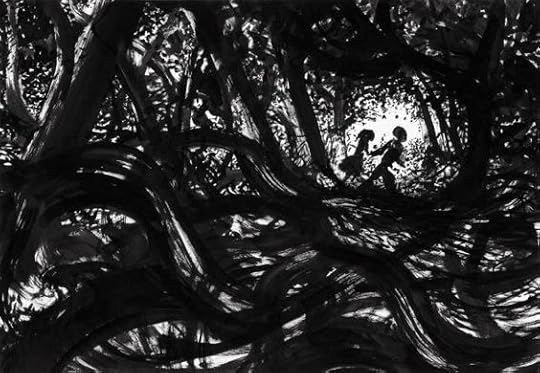
"It would soon be dusk: the birds were beginning to quieten down, the shadows had lengthened as the sun sank and finally melted into an overall darkening of the countryside. And as the evening approached, the wood, so silent and secretive during the daylight, seemed to come gently alive, with small rustlings and disturbances in the brambles, and a whispering of branches"
illustration by Lorenzo Mattotti
This was Penelope Lively's first published book, and has much in common with authors like Alan Garner, who explores the connections between the past and the present and the way in which landscapes are effectively 'haunted' by history. Published in the 1970's (which seems to be a vintage period for brilliant children's fantasy fiction) it still retains its appeal today, due to Lively's evocative prose and strong characterisation.
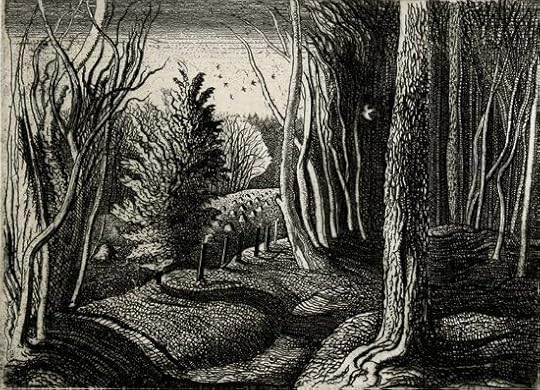
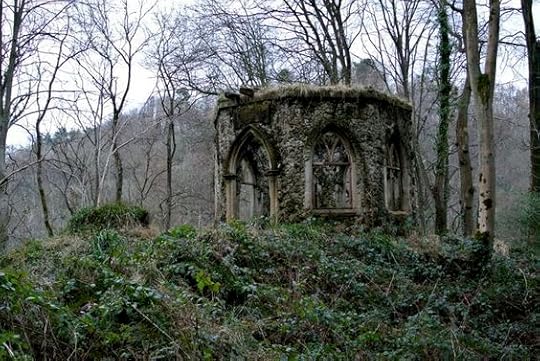
"Wood Interior" by Graham Sutherland, 1928
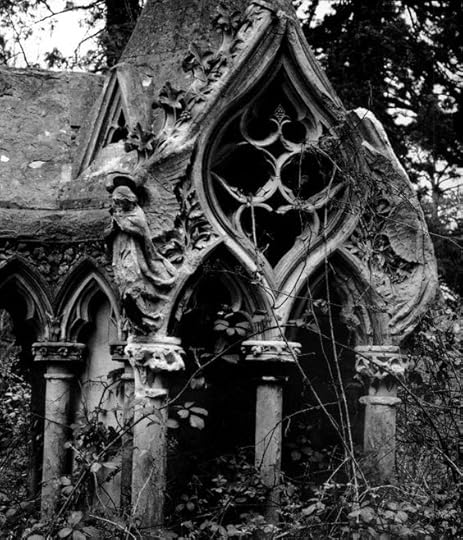
Mair and Peter Jenkins have moved to the small village of Charlton Underwood from Wales, where their father has accepted a job of headteacher at the local primary school. Mair is accompanied at all times by her small terrier, Tar - who at the beginning of the story escapes into the wood to chase a peregrine. The children then discover that the wood is hiding many secrets, namely that it contains the village Astercote, abandoned in the time of the black death and left to become overgrown. Amongst the undergrowth and trees lie the ruins of the village - broken window frames and the remains of walls. This is the home of Goacher - a dishevelled and superstitious young man who lives in the woods with his collection of animals. He has talents as a healer and mends Tar's paw. Initially wary of the children and seemingly of modern phenomena such as aeroplanes passing overhead, he befriends the two and they learn his secret - a hidden chalice is buried under an oak tree. This he believes, protects the village from the black death.
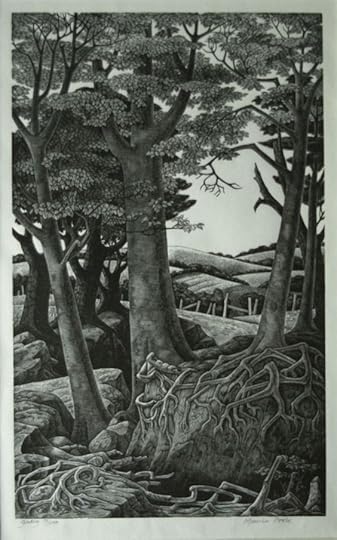
"Gully" by Monica Poole (wood engraving)
Lively writes effortlessly, conjuring up visions of the local countryside and rural life - we are transported amongst the hills and hedgerows of England, where rooks circle the trees, jays inhabit the lanes and rabbits scurry and burrow amongst the grass. Lively excels at writing about nature and the surrounding environment, and Astercote is beautifully written, with an atmospheric and driven past paced narrative. Her protagonists are determined, admirably independent and capable, enlisting the help of the outsider figure Goacher to save the day.
"Grunewald Forest" by Philip Cooper
This story explores the effect of modern day life encroaching on small rural communities (the children are living on an estate which has been built on the outskirts of the village) and the ensuing conflicts and differences of opinions which arise from lingering superstition and more traditional world views - and the threat of outsiders. It is a thoroughly enjoyable read that also raises complex questions and would equally be enjoyed by adults and children alike. I am looking forward to reading more of Lively's fiction for children, particularly The Wild Hunt of Hagworthy.
A hugely inventive story, in which Peter and Mair, two incomer children to a closed North Oxfordshire village of Charlton Underwood - Charlbury, perhaps is the basis - blunder into a secret held by the old families of the village since the fourteenth century: a chalice from the lost village of Astercote, now buried in the local woods. The secret preservation of this medieval artefact maintains the wellbeing of modern Charlton, itself straining with tensions from a new estate tacked-on to the old village. The chalice’s disappearance highlights the tensions between the old village and the newer estate, between the traditional views of the older generation and a newer one who are torn between a no-nonsense approach and an intrusive attitude that threatens the peace of the community. The lines of tension and power are complex, and Lively does well to negotiate them, slowly and subtly. Peter and Mair set out, with the help of Evadne the district nurse and the guardian of the chalice, Goacher, to resolve the mystery and bring a much-needed peace to the village. The adventure strand is well worked through - the demonising of the lads on bikes feels a bit outdated but at least believable - and there are odd threads of the supernatural worked into the narrative, enough to bring a slight chill to the reader! The sociology of new and old families in the village is subtly worked through, with characters bringing their own pasts in briefly, tantalisingly, to enrich the story; the landscape is vivid, so much so that I diverted into Google maps to find lost pathways round Wychwood in N Oxon while I read. This is a story to be savoured, from Goacher’s hawking skills to the ghostly bells of the lost village that Mair can hear, the tangible tension of the secret wood of Astercote, the menace and excitement of the final chase... Lively has given us a classic here, although I am reminded of Peter Hunt’s warning that children’s literature has (or can have) a short life span.
I far preferred Astercote to The Whispering Knights. Great, quick little read with loads of old-world charm in the fictional village of Charlton Underwood. Dark-haired* Mair and Peter Jenkins have just moved from Wales onto the new adjoining estate there, and are just getting acquainted with their new home and the locals. (*yet ANOTHER example of "blonding" the protagonists on the covers! In at least two editions, too! Why on Earth do they do it?! Peter and Tar the terrier are faithfully represented, though. Bother that! Let's see some raven-haired ladies for a change, for goodness' sake! Drawings inside are faithful to text, at least).
This book had all the backwards villagey superstition and terse farmers that Lively's The Wild Hunt of Hagworthy had (which I very much enjoyed!), and as also found in Mabel Esther Allan's The Horns of Danger (which I didn't enjoy, apart from the backwards villagey superstitious content).
I'm sure this book has been sufficiently encapsulated by others (it's not new - 1970!), so I'll just say that the disappointing aspects were that it was a bit shortish, and the "mystic/magical" aspects were very light and reminiscent of The House in Norham Gardens, in the sense that it all could just be a sensitive teenage girl looking at life through a particular lens (i.e. vivid imaginations). All well and good, if so, but I prefer a little more actual mystery and suspected magical content, if not full out fantasy. Still, it was sufficient to keep me entertained. Enjoyed it - nice and light and quick. And there were a few funny bits, too - sort of what Miss Read aspired to but never quite hit (from what I can tell. An attempt was made..), whereas Lively seems to be able to do it effortlessly and off the cuff, it seems, when she chooses to.
EDIT, after having slept on it (I really ought to do this more often...):
The Prologue concerning Astercote in 1396ish was very interesting - but unfortunately, it was a bit of a tease. . Now that I have reflected on it, this 'plot hole', if it qualifies, might have knocked this down to a 3.5 for me. But, thanks to the ridiculous 5 star rating system, it would still round up to a 4 anyway.
Mair and Peter Jenkins, newly moved into the village of Charlton Underwood after their father gets a job as headmaster of the local school, befriend a local oddball known as Goacher, an animal healer and guardian of what he only refers to as ‘the Thing’ in a local woods — a chalice which he and the villagers believe protected them in the past, and still protects them, from the Black Death, which destroyed the now-ruined and overgrown neighbouring village of Astercote. When ‘the Thing’ goes missing, the villagers start to get paranoid about a few coughs and colds, thinking the plague’s making a comeback. Chalk crosses (once used to mark houses shut off because of infection) are found on a few front doors, and the locals erect a barrier to keep away outsiders. The police and media think it’s quaint locals gone a bit doolally, but Mair and Peter know otherwise, and set out to put things right.
Or, they do eventually. Astercote’s a quick enough read, but I still found myself wondering, way past the midway point, when Mair and Peter were going to realise that they, as young adult protagonists of a young adult novel, ought to be not just sitting around watching things unfold but do something about it. ‘You know what,’ Peter says near the end of chapter 7, ‘it’s time someone looked for Goacher and brought the chalice back.’ And I thought, yes, it’s page 108 already, there’s only another 40 to go!
We do have an action-packed ending, though. I seem, in middle-age, to have developed an odd nostalgia for YA books from my own young adulthood that I never actually read. There’s something about the lost world of country villages, ghostly links with the past, and hints of mythical magic that books like Astercote conjure, which was lost a decade or so later. This was a moderately good example of the species (though the magic, here, is almost non-existent), enough for me to have ordered another of Penelope Lively’s YA books. I should say that I came to this novel thanks to The Heartwood Institute’s album, also titled Astercote, which provides a soundtrack to the book as if it were adapted for the TV of the time, along the lines of Children of the Stones and the like.
I think I would have enjoyed this book more if it had been what I expected. For some reason I thought it would be about children having an adventure in a Brigadoon-style magical village. But there is very little supernatural in the book - some ghosts make a token appearance at the end and that's it. The story is essentially about the mass hysteria that ensures when a 'magical' artefact allegedly keeping the village protected against disease is stolen. It's a well written but grim and depressing little tale, from the opening scene of a village being wiped out by the plague, to the theme of superstition gone crazy.
This early children’s book by one of my favourite authors could only have been written in the late Sixties or early Seventies (it was published in 1970). Although the phrase wasn’t coined until much later, and although Penelope Lively would be unlikely to approve, it has a sense of the ‘folk horror’ genre that pervaded much literature and film of the time. The impact of the past on the present has always been one of Lively’s major themes, though, and in Astercote we are in a Cotswold village where old traditions and beliefs start to impinge on modernity when an ancient chalice, long since buried in the deserted neighbouring village at the time of the Black Death, is stolen, and the villagers start to behave according to the prophecy linked to it. Lively is very good on village life of the period and the impact of incomers living in new fringe estates on the lives of villagers who have lived there for generations.
The writing in this book is fine, and the characters are suitably... characterful. The only problem really is that the plot lacks substance, and when things are resolved, you can't help but think - wait, that's it?
This was Penelope Lively's first published novel, and her first book for children. It is the story of Mair and Peter Jenkins who move from Wales to a Cotswold village when their dad gets a job as head of a village school. The children are living on a new estate which is bordered by woods that belong to Worlds End Farm.
When the children follow their dog into the woods they meet the mysterious Goacher, who seems afraid of the modern world. He shows them a gold chalice hidden in the woods, which he must guard, as it protects the village from the Black Death which wiped out the now-vanished village of Astercote.
However the chalice and Goacher go missing, and soon the village and new estate are in opposition, and chalk crosses are appearing on the doors of villagers suffering from minor illnesses. Mair and Peter must find Goacher and the chalice, and return things to normal.
This is not one of Lively's best books- my favourite is A Stitch In Time- but her amazing evocation of place and sense of history affecting the present are there. It would be a great book to challenge a high ability reader of Y4+.
I remember reading this as a child, so when we came across a copy at a bookswap the other weekend, I couldn't resist. Sadly, unlike other childhood books I've re-read as an adult, this one isn't standing up so well: half way through and although it's well-written there are loads of holes in the sketchy scholarship and the whole reads more like something written in the 50s than at the start of the 70s. Disappointing. An actual time-slip or ghost story would have been more engaging.
Was disappointed with this. Thought I would be reading something with a ghostly or time slip theme and it was nothing like that. The writing was very good and I had to finish it to see what the outcome was. But in all truth the ending was a bit of a damp squib. I know this is classed as a children's book but you can get some great books for adults in this genre.
The past seeping through into the present is a common premise of many classic children's books. Astercote, the debut novel of Penelope Lively first published in 1970, describes certain happenings in the isolated Cotswold village of Charlton Underwood, which finds itself trapped between a harrowing past and the unwelcome encroachment of modernity.
Rationally-minded schoolboy Peter Jenkins and his imaginative sister, Mair, are newly arrived in the village, where their father has taken up the post of headmaster at the local school, but before long they find themselves caught between the modern mode of life they are accustomed to and the uncompromisingly archaic ways of the old village.
Peter and Mair learn of the disturbing history of the area when their dog, Tar, dashes off into the forbidden woodland that adjoins the isolated World’s End Farm. Here they find the ruins of the abandoned medieval village, Astercote, whose 14th century inhabitants were wiped out by the Black Death, and meet a strange half-wild young man known as Goacher who guards something which is purported to ensure that the disease can never return.
When both Goacher and the protective object mysteriously disappear, mass hysteria grips the local populace, and isolated incidences of common illnesses are viewed by the superstitious villagers as proof that the plague is returning.
There is a wonderful lyrical quality to the author’s writing, which perfectly evokes the spirit of childhood during the 1970s while capturing with poetic detail a calming pastoralism. A keen gardener, Penelope Lively excels at describing the natural environment, and her protagonists are strongly characterized in a way which makes them entirely believable. The story also constitutes a snapshot of the clash between a largely pre-industrialized rural way of life and the modern society which exploded into being during the 1960s.
Astercote effectively explores the connections between the past and the present and the way in which landscapes and lives are 'haunted' by history. The power of belief and superstition and the potential harm they can inflict seems also to be a major theme of this story.
Although this book is a relatively short one, the story is powerfully atmospheric and will not easily be forgotten.
One of the pleasures of adult life is discovering those books that were published just outside of one's childhood. I was nourished with later Penelope Lively children's fiction, like "A Stitch in Time," rather dreamy literature if I remember correctly, but missed the earlier works that had a tinge of folk horror - or maybe that's folk eeriness, because it's certainly not Stephen King.
"The Wild Hunt of Hagworthy" then was a treasure to find. I hunted out her other early fiction, and this was my next read by her. I'd say Wild Hunt is better, but Astercote is still worth reading.
It felt very slow getting going, with no sense of urgency. For most of it, the characters (Mair and Peter, brother and sister, whose different strengths and responses are revealed gradually and delicately) observe the goings-on - how the older part of the village goes from concern to almost outright war with the newer half, only getting actively involved at the end. The fantasy element is slight - Mair hears the bells of the lost village - but Penelope Lively’s real strength is drawing the world of a village caught between old and new, and a generation passed, when children could wander afield without adults.
The BBC adaptation, The Bells of Astercote, can be seen on Youtube. It's a gentle film, with a little extra spookiness to ramp up the drama a bit, but I'm sad we didn't get to see Evadne trying to climb the chapel wall as she does in the book! Interestingly, the film chooses to send the children's mother away for the duration of the story, as if to make it a bit more beleiveable that the children are roaming far and wide. It was, after all, made ten years after the book, at the end of the age of children's freedom (cue soulful music!)
A sweet, if rather slim offering, and the plot is wrapped up very simply. I think it's possible to tell that this is an early work by Lively. I feel like I'm being 'down' on it because I really loved 'The Wild Hunt of Hagworthy', and so there's the inevitable comparison. Still, this book does have atmosphere- lots of that! And a real sense that the past is only ever at the edge of your fingertips! I also liked the dynamic of a small, insular community coming under siege, and acting with increasing paranoia and adamancy as things escalate. There's a lot going on here, as sides are drawn up and people get included or excluded. Lively is careful never to go overboard: there 'could' be perfectly reasonable explanations here, and nothing happens that you couldn't talk yourself out of. Instead, the emphasis is slightly more on the characters: the children, the adults all around them, who seem to shift and spiral. It occurs to me that this would make the leap to TV very well in the right hands!
I read this originally as an 11-ish year old and loved it at that age - the creepy atmosphere especially (plague! weird superstitious countryfolk!), but also the fact I was a similar age to protagonists Mair and Peter. Re-reading as an adult, the plot is a bit slow and of course what has recently become termed "folk horror" has become a bit of a cliché. What stands out to me now are the atmospheric descriptions of the woods that conceal a dark past - and though Peter is a geek (his hobby is ornithology), Mair is a pretty cool witchy girl (she can hear the bells of a church that was lost 600 years ago).
Before I mention the story I would like to say this is my favourite book cover of all time. By an illustrator called Robin Lawrie. It's absolutely beautiful. The actual story is wonderfully understated but contains little moments of delight and wonder. There are supernatural elements here but I would say it is more about the power of belief than anything. The dialogue has dated and I think it would be difficult now to find children who start a sentence with "I say....", or describe cartography symbols as "dear little trees", but I actually think it added to the overall charm.
Found in a charity book swap shelf. I was hooked by the prologue - the last moments of the last living person in a village struck by the Black Death in 1349. Heck of a way to start a children’s story. A fascinating YA story of the persistence of folk belief and history. Slightly spoiled for me by the “kid detective” adventure element towards the end - was this put in at an editor’s insistence?
Very much of its time - jeans and anoraks, but the rural village is still much as it was before the war. A good atmospheric tale, believable characters [district nurse ?] and a white-knuckle dénouement. Famous Five for the thoughtful child of the 60s ...
This is a very enjoyable children's book that has enough going on with it for adults to enjoy, especially those with leanings to rural stories steeped in history and myth. Recommended!
This was a quick re-read of a childhood favourite - Penelope Lively's first book. It has certainly aged well, I was still riveted. And I adore the 1970s cover.
This was a sweet, short read from Aunty Kay's bookshelf in New Brighton. There was one line I particularly liked where a child notices an adult being uncomfortable and lost for words, and it is the first time the child realises that adults aren't always self-assured. It was a lovely line and rang so true.
Beautifully written and evocative of the English landscape but...
This is a catfish of a book. You are led to expect more than what actually happens.
Given the author is Penelope Lively, the melancholy first chapter from the viewpoint of the final victim of the Black Death in Astercote 600 years earlier, a strange man (who doesnt recognise planes despite them regularly flying overhead and who thinks Mair is a witch) living in the ruins of Astercote, Mair hearing Astercote's church bells, and then as the book progresses more and more daily sounds from the long dead village, I was lead to believe some sort of time slip was going to happen.
But instead the book took a sharp right hand turn and changed itself into a story about old country ways and a footchase after a MacGuffin. With long periods of time of nothing much happening.
The book feels like the first half of one story and the second half of a different story set in the same place with the same characters. And frankly I wanted the first story.
I'm torn between giving it three stars because it is beautifully written, but ultimately decided on two because its made me cross for what might have been.
For this reader, the story will always be more important than the telling.
A very simple story for children. Chanced upon this book while going through my sister's collection.
Follows the adventure of two children called Mair and Henry whose Father has recently been transferred to an interior village as the School Master - there the children come up with the age old tradition of believing that the village - Astercote - had been ravaged by Black Death centuries before and that any change in the present status quo of the frightened yet rude villagers would once again plunge the village to similar situation.
This was a book I read as a kid, probably close to when it was first published, and I loved it! But I could not remember the title and only found it again thanks to the What is the Name of that book thread on this very site!
So thank to all those folks who chimed in with their ideas.
I was also delighted to find out that this was a book by Penelope Lively whose adult fiction I have enjoyed for decades.
Not awful but not particularly thrilling. I imagine (as I’ve never read one) this is along the lines of the Famous Five. I was hoping for a more time mystical aspect to it like time travel or ghosts. But was tame and a simple read for children as expected. I couldn’t help however but notice that the children would disappear for a whole day within distance of a notorious woods and nobody seemed to bat an eyelid. Clearly more innocent times.
Another lovely light tale of the Oxfordshire (ish) midlands countryside. Looks like this was PL's first book for children and yes it's lighter than Norham or Kempe but a solid read and a clear marker of quality for her future adventures.
Enjoyed the idea of a lost plague village, crumbled under bramble bushes, ivy and trees. Working my way through PL's books as a Christmas 2021 treat, with a couple more from her early adventuring period.