Jump to ratings and reviews
Rate this book

Leopold and Loeb: The Crime of the Century

Rate this book
Among the criminal celebrities of Prohibition-era Chicago, not even Al Capone was more notorious than two well-educated and highly intelligent Jewish boys from wealthy South Side families. In a meticulously planned murder scheme disguised as a kidnapping, Nathan Leopold and Richard Loeb chose fourteen-year-old Bobby Franks at random as their victim, abandoning his crumpled body in a culvert before his parents had a chance to respond to the ransom demand. Revealing secret testimony and raising questions that have gone unanswered for decades, Hal Higdon separates fact from myth as he unravels the crime, the investigation, and the trial, in which Leopold and Loeb were defended by the era's most famous attorney, Clarence Darrow. Higdon's razor sharp account of their chilling act, their celebrity, and their ultimate emergence as folk heroes resonates unnervingly in our own violent time.
 

384 pages, Paperback

First published April 1, 1975

57 people are currently reading
709 people want to read

About the author

Hal Higdon

85 books45 followers
Hal Higdon is an American writer and runner. He has contributed to Runner's World magazine longer than any other writer. He is the author of 34 books, including the best-selling Marathon: The Ultimate Training Guide. He has worked as a freelance writer since 1959, and has written a variety of subjects including a children's book that was made into an animated feature. He ran eight times in the United States Olympic Trials and won four World Masters Championships. He is one of the founders of the Road Runners Club of America (RRCA).

Ratings & Reviews

What do you think?
Rate this book

Friends & Following

Create a free account to discover what your friends think of this book!

Community Reviews

5 stars
152 (29%)
4 stars
222 (42%)
3 stars
126 (24%)
2 stars
20 (3%)
1 star
4 (<1%)
Displaying 1 - 30 of 66 reviews
Profile Image for Katherine Addison.
Author 18 books3,684 followers
February 10, 2018
This book, originally published in 1975 as The Crime of the Century, is excellent. Higdon is patient and thorough; he answers questions that a much later book, For the Thrill of It (2008) fails even to ask, and he manages something else Baatz fails at: to make the story gripping and compelling, despite the fundamental emptiness at its core. Partly this is because Higdon is a gifted writer; partly, I think, it's because he's genuinely interested in the unanswered--and unanswerable--question that lives a dark Heisenbergian life underneath the whole thing: who actually killed Bobby Franks?

Legally, Leopold and Loeb were equally responsible, so in one sense it doesn't matter. But Leopold said Loeb did it, and Loeb said Leopold did it, and neither of them ever wavered. Circumstantial evidence suggests Leopold did it; psychological evidence (including what may be a Freudian slip in his confession) suggests, much more strongly, that Loeb did it. But we can't know, and that uncertainty at the very heart of the case, for me, spreads outward, twisting and unsettling everything it touches. We don't know when exactly Bobby Franks died--the coroner contradicted himself on the witness stand, and neither prosecution nor defense demanded he resolve his testimony. (A tremendous flaw in the American legal system, as I have said in other reviews, is that a trial is a competition to tell the most compelling story, not an investigation to uncover the truth.) There are injuries to Bobby Franks' body that have never been explained. There are things about this crime, which is the epitome of the senseless murder, that don't make sense, even in its own upside down logic. There's the mystery of the other four crimes that Loeb mentioned but that were never pursued--the defense didn't want them brought to light, and the prosecution, arguing a death penalty case on first degree murder with confessions from both murderers, couldn't be bothered with. There's something very existentialist about Leopold and Loeb, about the dreary banality of their "perfect crime," about the unknowability of the details, about the tremendous emptiness that sits where a motive should be, as if they were invented by Sartre or Camus.

For two young men of such academic precocity and high IQs and with such inflated ideas of their own Ubermensch-ness, Leopold and Loeb were most dreadfully stupid. As Higdon points out, even without the most damning evidence of the glasses which Leopold somehow dropped when they were shoving the body into a culvert, there were a dozen leads that would have pointed the police directly at them, and the two of them were a fractured enough unit (they couldn't even keep their alibi straight) that they would inevitably have been tripped up in interrogation.

So much for Nietzsche.
Profile Image for Lord Beardsley.
383 reviews
September 26, 2012
I've already read this about five times (yeah, I actually have...depressing and pathetic, why yes I am. thank you). It's the definitive work about Leopold and Loeb. It's the Real Slim Shady.
481 reviews8 followers
April 25, 2024
Fascinating in depth analysis of the crime of the century. Previously published naby years ago with many other books on the aubject. This asks rhe nore difficult questions and attempts to find humanity and understanding whilist balancing out the fact we will never know who delivered the gunsl blow.
Throughly enjoyable a good read felt long in places. I had not heard of the crime so this gave me enough detail. Proper use of transcript gave this real power
Thank you netgallery and publisher and author
.
Profile Image for Dolores Wendland.
37 reviews
September 2, 2011
The book was written in 1975 and its discussion of anything related to homosexuality is quite dated, but if you can get past that it's quite gripping.
Profile Image for Annarella.
14.2k reviews167 followers
January 1, 2024
This is one of the most intriguing true crime story I read and I read also in other books.
This is a well researched and well written book, highly recommended
Many thanks to the publisher for this ARC, all opinions are mine
12 reviews1 follower
December 11, 2008
When you think of chicago during the 1920s, the first thing that comes to mind is Al Capone, prohibition, gangsters and crime. But in 1924, for a few months, Al Capone was no longer the talk of the town, Nathan Leopold and Richard Loeb became the most famous and unlikely celibrities of the time. Two extremely bright 19 year olds from very wealthy Chicago families, decide to kidnap and kill at random a person just for the "thrill" of it, with no other apparent motive than getting away with it and committing the perfect crime.
The author tells in details the planning of the crime, the day it happened, the investigation, the arrest, the trial and the aftermath. The trial in particular is fascinating as it gives you a great insight on the muderer's personnalities, their intelligence, their upbringing and how their relationship with one another led to murder. The book is written as if it were a fictional mystery novel, you will sometimes find yourself wondering whether or not this really happened. The suspense builds extremely well throughout the book, as if Hitchcock himself had put his touch to it. Even if i knew from the beginning who the killers were, as the investigation unfolded, i almost thought they would get away with it.
30 reviews2 followers
November 18, 2009
Extra interesting that this took place right in my neighborhood. Not sure what to expect-- after page 110, the confessions and details are out. What will they tell me for the next 200 pages?

OK, I finished this a while ago-- quick read, little too much details (the same way I felt about Devil in the White City), could have been 3/4 the length. But good and very interesting, nonetheless.

Really deserves 3 1/2 stars.
Profile Image for Juushika.
1,835 reviews220 followers
March 13, 2020
This has a slow start and a sometimes-tedious level of detail, but more importantly it fails to establish why, in the sea of crime of 1920s Chicago, this case caught public attention before perpetrators or motive were established, and also who Loeb and Leopold were--their similar backgrounds and names, combined with their close relationships and co-conspiracy, made them a single unit within their social circle and in the press, and they're similarly hard to distinguish until the second half of the book.

But this confusion is almost a benefit, and it may even be inevitable. The case is notable for numerous reasons (including the defense's criticism of capital punishment as punitive, rather than transformative, justice), but it's interesting for its lack of motive, and for the extensive psychiatric testimony that tried to answer why two gifted young men would murder without motive. Those psychological profiles (by professionals and the press) are overreaching and biased by bankrolls or even by patient/psychologist rapport, they elide or confuse the perpetrators. The question emerges: can a person be synopsized and known in this way? can their mind be picked out from the morass of affect and infamy? And to some degree, the answer still is yes: throughout the case, and in Leopold's autobiography written decades later, a codependency emerges. The book quotes Dr. Hulbert's testimony:

"Each boy felt inadequate to carry out the life he most desired unless he had someone else in his life to complement him, to complete him. Unless these two boys had the same constitution, which they had, unless those boys had their own individual experiences in life, the present crime could never have been committed. The psychiatric cause for this is not to be found in either boy alone, but in the interplay or interweaving of their two personalities, their two desires caused by their two constitutions and experiences. This friendship between the two boys was not altogether a pleasant one for either of them. The ideas that each proposed to the other were repulsive. Their friendship was not based so much on desire as on need, they being what they were. Loeb did not crave the companionship of Leopold, nor did he respect him thoroughly. But he did feel the need of someone else in his life. Leopold did not like the faults, the criminalism of Loeb, but he did need someone in his life to carry out this king-slave compulsion. Their judgement in both cases was not mature enough to show them the importance of trying to live their own lives."


So if the book is sometimes graceless, it's also thorough, thoughtful, and balanced. It has a well-rounded view of the central figures, and the nuanced conclusions it makes about the question of motive (and identity, personality, and relationship) are fascinating.
Profile Image for Jane Anne.
82 reviews1 follower
July 28, 2011
Who cd not be a Babe & Dickie junkie? Young, beautiful, wealthy, in love. Accomplished yet dangerously immature. The details so haunting -- how yrs later, a cache of 1920s nude male photos found in Babe's garage; Leopold family's changing their name. Their initial shaved-head mugshots (u can see elsewhere. Babe was to have entered Harvard right about then!) Dickie's murder in prison shower. Babe's chauffeur, who burst the case wide open, was kept on by his father afterward! Epic tragedy.
Profile Image for Manda.
169 reviews5 followers
May 23, 2013
A bit long and dragging, it goes into WAY too much detail about every person involved even peripherally in the case, and repeats itself constantly.

If you want to know EVERYTHING about the case, this is your book, but if you want a thrilling true crime read, this is a bit academic.
7 reviews2 followers
January 15, 2019
Good book well worth a read

Good book, factual but not boring, non judgmental, and I have to say it kept me riveted! Couple of reasons why it's not five stars:
Weird numbers in lots of sentences, and also a few spelling and grammatical mistakes.
Profile Image for Peg.
1,140 reviews12 followers
May 25, 2017
Unbelievable stupidity and genius?
Profile Image for Louise Gray.
891 reviews22 followers
December 3, 2023
A classic piece of true crime writing which covers a case both fascinating and disturbing. It is hard to believe it is 100 years since the events occurred and a testament to the author that this long-published account stands up well as a comprehensive account.
Profile Image for Sandy Nawrot.
1,116 reviews34 followers
February 4, 2016
Most of you will know, I am obsessed with true crime. It's my brain candy. So you know that when I attempt to read one for TWO AND A HALF MONTHS and only get to 40% there is a problem.

The topic of Leopold and Loeb, two young affluent men in 1920's Chicago who kill a child for sport and show absolutely no remorse, is rich for mining. Is it the "crime of century"? Maybe it seemed like it back then. But the details are fascinating. I just think that this particular gentleman, Mr. Higdon, didn't know much about writing true crime. No details on the family, no pictures, no intrigue in the prose. Just a flat, dry account of what happened. It was suggested that this may have been a thesis or some such thing, that was later published. That would make sense.

We read this for one of my book clubs. I think our intent was to read about this crime and we landed on this particular book somehow. That is too bad because I have to believe there are better ones out there. God love the folks in this book club because they are thirsty for knowledge and are tenacious, and most finished this book, but none of them loved it. Give this one a pass.
Profile Image for M. Newman.
Author 2 books75 followers
July 30, 2015
Nathan Leopold, Jr. and Richard Loeb were brilliant young men from wealthy families, who, seeking to commit the perfect crime, kidnapped and murdered 14 year-old Bobby Franks. The senseless crime captured the imagination of 1924 Chicago, as well as the rest of the nation. The newspapers ran with the story, calling it "The Crime of the Century" and readers were fascinated from the time the crime was perpetrated until the time the murderers were sentenced. Leopold and Loeb were represented in court by the great and flamboyant defense attorney, Clarence Darrow whose aim was not to have them found innocent but rather, to avoid the death penalty. Other courtroom characters included Robert Crowe, an ambitious State's Attorney and Judge John Caverly, whose mission it was to decide whether the killers should hang. Author, Higdon researched the case well and put together an excellent history. I found the sections of the book that covered the killers' time in prison and beyond, to be the most interesting part of the book.
Profile Image for Tracey.
11 reviews13 followers
January 20, 2009
An account of the Leopold & Loeb murder of their young neighbor Bobby Franks in the Kenwood neighborhood of Chicago in the 20's. Although I'm not a fan of crime novels, I thought this account was particularly compelling. It does not excuse the murderers, nor does it glamorize their crime, since neither Leopold nor Loeb ever admitted directly to the murder. What the book does bring across is the seeming pointlessness of their crime; they were two wealthy and privileged men who made a private intellectual bet that they could get away with anything, even murder.
70 reviews4 followers
January 29, 2024
What compelled two wealthy, brilliant college boys to commit the “crime of the century”? Greed, boredom, arrogance? On the eve of the 100th anniversary of the crime, this reissue of a book originally published in 1974 leaves no facet or fact overlooked. There are surprisingly few photos in such a detailed book. However, the Chicago murder of 14-year-old Bobby Franks remains a fascinating and famous moment in true crime history.
Profile Image for Diane.
149 reviews1 follower
November 16, 2023
This book was interesting but I felt it was too long with too many minute details. I just felt it was a bit bogged down with details
613 reviews5 followers
June 25, 2017
well written. seemed very even-handed and its presentation. very detailed account of the crime and aftermath. enjoyable
Profile Image for Shannon.
602 reviews1 follower
September 3, 2017
It was actually a pretty boring account of what happened. All the friends' names get introduced and I forget who's who. I did like that that book went through till both men were dead.
Profile Image for QuakerMaid.
156 reviews
August 16, 2019
This was a tough one for me to get through. It simply didn't hold my interest. I think it was too fact-laden.
Profile Image for Sarah Rigg.
1,673 reviews22 followers
November 7, 2019
I read a fair bit of true crime in my tweens/early teens and found this one fascinating, possibly because the perpetrators were only a few years older than I was.
Profile Image for Juli Rahel.
760 reviews20 followers
May 31, 2025
Review for the new edition from University of Illinois Press

While in the height of my true crime phase, I requested a review copy of Leopold and Loeb, the new edition of Higdon's enormous work about the death of Bobby Franks and the lives of his murderers. Somehow, I never actually got around to reading it, but then it suddenly grabbed me and it was an intriguing reading experience. Thanks to University of Illinois Press and NetGalley for providing me with a copy of this book in exchange for an honest review. My sincere apologies for the delay in reviewing!

One thing that was fascinating about reading Leopold and Loeb was how it made me reconsider the current true crime trend. On the one hand, there absolutely has been an enormous increase in the amount of media aimed at discussing, dissecting, and documenting crimes. This attention takes different kind of forms, from those which are legitimately trying to uncover information and address injustice to those who are girlbossing their way into excusing male violence. On the other hand, however, we have always been intrigued by and obsessed with the dark underbellies of our societies. Especially crimes such as these, in which a young boy is killed by two young, well-to-do men from his own social circle, for seemingly no other reason than thrills, is bound to have people asking all kinds of questions. It is the same intrigue behind the renewed interest in the Menendez brothers, I think. I don't think there is necessarily something wrong with being interested in these kinds of things, in wanting to know why things happen and how, either to be more informed about social issues or find out ways to keep yourself safe(r), but I noticed with myself that I needed to be careful in what I actually watched/read and how. It is important to keep one's eyes on those who were victimised, rather than turning the criminals into icons. Leopold and Loeb, as the title implies, does not quite land on the right side of that line for me.

In 1924, Bobby Franks was kidnapped and killed by two young men, Leopold and Loeb. The two attempted to get a ransom from Bobby's parents, despite the boy already being dead, and were eventually caught almost by mistake. Leopold and Loeb is an extensive, detailed work-up of the entire crime, from its lead-up, what is known of the murder itself, the direct aftermath and investigation, the hearing, and the lives of Leopold and Loeb afterwards. As the title suggests, the majority of the focus is on the two young men, although much of the first part focuses on Bobby and his family as well. What is really intriguing about this entire case in, perhaps, not so much the why behind it, but the enormous question mark following the who question. It is still unclear which of the two actually killed Bobby and Higdon masterfully evades answering the question himself, although he makes a case for either. Because of that gap, some of the remaining fascination with the case can be explained, as there remains something to question.

Leopold and Loeb absolutely is well-researched, containing a mountain of details and insights in its almost 400 pages that Higdon clearly brought together from different sources. I will say that the book, for my taste, could have done with another editing round. First published in 1975, it was written for a different kind of audience, but it felt a little repetitive at times, with similar kinds of information being repeated again in full. Higdon does have a knack for hitting on the right kind of detail to drive something home and I think here he really benefitted from all the journalists who covered this case in so much detail and even added to the investigation. However, I did get a little tired of the repeated assurances of how brilliant and clever and occasionally charming both Leopold and Loeb could be. This is why it sits on the "wrong" side of the true crime genre for me, too interested in the special minds that can commit murder rather than in the lives affected and ruined. They're not special, they were spoiled young men who misread Nietzsche and thought they could do whatever they wanted. For those who want to know everything there is to know about this case, Leopold and Loeb is definitely the book. Whether I'd recommend it to general readers interested in true crime, probably no.

For what it sets out to do, which is give all the information for an infamous crime and hearing, Leopold and Loeb does an excellent job. However, in its focus, it does feel dated by now.

URL: https://universeinwords.blogspot.com/...
Profile Image for Susan Molloy.
Author 150 books88 followers
January 17, 2025
Some Applesauce with a Bit of Cat’s Meow.

🖊 This book is a fairly good starting point for delving into the 1924 Bobby Franks murder (a.k.a. the Leopold and Loeb case). While this is filled with mounds of information, there are errors in the facts throughout. As I said, this is a good starting point in researching the now-century-old case. There are no photographs or illustrations otherwise.

📕Published in 1975, 1995, 1999 & 2010.

જ⁀🟡 Kindle Unlimited.
༺ ༅ ✬ ༅ ༻ ༺ ༅ ✬ ༅ ༻

✧⋆˚₊˚⋆✧Of note:
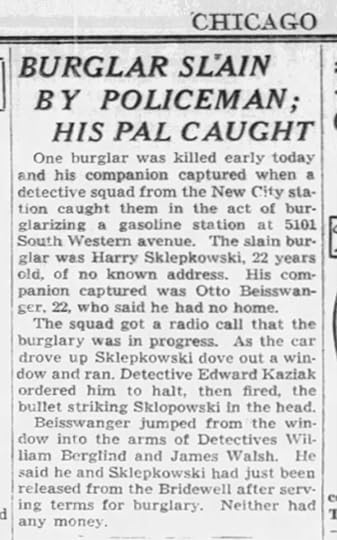
༒ Loeb's cellmate, a young burglar named Skeplowski [sic] it should be spelled Sklepkowski. 🪦Is this Sklepkowski Harry Sklepkowski? His background does fit in: Find a Grave .
🔺The question of where the murder weapon came from has never been satisfactorily answered-at least in public. At first, prison authorities thought that the razor had been stolen from the prison barbership. Loeb's cellmate, a young burglar named Skeplowski, insisted that the razor did not belong to Loeb. He pointed out that Loeb shaved barely once a week. Books crowded their cell because Loeb had been writing a history of the Civil War. They had a radio, but Loeb rarely used it. "He'd get sore at me if I wanted to turn it on at night while he was studying his history," said Sklepkowski.


OTHER RESOURCES:
જ⁀➴ 🟫 “The Lives and Legends of Richard Loeb and Nathan Leopold” on WordPress. Photographs are included.

જ⁀➴ 🟫 Leopold Statement: on Google Docs.
જ⁀➴ 🟫 Loeb Statement: on Google Docs.

જ⁀➴ 🟫 Loeb Confession: on Google Docs.
જ⁀➴ 🟫 Leopold Confession: on Google Docs.

જ⁀➴ 🟫 Leopold and Loeb Original Typed General Documents: on Google Docs.

જ⁀➴ 🟫 Illinois court documents I on Google Docs.
જ⁀➴ 🟫 General documents on Google Docs.

જ⁀➴ 🟫 Leopold Psychiatric Evaluation: I on Google Docs.
જ⁀➴ 🟫 Loeb Psychiatric Evaluation: I on Google Docs.


My ratings for this work:
Content: ★★★☆☆
Writing style: ★★★★★
Ease of reading: ★★★★★
My recommendation: ★★★★☆
My total rating for this work: ★★★★☆ (4.25)
Profile Image for Bookreporter.com Biography & Memoir.
712 reviews50 followers
January 8, 2024
In LEOPOLD AND LOEB, Hal Higdon presents a thorough, thoughtful and appropriately eerie account of the evil deeds perpetrated by two highly gifted young men seeking to achieve the “perfect crime.”

The book opens in May 1924 when 19-year-old Nathan Leopold and his friend and accomplice, 18-year-old Richard Loeb, kidnapped 14-year-old Bobby Franks, which was planned and carried out to prove their innate superiority. Leopold and Loeb had cemented a close relationship, having grown up in posh circumstances and attended the University of Chicago. Both were possessed of above-average intelligence, avidly examining and pursuing the benefits of their intellects, and fascinated by such anomalies as Nietzsche’s concept of the “superman.” Believing themselves to be far superior to ordinary human beings, they began committing various petty crimes together.

Then Leopold suggested a grand scheme to pull off the perfect crime. It was to be an abduction, and it took months to plan, with the victim selected and a series of ransom notes composed. But it was not perfect and did not go as planned. The tragic result was the senseless slaughter of an innocent child. When at last identified and arrested, Leopold and Loeb blamed each other. With a defense that favored sparing their sin-scarred lives, masterfully delivered by the renowned Clarence Darrow, the pair avoided execution and instead were sentenced to life in prison. They remained friends for a time but would meet very different ends.

Higdon, who has garnered praise for this book and others, includes diligently collected details of this heinous act and its perpetrators --- their personalities, plans and total disregard for the law. His writing style brings this series of events to full, cinematic view, making it plain why their deeds could be deemed “the crime of the century.” News sources all over America and beyond covered the story of the brutal, seemingly uncaring actions and attitudes of Leopold and Loeb. Higdon offers a unique behind-the-scenes view of the investigation and their arrest, noting that once word was out about Franks’ kidnapping and murder, readers thirsted for more.

And they will again with the release of this centenary edition of LEOPOLD AND LOEB by the University of Illinois Press. The book’s fresh appearance will be appreciated by those who have read the earlier publication, as well as those who wish to learn more about the infamous crime that shocked the nation and has reverberated through the years.

Reviewed by Barbara Bamberger Scott
70 reviews4 followers
January 11, 2024
"Leopold and Loeb: The Crime of the Century" by Hal Higdon is a gripping and meticulously researched account of one of the most infamous crimes in American history. The book stands out for its comprehensive exploration of the Leopold and Loeb case, delving into the motivations, personalities, and societal impact of the perpetrators behind what was labeled as the "crime of the century."

One commendable aspect of the book is Hal Higdon's dedication to providing a thorough and well-documented examination of the Leopold and Loeb case. The author navigates the complexities of the crime and its aftermath with precision, offering readers a detailed and insightful narrative. The exploration of the perpetrators' backgrounds, legal proceedings, and the cultural impact of the case adds depth to the historical account.

Higdon's writing style is engaging and informative, making the book accessible to a wide audience. The author successfully combines a journalistic approach with a storytelling flair, ensuring that the narrative maintains a compelling pace. The inclusion of historical context enhances the reader's understanding of the era and the societal factors that contributed to the crime's notoriety.

However, some readers may find the content intense and unsettling due to the nature of the crime and its details. Potential readers should be aware of the heavy subject matter, which involves a brutal crime and its legal aftermath.

In conclusion, "Leopold and Loeb: The Crime of the Century" is a well-crafted and comprehensive exploration of a notorious criminal case. Hal Higdon's meticulous research and engaging storytelling make the book a compelling read for those interested in true crime and historical narratives. While the intensity of the subject matter may be challenging for some readers, the book's overall impact lies in its ability to provide a detailed and nuanced perspective on the crime and its enduring legacy.
393 reviews
November 5, 2019
If interested in a true story of two sociopaths who murder an innocent in minute detail, this is for you. I don't like reading about mentally sick people and the horrific crimes they commit.

The crime occurred during the time of Al Capone. The Miranda case hadn't been heard in the Supreme Court at that time so Loeb and Leopold confessed to the killing without any rights read to them and without a lawyer present. Although the criminals thought they were planning a perfect crime, they left a lot of clues, hinting at a compulsion to be caught.

Just like many sensational murders today, everyone wanted to know why they committed the crime. The psychiatrists were worthless. The criminals were spoiled, loved crime and fantasy, alternated from arrogance to insecurity and had weird childhoods. They were brilliant, skipping years of school, but amoral.


The judge did not order the death penalty although Loeb and Leopold pleaded guilty Clarence Darrow suggested that they plead that way so the judge would be solely responsible for the verdict, not a jury. Although their lawyer gave a long reasoned approach, the judge claimed he was hesitant to give the death penalty because they were so young (19).

I was relieved when I finished the book. Good riddance! Loeb was killed in a prison shower by prisoner Day with razor blades. Leopold managed to earn parole after 33 years. Still was able to maniupulate people. He had volunteered to participate in a malaria study while in prison. He convinced some to testify on his behalf. This was a very disturbing story.
This entire review has been hidden because of spoilers.
Profile Image for Ben M..
195 reviews
November 26, 2023
Thanks to the publisher and NetGalley for providing me with this book to review.

Leopold and Loeb: The Crime of the Century is a true-crime book written by Hal Higdon. It was first published in 1975 and is considered to be the definitive account of the 1924 murder of fourteen-year-old Bobby Franks by Nathan Leopold and Richard Loeb. The book was a bestseller and was adapted into a film in 1978.
Higdon's book is a detailed and well-researched account of the crime, the investigation, and the trial. He provides a balanced view of the case, giving attention to both the prosecution and the defense. He also explores the motivations of the two killers, who were both highly intelligent and came from wealthy families.
Higdon's book is a fascinating and disturbing read. It is a reminder of the evil that can exist even in the most seemingly normal people. It is also a cautionary tale about the dangers of peer pressure and the importance of moral values.
I highly recommend Leopold and Loeb: The Crime of the Century to anyone interested in true crime or the history of American law. It is a well-written and informative book that will stay with you long after you finish reading it.
214 reviews17 followers
November 27, 2023
This is a classic of true crime. I found it a great meditation on the darkness that can overcome humanity. I had read the original version but was interested in what would be added in this new edition, based on the centennial of the case. The young people I teach always find the story captivating, in part because of the age, in part because of the randomness of the murder. This point makes the murder a mystery to try and unravel. I have often compared the attention this case brings to the Holocaust. Both, while different on scale, attracts people to study the cause and motive of the people.

This book does a great job giving background and context to both of these men, and laying the groundwork for understanding the idea that these men would never have ordinarily been suspected of murder, let alone any kind of kidnapping. The book also does a great job of looking at the legal thriller aspect of the case, including Darrow and how the case helped shape his image of a celebrity during the time.

I have recommended the earlier editions to students, and I think the new edition would also be of interest to them.
Displaying 1 - 30 of 66 reviews

Can't find what you're looking for?

Get help and learn more about the design.