

What do you think?

Approaching Ice: Poems
“A deft naturalist with a keen eye for details of nature, human and nonhuman. . . . Bradfield’s poems delight.”― San Francisco Chronicle This collection portrays the gripping history of polar exploration by channeling its most notable figures―Symmes, Mawson, Scott, Cherry-Garrard, Byrd, and Shackleton among them. From their perspectives and her own, Elizabeth Bradfield relays the wonders and dangers, physical and mental, encountered while endeavoring to reach the earth’s least-hospitable regions.
- GenresPoetry
102 pages, Paperback
First published December 22, 2009
About the author
Elizabeth Bradfield
16 books65 followersElizabeth Bradfield is the author of Toward Antarctica (Boreal Books/Red Hen, 2019) Once Removed (Persea, 2015), Approaching Ice (Persea, 2008), and Interpretive Work (Arktoi Books/Red Hen Press, 2008). She is also co-editor of two anthologies: Cascadia Field Guide: Art, Ecology, Poetry (Mountaineers Books, 2023) and Broadsided Press: Fifteen Years of Poetic/Artistic Collaboration, 2005 - 2020 (Provincetown Arts Press, 2022).
Liz is editor of Broadsided (http://www.broadsidedpress.org), a modern incarnation of the traditional broadside. Her poetry been published in such journals as The New Yorker, The Atlantic Monthly, Poetry, The Sun, and elsewhere.
Bradfield grew up in Tacoma, Washington, has received a Stegner Fellowship, a Bread Loaf Scholarship, the Audre Lorde Prize. She lives on Cape Cod, works as a naturalist, and teaches at Brandeis University.
Liz is editor of Broadsided (http://www.broadsidedpress.org), a modern incarnation of the traditional broadside. Her poetry been published in such journals as The New Yorker, The Atlantic Monthly, Poetry, The Sun, and elsewhere.
Bradfield grew up in Tacoma, Washington, has received a Stegner Fellowship, a Bread Loaf Scholarship, the Audre Lorde Prize. She lives on Cape Cod, works as a naturalist, and teaches at Brandeis University.
Ratings & Reviews
Friends & Following
Create a free account to discover what your friends think of this book!
Community Reviews
Displaying 1 - 12 of 12 reviews

November 14, 2017
“I hoped a book would offer pattern
to my own haphazard points.”--Bradfield
As I grew up I went to the library, as most of us did, and got an array of books. Early on my stack included biographical tales of Arctic and Antarctic explorers: Weddell, Scott, Amundsen, Shackleton, and Byrd. Brave men, casting off societal inhibitions for a quest for adventure, for a sense of accomplishment, and knowledge. Men, usually. When I was older I read Arctic Dreams by Barry Lopez and was thrilled by it. And then, I have been reading books about the disappearance of the ice, rapidly disappearing, never to be seen again. So, it was with some sense of nostalgia that I skimmed (I try not to read whole reviews of books here until I have read them, especially if those reviews are raves) Roger Brunyate’s passionate review, entitled, “Prepare to be Amazed,” of this book of poems. And ordered it immediately.
On the Longing of Early Explorers
I would prefer one hour of conversation with a native
of terra australis incognita to one with the most
learned man in Europe.
—Pierre Louis Moreau de Maupertuis, ~ 1740
Before satellites eyed the earth's whole surface
through the peephole of orbit, before
we all were tracked by numbers trailing from us
like a comet's tail—O if only,
they'd say in quaint accents and obscure
sentence structures—if only the unsullied
could be discovered, if only, once found,
it could speak its own nobility and let us
empathize. Poignant, the despair that itched
beneath their powdered wigs, their longing to touch
the unspoiled, their sense that the world was already ruined.
Bradfield, a naturalist, with experience in the Arctic, who also writes poetry, is a historian here, doing interpretive naturalist work. Let me call this history and science, a deep part of it. She’s done archival research, she’s been to the Arctic herself; reading this book is like reading a journal of her research, transcribed into poetic insight.
I love all of the references to different kinds of ice that she includes and responds to on some pages: Ice fog, ice foot, ice jam, ice keel.
And lines like this:
“and in the water all have tongues.”
“Marrying what you know to what you see/and all it tells of knowing’s impossibility”
I loved “A Grim Place for Ponies,” “It Began with Reading Antarctic Adventures,” “Why They Went” (“the light never left them”!), “Roughnecks and Rakes, One and All, The Poet Speaks to Her Subjects, the Polar Explorers.”
Here’s a surprising one, with real intimacy:
Against Solitude
Leave your reindeer bag, damp and moldering,
and slide into mine. Two of us, I'm sure, could
warm it, could warm. Let me help you from your traces,
let me rub what's sore. Don't speak. Your hair has grown long
in our march, soft as my wife's. Keep your beard turned
toward the tent's silk, your fusty breath—I know none of us
can help it, I know, and truthfully I'm glad for any scent in this
don't speak. How long has it been since my mouth
has held anything other than ice and pemmican? Your skin,
though wan and sour, is firm, delicious. Yes, your shoulder,
your hip. I'd not thought how soft a man's hip would be,
how curved the flesh above the backs of his thighs—listen
do you hear the wind moaning, the ice groaning
beneath us as it strains?
She finds women explorers, too, being a woman explorer herself. And names all the wives of famous men who were explorers in one poem. A must read! Thanks, Roger.
“I will never know/ what they hoped to see/what the vast light allowed them.”

August 28, 2017
Ready to be Amazed
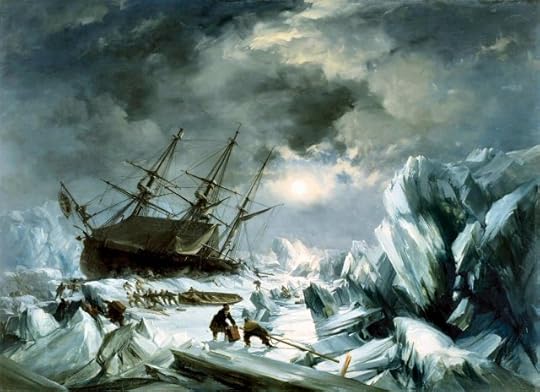
George Chambers: HMS Terror caught in the ice, 1838
I bought this collection on the recommendation of a friend who had read my review of the novel Minds of Winter by Ed O'Loughlin. That one wasn't a very complimentary review: although I was also fascinated by many of the stories of polar exploration that he tells, I did not think he managed to integrate them very well, and the present-day story that was supposed to hold them together was mystifying and inconclusive. In this 2010 collection of around 60 poems, Elizabeth Bradfield also revisits the lives of the great explorers: Weddell, Scott, Amundsen, Shackleton, and Byrd, among many others. But, being poetry and not narrative, there is no need to make linear connections between them, other than the shared impulse to pit themselves against the unknown. And instead of linking them by a contemporary story, the poet needs nothing more than to show how her subjects reflect the drives and disappointments within her own mind. I found this the most interesting aspect of the entire book, beginning right away with the author's preface:
Because this life, this alarm clock time card
percolator direct deposit income tax stop light
seems vast and blank and numbing.
Tell me secret orchids hide
between the black rock and the ice.
Tell me a wild bird sings deep
in the crevasses, wingstrokes cracking air.
Tell me there's a surface we can walk on
lidding miles of plumed and luminescent fish.
I'm ready to be amazed. I'm longing for it.
And amazement is what she finds, and what she delivers. By imagining herself into the minds of the early explorers, she expands her own. She does not dwell much upon the wonders these men must have encountered, the bright ice, the pristine snow. She is more concerned with the feats of endurance, the setbacks overcome, and of course the heroic failures. But more than anything, she is attuned to the obsession, the quality that separates the distant pioneer from home, and once home obsesses him again. Here is the complete poem "Why They Went":
Frost bitten. Snow blind. Hungry. Craving
fresh pie and hot toddies, a whole roasted
unflippered thing to carve. Craving a bed
that had, an hour before entering,
been warmed with a stone from the hearth.
Always back to Eden—to the time when we knew
with certainty that something watched and loved us.
That the very air was miraculous and ours.
That all we had to do was show up.
The sun rolled along the horizon. The light never left them.
The air from their warm mouths became diamonds.
And they longed for everything they did not have.
And they came home and longed again.
Typing this out now, I am struck by the phrase "we knew with certainty that something watched and loved us." Something or someone. For, surprising as it may be in such a context, Bradfield is also a love poet. Interspersed among the verses are seven prose-poems titled "Notes on Ice in Bowditch." Nathaniel Bowditch, as she explains in her brief notes, was the author of The American Practical Navigator, first published in 1802. These seven interludes consist of quotations from the book's glossary, each followed by her own comments. Here are three of them, reproduced as printed in the book:*
ice breccia. Ice pieces of different age frozen together.
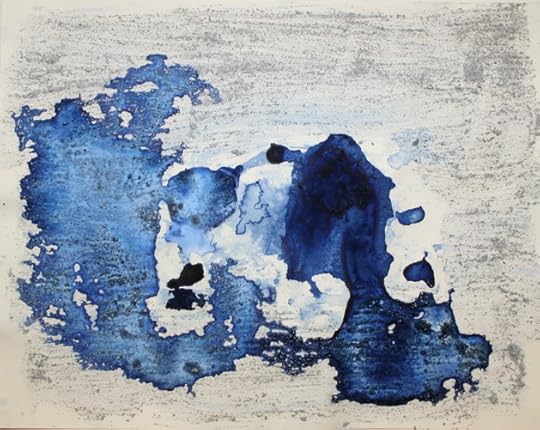
Xavier Cortada: Astrid, 2007
(made onsite with sea ice and pigments from Antarctic sediment)
There are two women among Bradfield's mostly male subjects: Louise Arner Boyd, "California socialite turned explorer" who "lived with Greenland as hearth and lodestone", and the swimmer Lynne Cox. Another poem, "Wives of the Polar Explorers," takes the point of view of the women left on shore while their husbands sail off, their names inserted as markers every three lines: Adélie d'Urville, Eva Nansen, Kathleen Scott, Josephine Peary, Lucy Henson, Emily Shackleton, Elizabeth Byrd—and then suddenly this:
Either way, no easy slide back
into a shared sleep. I missed you, I missed
you each would say, trying to understand
[Liz Bradfield]
through the strange dialects discovered in separation
of solitude, of companionship.
And then, the third stanza of "Vicarious," almost the last poem in the book, just before the tribute to the Antarctic swimmer, Bradfield writes, beautifully:
I've read so many stories
about what got them,
the explorers, the sailors,
the sealers and adventurers.
But this is you. Whose breath
I've heard change from dream
for ten years of mornings.
Who is the you? Bradfield herself is a naturalist whose work has taken her to Alaska and the Canadian Arctic. Is this poem then a reversal, looking at her own absences through the eyes of her partner? Or is there someone else who has traveled while the poet stayed at home? She knows, but we don't have to. But there is no mistaking the very last words in the book, the closing dedication: "Finally, Lisa. I'd have been obsessed with the subject without you, but you gave it warmth."
======
*The only thing that I dislike about the physical book is its printing. Although the main text is elegant and readable, the italics are stringy and too loosely set, and the title of each poem presses right up against the top edge of the paper with no margin. No doubt there is a reason for this, but to me it just makes the book look slightly scruffy and crowded. A pity, given its humanity, generosity, and space.
[The images here are my own choices, not included in the book.]
George Chambers: HMS Terror caught in the ice, 1838
I bought this collection on the recommendation of a friend who had read my review of the novel Minds of Winter by Ed O'Loughlin. That one wasn't a very complimentary review: although I was also fascinated by many of the stories of polar exploration that he tells, I did not think he managed to integrate them very well, and the present-day story that was supposed to hold them together was mystifying and inconclusive. In this 2010 collection of around 60 poems, Elizabeth Bradfield also revisits the lives of the great explorers: Weddell, Scott, Amundsen, Shackleton, and Byrd, among many others. But, being poetry and not narrative, there is no need to make linear connections between them, other than the shared impulse to pit themselves against the unknown. And instead of linking them by a contemporary story, the poet needs nothing more than to show how her subjects reflect the drives and disappointments within her own mind. I found this the most interesting aspect of the entire book, beginning right away with the author's preface:
Because this life, this alarm clock time card
percolator direct deposit income tax stop light
seems vast and blank and numbing.
Tell me secret orchids hide
between the black rock and the ice.
Tell me a wild bird sings deep
in the crevasses, wingstrokes cracking air.
Tell me there's a surface we can walk on
lidding miles of plumed and luminescent fish.
I'm ready to be amazed. I'm longing for it.
And amazement is what she finds, and what she delivers. By imagining herself into the minds of the early explorers, she expands her own. She does not dwell much upon the wonders these men must have encountered, the bright ice, the pristine snow. She is more concerned with the feats of endurance, the setbacks overcome, and of course the heroic failures. But more than anything, she is attuned to the obsession, the quality that separates the distant pioneer from home, and once home obsesses him again. Here is the complete poem "Why They Went":
Frost bitten. Snow blind. Hungry. Craving
fresh pie and hot toddies, a whole roasted
unflippered thing to carve. Craving a bed
that had, an hour before entering,
been warmed with a stone from the hearth.
Always back to Eden—to the time when we knew
with certainty that something watched and loved us.
That the very air was miraculous and ours.
That all we had to do was show up.
The sun rolled along the horizon. The light never left them.
The air from their warm mouths became diamonds.
And they longed for everything they did not have.
And they came home and longed again.
Typing this out now, I am struck by the phrase "we knew with certainty that something watched and loved us." Something or someone. For, surprising as it may be in such a context, Bradfield is also a love poet. Interspersed among the verses are seven prose-poems titled "Notes on Ice in Bowditch." Nathaniel Bowditch, as she explains in her brief notes, was the author of The American Practical Navigator, first published in 1802. These seven interludes consist of quotations from the book's glossary, each followed by her own comments. Here are three of them, reproduced as printed in the book:*
ice breccia. Ice pieces of different age frozen together.
Patchwork sewn tight with freeze into one big blanket. The old, old blue with the new white. Different strengths and ways of being brittle. This is my answer for the years between us. There can be fusing. There is a name for it.ice cake. Any relatively flat piece of sea ice less than 20 m. across.
Serve this on my birthday, would you? Frosted with hoar and lit by beacons so ships won't crash upon it.ice canopy. From the point of view of the submariner.
Always a point of view. But try and rig this up for my birthday also, over the ice cake, sky filtering through, refracting. And indicating by its very presence that we must be drowning.
Xavier Cortada: Astrid, 2007
(made onsite with sea ice and pigments from Antarctic sediment)
There are two women among Bradfield's mostly male subjects: Louise Arner Boyd, "California socialite turned explorer" who "lived with Greenland as hearth and lodestone", and the swimmer Lynne Cox. Another poem, "Wives of the Polar Explorers," takes the point of view of the women left on shore while their husbands sail off, their names inserted as markers every three lines: Adélie d'Urville, Eva Nansen, Kathleen Scott, Josephine Peary, Lucy Henson, Emily Shackleton, Elizabeth Byrd—and then suddenly this:
Either way, no easy slide back
into a shared sleep. I missed you, I missed
you each would say, trying to understand
[Liz Bradfield]
through the strange dialects discovered in separation
of solitude, of companionship.
And then, the third stanza of "Vicarious," almost the last poem in the book, just before the tribute to the Antarctic swimmer, Bradfield writes, beautifully:
I've read so many stories
about what got them,
the explorers, the sailors,
the sealers and adventurers.
But this is you. Whose breath
I've heard change from dream
for ten years of mornings.
Who is the you? Bradfield herself is a naturalist whose work has taken her to Alaska and the Canadian Arctic. Is this poem then a reversal, looking at her own absences through the eyes of her partner? Or is there someone else who has traveled while the poet stayed at home? She knows, but we don't have to. But there is no mistaking the very last words in the book, the closing dedication: "Finally, Lisa. I'd have been obsessed with the subject without you, but you gave it warmth."
======
*The only thing that I dislike about the physical book is its printing. Although the main text is elegant and readable, the italics are stringy and too loosely set, and the title of each poem presses right up against the top edge of the paper with no margin. No doubt there is a reason for this, but to me it just makes the book look slightly scruffy and crowded. A pity, given its humanity, generosity, and space.
[The images here are my own choices, not included in the book.]
June 30, 2017
In most bookshops, if it is there at all, poetry is generally consigned to a modest shelf hiding in the shadows. Those of us who love poetry must work to find it. But I had read that the subject of my upcoming biography, American polar explorer Louise Arner Boyd appeared in its pages so I went hunting for it. This is a slim volume- quiet and unassuming in appearance. But, as a poet and a woman enthralled by polar exploration, I began reading this book with high expectations. I was not disappointed. Elizabeth Bradfield is the author of a previous collection 'Interpretive Work' which won the Audre Lord Award for Lesbian Poetry. Tellingly, she is a naturalist with a keen eye and an affinity for the wind and the water, the changing seasons, the relationship between humans and the world we live in. Meticulously researched, these sixty poems explore the history of polar exploration from the travails of some of the earliest European and North American adventurers including Carsten Borchgrevink, Admiral Peary, Sir Ernest Shackleton, Donald Macmillan, Richard Byrd. Tempestuous and haunting, 'Approaching Ice: Poems' invites the reader to share the harrowing experiences of these heroic figures. A splendid read!

November 8, 2009
Hearing Liz read her poetry while we were both at Stanford was one of the reasons I started reading contemporary poetry (finally--long overdue). As with her previous book, Approaching Ice is amazing. Here's a little bit from "Polar Explorer Louise Arner Boyd (1924)" so you can see what I mean:
. . . She's ignorant of him, in love
with her own thrum to the air, the ice, the impossible
walrus. She senses her life's compass
has just set its pointed foot and the rest of her years
will rotate around it. He may have noticed her
sighing over the rail, shoving her dreams
out over the ice. Most likely he didn't, thinking
of home, of his love or hatred for the sea and what
he'd come to, a shuttle for fantasies
that, every so often, survived the trip home,
the docking, the littered wharf, whether he knew it or not.
Whether he cared or not.

November 17, 2012
This incredible book of poems reads more like an authentic journal of a journey into the Arctic than the clear, concisely-worded examination of the human experience that it is. It's also amazingly engrossing and transportative, feeling at times like the intersection of great poetry and the choose-your-own-adventure novel. The command of language is masterful, and the notes at the back of the book, engagingly written and informative, in some instances made the poem. One of the best books of poetry I've ever read.

July 9, 2010
I find it amazing what Bradfield accomplishes in this book. A veritable history/ essence of polar exploration rendered in exceptionally strong poetry with innovative approaches. A many-pronged pleasure that is never didactic despite its focus, here are powerful poems to really savor.

October 7, 2024
Loved this book of poems - handling historical events with such sensitivity and insight. Wish I'd written it, and that's high praise! The only bits that didn't work for me were the lyric glossaries of ice-related terms; they just fell flat.


December 28, 2023
Like the author-poet, I became enthralled with polar exploration after reading Alfred Lansing's book about Shackleton's leadership in Antarctica, Endurance. It's an intriguing concept: a series of poems following all the polar explorers, many of my favorites but some ones new to me (and their wives!). But mainly, it's about ice and cold and white and snow. And she really captures it (except for her quest-for-Eden theory), and I'll be reflecting on them for a while ... and reading further on ones I didn't know.

July 9, 2019
I’ve owned this book for some time but hadn’t read it, as I’m a fan of Bradfield and her work. I don’t know why I waited, and I regret the lost years where these poems could have been living with me when they haven’t. Better late than never. I’ve been living vicariously in the ice all spring through the work of people like Barry Lopez, and the eternal Shackleton. Bradfield’s perspective is also essential. I love this book.

August 25, 2019
I took this volume with me on a recent trip to the Arctic, and it was a perfect thing - the poems full of music and longing and beauty.

February 4, 2017
I loved the "Notes on Ice" poems. Overall, I think this collection is worth picking up.
Displaying 1 - 12 of 12 reviews